Workplace stress in Mexico: A statistics guide for HR leaders
The workplace stress statistics in Mexico are a wake-up call that no Human Resources leader can afford to ignore. They aren’t just cold numbers; they speak of burnout, of valuable talent walking out the door, and of productivity that is fading away day by day across our teams.
When we say that 75% of workers have felt the weight of workplace stress, we aren't talking about having a bad week. We are describing the reality of three out of four people in your organization. For you, as a talent leader, this number is the starting point for very real challenges: high turnover, absenteeism, and a work environment that feels tense and uncollaborative.
The Workplace Stress Landscape Every HR Leader Must Know
As a talent strategist, you know perfectly well that stress goes far beyond a temporary spike in workload. It is a silent, persistent enemy with consequences that can be measured directly on the bottom line. Before designing any wellness program that truly works and helps move your KPIs, the first step is understanding the scale of the challenge we face in Mexico.
In our experience working with HR teams of all sizes in Mexico, we have seen how this data transforms executive-level conversations. What was once seen as a "soft" topic or a nice-to-have becomes a strategic priority. Because a stressed team doesn't innovate, doesn't collaborate, and ultimately, doesn't meet its goals.
Statistics That Put Numbers to Burnout
To start building a solid business case and justify investing in your people's health, data is your best ally. It validates what you are already sensing in the hallways or during meetings, and it provides compelling arguments to present to leadership.
Here is a table with the hard facts to help you grasp the situation at a glance.
A Snapshot of Workplace Stress in Mexico (Key Data)
Indicator | Percentage / Relevant Data |
|---|---|
General prevalence of workplace stress | 75% of workers in Mexico suffer from it. |
Chronic stress (risk of burnout) | 27% of employees experience it chronically. |
Global ranking | Mexico ranks among the highest worldwide. |
This table isn't just a summary; it is proof of a silent crisis unfolding inside offices and manufacturing plants across the country.
And if a picture is worth a thousand words, this infographic sums it all up.
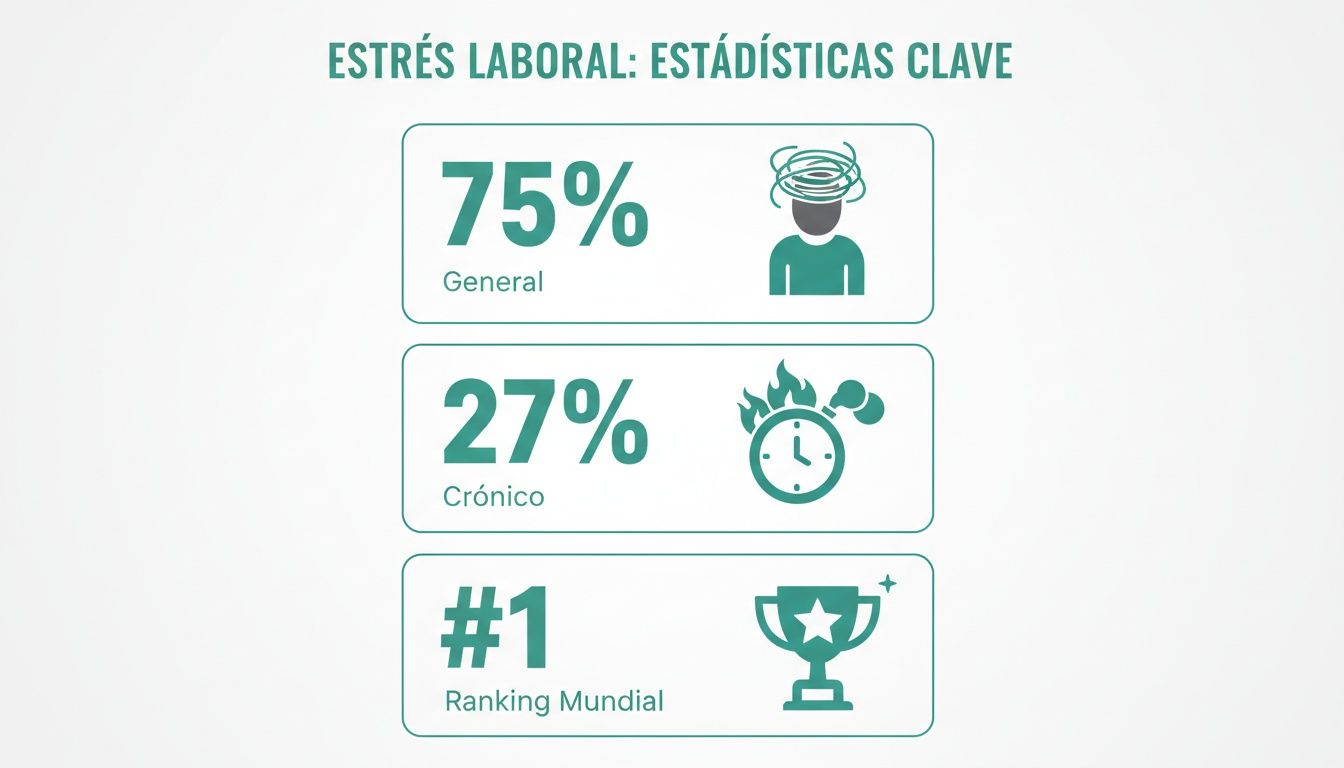
What we see here confirms that workplace stress isn't just an issue for a few individuals. It is a phenomenon affecting the vast majority, and for more than a quarter of talent, it has turned into a chronic condition that drains energy and potential. The urgency to act is clear.
Workplace stress can no longer be viewed as the cost of doing business. It is a drain on talent, productivity, and well-being that no modern company can afford to ignore.
Data from the Mexican Social Security Institute (IMSS) itself paints a similar picture. Its reports confirm that 75% of the working population has experienced workplace stress and that 27% deals with its chronic version, keeping us in an alarming position globally. If you want to dive deeper, you can explore more data on workplace stress in Mexico.
Understanding these workplace stress statistics in Mexico is only the beginning. Throughout this guide, we will provide you with tools to translate these numbers into tangible costs for your company and, above all, into a concrete action plan—one that allows you to build a culture of wellness that protects your people and, consequently, your organization.
How to Translate Statistics into Real Costs for Your Company

The workplace stress statistics in Mexico that we examined are undoubtedly alarming. But their real power to persuade executive leadership lies in translating them into the only universal language in business: money. As an HR leader, you know perfectly well that a stressed employee isn't just someone having a hard time; they represent a flashing red light on your key performance indicators (KPIs).
The financial impact of stress isn't always immediately obvious on the income statement. It disguises itself as operational costs that, without close scrutiny, seem like just "the normal cost of doing business." But the reality is that these phantom expenses are quietly draining your company's profitability.
Absenteeism: The Visible Cost of Poor Well-Being
Absenteeism is the most obvious and easily measurable consequence. Every day an employee misses work due to illness, exhaustion, or stress-related medical appointments, the company is paying a salary for work that isn't getting done.
Yet the true cost goes far beyond payroll. It forces the redistribution of tasks, which inevitably overburdens other team members—increasing their own risk of stress—and can cause delays on projects that are critical to the business.
Presenteeism: The Silent Productivity Thief
Far more expensive and difficult to quantify is presenteeism. This phenomenon occurs when employees are physically at their desks (or logged in online), but their minds are elsewhere. They are exhausted, unfocused, and lacking motivation.
An employee in "presenteeism" mode:
Makes more mistakes: Demanding extra time and resources to fix them.
Takes longer to finish tasks: Their productivity plummets, impacting delivery deadlines.
Does not participate actively: Their ability to innovate, pitch ideas, or collaborate drops to zero.
Dampens company culture: Their negativity and apathy can be highly contagious to the rest of the team.
Presenteeism is like having a slow, constant leak in the company’s finances. It doesn’t cause an immediate flood, but over time, the structural damage is immense and very costly to repair.
The combined impact of absenteeism and presenteeism is devastating. In fact, the IMSS itself has noted that rising stress is directly tied to an increase in medical leave. Anxiety and depression disorders now account for more than 12% of work-related medical leaves in recent years, generating millions in losses for Mexican companies. You can learn more about the impact on public health and productivity and how it hits organizations.
Turnover: The Cost of Losing Valuable Talent
Ultimately, the most drastic consequence of chronic stress is employee turnover. When a good employee resigns due to burnout, you don't just lose their experience and institutional knowledge; you set off a very costly chain of expenses.
The cost of replacing an employee isn't limited to severance pay. You also have to factor in:
Recruitment costs: Job postings, HR team hours, interviews.
Training costs: The time and resources invested in onboarding the new hire.
Learning curve: The period during which the new employee is not yet 100% productive.
Loss of institutional knowledge: Company know-how and key relationships that walk out the door with the departing employee.
When you add up these three factors—absenteeism, presenteeism, and turnover—the workplace stress statistics in Mexico cease to be abstract data. They become a compelling financial argument showing that investing in well-being is not an expense, but an essential strategy to safeguard the organization's financial and operational health.
To Understand Stress in Mexico, You Have to Look Beyond the Desk
To genuinely move the needle on workplace stress statistics in Mexico, surface-level solutions aren't enough. As an HR leader, you know that solving a problem at its root requires understanding what feeds it. Stress in the Mexican workplace is not an accident; it is the result of deeply ingrained cultural and structural factors.
Looking beyond individual workload is key. It's about analyzing systemic patterns that create the perfect breeding ground for exhaustion and burnout. Shifting the conversation from "the employee can't manage their stress" to "what are we doing as an organization that creates this stress?" is the first major step toward meaningful change.
The Culture of Endless Workdays
Year after year, Mexico ranks among the OECD countries with the longest working hours. This culture of "presenteeism" glorifies long hours as if they were synonymous with commitment, when in reality, they are often just a sign of inefficiency and a direct ticket to burnout.
This mindset creates a silent but constant pressure on employees to stay late, even if they have already finished their work. The result is that work-life balance disappears—a factor directly linked to the rise in chronic stress.
For HR, the challenge is twofold: first, shifting this mindset among leadership, and second, implementing policies that reward objective-based productivity rather than desk time.
The Lack of Well-Conceived Wellness Programs
Even though corporate wellness is trending, the reality is that few companies approach it strategically. Many initiatives remain isolated actions, like a nutrition talk or an occasional yoga class which, while helpful, fail to tackle the core issue.
An effective wellness program is not a collection of disconnected activities. It is a comprehensive strategy born from a clear diagnosis, with measurable goals and full executive buy-in.
The lack of structured programs leaves employees without formal tools or resources to manage stress. This only perpetuates a cycle where the employee feels unsupported and the company fails to take ownership of its role in fostering a healthy environment.
The Big Unfinished Task: Assessing Psychosocial Risks
This is where NOM-035 comes into play. Far more than a legal requirement, this standard is an exceptionally powerful diagnostic tool for any HR department. However, its implementation remains an unresolved issue across much of the Mexican business landscape. If you'd like to learn more, you can consult our complete guide on what NOM-035 is and how to implement it.
The absence of formal psychosocial risk assessments means companies are operating blind. They don't know which teams are most overworked, which leadership styles are toxic, or which internal policies are creating friction and distress.
This gap is compounded by the country's labor context. National statistics indicate that more than half of the workforce—between 50% and 56%—operates in the informal economy, without access to social security or stability. And among formal companies, it is estimated that only 20% to 30% implement mental health programs or conduct these risk assessments. You can read more about how Mexico leads in hours worked and workplace stress to understand the full context.
In our experience working with HR teams across Mexico, we have seen that organizations that proactively apply NOM-035 gain a clear roadmap of their vulnerabilities. This enables them to design surgical, effective interventions rather than spending budget on initiatives that don't address their people's real needs.
The HR Action Plan for Building a Culture of Wellness
Knowing that workplace stress statistics in Mexico are a red flag is one thing; having a clear action plan is another entirely. As an HR professional, your role is to be an agent of change—the bridge that turns concern into strategic action.
It’s not about rolling out isolated initiatives and hoping something sticks. The goal is to weave a robust, sustainable culture of well-being that is felt in everyday work life.
And the ideal starting point, which many companies still view merely as paperwork, is NOM-035. Instead of treating it as a simple bureaucratic requirement to avoid fines, it should be used for what it truly is: an exceptionally powerful diagnostic tool.
From Obligation to Diagnosis with NOM-035
NOM-035 compels you to ask, listen, and measure. Think of it this way: its surveys provide a detailed roadmap of the psychosocial risk factors affecting your organization.
Is the problem workload overload in finance? Is it toxic leadership in the sales team? Or is it a lack of recognition felt across all departments?
Without this diagnosis, any wellness program is like throwing darts with your eyes closed. In our experience working with diverse HR teams, we have noticed a clear pattern: the most successful companies are those that use NOM-035 results to design targeted interventions, directing their budget exactly where it hurts most (and where it will make the greatest impact).
Once you have the roadmap, the next step is designing a program that is realistic and high-impact, even on a modest budget. The key lies in understanding and maximizing emotional salary.
Designing Wellness Programs with Real Impact
Emotional salary encompasses everything an employee receives beyond their paycheck that genuinely enhances their quality of life. Today, it is a decisive factor in attracting top talent and, most importantly, getting them to stay.
A strong wellness program can be a smart blend of the following initiatives, tailored to your diagnostic findings and budget:
Mental health support: Providing access to therapy, whether through corporate partnerships or specialized platforms, is one of the most valued benefits today. Period.
Flexibility and genuine work-life balance: Implementing hybrid work policies, flexible hours, or compressed workweeks directly targets one of the root causes of stress: endless workdays.
Recognition programs that resonate: Establishing formal systems to celebrate people's effort and achievements has a direct impact on motivation and sense of belonging.
Active breaks and physical wellness: Initiatives like corporate in-office massages or yoga classes don't just ease physical tension. They send a powerful message: the company cares about the holistic health of its people.
Justifying wellness investment to leadership is much easier when you speak their language. It isn’t an expense to "make people feel good"—it’s an investment to reduce the costs of turnover, absenteeism, and low productivity we analyzed earlier.
A strong culture of wellness also becomes your best Employer Branding tool, attracting and retaining talent in this highly competitive market. It isn’t just about taking care of current staff; it’s about turning your company into a magnet for top professionals.
To start taking the pulse of your organization, tools like a stress assessment test can give you a quick, actionable initial view of how your teams are feeling.
A Strategic Partner for Implementing Real Solutions
We have been working side by side with HR teams across Mexico since 2019. If there’s one thing we’ve learned, it’s that the real challenge isn’t acknowledging that stress exists, but finding and launching solutions that actually work, make a daily difference, and can be measured. The numbers are alarming, yes, but the million-dollar question is always the same: how do we move from statistics to concrete action?
We fully understand the pressure you face: you have to justify budgets, demonstrate results, and manage the logistics for every initiative, all while constantly putting out daily fires. The last thing you need is a vendor that complicates your life. You need strategic allies.
That’s precisely where a tangible wellness program, like the one we’ve perfected at Zen to Go, stops being just "another perk" and becomes a tool that directly confronts the challenges we’ve just outlined.
Tackling Stress Directly and Visibly
Our in-office massage services, whether in our renowned Shiatsu Chair or directly At Your Desk, are designed with one goal: to deliver an immediate blow to the physical and mental symptoms of stress. They are a high-impact intervention that people feel right away.
Instant relief: A 15-minute massage can break the cycle of accumulated tension, relieve familiar neck and back pain, and literally clear the mind to keep moving forward.
Zero logistics for HR: We take care of absolutely everything. From the platform where employees book their own slots to coordinating our certified massage therapists. Your team only needs to share the good news.
A powerful cultural message: Offering these kinds of active breaks sends a clear message across the entire company: "We care about your well-being, and we show it through real action."
Implementing a program like this helps build a culture of genuine care, not just empty talk. It’s an action people see, feel, and appreciate, boosting their emotional salary and turning your company into a place where people truly want to be.
Results You Can Take to Leadership
Best of all, the impact of these initiatives is measurable. Based on our biannual satisfaction surveys, we’ve gathered hard data showing that this works:
79% of participants report reduced stress right after their session.
99% feel their company values their well-being by offering this benefit.
95% of employees would recommend the program to their colleagues.
These figures turn a wellness initiative into a business driver. They allow you to demonstrate a clear return on investment in workplace climate, engagement, and retention. It’s simple: when employees feel cared for, their commitment and productivity soar.
Moreover, these actions serve as a key pillar in psychosocial risk prevention, aligning perfectly with NOM-035 requirements. If you'd like to explore this further, we invite you to read our article on how to build an effective strategy for psychosocial risk prevention in your company.
At the end of the day, tackling Mexico's concerning workplace stress statistics requires practical solutions that work for real teams and real budgets.
The Next Step Is Yours: Transform Your Company from Within
The workplace stress statistics in Mexico we reviewed paint a familiar picture. Every percentage reflects the challenges you manage every single day. Yet behind each number, however daunting it may seem, lies a genuine opportunity for you as an HR leader: the chance to champion change that can truly be felt throughout the halls.
This data is not a final verdict. It is a call to action. Now is the time to stop merely putting out fires and start building a system that prevents them. You have the opportunity to design a workplace environment that is more human, more resilient, and consequently, far more productive.
From Statistics to Strategy
Moving the needle takes more than good intentions; it requires a concrete first step. Company culture doesn't transform overnight, but it does change through bold decisions and consistent actions. Investing in your people's well-being isn't a secondary expense or a luxury. It is the smartest business move you can make today.
By doing so, you protect your organization's most valuable asset: the talent, creativity, and commitment of your workforce. It is an investment that translates almost immediately into lower turnover, higher engagement, and an employer brand that attracts top performers.
A Partner to Kickstart the Transformation
From our experience supporting companies across Mexico, we know that the first step is often the hardest. That's why this final message isn't about pressure; it's about momentum. You don't have to walk this path alone.
Think of this guide not as a finish line, but as the launch of a new conversation within your company—a dialogue about how to collectively build a better place to work. And when you decide to take that first step, look for partners who understand your challenges, both operational and human.
Change begins with a decision. Yours. The choice to put well-being at the heart of your business strategy and prove, through real action, that taking care of your team is the best way to take care of the company.
At Zen to Go, we have witnessed how simple initiatives like an office massage program can spark a much larger transformation. Never underestimate the power of a small step to set a major movement in motion.
Answering HR's Top Questions
As your partners, we know that questions about implementing a wellness program that genuinely works are just as real as the stress statistics themselves. Here, we address the three most common questions we hear daily from HR leaders.
How do I justify a wellness program on a limited budget?
This is the ultimate question. And the answer isn’t asking for more, but demonstrating value with less.
The key is starting with a targeted pilot program. Instead of launching a massive annual plan, propose a single-quarter intervention specifically in the department with the highest turnover or absenteeism. The key is measuring the impact and speaking to finance in their language: return on investment (ROI).
Here’s what that looks like in practice:
Direct savings: "If this pilot reduces absenteeism by 10% in this department, we save ‘X’ amount on payroll and overtime. It's a safe bet."
Fewer errors: "A less stressed team makes fewer mistakes. We'll measure the team's output quality before and after. The numbers will speak for themselves."
Protecting talent: "The cost of replacing just one person on this team could fund the entire pilot. We’re investing to retain our key people."
Our experience shows that a high-impact, logistically simple initiative, like a chair massage program, delivers such visible results that it makes securing larger budgets down the road much easier.
Beyond NOM-035, how else can I easily measure stress?
NOM-035 provides your official diagnostic baseline, but you can’t wait until the next checkup to assess the patient’s condition. You need to take the organization's pulse regularly and quickly to catch issues before they turn into full-blown crises.
A few ideas that work exceptionally well:
Pulse surveys: Very short surveys (3 to 5 key questions) conducted every month or two. Direct questions about workload, leadership support, and overall well-being. They're fast, anonymous, and reveal clear trends.
Key questions in 1-on-1s: Train your leaders to discuss more than just tasks. Asking questions like "How are you feeling about your workload this week?" or "What has felt most draining lately?" sparks conversations that reports never capture.
Anonymous wellness suggestions: A simple physical or digital channel where employees can voice concerns without fear. Often, your most valuable insights arrive through this channel.
These practices provide the nuanced context behind formal metrics, enabling you to take action before it's too late.
How can I ensure wellness initiatives reach hybrid teams?
The hybrid model isn’t a passing trend; it’s the new normal. Because of that, one-size-fits-all wellness programs no longer cut it. The key today is flexibility and an omnichannel approach.
Not everything can be in-person, but not everything should be virtual either. You need a thoughtful mix:
In-person events that make the commute worthwhile: Use office days for what truly matters: connecting. Activities like corporate massages, mindfulness workshops, or team breakfasts turn going to the office into an experience rather than an obligation.
Digital benefits for everyone: Provide access to telehealth platforms, meditation apps, or online therapy sessions. This allows everyone to focus on their well-being wherever they are, at their own pace.
A menu of options, not a fixed plate: Rather than enforcing a rigid schedule, empower your people to choose what works best for their lifestyle, whether they are working from home or at the office.
A wellness program that succeeds in a hybrid environment recognizes that everyone's day-to-day reality is different and provides the tools to stay well, no matter where their laptop happens to be.
At Zen to Go, we have designed our services to be an easy-to-implement solution tailored to these exact needs. We help reduce stress with measurable results, adapt seamlessly to hybrid setups, and equip you with the data needed to justify the investment. Discover how we can be your partner in building a culture of wellness.