Solutions for workplace stress in the technology sector: A practical guide for HR
Solutions for work-related stress in the tech sector range from implementing flexible schedules and active breaks to wellness programs that actually work, such as in-office massages. As an HR ally, we know your goal is to break away from that culture of hyperconnectivity and constant pressure to transform the work environment into a space that truly cares for its people.
Why stress in your tech team is a ticking time bomb
The Mexican tech sector is all about innovation and speed, but that pace comes with a hidden cost that, as an HR leader, you're probably already starting to notice. The pressure to meet sprints, product launches, and that always-on mentality create the perfect breeding ground for burnout.
And this isn't just a matter of "that's tech industry life." Stress has become a measurable operational risk. It's not an employee's personal issue, but a crack in the organizational culture that directly impacts your turnover, absenteeism, and engagement KPIs. Every exhausted developer or manager absent due to burnout translates into delays, lower quality code, and, ultimately, a reduced capacity to innovate.
The real cost of ignoring your team's fatigue
When a team lives under constant pressure, the first symptoms are almost invisible. Perhaps you notice some apathy in daily stand-ups or more curt communication across Slack channels. But very soon, those small details turn into problems that show up on your reports:
Increased absenteeism: Employees calling in sick more frequently, almost always due to mental fatigue.
Higher turnover: The most valuable talent, especially senior profiles, are the first to look for less toxic environments.
Drop in engagement: Participation in company initiatives declines, and commitment to goals feels increasingly weak.
To better understand how these symptoms translate into direct costs for the company, we've put together a table connecting team burnout with the metrics that matter most to you as an HR professional.
Impact of workplace stress on key HR metrics
Team stress symptom | Affected HR metric | Hidden cost to the company |
|---|---|---|
Mental exhaustion and apathy | Low productivity | Project delays, lower deliverable quality, and lost competitiveness. |
Irritability and poor communication | Poor work environment | Internal conflicts, lack of collaboration, and a toxic organizational culture. |
Demotivation and lack of commitment | High employee turnover | Recruitment costs, loss of institutional knowledge, and overload on the remaining team. |
Physical fatigue and health issues | Increased absenteeism | Operational disruptions, reduced team capacity, and higher medical expenses. |
As you can see, what starts as a wellness issue ends up becoming a business problem. Ignoring it is not an option if you want to maintain a competitive and healthy team.
In this context, work-related stress statistics in Mexico paint a picture that cannot be ignored. In fact, the country leads globally in this issue, with an alarming 75% of workers suffering from fatigue due to work stress, a figure that surpasses powerhouses like China and the United States. If you'd like to explore the data further, you can learn more about work-related stress statistics in our dedicated article.
In our experience working with HR teams of various sizes across Mexico, we've seen how unmanaged stress in tech teams eats away at company culture. It starts as a quiet issue and ends up hurting the company's ability to attract and retain the talent it needs to grow.
This scenario not only compromises your people's well-being, but also complicates compliance with key regulations like NOM-035. That's why tackling workplace stress in the tech sector isn't a luxury—it's a strategic necessity to protect your most valuable asset: your teams. Learn more about the alarming work stress figures that confirm the urgency of taking action now.
How to effectively diagnose stress levels across your teams
Before launching any wellness initiative, you need data that speaks for itself. As an HR professional, you know full well that perceptions and good intentions aren't enough to justify a budget to executive leadership. You need a clear diagnosis that demonstrates the true scope of the problem.
It's about transforming stress from a "feeling" into a measurable, actionable metric.
The good news is that this process doesn't have to be complicated or overwhelming. In fact, you likely already have much of the information you need right at hand. The key is knowing where to look and connecting the dots between regulatory compliance, how your teams feel, and everyday metrics.
Going beyond the NOM-035 questionnaire
Complying with NOM-035 is an excellent starting point, but it cannot be the end of the road. This standard is fundamental for identifying psychosocial risk factors that, in the tech sector, are often glaring: overwhelming workloads, limited autonomy over tasks, and working hours that spill over into personal life.
However, to get a complete and up-to-date picture, it's vital to complement NOM-035 with faster, more direct tools.
Anonymous pulse surveys: They are short, frequent, and, most importantly, anonymous. This encourages honesty. Include straightforward questions that give you a real-time read on how the team is feeling.
Focus groups with leaders: Host confidential sessions with team leads and managers. They are on the front lines and are the first to spot behavioral patterns that signal stress: irritability, lack of focus, or communication turning sharp.
Operational metrics analysis: Dive into the data you already have. A sustained increase in overtime, a higher error rate on key projects, or a spike in PTO requests due to "burnout" aren't coincidences; they are clear symptoms of a team pushed to the limit.
By cross-referencing these three sources, you move from a simple compliance assessment to a comprehensive diagnosis that reveals where it hurts most and why.
From our experience working with HR teams, we've found that the most revealing questions are the simplest ones. A question like: "On a scale from 1 to 10, how possible does it feel to mentally disconnect from work at the end of your day?" can tell you far more than a 50-question survey.
This diagram makes it clear: constant pressure leads to burnout and, if unaddressed, ends in talent loss. It's a vicious cycle that you can and must disrupt with an early diagnosis.
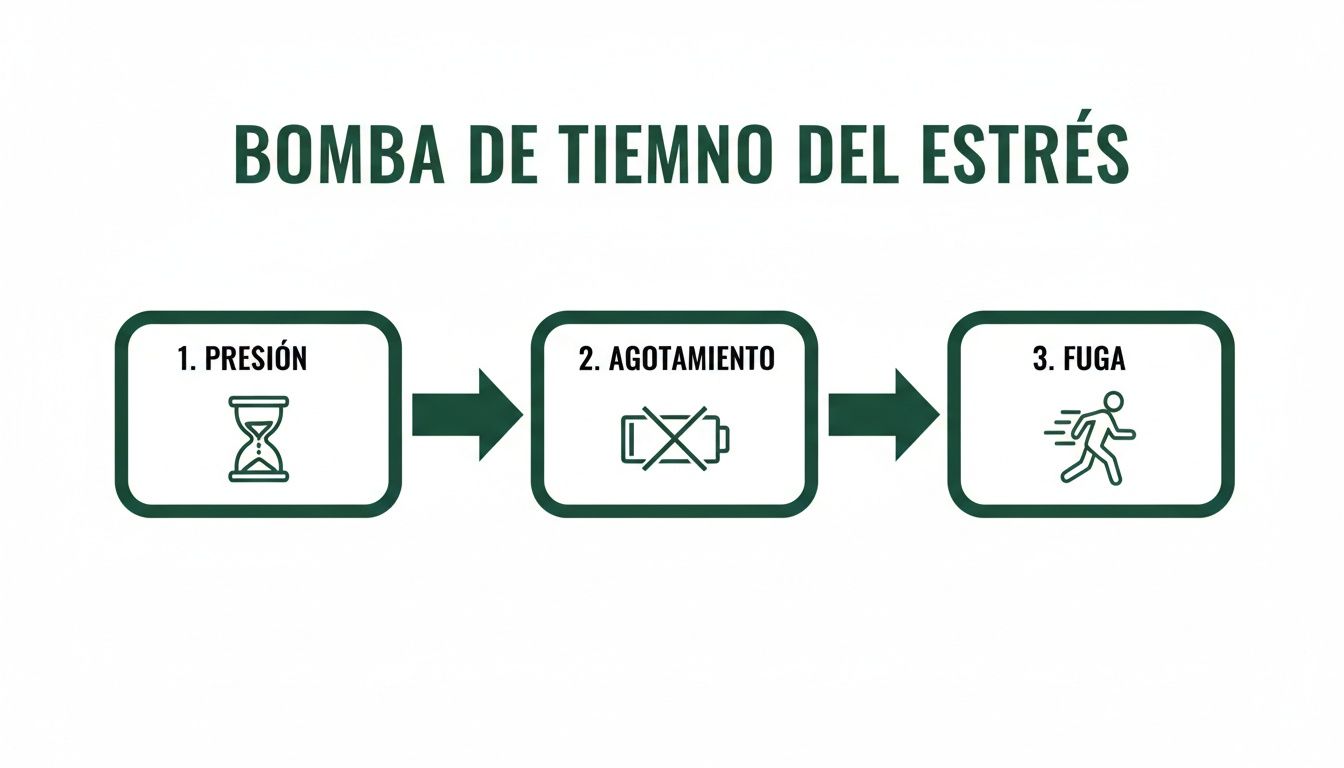
As the image shows, intervening during the pressure stage is crucial to prevent stress from escalating into a talent retention issue.
The importance of proactive action
The data from Mexico's tech sector doesn't lie. According to the Barometer of Workers' Mental Health in Mexico, 36% of employees regularly feel tension or distress. But what's most revealing is this: the same study found that 30% of teams rated with low or medium risk under NOM-035 showed high levels of stress and anxiety in more specialized assessments.
This confirms the urgent need to look beyond basic compliance. You can check out the full study on the rise of workplace stress to dive deeper into this trend.
A solid diagnosis won't just give you a strong foundation to design work-related stress solutions in the tech sector that truly work; it will also arm you with the arguments needed to secure budget and leadership buy-in.
If you're looking for practical tools to get started, we recommend checking out this stress assessment test, which can be an excellent complement to your internal surveys.
Designing a wellness program your tech teams will truly value
Generic perks like putting fruit in the breakroom or hosting an occasional yoga class rarely resonate with the analytical mindset of tech teams. Let's be honest: to create a program with real impact, you have to go further. You need to offer solutions that directly tackle their real pain points: lack of autonomy, difficulty unplugging, and the need for clear career growth.
As an HR professional, your challenge isn't just designing an appealing strategy, but making it feel like a genuine tool to improve their everyday routine. In our experience, the most successful programs are built on three foundational pillars that tech teams actually value.
Flexibility and autonomy: the true emotional salary
For a developer or data engineer, autonomy isn't a perk; it's an essential requirement for entering that flow state where productivity skyrockets. Constant interruptions and rigid schedules are their worst enemies.
Truly flexible schedules: It's about letting them manage their energy, not just their time. If someone is most productive at 10 p.m., give them the trust to structure their day accordingly, as long as goals are met.
Clear hybrid work policies: Define expectations for remote work. A solid hybrid model cuts down commute stress and multiplies focus.
Meeting-free "Focus Days": Implement one day a week—Wednesdays work great—free of internal meetings. This allows teams to dive into complex tasks without interruptions, reducing frustration and boosting satisfaction.
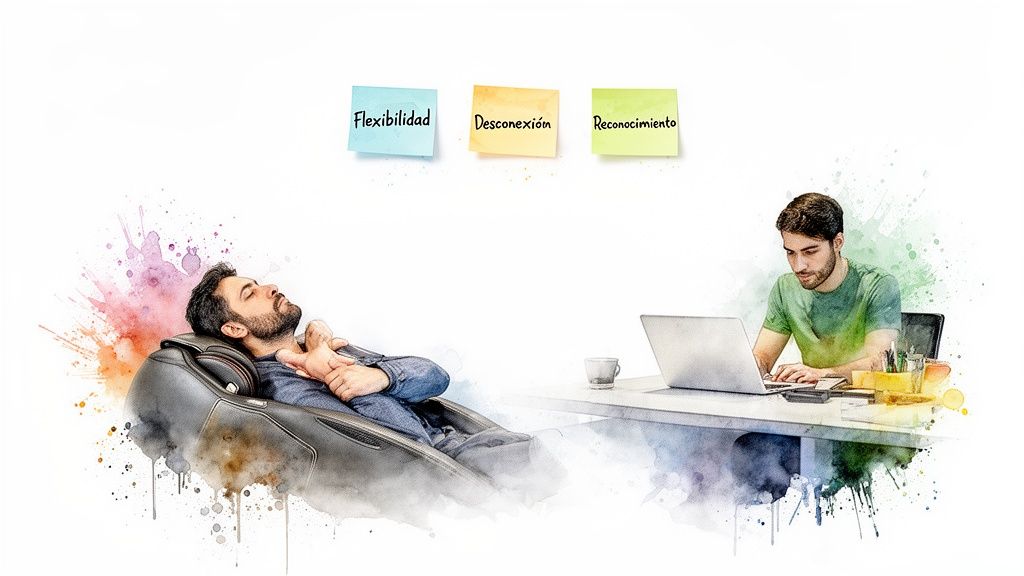
The image captures that exact balance aimed for with a well-designed program, where work and recovery can coexist healthily.
Unplugging and physical recovery
Spending hours in front of a screen builds up physical and mental tension over time. This is where tangible, easily accessible solutions make a world of difference. Promoting the right to disconnect is key.
In our experience working with HR departments across Mexico, we've seen that the most valued benefits are those offering immediate relief without demanding heavy logistical effort from employees.
One of the most powerful solutions for workplace stress in the tech sector is active breaks that genuinely rejuvenate. Corporate in-office massages are the prime example. A 15-minute session in a Shiatsu chair or right at their desk doesn't disrupt workflow; instead, it breaks the cycle of muscle tension and eye fatigue. It's a pause that recharges energy for the rest of the day.
If you want to dive deeper into how to put something like this together, check out our guide on how to create a corporate wellness program tailored to your needs.
Meaningful growth and recognition
Tech talent is ambitious. They value career growth above many other things. Feeling stuck is a direct source of stress and demotivation.
Internal mentorship programs: Pairing junior developers with senior leaders doesn't just speed up learning; it builds loyalty and a sense of belonging.
Professional development stipends: Offer an annual individual budget for courses, certifications, or conferences. This shows that the company actively invests in their growth.
Recognizing real effort: Don't limit celebrations to successful launches. Also recognize the hours of research, solving an infuriating bug, or great collaboration on a tough project.
Finally, one of the solutions that brings the greatest peace of mind is offering your teams access to major medical insurance. It's a tangible way to reduce the stress caused by concerns over their health and that of their families.
How to integrate wellness into daily operations without losing your mind
You already have the diagnosis and a wellness program design that looks incredible on paper. But let's be realistic: as an HR professional, your biggest fear is watching a great strategy fail due to poor execution—or worse, turning into yet another administrative burden on your plate.
The success of any wellness initiative isn't about piling on more tasks; it's about choosing solutions that take work off your hands. The secret lies in operational ease. A successful rollout feels effortless, both for you and your teams. When wellness becomes complicated, it creates more stress than it aims to solve.
A practical checklist for frictionless implementation
Execution is everything. Before launching the program, review these checkpoints. They'll help you anticipate the most common obstacles we've seen across hundreds of HR teams in Mexico.
Communication that inspires, not mandates. How you introduce the program defines its reception. Ditch the corporate tone and focus on "what's in it for me?" Communicate benefits clearly, directly, and humanly. Instead of "Q3 Wellness Initiative," try something like "Your recharge break before the next release."
Leaders as champions, not gatekeepers. Buy-in from team leads is vital. They are the ones who must actively promote breaks and, above all, participate. If a team lead is the first to get a chair massage, it sends a powerful message to everyone: "taking care of yourself is encouraged and valued."
Simple, centralized logistics. You can't afford to waste time coordinating separate vendors, schedules, and invoices for every initiative. Look for partners that offer unified management to simplify your life.
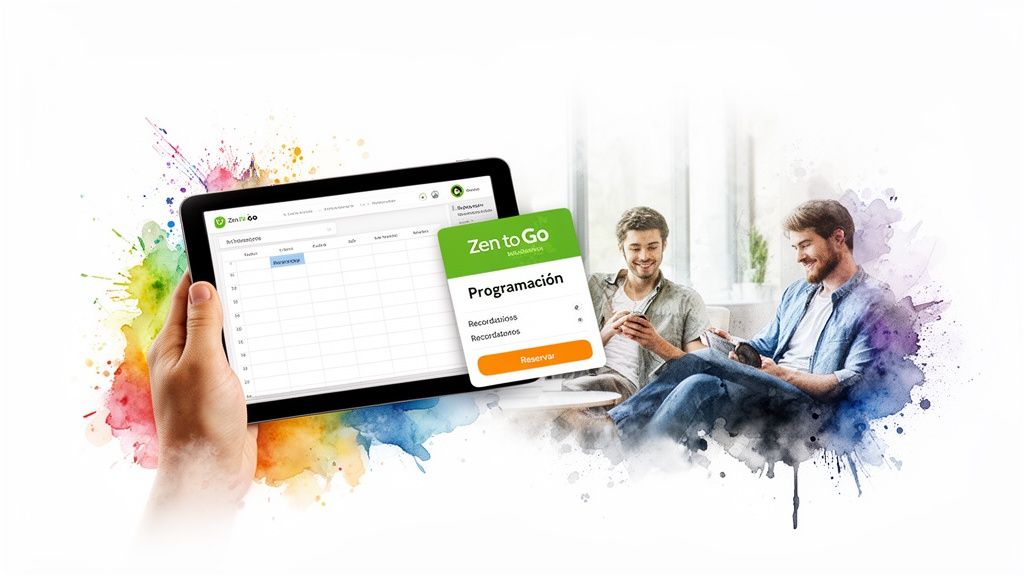
From our experience at Zen to Go, we know your time is valuable. That's why we built a platform where you can schedule wellness days, manage employee bookings, and receive automatic reminders. All in one place, hassle-free.
A real-world case of an implementation that actually works
Picture this: a software development company in Guadalajara is two weeks away from a critical release. Tension is running high. As the People & Culture Manager, you decide to implement one of the fastest, most effective stress relief solutions: a day of Shiatsu chair massages.
With a partner like Zen to Go, the process is that simple. You log into our platform, choose the date, select the number of employees, and send out the invite. Each person books their own 15-minute slot via a link, preventing overlaps and the headache of manual scheduling.
On the day of the event, our therapists arrive with everything ready to deliver that energy recharge the team so desperately needs.
The result is a team that feels valued, a visible reduction in stress, and—most importantly—zero operational burden for you. That's how you prove wellness isn't just possible, but can be incredibly seamless to integrate right when it's needed most.
How is this measured? Justifying wellness investment to leadership
For your wellness program to avoid remaining just a nice thought (and losing its budget by the next quarter), you need to prove its value with data. Hard data. As an HR leader, you know leadership needs to see a clear return on investment (ROI) to keep backing an initiative.
The million-dollar question is: how do we translate something as human as "less stress" into numbers that directly impact the business?
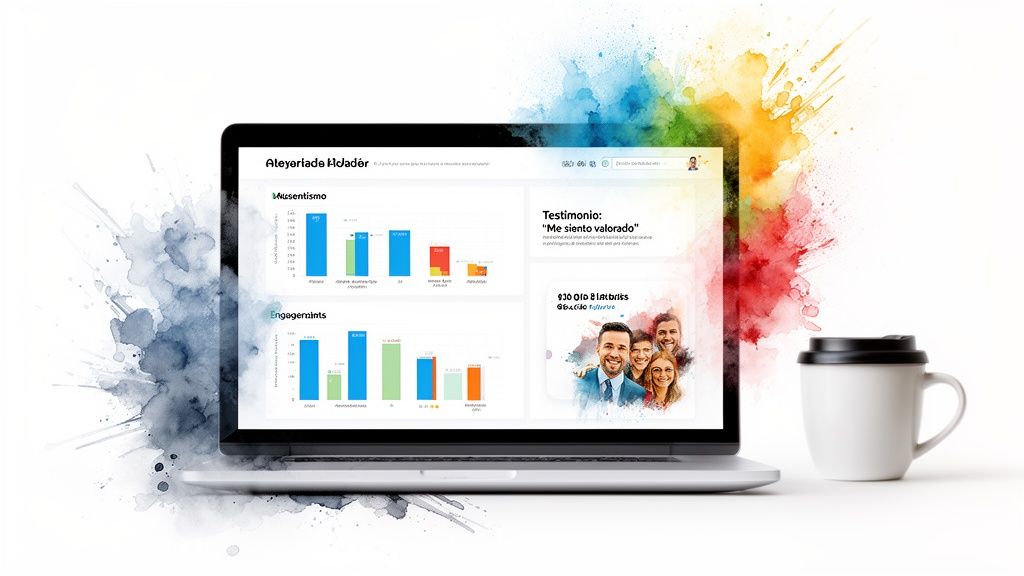
It's about going beyond the standard satisfaction survey. The goal is to build a wellness dashboard that combines quantitative metrics (what Finance cares about) with qualitative ones (what speaks to the heart of company culture) to tell a complete, powerful, and ultimately convincing story.
Quantitative metrics: data that speaks the language of business
These are the indicators connecting well-being to the company's financial and operational health. They are your strongest case for showing the program isn't an expense, but a strategic investment.
Reduction in voluntary turnover rate: This is the golden metric. Calculate your turnover rate before and after rolling out the program. Even a drop of a couple of points represents massive savings in recruiting, hiring, and onboarding costs.
Decrease in sick days and absenteeism: Track unplanned absences, especially those reported for minor illnesses, burnout, or "mental health days." Less absenteeism means more productive hours and more stable teams to hit those sprints.
Productivity increase (by proxy): Measuring productivity in developer or creative roles is challenging, we know. But you can use indirect indicators like project delivery speed (velocity in agile teams) or a reduction in error and bug rates reported by QA.
Qualitative indicators: data that gives heart to the strategy
Numbers tell part of the story, yes, but it's your people's perceptions and experiences that provide the human context needed to convince any leader.
Sentiment analysis in climate surveys: Don't settle for just a 1-to-10 rating. Use tools to analyze open-ended feedback and see if words like "exhausted" and "stressed" dominate, or if words like "valued," "focused," and "motivated" are beginning to emerge instead.
Internal testimonials and success stories: Gather short quotes and stories. An anonymous testimonial stating "the massage breaks helped me hit the release deadline without burning out" is incredibly powerful. Far more so than any chart.
Program recommendation rate (internal NPS): Simple as that. Ask participants how likely they are to recommend a specific initiative to their teammates. A high NPS validates the quality and relevance of what you're providing.
A practical example for your next presentation: "Before the wellness program, annual turnover in our QA department sat at 25%. Six months after introducing flexible hours and biweekly chair massage sessions, turnover dropped to 18%. This represents an estimated savings of $XXX,XXX MXN in recruitment and onboarding costs."
Here is a quick guide to start translating your actions into measurable results and presenting them compellingly to executive leadership.
Metrics to measure your wellness program's ROI
Metric | How to measure it | Example impact in tech |
|---|---|---|
Turnover Rate | Compare the % of voluntary departures before and after the program (quarterly/annually). | A 7% reduction in senior developer turnover can save over $1,500,000 MXN annually in replacement costs. |
Absenteeism | Track unplanned absence days per employee/team. | Reducing average annual absences by 1 day per employee on a 100-person team recovers 800 hours of productive work. |
Productivity (proxy) | Measure delivery velocity in sprints (Agile teams) or post-launch error (bug) rates. | A team receiving active breaks can improve velocity by 10-15% and reduce critical bugs that delay projects. |
eNPS | Regularly ask: "On a scale from 0 to 10, how likely are you to recommend working here to a friend?". | Raising eNPS from 20 to 40 points strengthens your employer brand, organically attracting top talent and cutting headhunting costs. |
Benefit Utilization | Track the participation % in each initiative (massages, yoga, workshops). | If 80% of the DevOps team actively participates in massage breaks, it's a clear signal that the initiative meets a real need. |
Connecting these dots will allow you to demonstrate that taking care of your people isn't just "the right thing to do"—it's also the smartest move for the business.
In our experience at Zen to Go, we have consistently measured our programs' impact. According to our semiannual satisfaction surveys, 99% of employees who take part in our wellness sessions feel that the company truly values their health.
That's no small detail. It's a direct indicator of your employer brand's reputation.
Ultimately, justifying this investment isn't about defending an expense. It's about demonstrating, through numbers and stories, how taking care of your people is the most profitable strategy for business growth.
Frequently asked questions about tech workplace stress
We know that as an HR leader, you have plenty of questions when it comes to implementing real stress solutions in the tech sector. Here, we get straight to the point with the questions we hear most often while working with companies like yours.
How do I convince my director that investing in massages is cost-effective?
The key is speaking their language: Return on Investment (ROI). Forget presenting it as a "wellness perk" and frame it as what it truly is: a strategic investment to reduce operational costs.
Use the data you already have at your disposal. Connect the cost of the massage program to potential reductions in turnover. For example: "Investing $X in massage sessions can help us retain just one senior developer, saving over $300,000 MXN in recruitment and onboarding expenses." That way, it stops being a nice-to-have and becomes a retention tool with a direct, measurable impact on the bottom line.
What if my teams don't participate in activities due to lack of time?
That is a clear indicator that company culture implicitly penalizes taking breaks. The solution isn't to pressure people into participating, but to integrate wellness in a way that doesn't compete with sprint deliverables. This is where operational ease becomes your greatest ally.
The most effective solutions are "low-effort" for the employee. For instance, Shiatsu chair or desk massages are ideal because they last just 15 minutes and don't require changing clothes or stepping away for long. It's a restorative break that fits seamlessly into the workday routine, proving through actions that the company actively supports their well-being.
Does a wellness program really help with NOM-035 compliance?
Yes, directly and proactively. NOM-035 requires you to identify, analyze, and prevent psychosocial risk factors. Workloads exceeding employee capacity and grueling schedules are everyday realities in the tech sector.
A well-designed wellness program—featuring active breaks, massages, and clear disconnection policies—isn't just a nice extra. It's one of the most effective preventive measures you can implement. By offering these tools, you demonstrate through concrete actions that the company cares about and addresses its teams' mental health. And that, ultimately, is the spirit of the regulation.
At Zen to Go, we understand the complexity of your role and know you need practical, measurable solutions that work. We've been helping companies across Mexico transform their workplace culture since 2019, one break at a time.
Discover how our corporate wellness programs can help you reduce stress and empower your teams.