Occupational health in Mexico: The ultimate guide for HR leaders
Occupational health in Mexico is much more than paperwork and regulations; it is a strategic discipline designed to protect and, above all, boost the physical, mental, and social well-being of your employees.
For HR leaders like you, it is one of the most powerful tools to build resilient teams, reduce absenteeism, and ultimately strengthen your employer brand in an increasingly competitive talent market.
Understanding Occupational Health Beyond Compliance
For many HR professionals in Mexico, the phrase "occupational health" brings to mind images of inspectors, safety manuals, and the dreaded compliance with Official Mexican Standards (NOMs).
And yes, that part is essential. But seeing it solely as a legal obligation is missing the full picture. It's like owning a race car and only using it to drive to the grocery store. Occupational health, at its core, is one of the most powerful levers for strategic talent management.
Think of it this way: every time an employee is absent due to stress, suffers from back pain caused by a bad chair, or feels "burned out" (burnout) from heavy workloads, it isn't just an individual issue. It is a symptom that directly impacts the metrics that matter most to you:
Productivity: A healthy and safe team is a focused and efficient team. It's that simple.
Employee Turnover: An environment that takes care of its people becomes a place where they want to stay.
Talent Attraction: Newer generations no longer look only for a good salary; they actively seek out companies with a solid culture of well-being.
Work Environment: Safety, both psychological and physical, is the foundation of trust, engagement, and collaboration.
The New Approach for Modern HR
In our experience working with HR teams of various sizes across Mexico since 2019, we have witnessed a very clear shift in mindset. Talent leaders no longer ask themselves if they should invest in their people's well-being, but how to do it intelligently and, above all, measurably to justify the budget.
Today, occupational health is the bridge connecting regulatory compliance with the creation of an exceptional employee experience. It is no longer just about preventing accidents, but about building an environment where people can thrive.
Current challenges, such as burnout in hybrid work models or mental health management, have placed the spotlight on a proactive approach. It is no longer enough to react to problems. The key lies in anticipating them.
This means that caring for your people is not an expense. It is, without a doubt, the best investment you can make for the future of your organization.
The Legal Framework of Occupational Health in Mexico: What You Need to Know
For an HR leader, laws and Official Mexican Standards (NOMs) can feel like a labyrinth. Let's be honest, they can be a bit intimidating at times. However, understanding the legal framework of occupational health in Mexico doesn't have to be a monumental task.
The key is to view it not as a rulebook, but as a roadmap guiding you to protect your people and, along the way, safeguard the company. Think of NOMs as the foundation that supports a solid and safe culture of well-being.
The Legal Pillars You Must Know
Everything stems from the Federal Labor Law, which establishes the employer's obligation to ensure the safety and health of their employees. But it is the Official Mexican Standards, issued by the Ministry of Labor and Social Welfare (STPS), that translate that obligation into concrete actions.
Instead of overwhelming you with an endless list, let's focus on the NOMs that are the daily bread and butter of talent management in Mexico.
Below, we have prepared a summary table featuring the most important standards, their purpose, and the key action you need to take as a Human Resources leader. Think of it as your quick compliance guide.
Essential Occupational Health NOMs for HR in Mexico
A practical summary of the most important standards, their purpose, and the key action you must implement to comply.
Official Mexican Standard (NOM) | Main Purpose | Key Action for Human Resources |
|---|---|---|
NOM-030-STPS-2009 | Establishes preventive workplace safety and health services. It is the baseline standard requiring you to identify and manage hazards. | Conduct a comprehensive risk assessment and design an annual program to systematically address them. |
NOM-035-STPS-2018 | Identifies, analyzes, and prevents psychosocial risk factors such as work-related stress, burnout, and workplace violence. | Administer the questionnaires, analyze results by department, and build an action plan to mitigate identified risks. |
NOM-036-STPS-2018 | Prevents ergonomic risks, specifically those related to manual material handling, to avoid musculoskeletal disorders. | Evaluate tasks involving manual lifting, train staff in safe techniques, and provide necessary supportive equipment. |
Ignoring these regulations comes with a real and tangible cost. In Mexico, occupational health faces a massive challenge with over 270,000 workplace accidents reported annually, according to IMSS data. This figure reflects not only the vulnerability of workers, but also the economic impact on businesses, which can be devastating.
Think of it this way: complying with NOMs isn't just about avoiding a fine; it's a direct investment in lowering operating costs, reducing turnover, and improving the productivity of your teams.
From Standard to Daily Practice in HR
Knowing what the law says is the first step, but the real challenge for HR is translating it into actions that people experience and feel day in and day out. You don't need to be a legal expert to start.
For NOM-035, for example, an excellent starting point is administering the questionnaires provided by the standard itself. The results will give you a clear map of where the red flags are in your organization. If you want to go beyond simple compliance, we recommend our comprehensive guide on how to comply with NOM-035 and foster psychosocial well-being.
In the case of NOM-036, the key is observation and training. Are your warehouse or logistics teams lifting weight properly? Do they have the right tools? Sometimes, simple training on lifting techniques can prevent costly injuries and weeks of absenteeism.
In addition to these regulations, don't overlook the implications of data privacy policies in Mexico when handling employees' medical or personal information. Confidentiality is a pillar of trust.
Ultimately, understanding this legal framework positions you as a strategic partner who not only cares for people, but also protects the business. You demonstrate through action that health and safety are not an expense, but an essential component for success.
Identifying Workplace Risks in the Modern Office
As an HR professional, you know very well that the greatest risks at work today aren't always the most obvious ones. Gone are the days when occupational health focused almost exclusively on evident hazards like heavy machinery or chemical handling. Today, in the modern and hybrid office, the real enemies are much more subtle, silent, and frequently underestimated.
These hazards do not cause dramatic accidents, but they gradually erode well-being, productivity, and work climate. From your vantage point, you have the unique visibility to detect these signs before they turn into serious problems, such as chronic absenteeism or the loss of key talent.
Let's explore the three major risk fronts your teams face every day.
The Silent Enemy of Poor Posture
Ergonomic risks go far beyond lifting heavy boxes. In today's office environment, the main issue is prolonged immobility and poor posture—a concern that skyrocketed with the widespread adoption of remote work.
Think of that recurring complaint about back or neck pain during team meetings. That is the well-known "work-from-home back," a clear sign that something is off.
The most common causes we see in our experience working with companies in Mexico are:
Inadequate chairs: Whether at home or in the office, a chair that lacks lumbar support is a recipe for disaster.
Poorly positioned monitors: Working with the head tilted downward for hours to view a laptop screen generates brutal neck strain.
Workdays without breaks: Sitting for more than eight hours without moving impacts circulation, the lower back, and even concentration.
These factors, which may seem like minor details, accumulate and can lead to musculoskeletal disorders—one of the leading causes of workplace disability in the country. Understanding what ergonomics in the workplace is and how to implement it is the first step toward protecting the physical health of your employees.
When the Mind Is the Battleground
Psychosocial risks are perhaps the biggest challenge for occupational health in Mexico today. NOM-035 brought this topic to the forefront, but the reality is that burnout, stress, and anxiety are silent epidemics that directly strike your HR metrics.
The hyperconnectivity of hybrid work has blurred the boundaries between work and personal life. That Slack message at 9 p.m. or the weekend email are symptoms of an "always-on" culture that exhausts anyone.
A burned-out team is not an engaged team. Burnout is not an individual failure of time management; it is an organizational issue stemming from unsustainable workloads, lack of recognition, or poor leadership.
Identifying these risks requires active listening. Has irritability increased within a team? Do you notice key contributors feeling disengaged or apathetic? These are not "bad attitudes"; they are red flags.
The Physical Risks We Don't See
Finally, there are subtle yet constant physical risks in any office. They are not as dramatic as a fall, but their daily impact is significant.
The most common include:
Eye strain: Poor lighting, excessive screen glare, and a lack of visual breaks cause headaches, dry eyes, and generalized fatigue.
Indoor air quality: Poorly ventilated spaces can increase the spread of illnesses and create a sense of lethargy that saps the team's energy.
Constant noise: A loud office environment hinders focus and elevates stress levels almost imperceptibly throughout the day.
Recognizing these three types of risks enables you to shift from a reactive role to a proactive one. It's not about becoming an inspector, but about acting as a strategic observer who connects employee well-being directly with business outcomes.
How to Design an Occupational Health Program That Actually Works
Moving from theory to action is the great challenge for any HR leader. We know that identifying risks is crucial, but how does that knowledge translate into a tangible plan that delivers real impact for your people and, at the same time, for business metrics?
Designing an occupational health program in Mexico that truly works isn't about launching isolated initiatives. It is about building a system that is cohesive, measurable, and, above all, human.
The Starting Point: An Assessment Rooted in Your Culture
Before moving a single piece, you need a clear map of the landscape. That map is the risk assessment. And no, it's not just to check a box for NOM-030; it is your strategic tool to understand where your organization is truly hurting.
For this map to be useful, it must go beyond a simple checklist. It has to be an active process that engages your people.
Combine numbers with stories: Yes, administer the NOM-035 questionnaires. But then sit down and talk. Organize focus groups or run anonymous pulse surveys. Sometimes, a hallway conversation reveals more than any form ever could.
Walk through the office or the plant: Are people getting up to stretch? Are the chairs a joke? Are there constant complaints about the air conditioning or the lights? Everyday details speak volumes.
Take a look at your own data: Review metrics on absenteeism, turnover, and medical leaves. Is there a pattern? Are certain teams or roles more affected? Those numbers tell a story you need to hear.
This deep dive into reality will allow you to prioritize. You might discover that your biggest risk isn't an uncomfortable chair, but rather the intense stress the finance team experiences during every month-end close.
Setting Goals That Your CFO Understands
With your assessment in hand, it's time to translate the findings into goals that leadership can easily understand and support. This is where your role becomes 100% strategic.
Forget saying "we want to improve well-being." Instead, try something like:
"We are going to reduce work-related stress leaves by 15% over the next semester."
"The goal is to decrease customer service turnover by 10% this year."
"We need to improve the ‘work-life balance’ score by 20 points on the next engagement survey."
These goals not only provide a clear target, but they are also your strongest case for securing budget approval. They prove that your health program is not just a nice-to-have expense, but a solution to very concrete business challenges.
The following diagram simplifies the three main risk fronts you should monitor in your organization.
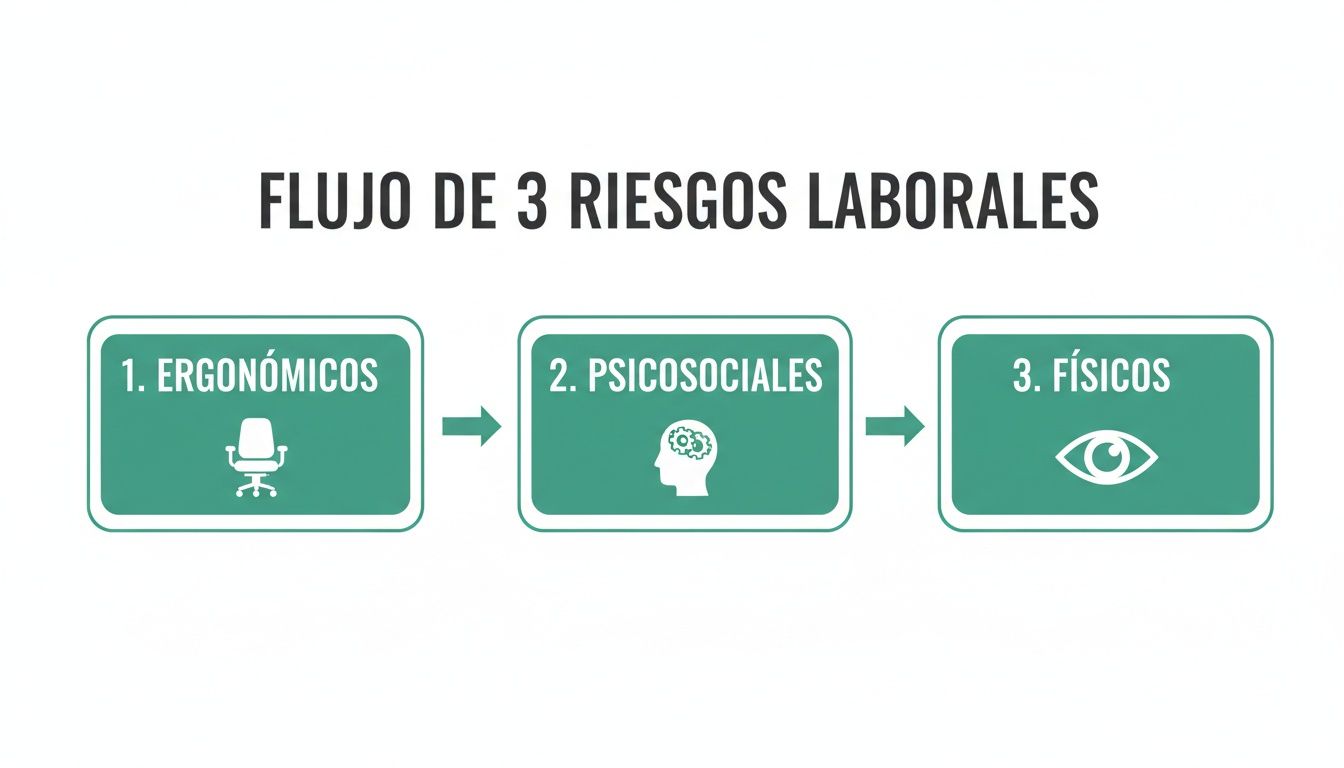
Keeping these three fronts in mind helps you build a comprehensive program that leaves no loose ends, targeting both the visible risks and those that quietly cause damage.
Engaging Everyone, from Interns to Executives
An occupational health program created and kept entirely within the HR office is destined to fail. You need allies.
Forming a Health and Safety Committee is an excellent way to formalize this support. Invite leaders from different departments, but above all, invite team members from the front lines. They are the ones living the day-to-day operations, and their insights are invaluable.
For the program to truly connect with well-being rather than remaining a matter of mere compliance, it is essential to master effective communication. You need to know how to present the benefits clearly and persuasively.
A successful program is one co-created with the people. Ask them what they need. They might value guided active breaks more than a nutrition workshop. Listening is the most powerful tool you have.
Finally, design initiatives that are appealing and easy to adopt. Instead of another mass email, launch a fun internal campaign about the importance of taking breaks. Organize "wellness weeks" featuring activities like stress management workshops, mindfulness sessions, or chair massages.
In our experience, the most effective initiatives are those that feel like genuine support, not an added chore. When employees see that the company truly cares about them, engagement soars.
The Bridge Between Corporate Wellness and Occupational Health
This is where HR strategy truly shines. For a long time, corporate wellness was seen as an "extra perk"—a nice benefit, but not essential. Yet in today's Mexico, within the framework of occupational health, that view is outdated.
A well-designed wellness program has become your smartest and most human tool for achieving compliance. Even more importantly, it helps build a genuine culture of care that resonates across every workspace. It is no longer an expense; it is a strategic investment in your people.
From a "Nice-to-Have" Perk to a Strategic Tool
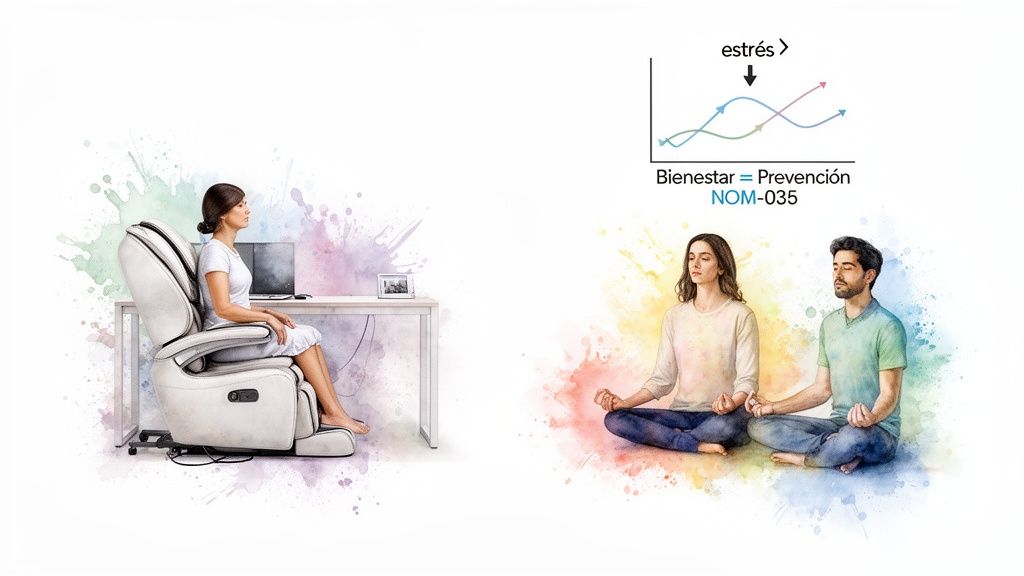
Think of it this way: NOM-035 requires you to identify and prevent psychosocial risks. What is an in-office chair massage program if not a direct, tangible way to combat accumulated stress? And what is a mindfulness session if not a practical tool to help your staff manage daily cognitive overload?
Every wellness initiative becomes a measurable preventive action. You stop offering a mere "perk" and start addressing the root risk factors that undermine productivity and workplace climate—and that you have a legal obligation to manage.
The Mexican landscape makes this even more pressing. Mexico remains one of the countries with the longest working hours, averaging 2,226 hours per year per employee. This intensive work culture fuels a stress epidemic that, according to IMSS data, already impacts 75% of the workforce. If you want to understand the scale of the challenge, you can explore how work stress impacts companies in Mexico in this Wellhub analysis.
The Measurable Impact of Wellness on Occupational Health
At Zen to Go, working side by side with HR departments across the country, we have had a front-row seat to how these initiatives translate into hard data.
A well-implemented corporate wellness program does more than lift spirits. It reduces stress-related absenteeism, sharpens focus, and becomes a pillar of emotional compensation, helping you retain the talent you worked so hard to attract.
For example, after rolling out corporate massage programs, we have measured highly consistent outcomes that validate this connection:
99% of employees feel that the company actively values their well-being.
We achieved an average reduction of 79% in reported stress levels among participants.
95% of employees would actively recommend the program to their peers.
These aren't just vanity metrics for a slide deck. They are KPIs showing a clear return on investment and proactive compliance with your occupational health responsibilities.
Practical Initiatives and Their Direct Connection
To make it even more concrete, let's look at how different wellness programs connect directly with the specific risks you encounter in daily operations.
This table will help you visualize how each wellness action serves as a mitigation tactic.
Wellness Initiatives and Their Direct Impact on Occupational Health
A clear comparison of different wellness programs, their implementation ease, and the specific risk they help mitigate.
Wellness Initiative | Primary Risk Mitigated | Implementation Ease for HR | Practical Example |
|---|---|---|---|
Shiatsu Chair Massages | Stress (Psychosocial Risk) and muscle tension (Ergonomic Risk) | High (easy to coordinate, requires no special spaces) | 15-minute sessions in an office common area during month-end closing week. |
Mindfulness Workshops | Burnout and lack of focus (Psychosocial Risk) | Medium (requires scheduling and driving participation) | One-hour virtual workshop on "Focus Techniques in Hybrid Work." |
Active Break Sessions | Sedentary lifestyle and poor posture injuries (Ergonomic Risk) | High (can be done virtually or in the office) | Short 5-minute videos shared via Slack twice a day for teams to stretch. |
Mental Health Consultations | Anxiety and depression (Psychosocial Risk) | Medium (requires vetting a provider and ensuring confidentiality) | Access to an online therapy platform included as part of the benefits package. |
By integrating these initiatives, you stop putting out fires and start building a firebreak. Occupational health evolves from a checklist of duties into an active strategy that strengthens your organizational culture from within.
How to Measure the Impact of Your Health and Safety Strategy
As an HR leader, you know full well that your work must be visible to be appreciated. An occupational health program in Mexico might feel like a triumph in the hallways, but for leadership to view it as a strategic investment, you must speak their language: data.
Measuring impact goes far beyond ticking a regulatory compliance box. It is about connecting your wellness actions with the KPIs that move the needle for the business. This is the final step that establishes your role as a vital partner driving results, rather than someone who merely manages staff.
Metrics That Speak the Language of Business
To build a solid business case, you need to focus on indicators that leadership understands and values. Put compliance reports aside for a moment and zero in on these high-impact metrics:
Absenteeism Rate: This is one of the most direct and easily understood indicators. Are your initiatives to prevent stress or improve ergonomics successfully reducing missed days? That's a question with a clear numeric answer.
Voluntary Turnover Rate: A workplace that cares for its people is a place where they want to stay. Simple as that. If fewer people leave, it's compelling proof that your strategy works.
Disability and Sick Leave Costs: Analyze what medical leaves related to stress, musculoskeletal injuries, or burnout are costing the business. Demonstrating a reduction here provides an undeniable financial case.
eNPS (Employee Net Promoter Score): Would your employees recommend the company as a great place to work? If this score climbs after launching your program, you have clear evidence of an improved work environment.
Gathering and Presenting the Data
You don't need expensive software to start measuring. The secret is discipline and consistency. Before rolling out any initiative, establish a clear baseline. You need a "before" picture to make a valid comparison with the "after."
Your goal is to tell a story with data. It's not just about showing figures in a spreadsheet, but explaining what they mean for the business. For example: "By reducing absenteeism by 5%, we saved X productive hours, equivalent to Y pesos."
A very practical way to take the organization's pulse is through direct assessments. In fact, you can administer a stress assessment test to get a clear picture of your teams' psychosocial well-being before and after interventions.
When presenting your results, think like an executive: clear, visual, and straight to the point. Use simple charts showing trends and highlight key milestones with bullet points. That is how you demonstrate that occupational health is not a cost center, but an engine of efficiency and engagement that directly boosts the bottom line.
Frequently Asked Questions About Occupational Health for HR Leaders
As an HR leader, you likely face ongoing questions about how to manage health and wellness across your company. Here, we address some of the most common questions with clear, direct answers tailored to give you the confidence you need in your day-to-day work.
If I run an SME, do I have to comply with all STPS NOMs?
No, not all of them, but you do have to comply with the core ones. The applicability of several NOMs depends directly on your company's size and, above all, the risk level involved in your operations.
However, standards like NOM-035 (which addresses psychosocial risks) are mandatory for all workplaces. What varies is the level of requirements based on your headcount. The smartest approach is to start with a basic assessment to identify the critical standards for your business and concentrate on those.
How can I justify the budget for a wellness program?
You need to translate wellness into the language of business. Instead of asking for funds to “improve workplace climate,” present a business case backed by hard data.
Calculate your current costs for voluntary turnover, stress-related absenteeism, or medical leaves. Then, project how a well-targeted wellness program can lower those costs by 10% or 15%.
Your strongest argument is this: “Investing X amount in this program will save us Y amount in turnover and absenteeism, delivering a tangible return on investment.” Show that it isn't an expense, but a direct investment in the team's productivity.
What should I do if I notice a case of burnout in an employee?
Act with empathy, but also in a structured manner. The first step is to speak with the individual privately to offer support and listen to their situation without judgment.
At the same time, look into the organizational drivers. Is there systemic workload overload? Is there role ambiguity? Is leadership style missing the mark? Burnout is rarely just an individual issue; it is almost always a symptom of broader challenges within the team or company culture. If possible, provide resources such as access to professional psychological counseling.
Do office massages really help me comply with NOM-035?
Yes, and in a very direct and visible way. NOM-035 mandates implementing measures to prevent psychosocial risk factors, with work stress being the primary one.
A chair massage program is a tangible, preventive action that directly targets the physical and mental tension built up from heavy workloads. It not only helps reduce stress (by up to 79%, based on our experience), but it also sends a powerful message to your employees: the company actively cares about their well-being. It is a practical, highly appreciated way to bring regulatory compliance to life.
At Zen to Go, we have helped hundreds of HR teams in Mexico leverage wellness as a strategic occupational health tool. If you are looking for an easy-to-implement solution with a measurable impact on your workforce, we are ready to partner with you.
Discover how our corporate wellness programs can transform your workplace.