Mindfulness practice guide for businesses and high-performance teams
Mindfulness practices are nothing more than training for the mind. The idea is simple: learning to focus attention on the here and now, intentionally and without judgment. For companies in Mexico, this has stopped being a trend and has become a strategic tool that helps teams reduce stress, improve concentration, and strengthen their resilience in the face of daily challenges.
Why mindfulness is a strategic tool in the corporate environment
In Mexico's competitive business world, stress and burnout are not just a personal problem; they are a direct brake on productivity and innovation. When teams operate under constant pressure, it is natural for concentration to decrease, for decision-making to become reactive, and for team morale to take a hit.
It is precisely at this point that mindfulness transforms into a business solution with tangible results.
Far from being something esoteric, it is practical mental training. The goal is to strengthen employees' capacity for attention so they can better manage their automatic reactions to stress. In our experience at Zen to Go since 2019, we have seen how leading companies adopt these techniques not as an extra, but as a key piece in their strategy to develop and retain top talent.
From theory to the reality of corporate wellness
The message is clear: mental well-being directly impacts business results. An employee with a clear mind is more focused, more creative, and collaborates better. Investing in their well-being is just as vital as any technical training. Mindfulness offers an accessible route to achieve this, without the need for large investments or complex logistical changes in the office.
At Zen to Go, we understand that well-being is not a luxury, but an operational necessity. We have proven this by seeing how short mindfulness sessions can recharge a team before an important meeting or help manage pressure during peak workloads.
A well-structured program benefits not only individuals, but also strengthens the culture of the entire organization. A supportive environment begins to take shape, where mental health is discussed openly and given the importance it deserves. This proactive approach is what builds resilient teams, capable of adapting and growing in the face of any challenge.
To better understand how these initiatives fit into a broader strategy, you may find it helpful to explore what workplace wellness is and its profound impact on corporate culture.
The context of mindfulness in Mexico
Although well-being is being talked about more and more, bringing it to Mexican companies in a structured way still holds enormous potential. According to recent data from the wellness industry, demand for mental health solutions at work has grown exponentially over the last two years.
Implementing these practices helps combat serious issues such as anxiety and work-related stress, which carry a direct cost to productivity. At the end of the day, it is one of the smartest investments a company can make in its human capital.
How to introduce mindfulness without generating pushback
Introducing mindfulness practices in your company doesn't have to be mission impossible. The key is to present it not as yet another obligation, but as a practical, accessible tool that the team can use right here and right now. The goal is to demystify the concept so they see it as an ally for their daily routine.
To achieve this, communication must be direct and focused on tangible benefits. Instead of talking abstractly about "well-being," focus on concrete outcomes. Phrases like "Would you like to feel less pressure before an important deadline?" or "What if you could regain your focus after a long meeting in just 5 minutes?" resonate much more in a corporate setting.
The good news is that the ground is already fertile. Surveys from the last 12–24 months show a growing interest among Mexican workers for their companies to offer tools for stress management. This means it is very likely that a good portion of your team is not only familiar with the topic, but genuinely interested.
Preparing the ground for initial practices
You don't need a magazine-worthy meditation room to get started. In fact, it's better if you don't. A small, quiet space is more than enough: an unused meeting room or even a corner of the office that can be temporarily adapted. The only thing that matters is that it's a place with minimal interruptions.
And in terms of materials, less is more. To get going, all you need is:
Comfortable chairs: The very same desk chairs work perfectly.
A guide: This can be a team leader with a simple script or a guided meditation audio.
Willingness to try: This is, without a doubt, the most important element.
The idea is to eliminate any logistical barriers. If an employee can participate right from their desk, the likelihood of them joining increases exponentially.
From our experience at Zen to Go, we have learned that simplicity is the best strategy. The most successful initiatives are those that integrate naturally into the routine, without requiring major changes or complex preparations.
To help you take the first steps, we have created a simple, straightforward plan.
Quick Start Plan for Office Mindfulness
A practical guide to implementing your first mindfulness sessions smoothly, focused on initial logistics and communication.
Phase | Key Action | Zen to Go Practical Tip |
|---|---|---|
1. Communication | Launch an informal announcement promoting "5-minute pauses to recharge your energy." Avoid words like "meditation" if you think they might create resistance. | Use an approachable tone. Ask: "Who's up for trying a 3-minute technique to lower stress before the next meeting?". |
2. Zero Logistics | Choose an exercise that can be done right in the chair. The first session shouldn't require anyone to move from their spot. | Send a 10-minute calendar invite (5 minutes for the exercise, 5 for questions). Brevity is your best ally. |
3. First Session | Guide a very short exercise, such as the "one-minute pause." At the end, ask in just one word how they feel. | The goal is not perfection, but demonstrating that a shift can happen in very little time. Celebrate the team's willingness! |
4. Continuity | Propose repeating it at the same time twice a week. Turn the pause into a small voluntary ritual. | Keep the door open. Those who feel comfortable will adopt it. Those who don't will see there is no pressure and might join later. |
This step-by-step approach removes friction and allows the program to grow organically, driven by genuine interest from the team.
Mindfulness exercises to start today
To break the ice, very short exercises that offer a tangible sense of calm work best. Here are two ideas that anyone can do at their desk in under five minutes.
1. The one-minute pause with breath awareness:
Simple script: "Sit with your back straight but without tension. Close your eyes or simply lower your gaze. Now, bring all your attention to how air enters and leaves your body. You don't have to change anything, just feel it. For 60 seconds, this is your only job. If your mind wanders, gently bring it back to your breath."
2. The express body scan (3 minutes):
Simple script: "In your chair, direct your attention to your feet. Notice their contact with the floor, the temperature. Now, slowly, move that attention up through your legs, your torso, your arms, until you reach your neck and head. Don't judge or change anything, just notice what you feel in each part. It's a way to reconnect with your body and release tensions you didn't even know you had."
Starting with these brief, direct mindfulness practices demonstrates their value almost instantly and builds a solid foundation for a more complete program. This way, you foster an environment where self-care is a real priority—a key pillar if you are looking to improve the work environment in a sustainable way.
Practical mindfulness exercises for the office
Theory is important, but action is what transforms an office environment. Implementing mindfulness practices isn't about huge investments or remodeling spaces; it's about intention and having the right tools at hand.
Here, we share a selection of exercises that we have seen work across companies of all sizes, specifically designed for the pace and pressures of the corporate world. Any team leader or HR manager can take the initiative.
The key is to start simple and stay consistent. Even five minutes can make a noticeable difference in the team's focus and mood.
5-minute practices for a quick reset
When time is limited and pressure is high, these pauses are incredibly effective. They can be done right at the desk without disrupting workflow, and the return in mental clarity is immediate.
1. Mindfulness pause (Ready-to-use script)
This is the perfect exercise to do right before an important meeting or after completing a demanding task.
Objective: Calm the mind and regain focus.
Format: At the desk.
Script:
"We are going to take a very brief pause. Sit comfortably, with your back straight yet relaxed, and your feet firmly on the floor. If you feel comfortable, close your eyes; if not, just lower your gaze."
"Now, bring all your attention to your breathing. Feel the air entering through your nose, filling your lungs, and slowly flowing out. Don't change anything, just observe your body's natural rhythm."
"It is normal for the mind to wander to your to-do list. When that happens, simply notice it, and gently bring your attention back to your breath."
"Stay like this for a couple of minutes, using your breath as an anchor. Now, take one final deep breath, and when you are ready, open your eyes."
2. The 5 senses exercise to anchor yourself in the present
Ideal for those overwhelming moments when your mind won't stop racing. It helps break the thought loop and reconnect with your surroundings.
Objective: Reduce anxiety and in-the-moment stress.
Format: At the desk.
Script:
"Take a moment and, without judging, simply notice what is around you. First, identify five things you can see: your monitor, a pen, the light coming through the window."
"Now, pay attention to four things you can feel: the texture of your chair, your feet touching the floor, the temperature of the air."
"Next, listen for three things you can hear: someone typing, a distant conversation, your own breath."
"Focus on two things you can smell: the scent of coffee in your mug or any other subtle aroma in the room."
"And to finish, bring into your awareness one thing you can taste: the lingering taste of your last beverage, or simply the taste in your mouth."
10-minute practices to deepen calm
When you have a bit more room in the schedule, these exercises help release the tension that builds up in the body. They are perfect for the middle of the day or for closing out the workday with renewed energy.
Progressive muscle relaxation technique
This exercise is excellent for releasing the physical tension we carry from stress and poor posture.
Objective: Reduce physical and mental tension.
Format: In an office chair or, ideally, in a Shiatsu massage chair.
Script:
"Find a comfortable posture. Close your eyes and take three deep breaths. With each exhale, imagine your body relaxing a little more."
"Now, bring your attention to your feet. Tense all the muscles in your feet tightly, hold for five seconds... and now, release them all at once. Notice the difference."
"Let's move upward. Now tense your calves... hold... and release. Continue to your thighs... hold... and release."
"Do the same with your hands, clenching your fists. Tense your arms, your shoulders by bringing them up toward your ears, and even your facial muscles. After each tension, release completely and feel how that area relaxes."
"To finish, do a quick scan of your entire body, enjoying this feeling of lightness. Stay here for one more minute before moving on."
At Zen to Go, we have seen that combining these pauses with our Shiatsu Chair massages enhances results in an incredible way. While our certified therapist relieves physical tension, a mindfulness guide helps the person mentally disconnect as well, achieving a complete and efficient wellness experience.
15-minute practices for full immersion
These longer sessions are ideal for dedicated wellness days, team retreats, or as a recurring weekly practice that truly strengthens the group's resilience.
Guided visualization to manage frustration
This exercise is a powerful tool for processing difficult emotions and shifting perspective when facing a challenge.
Objective: Manage complex emotions and foster a more positive mindset.
Format: Ideally in a quiet space. Works wonderfully in a Shiatsu Chair.
Script:
"Begin with a few deep breaths to center yourself. Close your eyes and let your body feel heavy and completely relaxed."
"Gently bring to mind the situation that is causing you frustration. Observe it as if it were a movie, without getting caught up in it. Simply notice what sensations arise in your body."
"Now, imagine you can place that emotion onto a leaf and let it drift down a river. Watch as it slowly floats away, carrying the intensity of the frustration with it."
"Visualize a place that represents peace to you. A beach, a forest, your favorite spot. Feel the warmth, hear the sounds, breathe in the air of that place. Stay here for a moment, recharging your energy."
"When you feel ready, bring that sense of calm back with you into the present. Take one last deep breath and open your eyes, feeling refreshed and clearer."
Integrating these mindfulness practices is a tangible and powerful step forward. Each one builds a solid foundation for well-being. If you want to explore this pillar further, on our blog you will find more breathing techniques for relaxation that complement these sessions perfectly.
How to design a customized wellness program
A successful mindfulness program is not one-size-fits-all; it is tailor-made. What works for a startup in Monterrey may not be ideal for a corporate office in Mexico City. That's why the first step is listening to your team. What do they really need? Tools for stress, or for improving focus?
Understanding your employees' specific needs will allow you to structure a plan that is not only well received, but also delivers real impact. The key lies in flexibility and consistency, creating a program that feels like genuine support rather than just another assignment.
Frequency and duration: what works best?
One of the most common questions we get at Zen to Go is about the ideal cadence. Based on our experience with corporate clients, consistency beats intensity.
Daily 5-minute pauses: Incredibly effective for building the habit. They easily integrate into the routine without disrupting workflow, and offer an immediate mental "reset."
Weekly 30-minute sessions: Allow for exploring more advanced techniques in depth. They work great for strengthening team cohesion and addressing specific topics, such as managing frustration.
A combination of both is usually ideal: daily pauses guided by internal leaders and a weekly session with an expert facilitator to delve deeper and sustain motivation.
Adapting practices to a hybrid model
With teams spread across the country, from Guadalajara to Mérida, an approach combining virtual and in-person experiences is essential.
Virtual formats ensure that everyone has access to the same tools. On the other hand, in-person sessions strengthen bonds and generate a unique group energy, ideal for special wellness days. At Zen to Go, we have seen the power of pairing a virtual session on Tuesday with a Shiatsu Chair massage day on Thursday; the impact multiplies.
Here is where the value of each modality shines:
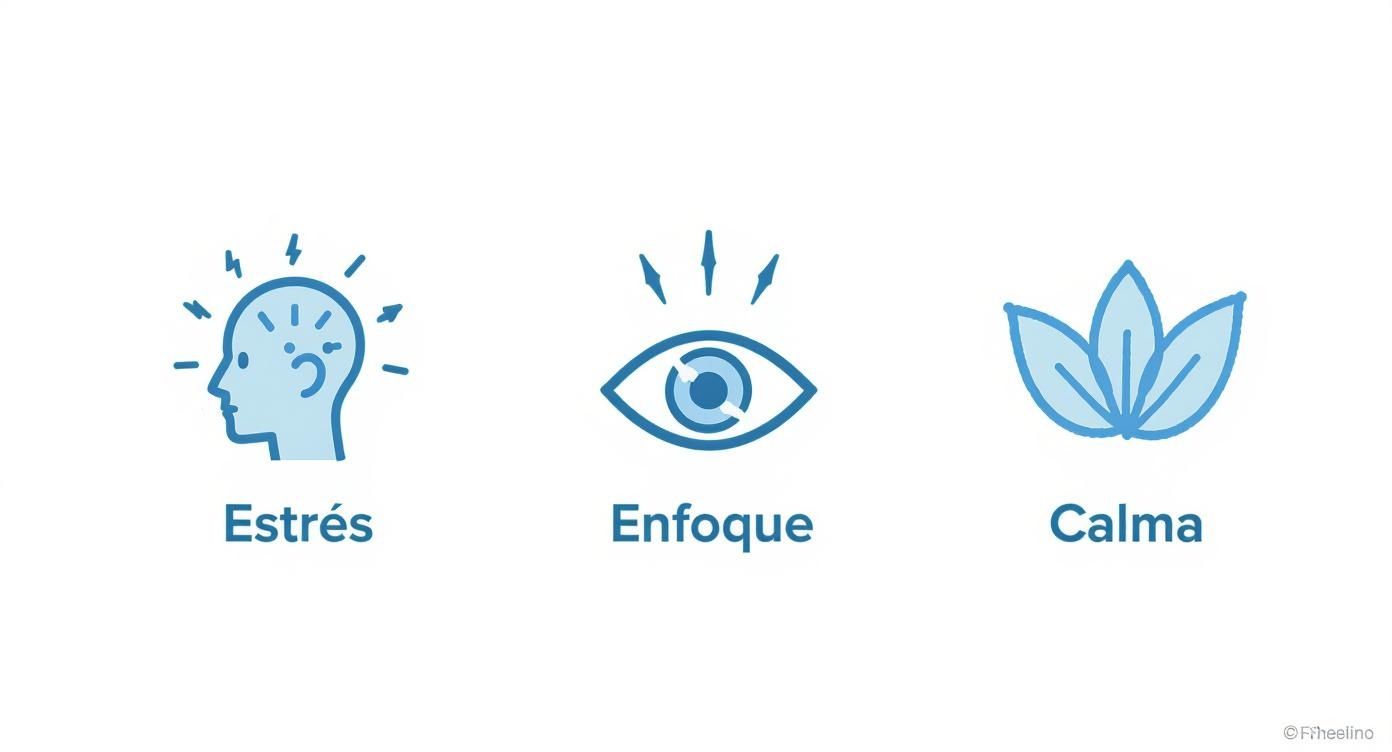
Each icon represents a pillar that mindfulness practices help strengthen: reducing stress, improving focus, and cultivating calm amidst workplace chaos.
Internal facilitator or external expert?
Another important decision is who will lead the sessions. Both options have advantages and are not mutually exclusive.
Trained internal leader: A fantastic option for keeping up consistency during daily pauses. A manager or HR team member can use simple scripts to guide short exercises. This fosters a culture where well-being integrates organically.
External expert: For deeper sessions or the program launch, having a certified professional brings credibility and ensures expert guidance. An external facilitator brings a fresh perspective and takes the pressure off the internal team.
At Zen to Go, we believe that well-being is an ecosystem. Mindfulness practices are a key piece, and their impact is magnified when integrated with other benefits, such as our recurring corporate massage programs brought directly to your facilities.
Ultimately, designing a successful workplace wellness program is an ongoing process of listening and adapting. It's about providing options that allow every employee to find what resonates best with them.
Beyond the office, a holistic approach can even include creating an optimal living environment, as explored in the healthy homes concept. By creating a customized plan, you lay the foundation for a culture where well-being is a way of working and living.
How to measure the real impact of your program
Implementing mindfulness practices is a big step, but for the program to enjoy a long lifespan and leadership support, you need to prove it works. Going beyond positive feedback is key to justifying the investment and ensuring wellness remains a strategic priority.
By measuring results, you understand what resonates with your team, you can adjust the strategy, and, most importantly, you communicate the program's value in a language everyone in the company understands: data. That way, a wellness initiative becomes a smart business tool.
Quantitative metrics: simple yet powerful
Numbers are your best allies in painting a clear picture. You don't need complex systems; with simple tools, you can collect valuable data.
Participation rate: The most basic yet revealing metric in the beginning. How many people attend? Simple tracking helps you see which schedules and formats work best.
Pulse surveys (before and after): A short questionnaire before launching, repeated quarterly. Questions like "On a scale from 1 to 10, how would you rate your stress level this week?" will give you solid comparative data.
Correlation with business KPIs: Look for changes in metrics like absenteeism or voluntary turnover after consistently implementing the program.
The value of the qualitative: stories that connect
Data tells you the "what," but stories explain the "why." Personal experiences give heart to your metrics and are often what wins over the most skeptical leaders.
In our experience with corporate clients, a testimonial about how a mindfulness pause helped an employee navigate a client crisis carries immense weight. It humanizes the program's impact in a way a chart can't always accomplish.
To collect this information, you can:
Host short feedback sessions: Dedicate 15 minutes at the end of a monthly session to open discussion.
Request anonymous testimonials: Use a simple survey where people can freely share how the practices have impacted their workday.
The complete picture: when numbers and stories unite
The magic happens when you bring both worlds together. Imagine presenting a report that not only shows a 15% reduction in self-reported stress, but also includes the story of a leader who now uses mindful breathing during high-pressure meetings.
This approach demonstrates both a tangible and emotional return on investment. For example, at Zen to Go, we consistently measure the impact of our corporate massages. Our biannual satisfaction surveys show that 79% of employees report reduced stress and 99% feel that the company values their well-being thanks to this program. This data, combined with direct testimonials, makes an irrefutable business case.
If you don't know where to start, you can use tools like a workplace stress test to get a clear picture of your team's baseline.
Measuring impact isn't just about filling out a report; it's about celebrating achievements, learning, and building a program that truly transforms your company's culture.
The questions you're likely asking yourself about mindfulness in the office
When talking about introducing mindfulness practices at work, questions naturally come up. We have been supporting HR leaders and managers on this journey since 2019, and we've noticed that certain questions come up time and again. Here, we answer them directly.
Won't my employees think this is too "spiritual"?
It's a valid concern. The key is how you frame it. Present it as what it is in the corporate world: mental training to develop concrete skills.
Speak to direct, tangible benefits. Instead of "finding your inner peace," try "improving focus before a deadline" or "learning to manage stress during workload spikes." When the team sees it as a practical tool for everyday use, the perception changes.
Do we really have time for this during the workday?
Yes, and it is one of the most profitable time investments you can make. We often think that more hours working equals more productivity, but the quality of those hours is what counts.
An employee who takes five minutes for a mindful pause can easily make that time back by working the next hour with greater focus and fewer errors.
Think of it this way: it's not an interruption of work, but a tool to optimize the quality of the rest of the day. Productivity isn't measured in hours spent typing, but in the clarity and effectiveness with which work gets done.
What if some people aren't interested in participating?
There's no debate here: participation should always be 100% voluntary. Forcing someone to practice mindfulness goes against the very foundation of the practice: acceptance.
Your goal isn't to pack the room, but to create a valuable offering and a safe space for those who want to give it a try. Communicate the benefits, make it appealing, and let people join when they feel ready. In our experience, skeptics often end up joining once they see the positive effect it has on their colleagues.
Do I need a certified instructor to get started?
To take the first steps, it's not essential. A team leader can lead simple sessions using basic scripts like the ones we've shared. This is great for introducing short breaks and building the habit.
However, if you're aiming for a deeper, more structured program, bringing in a certified facilitator is a game changer. An expert lends credibility, knows how to navigate group dynamics, and ensures practices are safe and professional, maximizing long-term benefits.
Building a culture of well-being is a marathon, not a sprint, and every small practice counts. At Zen to Go, we are your strategic partner in creating an environment where your team doesn't just work, but truly thrives.
Discover how our corporate massage and wellness solutions—with certified therapists coming On-Site to Your Facilities—can complement and elevate your mindfulness initiatives. Visit https://www.zentogo.com.mx and let's start designing the perfect program for your company together.