Corporate massages in the manufacturing industry: a guide to reducing stress and turnover
As an HR professional in the manufacturing industry, you know that a corporate massage is much more than just a perk. It is a tactical tool to combat the physical and mental wear and tear experienced daily by your operational staff. When properly implemented, it directly impacts the reduction of turnover, absenteeism, and work-related risks linked to fatigue.
The Real Challenge of Wellness on the Production Floor
Talking about wellness in an office is one thing; bringing it to the production floor is an entirely different ballgame. As an HR leader in manufacturing, you know this better than anyone. You not only manage productivity goals, but you also deal with the human impact of rotating shifts, repetitive movements, and the constant pressure to keep the line moving.
That operational reality creates wear and tear that goes far beyond simple fatigue. It is reflected in metrics that surely keep you up at night:
Increased employee turnover: Especially during the first few months, when the body is barely adapting to the physical demands.
Rise in absenteeism: Almost always tied to musculoskeletal ailments, chronic fatigue, or the dreaded burnout.
Safety risks: A fatigued employee or one experiencing pain simply does not have the same level of concentration, which increases the likelihood of accidents.
NOM-035 compliance: Workload and physical environment factors are psychosocial risks that you are obligated to manage.
In our experience working with HR teams from dozens of manufacturing companies in Mexico, we have seen how a well-designed corporate massage program for the manufacturing industry ceases to be an "expense" and becomes a strategic investment. We are not talking about a luxury, but an operational necessity.
It is a tangible action that tells your team: "We understand the physical effort you make every day, and we are here to take care of you." This message is incredibly powerful for strengthening emotional salary and loyalty.
Of course, implementing something like this in a plant requires flawless logistics, but the benefits are undeniable. A well-adapted program becomes a pillar for creating a safer, more human, and consequently, more productive work environment. It is one of the most direct ways to demonstrate that the company genuinely values the well-being of its people.
How to Roll Out a Massage Program on the Production Floor
Implementing a corporate massage program in the manufacturing industry is not like doing it in an office. Here, there is no room for improvisation. Bringing wellness to the production floor demands clockwork logistics that integrate into the operational rhythm without disrupting even a single minute of productivity.
The secret, after years of experience in all types of plants, lies in planning and choosing the right format from day one.
Without a doubt, the most effective and practical solution for this environment is the Shiatsu chair massage. Why? Because it is designed for the reality of a plant.
It's fast: Each session lasts between 10 and 15 minutes. It is the perfect amount of time for a break that recharges batteries without disrupting the line schedules.
It's practical: No one has to remove their uniform, and no oils are used. Any logistical complications are eliminated, and compliance with safety standards is maintained.
It's effective: The massage focuses right where operational staff accumulate the most tension: upper back, neck, shoulders, and arms. It goes straight to the problem.
Once the format is defined, the real challenge is operational coordination. The program must be woven into the plant's complex web of shifts and spaces.
Shift and Space Logistics: The Big Challenge
The greatest fear of any production manager is clear: affecting staffing levels on the line. Therefore, the program cannot be rigid; it must fit the operation like a glove. In our experience, there are two models that work wonderfully:
Fixed stations in break areas. The chair is placed in a safe, easily accessible area, such as the cafeteria or designated break areas. Staff can attend during their already scheduled breaks, using their free time on a voluntary basis.
Direct coordination with supervisors. "Passes" are assigned, which line leaders distribute in a rotating, controlled manner. This ensures that only one or two employees are away at a time, keeping the operation running smoothly and without disruption.
This approach must be replicated without exception across all shifts: morning, afternoon, and especially the night shift. The latter usually reports the highest levels of physical fatigue and is often the most overlooked in wellness initiatives.
If you want to better understand how these models adapt, we recommend exploring the different formats of our corporate massage service.
The manufacturing industry in Mexico is an economic pillar, with exports exceeding 852 billion pesos in 2023. But this productive powerhouse faces rates of physical stress and turnover that directly impact costs and efficiency. This is where well-executed wellness programs cease to be an "expense" and become a strategic investment.
This diagram simplifies the chain of consequences that a wellness program seeks to interrupt.
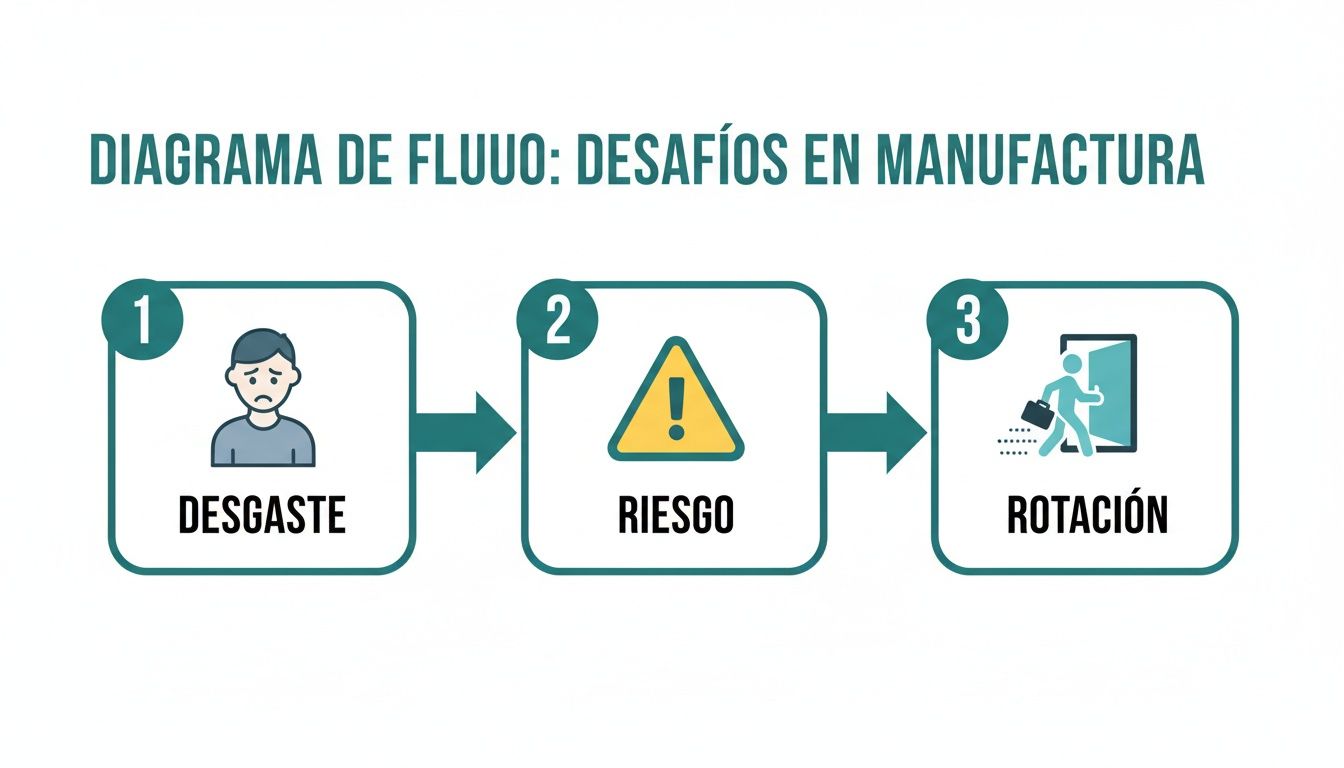
Looking at this progression, it becomes clear that addressing physical wear and tear is not just an employee perk. It is a preventive measure against operational risks and the costly talent drain that staff turnover represents.
Creating a Realistic Action Plan
So that you can present a solid, grounded proposal to your executive committee, here is a basic checklist with the essentials:
Identify safe, viable spaces: Look for areas of at least 2x2 meters that are well-ventilated, with minimal noise, and, crucially, far from heavy machinery or forklift routes. Safety is non-negotiable.
Define a smart frequency: You don't have to start with a daily program. Begin with a monthly or biweekly event to measure impact, gauge team acceptance, and adjust logistics along the way.
Communicate clearly through the right channels: Forget mass emails. Use the channels your staff actually sees: cafeteria bulletin boards, 5-minute safety talks at the start of the shift, and, most importantly, the support of supervisors and team leaders. They are your best allies.
A well-executed plant massage program does not interrupt; it revitalizes. It is a strategic pause that translates into greater concentration, fewer errors, and a team that feels genuinely valued by the company.
Industrial Safety and NOM-035 Compliance: Killing Two Birds with One Stone
In the manufacturing industry, safety is not an option; it is the foundation of the entire operation. As an HR professional, you know perfectly well that any new initiative, no matter how good it is, must first pass the industrial safety filter. The key question is: how can you introduce a corporate massage program in the manufacturing industry without adding a single risk and, instead, strengthening safety?
The answer lies in meticulous planning and choosing an ally that truly understands your environment. You cannot afford to have an external vendor enter your plant without a deep knowledge of regulations. That is why it is essential to work with companies that guarantee a rigorous selection and training process for their therapists. At Zen to Go, this is non-negotiable; each specialist understands how to move and operate in an industrial environment.
A Direct Bridge to NOM-035 Compliance
Beyond physical safety, this type of program becomes an exceptionally powerful tool for complying with NOM-035. The standard requires you to identify and mitigate psychosocial risk factors, and physical wear and tear among operational staff is one of the most obvious and tangible.
A massage program addresses several fronts directly:
Fatigue and chronic stress: It works as a primary prevention measure. It offers a restorative break that truly reduces the physical and mental strain accumulated during the shift.
Musculoskeletal pain: It relieves tensions stemming from repetitive motions or awkward postures, which are a constant source of stress and distraction.
Improved concentration: An employee experiencing physical relief can maintain a higher level of attention on their tasks. This not only improves productivity, but it is also a crucial factor in reducing the likelihood of workplace accidents.
Implementing on-site massages is not merely a "wellness" perk; it is a corrective and preventive action that you can document in your NOM-035 compliance plan. You demonstrate to authorities and your team that the company is taking concrete steps to care for their holistic health.
To learn more about how these actions align with the standard, you can consult our complete guide on what NOM-035 is and its practical implications.
The final pillar of safety is the strategic placement of the massage stations. These must always be set up in designated safe areas, away from heavy machinery, forklift routes, or high-risk zones. Spaces like cafeterias, break rooms, or training areas are ideal, as they ensure a controlled environment where the sole focus is employee recovery.
By integrating safety and regulatory compliance, the program becomes undeniably valuable.
Communication That Transforms a Perk into Perceived Value
Having the best wellness program is useless if no one knows about it, if people don't understand its purpose, or, worse yet, if they don't see it as something valuable. In the manufacturing industry, this challenge is even greater. Here, email access is limited, and digital communication is not always the way to go.
To ensure that corporate massages don't remain just another "perk," but rather become a value that people genuinely appreciate, mastering effective communication is essential. The key is very simple: deliver the message where the people are, using the channels they actually consume day to day.
This means thinking beyond the typical corporate email and deploying a multi-channel strategy that works on the production floor.
Activating the Right Channels in the Plant
After implementing programs across dozens of plants, we have seen time and again what truly works to get people to participate and value the initiative. There are no secrets, just proven tactics:
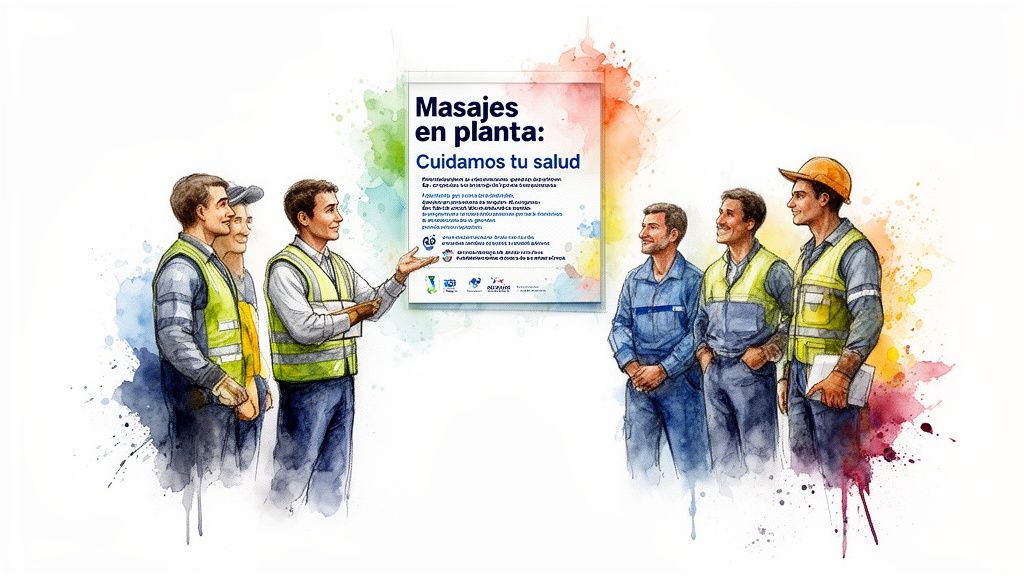
Visual communication at key points: A well-placed poster in the cafeteria, locker rooms, or next to time clocks has a direct impact. The message should be simple and to the point: "The company cares for you. Take advantage of your recovery massage this week."
Strategic verbal announcements: Five-minute meetings at the start of the shift are pure gold. When the supervisor communicates the program verbally, the message carries incredible weight. It provides direct validation from their immediate leader.
Supervisors as ambassadors: They are your main ally on the floor. It is crucial to train them so that they don't just announce the program, but also explain the "why," answer questions, and encourage their team to participate. Their support lends credibility and trust to the entire initiative.
The Message That Truly Resonates with Operational Staff
Just as important as where you communicate is how you communicate. The approach cannot simply be "a free massage." That sounds like just another giveaway. The message must be a tangible recognition of the physical effort they put in every single day.
Frame the program as a tool to protect their health and prevent injuries. Connect it to their long-term well-being: "This is our way of appreciating your work and helping you finish your shift with less fatigue and pain."
This small change in messaging transforms everything. It is no longer just a perk, but a core component of emotional salary. When employees feel that the company is truly investing in their physical health, engagement and loyalty skyrocket.
Ultimately, what we want is for the buzz across the plant floor to be positive—for people to talk about it and encourage one another. That is the organic adoption that ends up maximizing the impact on workplace culture.
How to Measure the ROI of Your Wellness Program
As an HR leader, you know that justifying a budget is no easy task. To ensure your corporate massage initiative in the manufacturing industry isn't seen as a "nice-to-have expense" but rather as a strategic investment, you need to speak the same language as executive leadership: Return on Investment (ROI).
The good news is that a well-implemented wellness program is profitable. The key is to define your key performance indicators (KPIs) before getting started. You cannot prove that something improved if you don't have a clear picture of your baseline.
Quantitative Metrics to Justify the Investment
Hard data is your best ally. Before launching the program, gather figures from the past 6 to 12 months in these areas. Then, measure again at 3 and 6 months after starting the massage sessions to compare the "before and after."
Absenteeism rate: Calculate the percentage of workdays lost to absences, especially those related to musculoskeletal complaints, exhaustion, or fatigue. A reduction here translates directly into cost savings for the company.
Voluntary turnover rate: Measure how many operational staff members choose to leave. Replacing someone is very expensive: there are recruitment costs, training expenses, and the unavoidable learning curve. Demonstrating a decrease, no matter how small, delivers a significant financial impact.
Incident and accident reports: Analyze the frequency of minor incidents and workplace accidents. A less fatigued workforce with sharper focus is a safer workforce. This is a compelling argument for any plant manager.
In an industry like manufacturing, which employs more than 4.2 million people in Mexico, the evidence is already becoming clear. Companies in the automotive sector, for instance, have reported a 25% reduction in musculoskeletal complaints and a 15% increase in operational efficiency after implementing on-site massages.
The Qualitative Impact That Translates into Numbers
Of course, not everything can be measured directly in dollars and cents. But the impact on the workplace environment is just as crucial and, ultimately, carries financial consequences as well.
A team that feels cared for is a more engaged and productive team. Corporate massage is one of the most powerful tools for boosting emotional salary and improving how the team perceives the company.
To measure this impact, you don't need complex tools. Rely on these two:
Workplace climate surveys (pulse surveys): Launch short, anonymous surveys before starting and repeat them after some time. Keep it simple; include direct questions such as: "Do you feel the company cares about your physical well-being?" or "How satisfied are you with the benefits the company offers?".
Focus groups with supervisors: They are the thermometer of the production floor. Talk to them. Ask them directly if they have noticed shifts in their teams' morale, collaboration, or overall energy levels during shifts.
When you combine hard data on absenteeism and turnover with positive survey results and supervisor feedback, you have an irrefutable business case. You will be proving that investing in your people's well-being is not only the right thing to do, but also the smartest move for the operation.
If you need a broader framework to structure these metrics, our guide on how to create an employee wellness program can serve as an excellent starting point.
Frequently Asked Questions About Massages in the Manufacturing Industry (and Direct Answers)
We fully understand that bringing an initiative like corporate massage to a manufacturing plant raises very specific questions. As HR partners, we have heard and resolved these concerns in the field, working directly across all types of plants. Here are answers to the most common questions we receive, delivered with the transparency and practical focus you need.
How do you implement a massage program without stopping the production line?
This is, without question, the million-dollar question. And the answer comes down to two words: flexibility and surgical planning. Halting the operation is not an option—we understand that completely.
Express format: We use the Shiatsu massage chair. It allows for 15-minute sessions hyper-focused on the back, neck, and shoulders. They are so fast and effective that they fit seamlessly into break periods.
Adaptable logistics: The most common tactic is coordinating sessions to coincide with already scheduled breaks. Another option that works wonderfully is creating rotating stations; line supervisors manage the flow, sending small groups without ever compromising coverage.
Zero complications: Personnel do not need to remove uniforms, and we do not use oils. This eliminates any delays or preparations that might complicate logistics.
The goal is simple: the program molds to your plant's rhythm, not the other way around.
Is it safe to bring external therapists inside the plant?
Safety is non-negotiable. And a professional provider must guarantee it from the very first contact.
At Zen to Go, for example, all our therapists undergo a highly rigorous screening process that includes background checks. Not only that, they receive specialized training on how to move and act safely in industrial environments. Prior to the first session, our logistics team coordinates with your safety manager to understand protocols, hazard areas, and Personal Protective Equipment (PPE) requirements.
Choosing a provider who understands industrial safety regulations is not an extra—it is a baseline requirement. It ensures the program adds wellness without introducing a single risk to your operation.
Does this benefit genuinely help reduce turnover?
Yes, and significantly so. Operational personnel deeply appreciate perks that directly address their physical wear and tear. It is one of the most powerful emotional salary tools you can offer.
A massage program sends a clear message: "We understand the physical effort you make, and your health matters to us." In such a competitive labor market for plant workers, this differentiator strengthens loyalty and a sense of belonging. In fact, industry studies have shown that well-executed wellness programs can reduce turnover by up to 18%. That represents a direct impact on your recruitment and training costs.
And what does it cost? How do I justify the investment?
The cost is much more accessible than people think and naturally varies depending on frequency and headcount. Most importantly, the investment justifies itself through a clear business case using your own data.
To get executive buy-in, focus on Return on Investment (ROI):
Calculate your current costs: Put a dollar figure on what absenteeism due to physical ailments and voluntary turnover among operational staff are costing you.
Project savings: Set a conservative reduction goal (10%, for example) across both metrics as a result of the program.
Compare the numbers: The savings you generate in productivity and operational efficiency almost always far exceed the cost of the service.
This way, you stop talking about an "expense" and start talking about a smart investment in the health of your workforce and the efficiency of your plant.
At Zen to Go, we have refined the logistics required to deliver wellness to complex environments like the manufacturing industry. We understand your challenges and know how to design a program that works for your team and your operations.
Discover how we can tailor our programs to your plant's needs at Zen to Go