Employee wellness programs that really work: The ultimate guide for companies

Workplace wellness programs are much more than a list of benefits; they are a strategy designed with a clear goal: taking care of your employees' overall health. And we are not just talking about the physical aspect, but a comprehensive approach that encompasses mental, financial, and social well-being.
Today, more than a simple extra in the compensation package, these programs are a fundamental pillar for building resilient teams and companies that truly stand out in the competitive Mexican market. As your strategic partners in corporate wellness, we want to share what we have learned since 2019 so you can create a program that your team loves and that drives your results.
Why workplace wellness stopped being an extra and became a necessity
The corporate world has changed forever. What was once seen as a luxury or a "nice-to-have" perk is now a central piece in the strategy of any company that aspires to attract and, above all, retain top talent.
Employee expectations, especially among younger generations, have taken a 180-degree turn. A good salary is no longer enough. Teams are looking for something deeper: a work environment that values them as people, cares about their mental and physical health, and promotes a real balance between personal and professional life.
Investing in employee well-being is not an expense; it is the smartest investment a company can make in its own future. A healthy, motivated, and engaged team is the engine driving sustainable growth and innovation.
The new standard for talent in Mexico
And it's not just a perception—the data confirms it. Ignoring well-being today is no longer an option; it is a direct risk to the competitiveness of any business in Mexico.
According to the 2025 Workplace Wellness Outlook report, 88% of Mexican workers consider well-being in the office to be just as important as their salary. This figure is a wake-up call. But there is more: a staggering 90% of employees would be willing to change companies if their current workplace does not actively prioritize their well-being.
What does this tell us? That workplace wellness programs have stopped being just a benefit and have become an essential business tool to:
Attract top-tier talent: Companies that demonstrate a genuine commitment to their people become a magnet for the best professionals.
Reduce turnover: A team that feels cared for is a loyal team. Investing in their well-being is one of the most effective ways to curb talent drain and the costs it entails.
Strengthen organizational culture: A well-executed wellness program becomes the tangible manifestation of company values, creating a strong sense of belonging and pride.
We have seen it firsthand since 2019, helping companies of all sizes. Integrating solutions like chair or desk massages not only relieves day-to-day stress, but also sends a powerful message: "you matter to us." Well-being is no longer a trend; it is the new standard for companies leading the future of work.
What are workplace wellness programs?
You have probably heard the term workplace wellness programs over and over. But let's be honest, what does it actually mean in the day-to-day life of a Mexican office? For many, the mind immediately jumps to fresh fruit in the breakroom or that yoga class organized once. And while those are nice perks, a true wellness program goes much further. It is deeper. It is strategic.
Think of it this way: if your team is the engine of your company, a wellness program is the maintenance plan that ensures every part operates at its full potential without burning out in the process.
We are not talking about isolated initiatives, but an integrated strategy designed to care for the complete health of your employees. It means understanding that no one leaves their personal problems at the office door. What happens at home directly impacts work, and vice versa.
The 5 pillars of a program that actually works
For a program to be truly effective, it must address the different areas that make up a person's life. Over time, and by working with all types of teams, we have seen that the most successful programs build a balanced support ecosystem on five key pillars:
Physical wellness: Everything that helps the body stay healthy and energized. This ranges from active breaks and medical check-ups to nutrition programs or practical solutions like our chair massages to relieve the tension of sitting all day.
Emotional wellness: Caring for mental health and learning to manage stress. We are talking about mindfulness workshops, access to therapy, or creating a culture where it is safe to say "I'm exhausted" without fear of repercussions.
Financial wellness: Worries about money are one of the biggest sources of stress. Offering personal finance workshops or counseling can take a huge weight off your people's shoulders.
Social wellness: This is about building community and real bonds. Team building activities, volunteering, or setting up spaces to socialize strengthen relationships and collaboration.
Professional wellness: Helping your employees feel that they have a future at the company. This includes clear career paths, mentorship, and real training opportunities.
A workplace wellness program is not a catalog of benefits. It is a statement of principles. It is the tangible proof that the company values its people as complete human beings, not just as numbers on a payroll.
Theory put into practice
Integrating these pillars doesn't have to be mission impossible. At Zen to Go, we have proven that simple yet consistent actions make a huge difference.
For example, a monthly chair massage session doesn't just address the physical pillar by reducing muscle tension. It also directly impacts the emotional pillar by offering a moment of disconnection and care that, according to our internal surveys, makes 95% of employees feel that their company truly cares about them.
Ultimately, these programs are the bridge that connects business strategy with culture. When designed with empathy and executed consistently, they become part of the company's DNA, creating an environment where people don't just go to work, but go to grow and feel good.
The real impact of investing in your team: Beyond good intentions
Many leaders view workplace wellness as a cost. But after partnering with hundreds of Mexican companies since 2019, we have seen time and time again that it is one of the most profitable business strategies. Workplace wellness programs are not an expense; they are an investment with a tangible, measurable return.
When a person feels cared for, valued, and less stressed, their engagement and performance soar. It's not magic; it's the logical consequence of creating an environment where people can do their best work. The numbers don't lie: healthier and happier teams translate directly into better results.
Reduced absenteeism and increased productivity
One of the most immediate effects is a drop in absenteeism. A stressed employee is more likely to get sick or experience burnout. When you implement initiatives that target the root of the problem—like massages to relieve tension—health-related absences drop noticeably.
Similarly, a team with higher well-being is a more focused team. When the mental noise of stress is reduced, the ability to concentrate simply flows better. This not only improves the quality of work, but also drives innovation.
To illustrate this better, let's look at how key indicators change when a company takes well-being seriously.
Comparison of results with and without workplace wellness
A clear comparison of key indicators in companies with and without effective wellness programs, highlighting the return on investment.
Key Metric | Company WITH Wellness Program | Company WITHOUT Wellness Program |
|---|---|---|
Staff turnover | Reduction of up to 25–50% | High and costly (elevated replacement costs) |
Absenteeism | Decrease of up to 41% | Chronic levels, affecting daily operations |
Productivity | Increase of up to 25% per employee | Stagnant or declining, with more errors |
Engagement (eNPS) | High scores, brand ambassadors | Low scores, "just getting by" culture |
Medical costs | Reduction in insurance policy costs | Constant increase, higher utilization of services |
Talent attractiveness | Clear competitive advantage | Difficulty attracting and retaining key talent |
The table leaves no room for doubt: investing in your people is the best investment you can make in your business.
A more loyal and engaged team
Investing in well-being also pays off in loyalty. In such a competitive job market, employees who feel that their company truly cares about them are much less likely to entertain other offers.
A data point from the aforementioned 2025 Workplace Wellness Outlook report makes it very clear: 69% of workers with access to these programs rate their health as good or excellent, compared to only 53% of those who do not have them.
At Zen to Go, we see this often. Based on our biannual satisfaction surveys for recurring programs, 83% of employees report a reduction in stress after our corporate massage sessions, and 95% feel that the company values their well-being by offering this type of benefit.
That feeling of being valued is the foundation for building a strong culture. It is what transforms employees into true brand ambassadors. They don't just stay; they speak highly of the company and feed a virtuous cycle of growth and sustainable productivity.
Practical ideas for your wellness program (that don't cost a fortune)
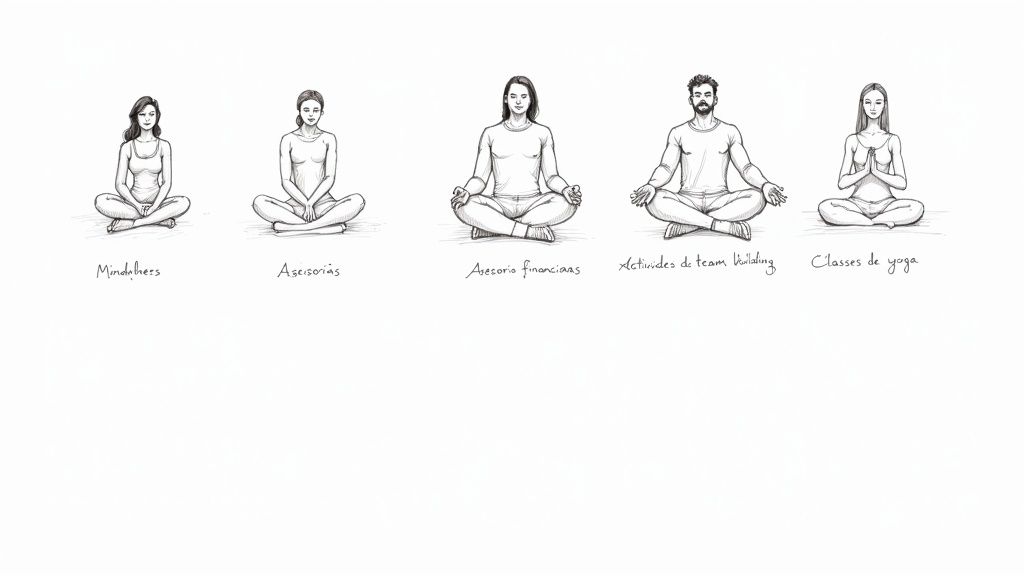
Creating workplace wellness programs doesn't have to be a monumental or overly expensive task. In fact, the initiatives that work best are those that feel personal, adapt to the reality of the team, and are implemented consistently.
The key is to start. You can begin with specific actions, measure what truly works for your people, and grow from there.
To help you move from idea to action, here is a menu of practical initiatives, organized according to the five pillars of wellness.
Physical wellness
The goal is simple: promote healthy habits so the body has more energy and better handles the daily pace.
Guided active breaks: Appoint a "wellness leader" per department to guide 5-minute stretches. It's a zero-cost initiative with a massive impact.
Hydration and step challenges: Launch friendly competitions to motivate the team to move more and drink more water.
Corporate massages: This is, without a doubt, one of the most valued solutions. Services like Zen to Go's Shiatsu Chair Massage or Desk Massage are incredibly easy to arrange. We bring our certified therapists to your office in Mexico City, Monterrey, Guadalajara, and more cities, without disrupting operations and generating instant stress relief.
In our experience, 83% of employees report a reduction in stress right after a massage session. It is a direct investment in your team's physical and mental health.
Emotional and mental wellness
Taking care of mental health is the foundation for having resilient teams. Initiatives here aim to provide tools for managing stress and building an environment of psychological safety.
Mindfulness and meditation workshops: Organize guided sessions, in-person or virtual, to teach breathing and mindfulness techniques.
Access to mental health resources: Consider partnerships with online therapy platforms to offer subsidized, confidential sessions.
Spaces to disconnect: Create a "zen zone" in the office: a tech-free corner with comfortable seating where people can take 10 minutes to reset.
Financial, social, and professional wellness
These three pillars strengthen security, belonging, and purpose for employees within the company.
Financial counseling: Invite an expert to lead a practical workshop on personal finances. Reducing financial stress lifts an enormous mental burden.
Team building activities with purpose: Organize team volunteer days. Helping the community brings coworkers together and creates a deep sense of pride.
Internal mentorship programs: Connect more experienced employees with those who are just starting out. It's an incredible way to foster professional development.
To help you visualize this better, we have prepared a table summarizing some of these ideas, categorized by their investment level.
Initiatives organized by wellness pillar
This table organizes different wellness activities according to the pillar they support, offering a structured view for your planning.
Wellness Pillar | Examples of Low-Cost Programs | Examples of Medium/High-Investment Programs |
|---|---|---|
Physical | Running club, active breaks, hydration challenges. | Recurring corporate massages, gym memberships, fresh fruit and healthy snacks. |
Emotional | Guided mindfulness sessions, creation of "unplugged zones." | Access to online therapy platforms, stress management workshops with experts. |
Financial | Internal talks on saving, sharing educational resources. | Workshops with certified financial advisors, access to savings plans with benefits. |
Social | Team lunches, birthday celebrations. | Off-site team building activities, corporate volunteering. |
Professional | Internal mentorship program, work-related book club. | Courses and certifications, structured career plans, licenses for learning platforms. |
As you can see, each of these ideas is a starting point. If you want to explore a high-impact, easy-to-implement option in depth, you can learn more about the benefits of chair shiatsu massage in our article.
How to launch a wellness program your team will actually use
Designing a workplace wellness program that people love is not as complicated as it seems. It's about listening, planning smart, and executing with empathy.
Since 2019, we have partnered with hundreds of companies in Mexico and identified the steps that make the difference between a program that stays trapped in a pretty PowerPoint deck and one that transforms culture.
1. Conduct an honest assessment: listen to your team
Before proposing anything, you need to know where you stand. And the first step—the most important one—is listening to your team. Don't assume what they need; ask them directly. An anonymous survey is pure gold. Ask about their stress levels, what worries them, and what activities they would like to have. This will give you a clear roadmap to invest effort where it matters most.
2. Get buy-in from decision-makers
For a wellness program not to die at the first budget cut, it must be a priority for leadership. Build a business case, not a wish list. Use the assessment data to show the current situation and present the program as a solution, speaking their language: return on investment, reduced absenteeism, and talent retention.
3. Communicate to generate excitement, not just to inform
Don't launch your program with a simple mass email that no one will read. Create a small internal campaign that builds anticipation.
Explain the "why": Share some findings from the survey (anonymously) so people feel that this is truly for them.
Keep it simple to understand: Explain what you are offering and how to participate, clearly and directly.
Use multiple channels: Communicate in meetings, put up posters, and use the intranet. Make sure no one can say "I didn't hear about it"!
The way you present the program is almost as important as the program itself. A strong launch sends a powerful message: "We hear you, you matter to us, and we are investing in you."
4. Personalize options and take care of logistics
Every team is unique. What works for sales might not work for development. Offer a menu of options so everyone can choose what best fits their preferences and schedules. And please, take care of logistics. If participating is a headache, people won't do it. At Zen to Go, we have seen that our easy online scheduling and SMS reminders dramatically boost participation in massage sessions.
5. Measure results to justify and improve
For the program to be sustainable, you must demonstrate that it works. Define from the start what you will measure:
Participation rate in activities.
Satisfaction surveys after each event.
Reduction in absenteeism over the medium term.
Improvement in eNPS (Employee Net Promoter Score).
Given the current context, where retention is a challenge, a wellness program is your best weapon to attract and keep the best talent. If you want to delve deeper, you can read more about the labor landscape in Mexico and its impact.
The first step to transforming your culture
At this point, one thing is clear: workplace wellness programs are the engine driving a solid, resilient, and, above all, human corporate culture.
Implementing such a program is not just an HR initiative; it is a statement of values. It is the first major step toward building a place where people don't just come to work, but feel valued, cared for, and motivated to do their best.
Cultural transformation doesn't start with a massive plan, but with a decision: putting your team at the center of your business strategy.
At Zen to Go, we have witnessed how small actions, implemented consistently, generate an extraordinary impact. Don't underestimate the power of a genuine gesture of care.
A recurring massage program, for example, can be the catalyst that transforms the atmosphere. It is a tangible action that reduces stress (by up to 83% according to our data), boosts morale, and sends a clear message: "your well-being matters to us." These types of initiatives are the foundation for improving the workplace environment for the long run.
Every company has its own pace, but the goal is the same: to create an environment where people can thrive. We are here to be your partner on this journey. Because taking care of your team is not an expense; it is the smartest investment you will make in your company's future.
Frequently asked questions about workplace wellness
We know that when considering implementing workplace wellness programs, many questions arise. Is the investment worth it? How do I know if it's working? Let's answer those questions directly and straightforwardly.
How much does it cost to implement a wellness program?
The good news is that there is no fixed price tag. You can start with zero-cost initiatives, such as organizing active breaks, and scale to larger investments. The smartest move is to focus on high-impact, affordable actions. For example, recurring Shiatsu Chair Massage sessions have a very reasonable cost per person and, as we've seen with our clients, lead 95% of employees to feel that their company truly cares about them.
How do I measure return on investment (ROI)?
Measuring wellness ROI is possible through concrete metrics:
Hard numbers (quantitative): Compare the absenteeism rate and turnover rate before and after the program. Measure whether team productivity improves.
The team's pulse (qualitative): Conduct workplace climate surveys to measure satisfaction and engagement. Use the eNPS (Employee Net Promoter Score) to find out if your employees would recommend your company as a place to work.
How soon will I see tangible results?
Some benefits are almost instantaneous: a massage session lowers stress within minutes. In fact, our data shows that 75% of employees report feeling in a better mood immediately after. Other outcomes, like a real decrease in absenteeism, take a bit longer. Generally, you can start seeing measurable changes in key indicators after the first three to six months of running a program consistently.
Where should I start if I have a limited budget?
If the budget is tight, focus on what matters most: listening to your team. Launch an anonymous survey to understand what causes them the most stress. With that information, you can prioritize low-cost actions that directly tackle those issues, such as internal workshops on how to manage workplace stress, organizing group walks, or creating a quiet space to unplug. The key isn't how much you spend, but how relevant your offerings are.
Transforming your company's culture starts with a single step. At Zen to Go, we help you take it with flexible, high-impact wellness solutions your team will love. Discover how we can create a tailored program for your company.