Create a workplace wellness program that really works.
A workplace wellness program is much more than isolated perks. It is a comprehensive strategy designed to improve the physical, mental, and financial health of your employees. Think of it as a direct investment in your human capital—one that strengthens company culture, reduces absenteeism, and becomes a key differentiator for attracting and retaining top talent in Mexico.
Why your company needs a workplace wellness program
In today's corporate landscape, a workplace wellness program is no longer a luxury; it is a strategic necessity. Market-leading organizations understand that team well-being is directly tied to business health.
And no, we're not just talking about putting fruit in the office or offering an occasional yoga class. It’s about building a genuine support ecosystem that creates a positive, measurable impact on the life of every person on your team.

Implementing a program like this is a direct response to the challenges faced by Mexican companies: high levels of work-related stress, burnout, and an increasing demand for a better work-life balance.
The measurable impact of wellness
Far from being an expense, wellness is an investment with a return you can see in your numbers. A healthy, motivated team is a more productive, creative, and engaged team.
Lower absenteeism: Employees with access to wellness programs tend to take fewer sick days.
Higher productivity: An employee who feels cared for and experiences less stress concentrates better and makes fewer mistakes.
Better work environment: Wellness initiatives foster camaraderie and a more positive, collaborative workplace atmosphere.
Stronger employer brand: A company that invests in its people becomes a magnet for the talent you're looking for.
The evidence is clear. In Mexico, workplace well-being has become a decisive factor for performance. According to industry data, improving these conditions can boost productivity by up to 12% and generate an average 4-to-1 return on health programs. Despite this, it is estimated that 94% of organizations barely meet minimum wellness standards, limiting their ability to compete effectively.
Beyond physical health
A common mistake is thinking that wellness is limited to the physical body. A program that truly works must be holistic and address the multiple dimensions of an employee's life.
This approach is the foundation of what we know as occupational health, which aims for the highest degree of physical, mental, and social well-being.
For a wellness program to make a real impact, it must be built on several core pillars that cater to the diverse needs of employees.
Table: Pillars of a Successful Workplace Wellness Program
Wellness Pillar | Primary Focus | Example Initiatives |
|---|---|---|
Physical Wellness | Promoting healthy habits and preventing illnesses. | Chair massages, active breaks, gym memberships, nutrition workshops. |
Mental and Emotional Wellness | Reducing stress, anxiety, and burnout. | Access to therapy, mindfulness workshops, digital disconnect policies. |
Financial Wellness | Alleviating economic stress and promoting stability. | Financial advising, savings and investment workshops, social security and welfare plans. |
Social Wellness | Fostering connection, a sense of belonging, and teamwork. | Team-building activities, corporate volunteering, social and break spaces. |
Integrating these four pillars ensures you aren't overlooking any key aspect of your team's lives, creating a much deeper and longer-lasting effect.
From our experience at Zen to Go, we have seen that the most valued initiatives are those that offer a tangible breather during the workday. A 15-minute chair massage can transform someone's day, reducing stress and making them feel genuinely appreciated by their company.
These types of actions demonstrate genuine commitment and generate a profound emotional impact that translates into greater loyalty and motivation. A well-designed program recognizes that each person is a whole individual and that their professional performance is linked to their overall well-being. Investing in that means investing in the engine of your organization.
How to design a program your employees will truly value
The most common mistake when putting together a workplace wellness program is assuming what people want. Copying and pasting models from other companies or rolling out generic initiatives almost always ends the same way: low participation and misallocated budget. The secret to making a program work and deliver real impact is simple, yet often overlooked: listen to your teams.
A program that grows from the inside out, grounded in what your employees need and desire, not only has a greater impact—it feels authentic. It shows that the company truly cares.
The first step: active listening, not guesswork
Before thinking about any activity, you need a diagnostic assessment. The goal is clear: understand the challenges, aspirations, and wellness preferences of your people. It's not just about asking what they want, but understanding what they need to feel better in their day-to-day lives.
To achieve this, the best approach is to combine several tools:
Pulse surveys: Short, anonymous questionnaires that are ideal for taking the pulse of the overall environment, measuring stress levels, or seeing which wellness topics generate the most interest.
Focus groups: Bring together small groups from different departments for an open conversation. This gives you the nuances that numerical surveys will never show. This is where you understand the "why" behind the data.
One-on-one interviews: Talk with team leaders and key contributors. They will provide a more personal, detailed perspective on the challenges faced within their departments.
These conversations are a goldmine. You'd be surprised by the amount of great ideas that emerge when you create a safe space for people to share their experiences.
Segment to personalize the experience
Your company is not a uniform block. It is made up of individuals with very different roles, responsibilities, and life stages. A developer spending eight hours in front of a screen doesn't have the same needs as a sales representative who is on the move all day.
Segmenting needs allows you to create a wellness offering that feels personal and relevant to everyone.
One thing we've learned at Zen to Go is that personalization is key. Instead of offering a "one-size-fits-all" solution, we work with our clients to understand the dynamics of each team. That way, we can recommend At-Desk massages for high-concentration areas and Shiatsu Chair sessions for teams needing a more active, social break.
Consider segmenting by:
Department or role: Customer service teams might need tools for emotional stress. Finance, on the other hand, might appreciate support for the physical strain of prolonged sitting.
Demographics: The needs of young parents (hello, flexibility) are very different from those of employees nearing retirement (financial planning, for example).
Work model: Remote workers value initiatives that combat isolation. Those coming into the office might enjoy in-person activities more.
Translate feedback into tangible initiatives
Once you have all that information, the next step is turning it into concrete actions. The key here is directly connecting what you heard with the solutions you offer. It serves as proof that you were actually paying attention.
For example:
If feedback screams "stress and mental burnout," you can implement mindfulness programs, stress management workshops, or provide access to online therapy platforms.
If people complain about back pain and muscle tension, a high-impact, highly appreciated solution is recurring corporate massages at the office.
When the issue is a lack of connection and camaraderie, organize team-building activities, group volunteering, or simply create spaces to socialize without work-related agendas.
If people value flexibility, offering perks like spa gift certificates gives them the freedom to choose when and how to enjoy their benefit.
And don't underestimate the weight this carries. According to a recent report (2023), 88% of workers in Mexico consider workplace wellness just as important as their salary. Even more revealing: 90% would be willing to switch companies if theirs doesn't prioritize their well-being. This data confirms that a well-designed program is not a luxury—it is a powerful tool for retaining top talent.
At the end of the day, designing a wellness program your employees will value comes down to treating them like the experts they are: experts in their own experience. Listen to them, understand their realities, and respond with solutions that genuinely make a difference in their workday.
Launching your wellness program
You’ve already done the foundational work: listening to your team and designing a meaningful program. Now comes the exciting part—bringing it to life. A successful rollout doesn't happen by magic; it requires a well-structured action plan, communication that builds excitement, and, above all, visible support from leadership.
How you introduce it is just as important as what you offer. It's about taking it from paper to reality, ensuring every initiative lands well and delivers the impact you're aiming for.
Communicate to connect, not just to inform
Communication is the engine of your launch. A clear, multi-channel strategy is what separates a program that takes off strong from one that falls flat. The goal isn't just to make an announcement; it's to inspire participation and remove friction.
To make this work, you need to be creative and consistent with your messaging.
Launch a teaser campaign: Weeks in advance, start dropping hints. Use internal channels everyone already uses, like Slack, newsletters, or office screens, to announce that "something new for your wellness is coming."
Speak everyone’s language: Tailor messages to the different groups you identified earlier. Explain how the new activities address the specific issues they brought up.
Use every channel at your disposal: Not everyone reads emails. Combine detailed emails with visual reminders in team chats and announcements during meetings. The key is smart repetition.
This visual flow simply summarizes the process to ensure your program genuinely connects with your team.
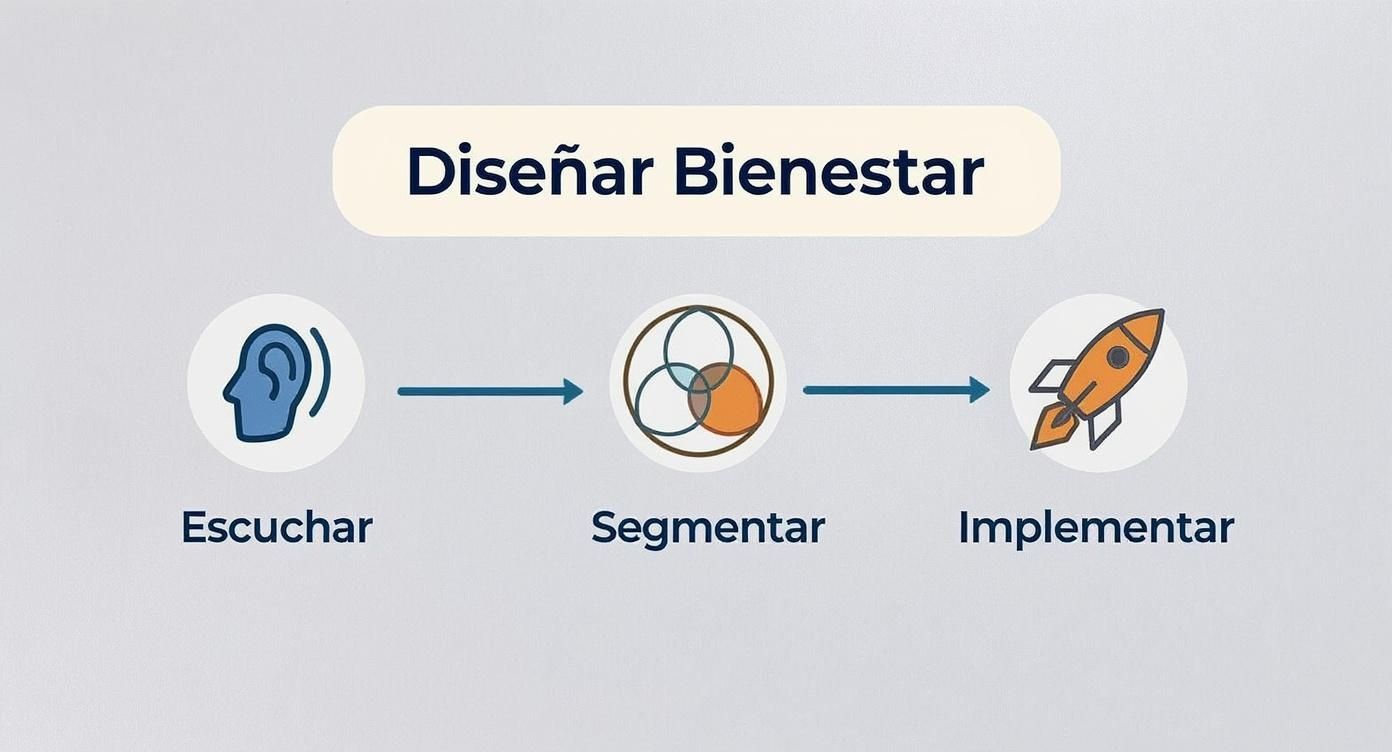
Following these steps ensures that what you implement meets real needs, maximizing the chances of your program's success.
Without leadership support, no program will last
For your workplace wellness program to be sustainable over time, leadership needs to see it as a strategic investment, not just another expense. You need to "sell" them on the concept with a self-sustaining business case.
Prepare a short, direct presentation showing how wellness supports company objectives, such as reducing turnover or improving productivity. Use the data you gathered during the diagnostic phase to prove you aren't making up problems, but solving them.
From experience, we know that when leaders genuinely join in on activities—for example, being first in line for a chair massage—they send a powerful message. Their example gives the rest of the team permission to participate without guilt.
Run a pilot before the big launch
Instead of rolling everything out to the entire company at once, test it with a department or a small, diverse group. A pilot allows you to fine-tune logistics, gauge real interest levels, and, most importantly, gather honest feedback in a controlled setting.
This helps you catch issues before they escalate. Maybe the sign-up process is too complicated, or the class schedule doesn't work for anyone. Fixing those details will save you plenty of headaches and make the company-wide rollout much smoother.
A checklist so nothing slips through the cracks
Logistics can be overwhelming, but a solid checklist keeps you on track. Make sure you have all of this covered before launch day.
Do you have your vendors lined up? For activities like massages, look for a reliable partner that guarantees certified therapists and seamless logistics, like Zen to Go.
How will people sign up? The system must be effortless to use. At Zen to Go, for example, we provide an easy online scheduling system that simplifies registration and sends automatic SMS reminders, taking a load off HR's shoulders.
Where will the activities take place? If you’re offering Shiatsu Chair massages, you only need a small space, but it must be designated and clearly communicated. To genuinely reduce stress, you need a partner who understands this; if you'd like to learn more, here’s our take on massages for stress relief and their impact.
Publish a clear schedule: Ensure everyone knows what’s happening, when, and where, in an easy and accessible way.
Have all materials ready: Prepare emails, posters, intranet banners, and any quick-start guides that may be needed.
Launching your program is an ongoing cycle: launch, measure, listen, and adjust. That’s how you ensure your wellness investment translates into a healthier, happier team that feels connected to the company.
How to measure the ROI of your wellness investment
A well-designed workplace wellness program is far more than an activity calendar; it is a full-fledged strategic investment. And like any serious investment, it must demonstrate its value in a clear, tangible way.
Measuring Return on Investment (ROI) doesn't just help you justify the budget to executive leadership. It serves as the compass that lets you see which initiatives are working, which aren't, and how you can refine your strategy to drive even greater impact.
The key isn't counting how many people attended a workshop. The real challenge is linking wellness initiatives to key performance indicators (KPIs) and showing how a healthier, more motivated team directly drives business results.
Identifying the KPIs that truly matter
To realistically measure your program's ROI, you need a mix of quantitative metrics (hard numbers) and qualitative metrics (people's perceptions and feelings). Only then will you get a complete, balanced view of the real impact.
Quantitative metrics (the "what")
These are objective data points you can track in your systems. Think of them as the financial evidence of success.
Participation rate: The starting point. How many employees are taking part in the activities? A participation rate of 40% or higher is generally considered a solid sign that the program is generating interest.
Absenteeism reduction: Compare absenteeism rates before and after launching the program. A small decrease here translates directly into cost savings and higher productivity.
Lower employee turnover: A team that feels cared for is a more loyal team. Analyze voluntary turnover rates; reducing them is one of the most significant cost savings wellness can generate.
Qualitative metrics (the "why")
These indicators give you the emotional pulse of the organization and tell the story behind the numbers.
Employee Net Promoter Score (eNPS): The key question: "How likely are you to recommend this company as a great place to work?". An increase in this score directly reflects improved satisfaction.
Workplace climate surveys: Measure perceptions of the work environment, leadership support, and, most importantly, stress levels. They are the thermometer of your culture.
Direct feedback and testimonials: Use quick post-activity surveys or focus groups to gather feedback. Questions like "How did you feel after the massage?" or "What was the most useful takeaway from the workshop?" provide a wealth of insight that no number can capture.
The key: connecting wellness with business results
The true power of measurement lies in tying these KPIs to company goals. It's not just about saying "people are less stressed," but demonstrating how that stress reduction shows up in higher productivity or better quality of work.
For example, with our corporate massage programs at Zen to Go, we don't just track attendance. We measure direct impact on employees through semi-annual satisfaction surveys.
Based on our surveys, 79% of employees report a reduction in stress after a massage session, 99% feel the company values their well-being by offering this benefit, and 94% consider the service to be high quality.
This kind of data demonstrates a clear ROI in team morale and reinforces a sense of belonging, a key factor for productivity and corporate wellness. It's proof that caring for your people delivers a tangible return.
A table to simplify your metrics
To maintain clarity from the start, organizing your metrics is extremely helpful. Here is a simple table comparing different indicator types and the tools you can use to track them.
Key metrics for evaluating your wellness program
Metric Type | KPI Example | Measurement Tool |
|---|---|---|
Quantitative | Voluntary Turnover Rate | HR reports (quarterly comparison) |
Quantitative | Absenteeism Rate | Attendance records and medical leave |
Qualitative | Employee Net Promoter Score (eNPS) | Anonymous pulse surveys (quarterly) |
Qualitative | Perceived Stress | Workplace climate surveys and post-activity feedback |
As you can see, the idea is to have a balanced mix that enables you to tell a complete, compelling story about the value of your program.
Ultimately, measuring ROI is an ongoing process. Start with a few clear metrics, collect data consistently, and, most importantly, use that information to prove that investing in your people is the best investment your company can make.
Overcoming common implementation challenges
Launching a workplace wellness program is a big step, but let's be honest: the journey is rarely a straight line. As leaders in corporate wellness in Mexico since 2019, we have guided many companies through this process and know that obstacles will arise.
The good news is that they all have solutions. In fact, understanding them beforehand gives you a major advantage in navigating them and keeping your program strong and relevant. Let’s break down the three most common challenges and share the strategies that, in our experience, genuinely work.
"Nobody is signing up": the ghost of low participation
You roll out an incredible initiative that took weeks to plan, and the response is... crickets. It's frustrating, but more common than you might think. In most cases, low participation isn't due to a lack of interest, but rather a disconnect in communication or employees feeling that "this isn't for me."
To combat this, the key is making wellness feel like part of the culture, not an extra chore on the calendar.
Gamification and meaningful rewards: Forget generic prizes. Organize friendly competitions between teams with rewards people actually value, like an extra day off or a dedicated massage day for the winning team.
Consistent, multi-channel communication: A single email gets buried in the inbox. Use all your channels: Slack or Teams messages, cafeteria posters, and, most importantly, ask team leaders to actively bring it up in their meetings.
Wellness ambassadors: Every department has enthusiastic team members. Identify them and make them your "champions." Their energy and example are far more contagious than any official announcement.
Sometimes the issue runs deeper than communication; it touches on things like heavy workloads that simply leave no time for self-care. That’s why understanding and addressing the prevention of psychosocial risks is essential as the foundation of your entire strategy.
"There's no budget for this"
This is perhaps the most common roadblock. Many HR leaders run into it when presenting costs, especially if leadership views wellness as an expense rather than the strategic investment it is. The play here is twofold: start small to demonstrate value, and then, backed by data, ask for more.
One of our clients, a growing tech company, started with a very tight budget. Instead of an ambitious program, they implemented a monthly Shiatsu Chair massage day. The impact on morale and the positive feedback were so immediate and visible that, by the next quarter, leadership not only approved a larger budget, but actively asked: "what else can we do?".
This case proves you don't need a massive budget to start moving the needle.
Low-cost, high-impact initiatives: Internal workshops led by employees themselves (someone skilled in personal finance, another in meditation), book clubs, or group walks. They cost next to nothing and foster connection.
Build a solid business case: Use data from your diagnostic surveys to illustrate the problem (e.g., "60% of the team reports high stress levels"). Then, present your pilot initiative as a measurable solution to that pain point.
Measure and showcase results: After the pilot, highlight the impact using hard numbers. A data point like "massage participation reduced perceived stress by 79%" is an undeniable argument for securing further investment.
"Leadership doesn't care": executive resistance
Sometimes the problem isn't money, but mindset. If leaders don't buy into the program, don't participate, or worse, view it as a waste of time, the message sent to the rest of the organization is devastating.
To break down that barrier, you have to speak their language: the language of business.
Focus on business outcomes: Don't frame wellness merely around "feeling good"—frame it around productivity, talent retention, and reduced absenteeism.
Use benchmarking to your advantage: Nobody likes falling behind. Show how other industry players (their competitors) are investing in wellness and the employer branding benefits they're gaining.
Involve them directly and effortlessly: Invite them to be the first to try an initiative. A 15-minute chair massage session can do more to win over a busy executive than a one-hour presentation.
Overcoming these challenges takes patience, strategy, and a bit of tact. It’s about understanding your company's realities and adapting your approach. By doing so, you aren't just rolling out a program; you're starting to build a wellness culture that sustains itself over time.
Frequently asked questions about workplace wellness
We know that launching a workplace wellness program can raise many questions. Since 2019, we have partnered with hundreds of companies in Mexico, and along the way, we've heard firsthand the questions that keep HR leaders up at night.
Here, we answer them with the honesty and practical insight gained from everyday corporate experience.
Where do I start if I have a very limited budget?
This is the million-dollar question, and the answer is simpler than it seems. Wellness doesn't always demand a major investment. The secret is starting with low-cost, highly visible actions.
You can, for instance, organize internal workshops where employees share their own expertise. Is someone great at personal finance? Does someone else practice relaxation techniques? There’s valuable content right there without spending a dime.
Another smart move is starting with a focused pilot. A monthly Shiatsu Chair massage day, for example, is a controlled investment with an immediate return in team morale. In our experience, the positive impact of those early steps is your best pitch for securing a larger budget next year.
How do I get employees to actually participate?
Let’s be direct: low participation is almost always a symptom, not the core problem. It is usually a reflection of poor communication, heavy workloads that leave no time for anything else, or activities that simply don't resonate with what people need.
To fix this, communication must be consistent across all channels and, above all, human. Get team leaders involved so they are the ones encouraging their teams.
At Zen to Go, we’ve learned that logistics are critical. If participating is complicated, people won't do it. That’s why our easy online booking system with automatic SMS reminders eliminates any friction. Streamlining the sign-up process is essential to getting people on board.
What types of activities have the greatest impact?
There is no silver bullet, as everything depends on what you uncovered in your initial assessment. However, there is a clear pattern: activities that offer a tangible breather during the workday are, by far, the most appreciated.
In Mexico’s day-to-day corporate environment, stress and physical tension are near-universal issues. That's why solutions like Shiatsu Chair or At-Desk massages enjoy exceptionally high adoption rates. Employees experience an immediate benefit and, more importantly, feel that the company genuinely cares about them.
Our client data speaks for itself: 99% feel the company values their well-being by providing this service. It’s a direct, powerful message.
How do I convince executive leadership that this is an investment, not an expense?
You need to speak their language: the language of business. Stop framing the program as "something nice for the people" and start positioning it as a strategic tool to improve key performance indicators.
Build a business case backed by hard data from your own organization. What is your turnover rate? What do your climate surveys say? Use them.
Research what competitors are doing and how wellness strengthens their employer brand. Pitch a pilot with clear metrics and projected ROI, such as decreased absenteeism or boosted productivity. When you use numbers to prove that wellness directly impacts bottom-line results, the conversation changes entirely.
At Zen to Go, we firmly believe that a well-cared-for team is the true driving force behind any successful business. If you are looking for an experienced, proven ally to design and implement a wellness program your employees will truly appreciate—one that delivers measurable results—we are here to help.