Wellness for technology companies: A practical guide for HR leaders in Mexico
Wellness for tech companies has ceased to be a "nice to have" perk and has become a key element of talent strategy. As an HR leader in Mexico, you know the challenge goes beyond offering snacks and a ping-pong table. It's about designing programs that genuinely address the physical and mental well-being of teams—something essential for combating burnout, curbing high turnover, and attracting the specialized talent that defines the sector.
The Real Challenge of Well-being in Mexico's Tech Sector
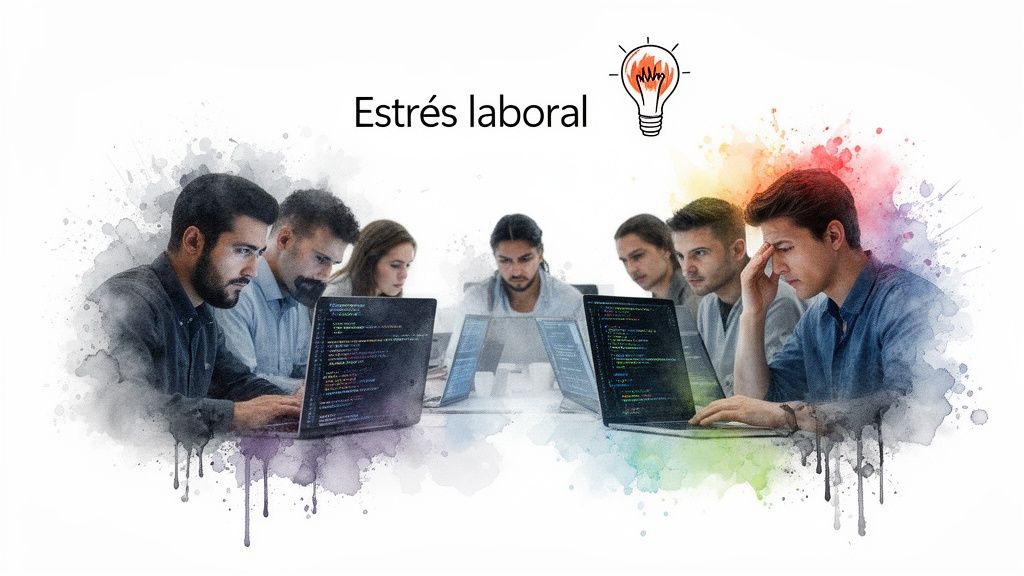
In Mexico's fast-paced tech ecosystem, the pressure to innovate and endless hours in front of a screen create the perfect breeding ground for chronic stress. If you lead a People & Culture department, this picture surely sounds familiar: exhausted staff, difficulty unplugging, and a steady trickle of valuable talent leaving in search of better conditions.
The challenge is two-fold. On one hand, your mission is to take care of your people so they stay motivated and productive. On the other, you need to build an Employee Value Proposition (EVP) that truly stands out in such a competitive job market. This is where a well-designed wellness program for tech companies becomes a tangible competitive advantage.
Beyond Generic Perks
Let’s be honest: traditional wellness solutions usually don't resonate with what a tech profile needs. A developer who spends hours immersed in code values solutions that don't disrupt their workflow, while a project manager might need tools to manage the stress of impossible deadlines.
In our experience working with HR teams in Mexico since 2019, we've seen that the success of a wellness program lies in its ability to adapt to the team's culture and routines, not the other way around.
The goal of this guide is to give you a clear, practical roadmap. We want to share what we’ve learned at Zen to Go by collaborating directly with tech companies so that you can:
Design a tailored strategy: One that addresses the real pain points of your employees, from software engineers to product teams.
Justify the investment: We will show you how to measure and present ROI in terms of productivity, engagement, and, above all, talent retention.
Implement without friction: Offering simple logistical solutions that integrate naturally into the day-to-day operations of a tech company.
We know that workplace stress in this industry plays by its own rules. That's why we've explored effective solutions for stress in the tech sector that can serve as your starting point. Throughout this guide, we'll give you the tools to build a program that not only complies with NOM-035, but also transforms wellness into a pillar of your culture.
How to Diagnose the Real Needs of Your Tech Team
Before launching any wellness initiative for tech companies, there is a key question every HR leader must ask: what does my team really need? Investing in a generic program without a prior diagnosis is like developing an app without researching the end user: it’s destined for low adoption and zero return on investment.
In the tech world, where each role faces unique challenges, understanding these nuances is everything. A wellness program that doesn't solve a real pain point becomes noise—just another message that everyone ignores on Slack and in company emails.
Active Listening Beyond the Annual Survey
The first step is gathering data, of course, but not just any way. You need to go beyond the typical climate survey to get insights that are genuinely useful. In our experience, the best perspective comes from combining quantitative and qualitative approaches.
Anonymous and highly focused surveys
Anonymity is key to getting honest answers. Design short, specific questionnaires aligned with the psychosocial risk factors of NOM-035. This not only helps you stay compliant, but also provides a crystal-clear map of where the stress hotspots are.
At Zen to Go, we always recommend including open-ended questions. A simple "What activity would help you unplug and recharge during your workday?" can reveal ideas that are far more valuable than a predefined list of options.
Focus groups by specialty
Organize short sessions (virtual or in-person) with well-defined groups: a focus group with backend developers, another with the QA team, and one more with product managers. Their pain points are different. While some suffer from eye strain and mental fatigue due to intense concentration, others deal with the pressure of launches and cross-team coordination.
These conversations will allow you to capture the everyday language and real situations that a mass survey simply cannot.
Analyze the Data You Already Have In-House
Often, the answers are already in the information you manage every day. The trick lies in cross-referencing data to spot patterns.
Absenteeism rates: Do you notice spikes in absences within certain teams right after a sprint or a major launch? That's a red flag for burnout.
Turnover rates: Analyze why people are leaving. If you hear phrases like "lack of balance" or "excessive workload" during exit interviews, you already have a very clear starting point.
Current benefits usage: How much are your existing perks actually used? If the gym membership has low adoption, maybe it's because people prefer activities that don't involve commuting or that can be done during short breaks.
Key Questions Checklist for Your Diagnosis
To make this process easier for you, here are a few questions you can adapt for your surveys or focus groups. It's not just about measuring stress, but about understanding what solutions they would appreciate. If you want to dive deeper, you can use a stress assessment test as a complementary tool.
On a scale of 1 to 10, how would you rate your energy level at the end of the day?
What barriers (time, workload, scheduling) do you face when trying to participate in wellness initiatives?
Do you prefer individual activities that you can do at your own pace, or group activities to socialize?
What type of break would help you be most productive? (e.g., a walk, a 10-minute meditation, a 15-minute massage session).
If you could change one thing about your daily routine to improve your well-being, what would it be?
Gathering this information will give you a clear, data-driven mandate. With these insights, you can move from assumptions to strategy, designing a wellness program that your team not only needs, but also values and actively uses.
Designing a Flexible and Appealing Wellness Program for Tech Professionals
Once you have the diagnostic data in hand, it's time to turn insights into action. You now have a clear picture of what your team needs, so the challenge is to build a value proposition that truly resonates with them. And in the tech sector, the keyword is flexibility. A rigid, one-size-fits-all program simply won't work.
The key to success for a wellness program for tech companies is offering a "menu" of options tailored to different roles, schedules, and work arrangements. Because let's be honest: not everyone needs the same thing at the same time.
The following diagram illustrates precisely that step: how to transform a general assessment into concrete ideas, which is essential before you even think about designing your program.
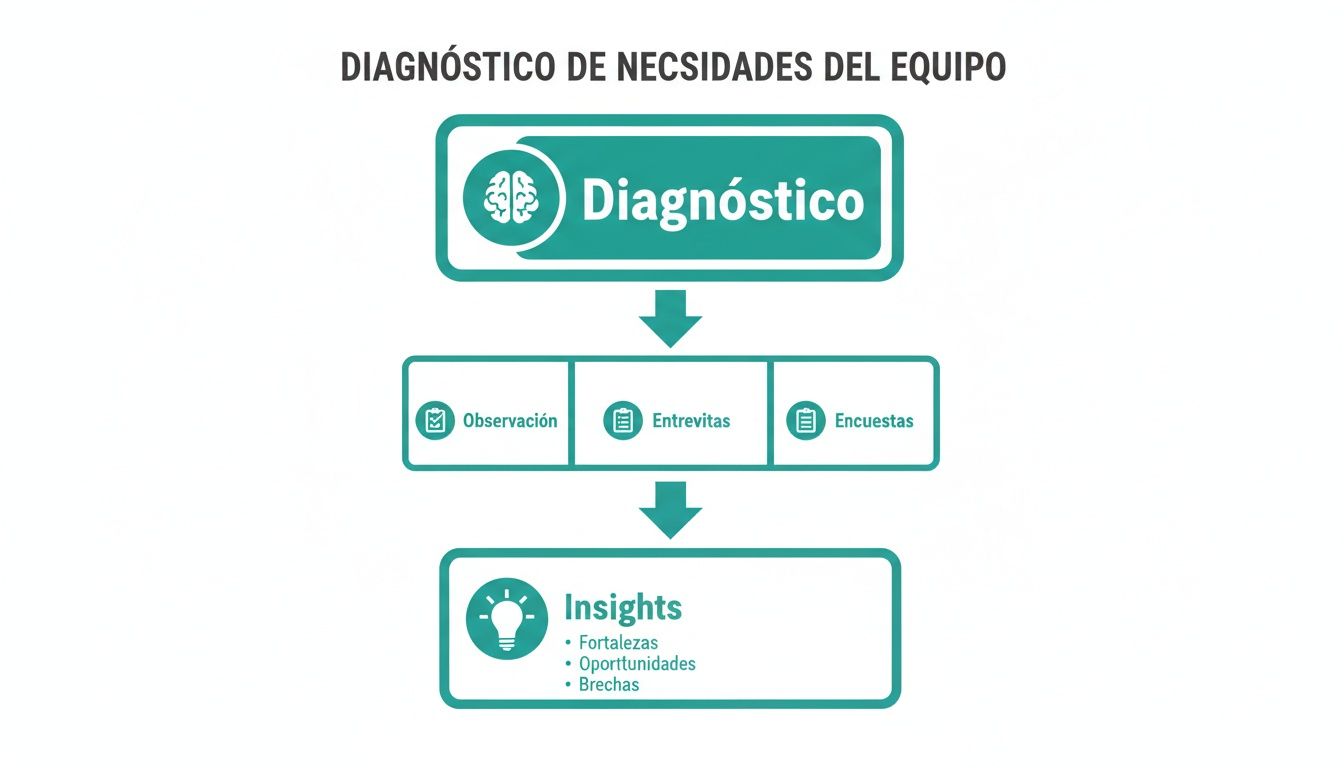
Keeping this process clear helps you understand that every data point you collect, whether from a survey or a focus group, should translate into personalized, tangible actions.
Creating a Multichannel Wellness Menu
The hybrid reality is here to stay; there is no turning back. That's why your wellness strategy must reflect this, providing fair and equitable support to both office-goers and remote workers. This is where a smart combination of physical and digital solutions makes all the difference.
From our experience at Zen to Go, we've found that certain formats work exceptionally well in tech environments due to their low disruption and high impact.
Desk massages: The perfect choice for development and engineering teams. They last between 10 and 15 minutes, take place right at their desk, and don't require the person to step away from what they're doing for long. It's a micro-break that combats postural tension without breaking their focus.
Shiatsu chair sessions: Ideal for peak office days, team-building events, or celebrating the end of a sprint. They create a highly visible hub for relaxation, fostering a super positive perception of the work environment.
Digital wellness solutions: For remote employees or those who prefer self-directed wellness, integrating access to online therapy platforms, meditation apps, or virtual fitness classes is essential. This ensures no one is left out.
And of course, a comprehensive program must also consider the physical workspace. Providing ergonomic furniture and proper accessories is vital to preventing common repetitive strain injuries.
Which Format Best Fits My Team?
To help you decide, here is a comparison table summarizing which service best fits your team's operational needs and culture.
Comparison of Wellness Formats for Tech Companies
Evaluate which type of wellness service best suits your tech team's operational and cultural needs.
Format | Ideal For | Key HR Benefits | Implementation Example |
|---|---|---|---|
Desk Massage | Development, engineering, and high-concentration roles. | Minimal disruption, high perceived ROI. | Biweekly 10-minute sessions per employee, scheduled by team to avoid disrupting sprints. |
Chair Massage | Event days, project completions, high-occupancy office weeks. | Creates a visible wellness hub, encourages social interaction. | A "Wellness Corner" during the quarterly All-Hands with 2 therapists for 3 hours. |
Digital Wellness | 100% remote teams, employees across different time zones. | Scalable, equitable, and offers 24/7 flexibility. | Meditation app subscription and access to 3 online therapy sessions per quarter. |
Guided Active Breaks | Teams spending long hours in meetings or sedentary work. | Encourages movement, prevents injuries, boosts group energy. | A 15-minute break led by a physical therapist via Zoom before the weekly team meeting. |
Each option has its time and place. The smartest strategy is usually to combine a few of them to cover the varying needs and work styles present across your company.
Structure Your Program Around Clear Pillars
To make your offering easy to communicate and understand, we recommend organizing it into three pillars. This way, every employee can quickly identify what they need and choose what works best for them.
1. Physical Well-being
The focus here is relieving the strain of sedentary work and recharging energy.
Examples: Corporate massages (chair, desk), guided active breaks, physical activity challenges, ergonomics workshops.
2. Mental and Emotional Well-being
The goal is to provide tools to manage stress, prevent burnout, and build resilience.
Examples: Access to online psychological therapy, mindfulness workshops, guided meditation sessions, talks on stress management.
3. Social and Community Well-being
This pillar seeks to strengthen team connections, especially in hybrid models where it's so easy to feel disconnected.
Examples: Team-building events with a wellness twist, outdoor group activities, special interest clubs (books, running, etc.).
The key retention statistic: A well-designed program is not a luxury; it's a strategic necessity. According to a recent report by Wellhub, 87% of employees in Mexico would consider leaving a company that does not actively support their well-being. The numbers speak for themselves regarding the urgency to act.
When designing your "menu," don't obsess over offering dozens of options. It's much better to start with two or three high-impact initiatives per pillar that directly address the data you've gathered. This will allow you to launch something solid, measure its impact, and scale smartly. The secret is offering meaningful options without overwhelming people with choices.
How to Implement Your Program Without Dying in the Attempt (and Without Operational Friction)
A great wellness idea for tech companies can easily fall apart due to poor execution. As an HR professional, you know all too well that logistics are everything. Your time is valuable, and any new initiative needs to integrate smoothly, almost invisibly, into daily operations.
This section is your field guide to making that happen. No theory here—just actionable steps and practical tips so that your program rollout is not only a success, but also makes your life easier.
The Key: A Strategic Partner, Not Just a Vendor
The first and most important step is choosing a partner who understands your operations. You're not just looking for someone to send therapists; you need an ally who cares about logistics as much as you do.
In our experience working with People teams across Mexico, operational ease is what truly makes the difference between a program people actively use and one that just creates more work for you.
A great partner should simplify your life with:
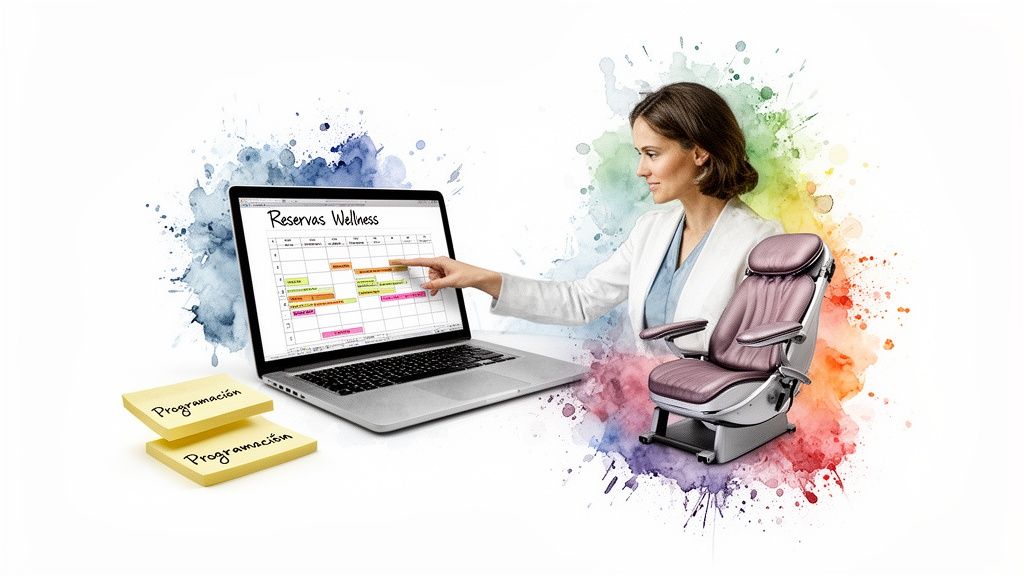
Online booking systems that actually work. Forget about shared spreadsheets and endless email chains. A platform where employees can view availability and book in a couple of clicks is non-negotiable. This takes manual admin off your plate.
Automated communication. The system should send email or calendar reminders. This minimizes no-shows and ensures everyone stays informed without you having to chase anyone down.
Real flexibility. Your partner must understand that every office is unique. They need to adapt to your spaces, schedules, and team culture, not the other way around.
A wellness program needs to feel like a benefit, not an administrative burden. If signing up is a hassle or logistics are confusing, people won't use it, no matter how incredible the initiative is.
Logistical Coordination for Each Format
Every service has its own nuances. Planning ahead prevents disruptions and ensures the experience is positive for everyone—both participants and non-participants alike.
For Shiatsu chair massages:
Designate a "Wellness Corner." Look for a semi-private yet accessible space. A small meeting room or a quiet corner of a common area works perfectly. You don't need complete isolation, just keep it out of high-traffic walkways.
Plan for foot traffic. If you have two or more therapists, ensure there's enough room for a short waiting area without blocking hallways.
Communicate the space in advance. Let everyone know where the massage area will be so those needing absolute silence can steer clear.
For desk massages:
This format is a gem for tech teams because disruption is minimal. The therapist walks directly to each person's desk.
Plan by zones or floors. To be more efficient, coordinate with your provider so therapists work by section. For example, from 10 to 12 on the engineering floor and from 12 to 2 in the product area.
Use a visual cue. Something as simple as a colored sticky note on the monitor can signal who has a scheduled session. That way, the therapist can identify them without interrupting others.
Build Excitement: Communication Is Everything
Success depends on how well you sell the program internally. Blasting a mass email isn't enough; you need to create a mini-campaign that sparks curiosity and excitement.
Here is a launch email template you can adapt, tailored to the tone of a tech company.
Launch Email Template
Subject: Your break to recharge is coming to the office 🚀
Hi Team,
We know things move fast around here and that your focus is key to everything we achieve. That's why we want to make sure you have the tools to genuinely unplug and recharge your batteries.
We are excited to announce our new wellness program! We're kicking things off with [Service Name, e.g., Chair Massage Sessions] right here at the office.
Why are we doing this?
To relieve physical tension from long hours in front of screens.
To give you a mental break so you can return to your tasks with greater clarity.
Because your well-being is our top priority.
How does it work?
These are [Duration, e.g., 15-minute] sessions focused on the neck, back, and shoulders. Perfect for releasing stress without disrupting your day.
🗓️ When? This coming [Date] from [Start Time] to [End Time].
📍 Where? In [Specific Location, e.g., the "Creativity" conference room].
👉 [Link to booking system] 👈
Spots are limited, so make sure to claim yours!
We hope you enjoy it!
Best regards,
The People & Culture Team
Adapt this message for your Slack or Teams channels. Use GIFs, emojis, and an approachable tone. Remember, how you introduce the initiative is just as important as the initiative itself. Seamless operational execution is the silent engine that powers a truly great wellness strategy.
How to Measure Your Program's ROI and Communicate Its Success
To shift your wellness program for tech companies from being viewed as an expense to a strategic investment, you must speak the language business leaders understand: Return on Investment (ROI). Demonstrating value is what secures the budget and keeps the initiative from being a one-off perk.
As an HR leader, you know full well that vanity metrics—like the number of massages booked—don't tell the whole story. The real value emerges when we cross-reference program data with the core metrics that leadership and your own department actually care about.
Beyond Participation: The Metrics That Really Matter
To build an airtight business case, the key is correlating who participates in wellness initiatives with shifts in organizational KPIs. The question isn't just how many attended, but rather: what changed for those who did?
In our experience, these data correlations are incredibly revealing:
Voluntary turnover: Compare the turnover rate among active program participants versus non-participants. A noticeable difference is a powerful argument for talent retention.
Absenteeism days: Track whether teams with higher program adoption see fewer sick or stress-related absences. Fewer absences mean higher productivity—it's that simple.
Employee sentiment results (eNPS): Segment your engagement survey responses. Do frequent wellness session participants have a higher Employee Net Promoter Score? This data directly links well-being with engagement.
Team productivity: While trickier to measure, you can observe whether teams that take structured wellness breaks, such as desk massages, report improved focus or complete their sprints with less friction.
Visualizing Impact: An Executive Dashboard
You don't need complex software to share your findings. A simple spreadsheet dashboard or a clean slide deck can tell a compelling story.
At Zen to Go, our data shows that after participating in our programs, employees report an average 79% reduction in perceived stress levels. This is the kind of tangible data that helps leadership connect investment to human and business outcomes.
Keep your report visual and concise. Include charts showing trends before and after program implementation. For example, a timeline demonstrating turnover declining as wellness participation climbs.
Sharing Success Across the Entire Organization
Proving ROI to leadership is only half the battle. It is equally important to share results company-wide to reinforce the program's value and boost participation. This demonstrates to the team that the company doesn't just claim to care about them—it actively invests in and measures the impact of that care.
Here are a few communication tactics that work exceptionally well:
Share anonymous testimonials: Post brief, anonymous quotes from employees in internal channels. A simple "Thanks to the massages, I was able to finish my report without back pain" carries more weight than any raw statistic.
Highlight aggregate data: Rather than singling out individuals, celebrate shared wins. "This quarter, our team reduced reported stress levels by X%."
Create simple infographics: A visual chart showcasing "Hours of wellness invested" or "Total participants" can make a great impression on office monitors or via Slack.
Industry growth reinforces this perspective. The corporate wellness market in Mexico reached a value of USD 847.8 million and is projected to hit USD 1,504.0 million by 2033. This compound annual growth rate (CAGR) of 5.90% proves that companies—especially in tech—increasingly view wellness investments as a core business strategy. You can explore the full analysis of the wellness market in Mexico for further insights.
Ultimately, tracking and communicating success completes the loop. It not only validates your work as an HR leader, but also transforms wellness for tech companies from a "nice perk" into a vital pillar of company culture. If you'd like to see examples applied to another demanding field, check out our article on corporate wellness in the fintech sector.
Answering Questions: Frequently Asked Questions About Wellness in Tech Companies
We know that launching a wellness program for tech companies brings up plenty of questions. As your partners in this journey, we've gathered the most common inquiries we receive from HR and People & Culture leaders. Here are direct, practical answers drawn from our hands-on experience in Mexico's tech industry.
How do I convince leadership to invest when the budget is tight?
This is undoubtedly the million-dollar question. The secret lies in flipping the narrative: instead of framing wellness as an expense, present it as a smart investment to prevent a much, much higher cost: doing nothing.
Your strongest leverage will always be hard data. Calculate what turnover for a single tech specialist actually costs your company. Add up recruiting expenses (headhunters, platforms), team interview hours, the entire onboarding process, and the learning curve required before that new hire reaches full productivity. That figure will almost always dwarf the cost of a solid wellness program.
Our recommendation is to start with a pilot. Don't ask for a massive annual budget right out of the gate. Instead, propose a high-impact, cost-controlled initiative, such as a quarterly chair massage day. Measure the impact with pre- and post-pulse surveys. A successful pilot serves as your strongest business case for securing larger investments down the road.
My teams are hybrid or remote—how do I make things equitable?
In flexible work environments, equity doesn't mean giving everyone the exact same thing. It means offering options of equal value tailored to everyone's working reality. The strategy must be omnichannel.
For office workers: Maximize high-impact in-person services, such as desk or chair massages. These are tangible perks that make the office commute feel genuinely worthwhile.
For remote teams: Partner with providers to grant access to digital benefits. Ideas that have worked remarkably well include credits for online therapy platforms, meditation app subscriptions, or home-delivered wellness kits for special milestones.
For everyone: Organize quarterly or semi-annual gatherings where the entire team can connect. These touchpoints are ideal for extending the same on-site perks to all employees, strengthening cohesion and community.
The most important factor is clearly communicating that the company cares about everyone equally, regardless of where they work.
Developers tend to be skeptical and slow to participate—how do I drive adoption?
This is a classic hurdle in the tech sector. To win over analytical and—let's be honest—skeptical profiles, you need to speak their language: data, logic, and efficiency.
First, ditch generic messaging. Instead of emphasizing "relaxation," focus benefits around performance: sharper concentration, reduced eye strain, and the prevention of postural injuries (such as carpal tunnel syndrome).
Second, leverage tech leads. A note from the CTO or a respected Tech Lead endorsing the program will carry far more weight than an all-company HR email. They are the true internal influencers within their teams.
Finally, logistics make or break adoption. Offer formats that don't pull them out of their "flow state." 15-minute desk massages are perfect for this because they don't require stepping away from their workspace or abruptly cutting off their momentum. An initial experience defined by stellar quality and seamless logistics will trigger the best marketing possible: word of mouth across the development team.
At Zen to Go, we understand that every company operates differently. That's why we design flexible wellness programs that adapt to your team's culture and logistics, helping you build a solid business case and execute it without friction. Discover how we can be your strategic partner in corporate wellness.