Solutions that empower your business against year-end stress
Year-end stress solutions must go beyond a simple toast. They need to focus on relieving that collective pressure we all feel when work goals, financial closings, and personal commitments converge. The key lies in implementing concrete actions that demonstrate a real commitment to the team's well-being. If done right, this critical period can become an opportunity to strengthen company culture and start the following year on the right foot.
Why Year-End Stress Is an Organizational Challenge
Year-end closing in Mexican companies is much more than a simple countdown on the calendar. In reality, it is a "perfect storm" where the pressure to hit quarterly and annual goals collides head-on with holiday planning and personal reflections.
This phenomenon, far from being simple individual fatigue, quickly escalates into a challenge for the entire organization that directly impacts the work environment.
Ignoring this accumulated tension is not a viable option. We have seen it time and again in our experience with clients: when pressure rises, productivity drops, team morale weakens, and the risk of burnout skyrockets.
At Zen to Go, we have observed how this cycle repeats year after year in companies of all sizes. Leaders who act proactively not only mitigate negative effects, but also lay the groundwork for a much more focused and positive start to the year.
The Perfect Storm of Work and Personal Demands
The situation is more complex than it seems. It's not just about delivering reports on time. Teams face a mix of exhaustion accumulated throughout the year, the social pressure of holiday celebrations, and the financial anxiety that often accompanies this season. It's a scenario where everyone's mental and physical well-being is put to the test.
Recent data confirms this. At the end of 2024, a study by the Asociación de Internet MX revealed that 75% of Mexican workers reported suffering from acute job-related stress, while an alarming 27% already suffered from chronic stress. These figures place us above countries like China and the United States, demonstrating the magnitude of the challenge.
This context highlights how crucial it is to identify psychosocial risk factors at work, a topic we explore in depth to help protect your team. Recognizing these factors is the first step toward creating a truly effective support environment.
Impact of Year-End Stress on the Workplace
This table summarizes the main consequences of seasonal stress on teams and how a timely intervention can mitigate them.
Area of Impact | Common Symptoms | Suggested Corporate Solution |
|---|---|---|
Productivity | Increase in errors, delayed deliveries, difficulty concentrating. | Scheduled active breaks (chair massage, mindfulness), readjustment of realistic deadlines. |
Work Climate | Irritability, conflicts among coworkers, low overall morale. | Team-building and recognition activities, decompression spaces (year-end events). |
Health and Well-Being | Physical and mental exhaustion, illness-related absenteeism. | Ongoing wellness programs, communication regarding mental health. |
Talent Retention | Increase in post-year-end turnover, lack of motivation. | Visible investment in team well-being, clear messages of gratitude and appreciation. |
As you can see, the affected areas are critical to the business. Letting year-end stress run its course is not a strategy; it's a risk.
An Opportunity for Leaders
Seeing year-end stress solely as a problem is only seeing half the story. In reality, this period is the ideal time for leaders and Human Resources teams to prove through action that the well-being of their people is a priority.
Fostering cohesion: Well-planned wellness activities can strengthen bonds among coworkers far more than a formal dinner.
Sending a message of care: Taking a break for a massage or a mindfulness session communicates something powerful: the company values its employees as people, not just as numbers.
Boosting loyalty: Investing in well-being during the most demanding time of the year is one of those actions that build long-term loyalty. It is a gesture that people don't forget.
How to Go Beyond "Are You Stressed?" to Understand What Your Team Needs
Before implementing any wellness initiative, there is a golden rule: first, stop and listen. Assuming what your people need is the shortest path to investing resources in solutions that don't connect with anyone. The goal is simple yet powerful: move from a generic plan to one that feels personal and proves that the company genuinely cares.
To achieve this, bureaucratic processes are not required. The key is opening honest, safe communication channels where everyone feels confident expressing what they are going through without fear of judgment.
Listening Is Not Just Hearing: Empathy as a Diagnostic Tool
The foundation of a good diagnosis is empathy. It is about understanding the true sources of pressure your people face, not just the symptoms. Sometimes workload overload is evident, but the root of the problem may be a lack of clarity in goals, fear of falling short of expectations, or anxiety over year-end performance evaluations.
An excellent starting point is creating informal yet structured conversation spaces. Some ideas we have seen work in the companies we collaborate with include:
Anonymous and Direct Surveys: Use a simple form with open-ended questions that get straight to the point, such as "What is causing you the most pressure during this year-end closing?" or "If you could ask for one type of support, what would it be?". You will gain very valuable insights.
'Virtual Coffee Chats' with Leaders: Organize brief, voluntary small-group meetings. A relaxed environment always fosters a more candid dialogue than a formal meeting.
Suggestion Box (Physical or Digital): Sometimes the most valuable feedback comes from those who prefer anonymity. This channel is perfect for capturing those voices.
Key Questions That Uncover Real Challenges
Asking the right questions makes all the difference. Instead of a generic "Are you stressed?"—which almost always invites a simplistic answer—you need to dig deeper into the causes. The goal is to uncover specific pain points.
Consider including questions that explore different areas of well-being:
Workload: "Do you feel that year-end delivery expectations are realistic? Why or why not?"
Flexibility and Balance: "What activity outside of work would you like to have more time for this season?"
Financial Stress: "Are there any personal financial concerns affecting your focus at work during this time?"
Recognition: "Do you feel that your team's extra effort during this closing is being recognized as it deserves?"
These questions will not only give you an accurate diagnosis, but they will also send a powerful message: the company cares about the holistic well-being of its people. If you are looking for a more structured tool, you can use a test to measure stress that will provide a quantifiable view of the tension levels within your team.
Our experience shows that when a company takes the time to ask, the response from teams is incredibly positive. It is the first step toward building one of the most effective year-end stress solutions: a program that your people truly want and need.
Designing a Wellness Plan That Actually Works for the Year-End
With a clear diagnosis on the table, it's time to build the action plan. The goal is not to pack a calendar with costly activities, but to put together a realistic, high-impact program that balances the budget with year-end stress solutions that truly add value.
A well-designed plan is more than an isolated event; it is a statement of intent. It proves that the company doesn't just listen, but acts to protect its people.
This framework summarizes the process we have seen work across hundreds of companies: listen carefully, ask with intention, and plan strategically.
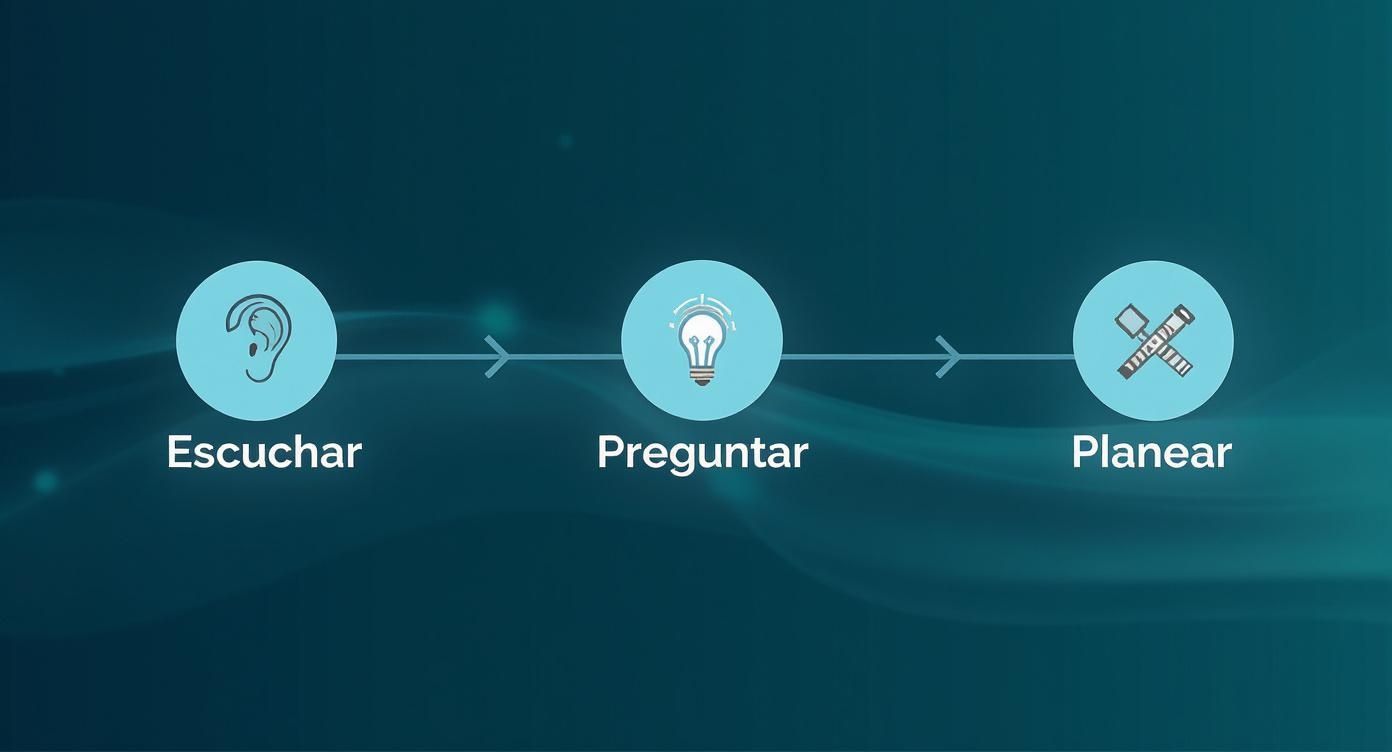
Each step builds upon the previous one, ensuring that the solutions you choose respond directly to what your team needs.
The Balance Between Budget and Real Value
The million-dollar question is always the same: how do we achieve a major impact without blowing the budget? The key is focusing on activities that offer a very high return in perceived well-being.
In our experience, the most effective solutions are those that offer a tangible, immediate break. A chair massage day, for example, can revitalize the office atmosphere in a single afternoon with an excellent cost-to-benefit ratio.
Shiatsu Chair Massages: This is our most popular and versatile option. It takes up minimal space and is performed over clothing, making it easy for people to participate without disrupting their day too much. The effect is immediate, relieving tension in the neck and back, right where stress from hours in front of the computer accumulates.
Mindfulness Workshops or Guided Active Breaks: These are excellent for teaching practical tools that employees can use in their daily routines. A 30-minute workshop can provide your team with breathing and stress management techniques that last long after the session ends.
Logistics and Communication Are Everything
A brilliant idea can fail due to poor execution. Logistics are essential. You must ensure that activities integrate smoothly into the workday without conflicting with critical delivery deadlines.
Communicating the plan in advance generates anticipation and maximizes participation. Don't announce it as an obligation, but as recognition of the team's hard work.
The goal is for it to be perceived as a genuine benefit, not as just another task on an already overloaded agenda. The "how" it is communicated is just as important as the "what" is offered.
For a more strategic approach, it is worth exploring the role of the Chief Happiness Officer for workplace well-being, a position that can elevate these initiatives.
Ultimately, having a partner like Zen to Go simplifies the entire process. We adapt to companies of any size, from startups to enterprises with offices in CDMX, Monterrey, or Guadalajara, bringing well-being directly to your facilities. If you want to dive deeper, we recommend our article on how to create a workplace wellness program that works year-round.
Wellness Solutions You Can Easily Implement
Great, you have the diagnosis and the ideas. Now it's time to put that wellness plan into action with concrete, hassle-free solutions. Often, logistics hold companies back, but with the right partner, the process is surprisingly simple.
This is where year-end stress solutions stop being just an idea and become a tangible reality for your team.
Since 2019, we have seen two corporate massage modalities make an immediate impact and adapt seamlessly to any office dynamic, especially during this fast-paced season.
'At-Desk' Massages: A Pause That Doesn't Interrupt
Imagine being able to offer your people a moment of deep relaxation without them having to leave their desks. That is the magic of the 'At-Desk' massage—a solution designed for high-demand environments where every minute counts.
Our certified therapists move throughout the office, applying techniques to the neck, shoulders, and upper back directly at the employee's workstation. It's simple: no extra equipment is needed, nor is there a need to clear out a designated room.
This modality is perfect for:
Fast-paced teams: Think call centers, sales departments, or finance teams that cannot afford extended breaks.
Surprise wellness days: It's a great way to break the routine and show appreciation without complicated logistics.
Offices with limited space: Because it requires no extra equipment, it adapts to any layout.
'Shiatsu Chair' Massages: The Office's Mobile Oasis
The 'Shiatsu Chair' modality is undoubtedly our most popular and versatile option. With just a small 6x6-foot corner, we can transform a common area or conference room into a true oasis of calm.
The employee sits comfortably in an ergonomic massage chair, fully clothed, while the therapist targets key tension points. A session of just 15 minutes is enough to recharge batteries and noticeably improve mood.
At Zen to Go, we have verified that these breaks not only relieve physical pain, but also send a powerful message of care. 99% of employees who receive our massages feel that their company values their well-being, according to our bi-annual satisfaction surveys.
When deciding, the following table can provide a clearer view of which option best aligns with your operational reality.
Comparison of In-Office Wellness Solutions
Service Modality | Space Required | Ideal For | Main Benefit |
|---|---|---|---|
'At-Desk' Massage | None (performed at the workstation) | High-tempo environments, call centers, sales teams. | Immediate relaxation without disrupting operations. |
'Shiatsu Chair' Massage | A small, quiet space (2x2 meters) | Offices with common areas, special events, wellness days. | Deeper, more focused disconnection experience. |
As you can see, both options are remarkably adaptable. The final choice will depend on your teams' workflow and the kind of experience you want to offer them.
Another simple solution is recognizing hard work through a thoughtful gesture. You can explore ideas for a unique gift that boosts team morale.
The key to these interventions is their accessibility. They make it easy for everyone to participate and experience immediate relief. If you want a deeper understanding of how these techniques combat tension, we recommend reading our article on the benefits of massages for stress.
Did the Initiative Work? Measure Success to Justify the Investment
Launching a wellness program is only half the battle. The other half, often overlooked, is measuring whether it truly worked. Demonstrating impact is what turns a good idea into a strategic pillar for the company, justifying the investment and ensuring these breaks become ingrained in the culture.
The good news is that you don't need complex dashboards. The key is capturing direct, straightforward data to understand what people enjoyed and, above all, why.
How to Gather Metrics Without Driving Anyone Crazy
The most agile and effective method we have seen is using ultra-short, near-instant surveys. They are sent right after the activity, such as a chair massage day, to capture the team's feedback while the experience is still fresh.
A couple of key questions are more than enough:
On a scale of 1 to 10, what was your stress level before the activity?
Now, on the same scale, how do you feel after?
This simple "before and after" gives you a tangible, powerful metric on immediate impact. At Zen to Go, we have gathered responses from thousands of these surveys, and the pattern is consistent.
Based on our bi-annual satisfaction surveys, 79% of employees report a real, measurable reduction in their stress. This number not only validates that the solution works, but it also becomes the best case an HR leader can make when presenting results.
Beyond Numbers: The Power of Listening to Your People
Hard data is essential, but personal stories bring the business case to life. Qualitative feedback puts a face and a voice to the statistics, highlighting the human impact behind the investment.
Encourage your team to share their experience with open, direct questions:
What did you enjoy most about this break?
How did this breather help you return to your tasks?
What message do you think the company sends by offering this?
The answers to these questions are pure gold. Phrases like "I felt valued" or "it was just the breather I needed to regain focus" carry immense power to demonstrate the return on investment in terms of morale, loyalty, and engagement.
Measuring impact also allows you to connect the dots with other key indicators. For example, a sustained reduction in stress almost always correlates with a decrease in absenteeism. If you want to dive deeper, we recommend reading our article on what workplace absenteeism is and how to combat it.
In the end, measuring is not about micromanaging, but about learning, adjusting, and demonstrating that investing in your people's well-being is the smartest decision you can make.
Have Questions? We Have Answers
These are the questions HR leaders and managers ask us most often when planning their year-end strategies. The answers are direct and grounded in our real-world experience helping hundreds of companies in Mexico.
How far in advance do I need to plan?
Our main recommendation: start planning 4 to 6 weeks in advance.
This timeline gives you the breathing room needed to accurately diagnose your team's needs without rushing. Additionally, it allows you to secure the availability of key partners like Zen to Go, as we experience very high demand during this season.
Planning early also prevents conflicts with critical year-end deadlines and leaves room to communicate initiatives internally, building anticipation and ensuring high participation.
How do I pitch the budget to leadership?
Speak their language: return on investment (ROI). Don't present it as an expense, but as a strategic investment to safeguard productivity, morale, and talent retention during the most critical time of the year.
Use hard data. Build your case with concrete numbers on the cost of absenteeism and burnout. Leverage our metrics to add weight to your argument: 99% of employees feel their company values their well-being through our programs. That is a key factor in strengthening engagement and loyalty.
The message is clear: caring for the team isn't just the right thing to do; it's the smartest move for the business. An investment in well-being today translates into a stronger, more focused team ready to hit the ground running in the new year.
What if my company has teams across multiple cities?
That is one of our specialties. At Zen to Go, we handle all the logistics so that your teams in CDMX, Monterrey, Guadalajara, and other key locations receive a standardized, high-quality wellness experience.
We centralize organization so you only have a single point of contact. This eliminates the headache of coordinating with multiple local vendors and ensures that all your team members, no matter where they are, feel equally valued.
Do in-office massages really help with stress?
Absolutely. The impact is immediate and measurable. It's not just a feeling of relaxation; a professional massage session releases accumulated physical tension in the neck, shoulders, and back, improves circulation, and acts as a true mental reset.
Our internal surveys, administered to thousands of employees, confirm this. 79% report a tangible reduction in stress right after their session. This relief allows them to return to their tasks with greater focus, a clearer mind, and a much more positive attitude, directly benefiting both the work environment and overall productivity.
Year-end stress doesn't have to be a losing battle. With a thoughtful strategy and the right tools, you can turn this challenge into an opportunity to strengthen your team and showcase leadership that truly cares about its people. At Zen to Go, we are ready to be your strategic partner on this journey.
Discover how our corporate wellness programs can help you close the year with energy and motivation.