Psychosocial risk factors at work: A complete guide for companies
When we talk about psychosocial risk factors in the workplace, we are not referring to employees' personal problems. Rather, they are cracks in the design, organization, and day-to-day management of work that ultimately affect the mental, physical, and social health of the entire team.
These flaws can generate stress, burnout, and a lack of motivation that, if left unaddressed, can spread throughout the entire office.
Understanding Psychosocial Risk Factors
Imagine the foundation of a building. If cracks appear and no one pays attention to them, over time they will weaken the entire structure. Psychosocial risk factors are precisely that: often invisible cracks at the foundation of your company.
Although they are not visible to the naked eye, they gradually undermine the motivation, engagement, and overall performance of your people.
More than a dictionary definition, let's think about everyday situations in an office in Mexico. They are those workloads that seem endless, the lack of clarity about what is expected from each role, or a leadership style that, instead of inspiring, creates uncertainty and mistrust.
Addressing these factors is not just a legal obligation under NOM-035. It is a strategic investment in your company's most important asset: the people who make it work every day.

Why is it crucial to talk about this today?
The conversation about well-being at work has changed. Offering a good salary is no longer enough; today's teams look for environments where they feel safe, valued, and aligned with a clear purpose.
Ignoring psychosocial risks has direct, measurable consequences for any business. We see it every day in the companies we collaborate with:
Employee turnover increases: Employees who live under constant stress or feel unsupported are the first to look for new opportunities.
Absenteeism skyrockets: Mental and physical exhaustion directly translates into more medical leaves and lower office attendance.
Productivity plummets: A demotivated team makes more mistakes, loses initiative, and their overall performance drops significantly.
The reality in Mexico is striking. A recent study revealed that a high percentage of workers are exposed to some level of psychosocial risk, and an alarming number of them showed severe exposure. These numbers are not an anecdote; they are a sign that the problem is widespread and requires immediate attention from team leaders and HR.
To understand the true scope, we have summarized the impact of the most common risks in the following table.
Impact of Major Psychosocial Risks
This table offers a quick overview of how flaws in work organization translate into direct costs for the company.
Type of psychosocial risk | Common example | Direct impact on the company |
|---|---|---|
Excessive workload | Impossible deadlines, understaffing. | Burnout, mistakes, increased overtime, turnover. |
Lack of control | Micromanagement, little decision-making autonomy. | Low motivation, zero proactivity, presenteeism. |
Negative leadership | Authoritarian managers, lack of recognition. | Poor work environment, absenteeism, loss of key talent. |
Role ambiguity | Not knowing what is expected of you, confusing objectives. | Rework, internal conflicts, low productivity. |
Long working hours | Culture of "staying late" without necessity. | Chronic fatigue, health problems, poor performance. |
As you can see, every risk directly echoes in business metrics. They are not "human resources issues"; they are operational problems that affect profitability.
Actively understanding and managing these risks is a cornerstone of occupational health. It is about shifting from a reactive approach—which only puts out fires—to a proactive culture that protects the team's well-being at its root.
By demystifying this term, we lay the groundwork to create a work environment that is genuinely healthy and sustainable. It is not about eliminating stress entirely, but about building an environment where challenges are manageable, leadership is positive, and every person feels that their well-being matters. If you want to delve deeper into this topic, we recommend exploring what occupational health is and the role it plays in prevention.
Warning Signs of the Top 5 Psychosocial Risks
Identifying psychosocial risk factors in the workplace is the first step. But the real skill lies in recognizing their symptoms day to day so you can act in time.
These problems rarely announce themselves with a neon sign. Rather, they seep into subtle behavioral changes, the team's energy, and dynamics that didn't exist before.
As a leader or HR manager, your ability to read these signs is crucial. Below, we break down the five most common risks in the Mexican workplace and the early warnings that will help you detect them before they turn into a crisis.
1. Excessive Workloads
This is the best-known villain of workplace well-being. It is not just about "having a lot to do," but that constant feeling of being under pressure that simply doesn't let up.
The signs are quite clear if you know where to look:
Increase in mistakes: People who are normally detail-oriented start making careless errors or delivering work of lower quality than usual.
Irritability and cynicism: Negative comments or curt replies become the norm, even among employees who used to bring spark to the team.
Working after hours as a rule: You see team members online or sending emails at all hours. Not as an exception, but as their new routine.
Think of Ana, a creative designer who always delivered her projects with impeccable quality. Lately, her proposals arrive right at the deadline and with obvious typos. This change is not a lack of ability; it is a cry for help from someone who probably doesn't even have a minute to review her own work calmly.
2. Lack of Control and Autonomy
When people feel they have no say in how they do their work, motivation plummets. Micromanagement and distrust are pure poison for initiative.
Notice if you detect this in your team:
Zero initiative: No one proposes new ideas or improvements. People limit themselves to passively following orders, as if on autopilot.
“Presenteeism”: Employees are physically at their desks, but their minds are elsewhere. They put in the hours, but add no real value.
Excessive dependency: They seek your approval for every single step, even on tasks they have mastered. Fear of making mistakes paralyzes decision-making.
A team without autonomy is a paralyzed team. Lack of control creates a culture of dependency where creativity and problem-solving simply vanish.
3. Negative Leadership
Poor leadership can contaminate the entire work environment in a matter of weeks. Poor communication, favoritism, or a total lack of recognition are factors that destroy trust and engagement.
Warning signs include:
Increase in gossip and rumors: When official communication is poor or unreliable, informal channels take over and misinformation reigns.
Low participation in meetings: People seem apathetic, don't share opinions, and avoid eye contact with the leader. There is a silence that speaks louder than words.
Formation of "silos" or cliques: Teams divide and cross-departmental collaboration collapses. Everyone defends their own turf.
4. Work-Life Imbalance
A culture that glorifies being "always available" is a ticking time bomb leading straight to burnout. Respecting personal time is not a luxury; it is a necessity to maintain high, sustainable performance.
Pay attention to these warnings:
Frequent vacation cancellations: Employees who postpone or cancel their time off because they feel they "can't" unplug.
Constant mentions of fatigue: Phrases like "I'm exhausted" or "I didn't sleep at all last night" become part of everyday conversation, almost like a greeting.
Little interest in social activities: The team shows clear reluctance to participate in team-building events or celebrations. There simply isn't energy for anything more.
This imbalance is one of the main expressways to burnout. To better understand its devastating consequences, we invite you to read our article on workplace stress and burnout, the silent epidemic of the 21st century.
5. Toxic Work Environments
This is the most dangerous risk. It encompasses destructive dynamics such as harassment, discrimination, or cutthroat competition. It directly attacks people's psychological safety.
The signs here are serious and require immediate action:
High turnover in a specific area: If a department or team has a constant brain drain, it is a giant red flag you cannot ignore.
Isolation of certain employees: You notice someone is consistently excluded from conversations, meetings, or team social activities.
Fear of expressing opinions: There is a palpable tension where no one dares to dissent or point out a problem for fear of retaliation.
Recognizing these signs is not about finding culprits. It is about understanding what is happening beneath the surface so you can offer solutions that truly help your team recover and thrive.
How Workplace Stress Hits Productivity in Mexico
Workplace stress is not just “feeling pressured.” It is the most direct, visible, and costly consequence of failing to manage psychosocial risk factors in the workplace. In Mexico, the problem has reached critical levels and has ceased to be an individual concern, becoming a business challenge that directly impacts profitability.
We must move beyond the idea that “stress is bad.” We need to understand how it translates into tangible losses. When employees live under constant pressure, their ability to focus, solve problems, and collaborate plummets. This drain not only reduces an individual's efficiency, but it also erodes the morale of the entire team.
The situation in our country is particularly alarming. According to recent data, close to 75% of workers in Mexico suffer from occupational stress-induced fatigue. That figure gives us the highest rate in the world and makes it clear that action is urgently needed.
The Direct Connection Between Chronic Stress and Business Results
A little stress is normal in any job that challenges you. The real problem starts when it becomes chronic and transforms into something more serious, like burnout or generalized anxiety. It is precisely there that the impact on company metrics becomes evident.
The cause-and-effect relationship is undeniable and manifests in several ways:
Declining productivity: A stressed employee makes more mistakes, takes longer to finish tasks, and their ability to innovate drops to zero. The mental energy that should be used to create value is spent managing anxiety.
Increase in medical leaves and absenteeism: Chronic stress has very real physical consequences, ranging from headaches and digestive problems to cardiovascular conditions. This translates into a clear increase in absences and medical leaves.
Loss of key talent: Top employees are often the most committed and, therefore, the most vulnerable to burnout. When the work environment becomes unsustainable, they are the first to look for opportunities at companies that do prioritize well-being.
This vicious cycle of stress and low productivity not only generates direct costs, such as medical leave payments or recruitment expenses to replace departing employees. It also causes hidden costs, such as the loss of institutional knowledge and damage to the employer brand reputation.
Understanding workplace stress as a silent epidemic is the first step toward combating it. It is not a personal weakness, but the result of a work environment that has exceeded its people's capacity to adapt.
From Individual Exhaustion to Organizational Crisis
When a significant number of employees experience burnout, the problem stops being theirs and becomes a cultural crisis. Demotivation spreads, affecting the work climate and how teams collaborate.
The long-term consequences can be devastating. An exhausted team cannot respond agilely to market changes, nor can it provide exceptional customer service. It simply lacks the energy.
In our experience collaborating with companies across Mexico since 2019, we have seen how addressing stress proactively not only improves well-being, but completely revitalizes company culture. Recognizing that burnout is a systemic problem, rather than an individual failure, is essential. If you want to dive deeper into how burnout is affecting Mexican companies, we recommend reading our analysis of 3 key burnout facts in Mexico you should know.
Managing psychosocial risk factors in the workplace is not an option; it is a strategic necessity for any company that wants to remain sustainable and competitive in today's landscape.
A Practical Guide to Implementing NOM-035
For many, the Official Mexican Standard NOM-035 sounds like just another bureaucratic requirement. But in reality, it is a roadmap designed to build a better place to work. The first step to genuinely transforming your team's well-being is seeing it as an ally, not a burden.
Its purpose is very clear: for companies in Mexico to actively identify, analyze, and prevent psychosocial risk factors in the workplace. Simply put, it gives you the tools to stop reacting to problems and start preventing them at their source.
With the enforcement of NOM-035-STPS-2018, a milestone was set in how workplace mental health is managed in the country. This regulation requires all companies, regardless of size, to take concrete actions to protect the balance of their workforce.
Key Steps for an Implementation That Works
Adopting NOM-035 does not have to be a headache. It can be summarized in a continuous improvement cycle that protects both your people and your business.
Identify and analyze risks: The starting point is applying the questionnaires provided by the standard itself. These surveys are like an X-ray: they give you a clear diagnosis of how your team feels regarding workload, leadership, and the overall environment.
Create an action plan: With the results on the table, the next step is designing prevention and control measures. It's not about fixing everything at once, but focusing on the most critical areas identified by the questionnaires.
Communicate and disseminate: It is essential that every team member knows the prevention policy. They must know who to turn to if they face a risk situation and what support mechanisms exist. Clarity builds trust.
NOM-035 does not look for culprits, but for solutions. Its true value lies in using data to open honest conversations about what can be improved and, above all, how to do it together.
This flowchart makes it very clear: it shows the path from risk identification to the consequences if it is not managed in time.
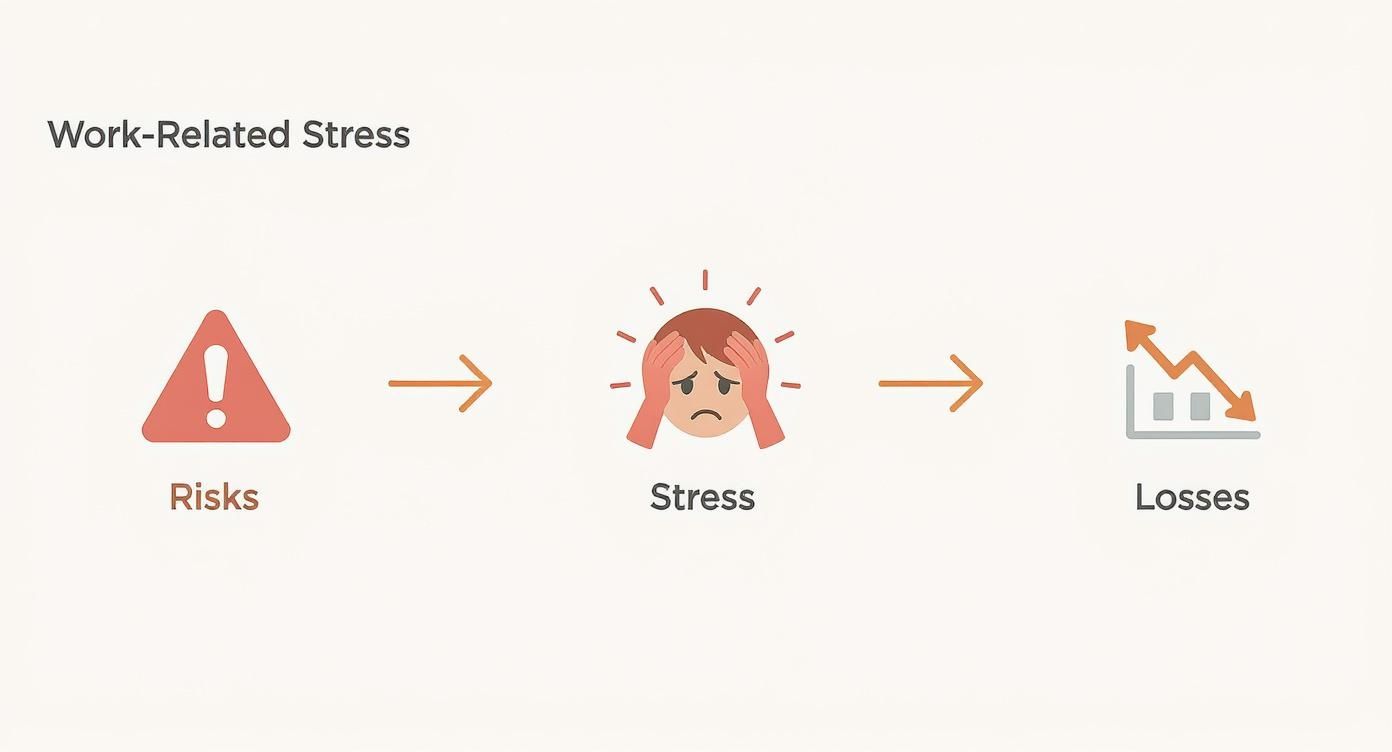
As the image shows, unaddressed risks lead directly to stress, which in turn translates into very tangible losses for the company.
From Questionnaires to Real Action
The real challenge is not administering the surveys, but knowing what to do with the information. The results are an invaluable guide for making strategic decisions that have a real impact.
Did workload score high? It's time to review task distribution, evaluate whether you need to hire more staff, or implement tools that automate repetitive processes.
Is leadership a weak point? It's the perfect opportunity to invest in training for your managers, focused on effective communication, emotional intelligence, and delivering motivating recognition.
Is there a lack of work-life balance? You can explore flexible policies, promote the right to disconnect digitally, or establish meeting times that are more respectful of everyone's time.
Implementing NOM-035 is an opportunity to listen to your team in a structured way and demonstrate with actions that their well-being is a priority. Instead of viewing it as a mere obligation, use it as the engine to build a stronger, healthier, and more productive organizational culture.
If you are looking for more ideas on how to start, our guide on psychosocial risk prevention offers practical and effective strategies you can implement today.
Effective Strategies to Mitigate Psychosocial Risks
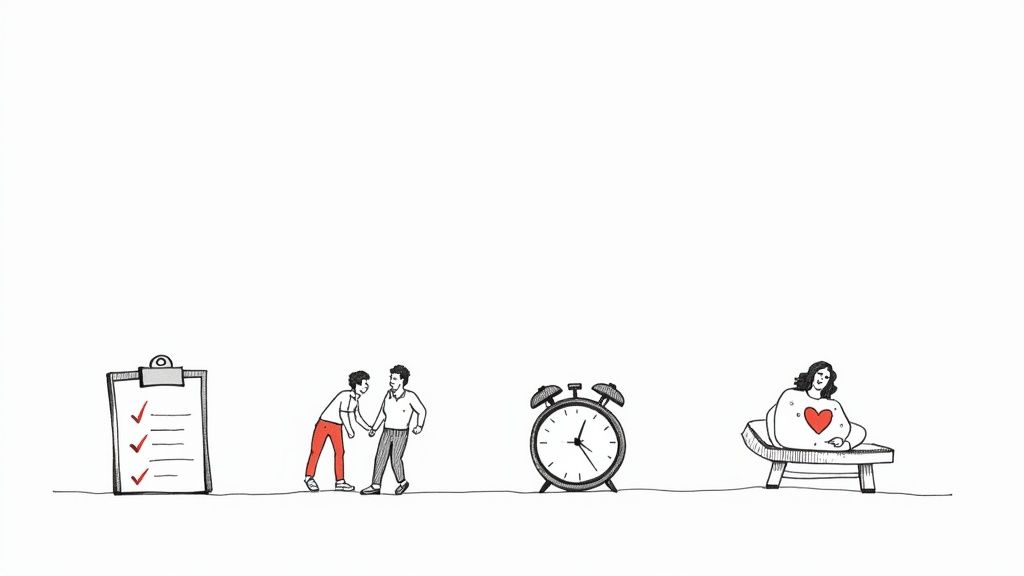
Knowing how to identify psychosocial risk factors in the workplace is the first step, but real change occurs when we move from theory to action. It is not about implementing overly complex or expensive solutions, but about making strategic, day-to-day adjustments that reinforce your team's well-being and resilience.
Here we share a set of concrete solutions, organized into four pillars, that you can start applying today to build a healthier and more productive work environment.
1. Improve Work Organization
Clarity and predictability are powerful antidotes to stress. When people know exactly what is expected of them and feel that goals are achievable, anxiety drops drastically.
Define clear roles and responsibilities: Make sure each team member has an updated job description that clearly outlines their duties. This prevents task duplication and conflicts from "stepping on each other's toes."
Set realistic and measurable goals: Objectives should be challenging yet achievable. Use frameworks like OKRs (Objectives and Key Results) to align the team and provide visibility into progress.
Distribute workloads equitably: Constantly monitor who is doing what. Project management tools can help you visualize each person's workload and reassign tasks before someone reaches a breaking point.
2. Foster Positive and Approachable Leadership
Leaders have a direct and profound impact on the work climate. Good leadership does not just direct; it supports, inspires, and protects its people.
Training your managers and coordinators in soft skills is one of the most profitable investments you can make.
A leader who knows how to listen, communicate with empathy, and recognize effort completely transforms the perception of safety and support within the team.
In our experience with various clients, we have observed that leaders who genuinely invest in their people's well-being manage to significantly reduce turnover and increase engagement.
3. Promote Work-Life Balance
The "always on" culture is unsustainable and leads straight to burnout. Promoting a healthy balance demonstrates that the company values its employees as whole people, not just as workers.
Implement flexibility policies: Whenever possible, offer flexible hour options or hybrid work models. This autonomy allows individuals to better manage their personal responsibilities.
Respect the right to disconnect: Establish clear policies regarding communication outside of working hours. Encourage leaders to set the example by avoiding sending emails or messages late at night or on weekends.
Encourage taking vacations: Actively encourage staff to use their PTO. A rested team is a more creative, focused, and productive team.
4. Create a Tangible Support Environment
Ultimately, concrete wellness actions are what materialize the company's commitment. This is where corporate wellness programs play a high-impact, tactical role.
Introducing active wellness breaks, such as corporate massages, is a direct way to combat stress and immediately improve the workplace climate. At Zen to Go, we have seen how these initiatives become one of the most valued perks by teams.
Our services adapt seamlessly to your company's dynamics:
Shiatsu Chair Massages: This is our most popular option. We only need a small space, and employees receive a relaxing massage without having to remove any clothing. It is ideal for wellness days or events.
Desk Massages: Perfect for not interrupting workflow. Our certified therapists move from desk to desk, offering a revitalizing break that relieves built-up tension in the neck and shoulders.
Implementing a well-structured workplace wellness program sends a clear message: "You matter to us." Based on our bi-annual satisfaction surveys, 99% of employees who receive our services feel their company values their well-being, and 79% report a tangible reduction in stress.
To decide where to start, it can be helpful to compare these strategies. Not all carry the same cost, complexity, or immediate impact.
Comparison of Risk Mitigation Strategies
This table helps you evaluate different strategies based on their ease of implementation, cost, and potential to enhance team well-being.
Strategy | Ease of implementation | Estimated cost | Potential impact |
|---|---|---|---|
Defining clear roles | Medium (requires analysis and communication) | Low | High |
Leadership training | Medium (requires investment in time and resources) | Medium | Very High |
Disconnection policies | High | Low | High |
Active breaks (massages) | Very High (external provider handles everything) | Medium | Very High |
As the table shows, some of the highest-impact actions, such as disconnection policies or well-managed active breaks, are surprisingly simple to implement.
Mitigating psychosocial risks requires a comprehensive approach, very similar to the risk management principles applied in other fields to identify, analyze, and control threats. By combining clear organization, empathetic leadership, and effective wellness programs, you not only comply with regulations, but you also build a culture where talent can truly thrive.
How to Measure the ROI of Your Wellness Program
Implementing a wellness program is not an expense; it is a business decision. And like any smart investment, its value must be measurable to justify its continuation and growth. The good news is that the results of addressing psychosocial risk factors in the workplace are directly reflected in the key performance indicators (KPIs) your company already tracks.
Demonstrating return on investment (ROI) is not about inventing complicated metrics, but connecting the dots between wellness initiatives and tangible business outcomes. When you invest in reducing stress and improving the work environment, the effects show up in the numbers. It is that simple.
Key Indicators to Measure Success
To translate well-being into figures, the key is focusing on the right KPIs. These indicators will allow you to build a solid business case and prove how a healthier team is undeniably a more productive team.
Turnover rate reduction: One of the quietest and highest costs for any company is talent loss. Measure your turnover rate before and after implementing your program. A positive work environment serves as an anchor that makes your key contributors choose to stay.
Decrease in absenteeism: Stress and burnout are direct causes of sick leaves and absences. Track the number of absent days per employee. You'll see how an effective program reduces this metric, translating into more productive working hours and fewer disruptions.
At Zen to Go, we have proven that well-being has a direct and measurable impact. Based on our bi-annual surveys, 99% of employees who participate in our programs feel the company actively values their well-being. That sentiment is a decisive factor in retention.
From Perception to Hard Data
Beyond classic HR metrics, the impact of a wellness program is experienced in daily operations and team morale.
Improvement in workplace climate surveys: Use pulse surveys or the NOM-035 evaluation itself to measure perceptions of the work environment. Compare results over time. An increase in satisfaction and engagement is a clear sign that your efforts are hitting the mark.
Increase in productivity: Although sometimes harder to quantify, you can observe improvements in goal attainment, work quality, and team agility. A less stressed team is a more focused, innovative team. Period.
Our experience with hundreds of corporate clients backs this up with data. Employees who participate in our massage programs report an average 79% reduction in their stress levels. This drop is not just a feeling; it is mental energy released and redirected toward solving problems and achieving goals.
Accurately measuring the ROI of your program allows you to demonstrate that taking care of your people is not only the right thing to do, but the smartest move for the business. At its core, it is a powerful engine for sustainable growth.
Answering Key Questions: NOM-035 and Psychosocial Risks in Practice
To conclude this guide, let's bring these concepts down to earth. We have gathered the questions we hear most often from HR leaders and company managers in Mexico. Here are direct, straightforward answers so you can manage psychosocial risk factors in the workplace with complete confidence.
Does NOM-035 also apply to my SMB?
Yes, without exception. NOM-035 applies to all workplaces in Mexico. What changes is not whether it applies, but how it applies, depending on your team's size.
The law divides it into three distinct tiers:
Up to 15 employees: Obligations are simpler. They center on having a prevention policy, taking basic steps to prevent risks, and, above all, communicating this information to everyone.
From 16 to 50 employees: Responsibilities increase here. In addition to the above, it is mandatory to identify and analyze psychosocial risk factors (yes, this involves administering the questionnaires) and keep records of everything.
More than 50 employees: Must comply with all of the above, plus two critical duties: conducting assessments of the organizational environment and providing specific medical evaluations to those who have been exposed to workplace violence or severe traumatic events.
How do I know if someone on my team is stressed or experiencing burnout?
This is one of the most common confusions, but the difference is key. Think of it this way: stress is a temporary reaction to a tight deadline or a complicated project. Once the pressure subsides, stress tends to disappear.
Burnout, on the other hand, is a state of chronic exhaustion. It does not go away with a weekend off. It is the result of months or years of poorly managed stress.
Signs of burnout go deeper than simple tiredness. Look for these three key symptoms: a pronounced cynicism or detachment toward work, a sense of ineffectiveness (the person feels they are no longer good at what they do), and an exhaustion that simply won't lift.
I identified a potential harassment case, what do I do now?
There is no room for hesitation here: speed and discretion are everything. The first step is to listen to the affected individual in a safe, confidential space without passing judgment. Your initial role is active listening. Document the facts as objectively as possible.
Immediately afterward, activate the internal protocol your company should already have under NOM-035. It is vital to protect the confidentiality of all parties involved and ensure zero retaliation while the investigation takes place. The ultimate goal is clear: ensure the work environment is safe for everyone.
Do massage programs really help mitigate these risks?
Absolutely. And they are not just a "nice perk." Wellness programs like corporate massages are a tactical tool with a tremendous impact. Not only do they tackle accumulated physical and mental stress at its source, but they also send a powerful cultural message: the company truly cares about its people.
These kinds of initiatives strengthen the perception of organizational support, which is one of the most important protective factors against psychosocial risks. It's not just an opinion, it's data: according to our metrics, 99% of employees who receive our massages feel that the company actively values their well-being.
Transforming your company's culture and protecting your team is not an expense; it is the smartest investment in your most valuable asset. At Zen to Go, we are your allies in implementing wellness programs that create a real, measurable, and positive impact.
Discover how our corporate massage solutions can reduce stress and empower your team.