Mental health in the workplace in Mexico: a strategic guide for HR
Mental health at the workplace in Mexico has stopped being hallway gossip and has become a strategic pillar at the Human Resources table. Pressure for results, new hybrid work models, and an "always-on" culture have created a perfect breeding ground for burnout and anxiety to directly impact productivity and talent retention.
For you, as an HR professional, this isn't new. Your challenge is twofold: caring for your people and, at the same time, proving the value of these initiatives to leadership with hard numbers in hand.
The Current State of Mental Health in Mexican Companies: What HR Needs to Know
Understanding the mental health landscape in Mexico isn't just a matter of empathy; it's pure business strategy. The data is compelling and paints a reality you can no longer sweep under the rug: your employees' emotional well-being is directly tied to the company's bottom line.
Ignoring it simply means allowing turnover, absenteeism, and low productivity to become silent—yet very real—operating costs.

Fortunately, the conversation has matured. We are no longer talking about just "toughing it out," but about building psychologically safe environments where teams can truly thrive. At Zen to Go, as your allies, we understand that your challenge is translating the human need for well-being into a solid business case.
A Reality Backed by (Painful) Data
The most recent statistics show the urgency to act. According to the Barometer of Workers' Mental Health in Mexico, an alarming 49% of employees feel high levels of tension in their day-to-day work.
This figure isn't just a percentage; it translates into concrete consequences that you surely recognize in your daily operations:
37% report serious sleep problems.
33% show levels of depression.
32% admit to having difficulty concentrating on their tasks.
If you want to delve deeper, you can consult the latest data on workplace stress in Mexico and its statistics, which detail how this problem directly impacts operations.
Most concerning is that 1 in 3 employees exhibits moderate disorders that already require specialized support, yet only 10% have real access to mental health services through their employment. You can explore these findings further in the complete Affor Health study on workers' health.
In our experience working with HR teams throughout Mexico, we see that these numbers aren't abstract. They represent that key employee who quit due to burnout, the team that misses its targets due to exhaustion, or the meeting where you had to explain a spike in absenteeism.
Understanding this landscape is the first step. It provides the context and arguments you need to move from concern to action and design solutions that truly work for your people and the business.
The Real Cost of Ignoring Well-Being: The Argument Leadership Needs
As an HR leader, you know people's well-being matters. But when the time comes to defend a budget, leadership needs to see past good intentions. They need to understand the impact on the bottom line.
Ignoring mental health isn't a "soft" choice. It's a financial decision with very tangible consequences.
Stress, anxiety, and burnout are not abstract concepts. They translate directly into the KPIs you review every month: absenteeism, turnover, and productivity.
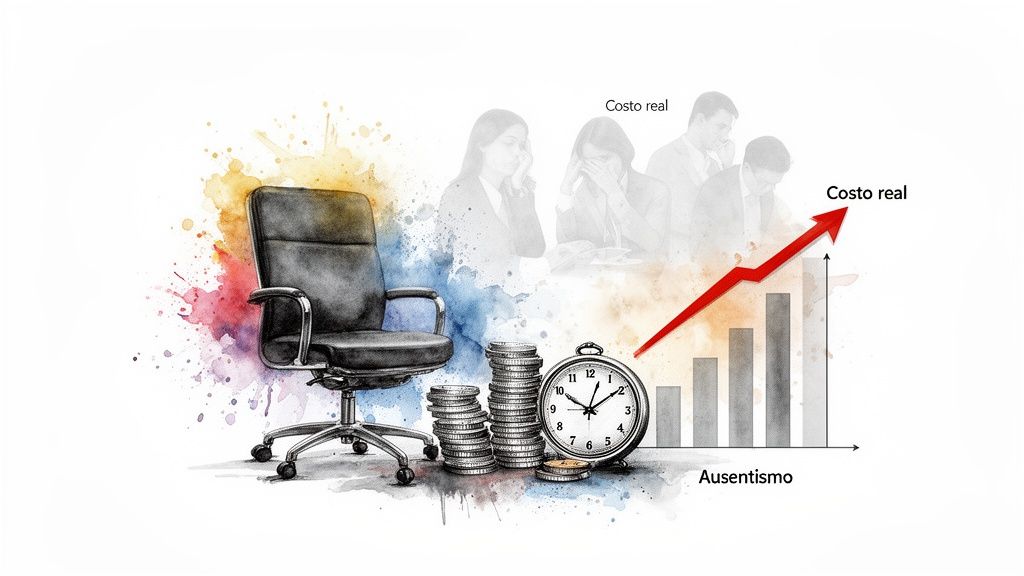
Every day an employee misses due to exhaustion is a direct cost. Every time valuable talent resigns, the company incurs unbudgeted recruiting and training expenses. And every project delayed because the team is fatigued directly hits profitability.
From Personal Distress to Operating Costs
The link between emotional well-being and business results is a straight line. An exhausted team cannot innovate, cannot solve complex problems, and certainly cannot deliver exceptional customer service. The impact quietly accumulates until it reverberates across the entire value chain.
To put the scale of the problem into perspective, one only needs to look at national figures. Workplace stress affects a staggering 75% of Mexican workers, a rate higher than economic powerhouses like China (73%) and the United States (59%).
This issue translates into the IMSS reporting over one million lost workdays in 2023 alone due to anxiety and depressive disorders. If you want to explore further, you can see the details of the impact of workplace stress in Mexico and its effect on health.
Those days aren't just numbers; they represent stalled projects and an extra workload for colleagues who do show up at the office, increasing their own risk of burnout. It's a vicious cycle.
The Metrics That Reveal the Problem (and Justify Your Budget)
To build a solid business case for leadership, translate distress into metrics that everyone at the table understands. Consider these three pillars:
Absenteeism and Presenteeism: It's not just about who's missing. "Presenteeism"—being physically present at work but mentally checked out—can be even more expensive. An exhausted employee makes more mistakes and spreads discouragement.
Staff Turnover: How much does it cost your company to replace a top performer? Add up recruiting costs, interview time, training, and the learning curve. A toxic work environment is one of the main drains on talent and money.
Decline in Productivity: In our experience working with HR teams in Mexico, we have seen that a team under high stress levels can take up to 30% longer to complete key projects. This delay impacts customer satisfaction and competitiveness.
Investing in mental health at the workplace in Mexico is not an expense; it is a risk-mitigation strategy. It's about protecting the company's most valuable asset: its people.
When you present this data, the dialogue changes. You are no longer asking for an "extra perk"; you are proposing a strategic solution to protect profitability and ensure business continuity.
How to Use NOM-035 as Your Strategic Roadmap (and Not Just a Compliance Checklist)
For many in HR, NOM-035 sounds like endless questionnaires and red tape. But what if I told you that this standard is actually the diagnostic tool you need to build a wellness strategy that truly works?
Instead of treating it as just another box to check, see it as your starting point. It provides hard data on where the organization "hurts," allowing you to move from assumptions to strategic actions.
NOM-035 is not designed to be an obstacle, but a guide. Its goal is to help you pinpoint red flags so you can act surgically and effectively.
The Three Pillars of NOM-035 as a Roadmap
The standard is structured into a logical three-step process that, if followed intentionally, transforms company culture. It's not just about rolling out a survey and filing it away, but about listening to what the results are telling you.
1. Risk Identification: You administer surveys to measure psychosocial risk factors. Think of it as taking the organization's temperature.
2. Analysis of Results: Here is where the magic happens. Dissect the data. Which departments show the highest stress spikes? Which teams report work overload or lack of clear leadership?
3. Prevention and Action: Armed with the diagnosis, you design tailored interventions. The standard obligates you to act on the risks, but gives you the freedom to choose how to do it.
Complying with the standard means administering the questionnaires. Using it strategically means taking those results and turning them into an action plan that improves engagement, reduces turnover, and fosters a healthier environment.
This approach lets you move well beyond mere compliance and start driving real impact.
From a Survey to a Business Case
One of the biggest challenges for HR is justifying wellness budgets. This is where NOM-035 data becomes your greatest ally. When you show executive leadership that "the operations department faces a 45% higher risk of burnout than the rest of the company," your request takes on an entirely different weight.
You are no longer asking based on a hunch. You are presenting clear evidence that demonstrates an urgent operational need. The standard's results are the perfect argument for proving the ROI of investing in your people's mental health.
If you want to dive deeper into this regulation, we recommend checking out our complete guide on what NOM-035 is and how to implement it effectively.
Implementing Evidence-Based Actions
Once you have the diagnosis, the actions can be incredibly varied and tailored to what you uncovered. The analysis will allow you to design a program that feels custom-made.
For instance:
If you detect work overload: You could propose digital disconnection policies, review workload distribution, or train leaders on priority management.
If the issue is lack of recognition: You can roll out a peer-to-peer recognition program, improve visibility around accomplishments, or train managers to deliver positive feedback.
If stress levels are high: Initiatives like active breaks, stress management workshops, or tangible services like onsite chair massages can provide immediate, highly appreciated relief.
In our experience, companies that use NOM-035 as a strategic tool achieve profound cultural shifts. They stop putting out fires and begin laying a solid foundation for well-being.
Practical Strategies to Build a Healthy Workplace Environment (That Actually Work in Mexico)
Knowing that mental health is key is only the first step. True transformation starts with action. As an HR leader, your challenge is implementing initiatives that are felt in your teams' everyday routine.
The good news is that not everything requires massive budgets. It's about building a support network that blends actions at the organizational, group, and individual levels.
The Foundation: Organizational-Level Actions
This is where the ground rules are set. These are policies that send a clear message from leadership: "Your well-being matters to us."
Flexibility Policies That Actually Work: This goes beyond remote work. It involves promoting digital disconnection (no more messages at 10 p.m.!), providing space for personal matters, and focusing on results rather than hours spent in a chair.
Transparent and Consistent Communication: Uncertainty is the main fuel for anxiety. Keeping everyone informed about company changes and goals builds trust.
Realistic Workloads: Use NOM-035 assessments to identify bottlenecks. Sitting down with team leaders to reallocate tasks or adjust deadlines is one of the most effective moves to prevent burnout.
And we can't forget the cornerstone of personal well-being: rest. There is a surprising link between sleep and mental health. An employee who doesn't sleep well will hardly be productive.
The Key Role of Leaders: Group-Level Actions
Managers have a direct impact on team climate and mental health. Here, training is everything. It's not about turning them into therapists, but about equipping them with tools to become more empathetic leaders.
In our experience working with HR departments in Mexico, we have seen that a leader trained in emotional management can reduce team turnover by up to 20%. The key is teaching them how to listen, spot warning signs, and foster psychological safety.
A few initiatives that work:
Empathetic Leadership Training: Workshops on how to give constructive feedback and handle difficult conversations without triggering anxiety.
Encouraging Recognition: Implementing peer-to-peer recognition programs or dedicating a few minutes during team meetings to celebrate wins.
Strengthening Cohesion: Promoting activities that build trusting bonds. A close-knit team functions as an internal support network.
The Power of the Individual: Tools for the Person
Finally, it is crucial to give employees resources to take care of themselves. This is where wellness programs and access to professional support come in.
An OCC study revealed that 57% of Mexican workers suffered from stress or anxiety due to burnout in 2023. Among them, 34% report fatigue so severe that it leads them to quit.
This is where tangible, high-impact benefits fit in:
Emotional Support Programs: Offering access to psychological therapy (virtual or in-person) through strategic partnerships.
Workshops and Educational Resources: Providing webinars or guides on stress management, emotional intelligence, or mindfulness.
Physical Wellness Initiatives: Implementing active breaks or solutions that offer immediate, highly valued relief, such as corporate chair massages. These kinds of perks are easy for HR to organize and enjoy exceptionally high perceived value.
Combining these three layers creates a resilient wellness ecosystem. It's not about a single initiative, but a coordinated effort that turns mental health at work in Mexico from a problem into a competitive advantage.
Selecting the right initiatives depends on your company's size and budget. Here is an action plan to help you visualize it.
Corporate Wellness Action Plan for Mexican Companies | |||
|---|---|---|---|
Initiative | Investment Level | Expected Impact | Ideal For |
Mental health webinars | Low | Medium (awareness) | Small and medium-sized businesses |
Recognition program (peer-to-peer) | Low | Medium (work environment) | All types of companies |
Corporate chair massage sessions | Medium | High (immediate stress relief) | Medium and large companies |
Online therapy platform | Medium-High | High (in-depth individual support) | Medium and large companies |
Empathy training for leaders | High | Very high (cultural shift) | Large companies with a long-term vision |
The important thing is to get started. Even a small initiative, if consistent, can be the first step toward building a culture where well-being is a reality.
How to Measure the ROI of Your Wellness Program (and Justify the Budget)
For any HR professional, the phrase "prove the return on investment" is a daily reality. It isn't enough to say that an initiative makes people "feel good"; hard data linked to business objectives is required.
The good news is that measuring the ROI of a mental health program at work in Mexico is completely achievable. The key lies in focusing on the right metrics and translating subjective impressions into quantifiable language.
From Vanity Metrics to Business KPIs
The first step is leaving superficial metrics behind. A "like" on the internal post about a wellness event doesn't pay the bills. To convince leadership, you need to speak their language: costs, savings, and productivity.
Focus on these three needle-moving KPIs:
Reduction in Voluntary Turnover: Calculate how much it costs you to replace an employee. If turnover drops after implementing your program, the savings are direct and tangible.
Decrease in Absenteeism: Track absent days due to illness or stress before and after your initiatives. Every day an employee isn't absent is a day of reclaimed productivity.
Increase in Engagement Scores: Use your climate surveys to measure gains in commitment. A more engaged team is, on average, 21% more profitable.
A Simple Formula to Calculate ROI
You don't need to be a financial expert. A basic formula will help you structure your results clearly:
ROI (%) = [ (Financial Benefit - Cost of Investment) / Cost of Investment ] x 100
Where:
Financial Benefit: Is the sum of the savings you generated (e.g., turnover cost savings + absenteeism reduction savings).
Cost of Investment: Is the total amount spent on the program (e.g., cost of workshops + investment in corporate massages).
Presenting this calculation turns your wellness program from a perceived "expense" into an intelligent investment that delivers measurable returns.
How to Present Your Results to Truly Convince Leadership
How you communicate your achievements is just as important as the achievements themselves. Build a narrative that connects the dots between investing in well-being and the company's financial health.
For example: "We invested $X in a chair massage and workshop program. As a result, voluntary turnover in the IT department dropped by 15%, saving us an estimated $Y in recruitment costs. The ROI on this pilot initiative was 120% in just six months."
In our experience, direct satisfaction data also serves as a powerful complement. At Zen to Go, for example, we measure the impact of our programs and found that 99% of employees feel the company values their well-being after participating. This type of qualitative data puts a face to your results and demonstrates the impact on emotional salary.
If you're interested in seeing how these strategies apply to high-pressure environments, you can read about corporate wellness in the Fintech sector, where ROI is crucial.
Ultimately, measuring ROI is not just about justifying a budget. It's about demonstrating HR's strategic value in building a more resilient and productive enterprise.
HR Frequently Asked Questions About Mental Health (and Direct Answers)
As your partners, we know that managing mental health in the workplace in Mexico raises very specific questions. Here are the ones we hear most often from HR teams, answered practically.
How do I convince leadership to invest if budgets are already tight?
Reframe the conversation. Don't talk about the "cost of wellness," but rather the "cost of doing nothing." Use your own data: calculate what voluntary turnover cost the company over the last quarter. Propose a low-cost, high-impact pilot, such as an onsite chair massage day. Measure satisfaction and present the results. That way, you're not asking—you're demonstrating: you present a controlled investment to reduce much larger costs.
Does complying with NOM-035 mean I'm fully covered?
No, NOM-035 is the map, not the destination. It's a fantastic diagnostic tool that highlights where the red flags are. Complying with the standard is barely the first step. True progress comes from the actions you take based on that diagnosis: training leaders, balancing workloads, and rolling out wellness programs.
Which wellness benefits do employees in Mexico value most today?
Today, employees value genuine flexibility, authentic recognition, and tangible benefits that improve their day-to-day lives. More than standard statutory benefits, they seek an emotional salary that feels authentic.
In our experience, initiatives that break up the routine and demonstrate genuine care have an outsized impact. Activities like active breaks or onsite corporate massages are deeply appreciated because they offer immediate stress relief and send a clear message: "You matter to us as a person, not just as an employee."
At Zen to Go, we understand that your role is to balance the well-being of your people with business objectives. That's why we provide flexible, high-impact corporate wellness solutions designed to make your job easier while demonstrating real care for your teams. Discover how we can be your partner in building a healthier workplace culture.