The importance of self-care for successful teams: a guide for companies
Self-care is much more than just taking a break. It is an intentional and conscious practice to care for our physical, mental, and emotional well-being. For companies, it represents a key strategy for building resilient, engaged, and productive teams, transforming the work environment into a space of mutual support and sustainable growth.
What is self-care and why is it key in your company?
Far from being a luxury or an indulgence, self-care is a set of deliberate actions that each person takes to maintain and improve their holistic health. Think of it like preventive maintenance for an engine: if you don't give it regular attention, sooner or later it will stop working, affecting the entire system. In a company, every employee is an essential part of that engine.
The importance of self-care in the workplace lies in its ability to equip employees with the tools needed to manage stress, prevent burnout, and maintain a high level of focus. It's not about grand gestures, but about small daily practices that add up to a big impact.
The true value of self-care is that it turns individuals into active agents of their own well-being, translating into greater autonomy, responsibility, and personal and professional resilience.
The shift in perception in Mexico
The conversation around wellness has evolved. In Mexico, self-care is no longer seen as a superficial practice, but as a pillar of health. In fact, according to the 'A New View of Care' study, 68% of Mexicans confirm that their self-care routine actively improves their mental health and well-being. You can learn more details about this shift in mindset in this report on self-care in Mexico.
This data highlights a reality that companies cannot ignore: employees are actively seeking ways to take care of themselves and expect their workplace to support those efforts. By doing so, organizations are not just addressing a need; they are investing directly in their most valuable asset: their people.
Encouraging these practices is an essential component of what we now understand as comprehensive occupational health, an approach that protects and promotes the overall well-being of the worker.
Beyond common myths
To implement a wellness culture, you first need to debunk several misconceptions that continue to hold many companies back. Often, these myths sound logical on the surface, but in practice, they are barriers that hinder growth and sustainability.
Here is a table contrasting the most common perceptions with the strategic reality experienced by organizations that do invest in their people.
Myths and realities of corporate self-care
Common Myth | Strategic Reality |
|---|---|
"Self-care is selfish and personal; it's none of the company's business." | An employee who takes care of themselves is more collaborative, innovative, and better supports their team. It is an act of collective responsibility. |
"Implementing it takes too much time and is very expensive." | Practices such as 5-minute active breaks, breathing exercises, or a 15-minute chair massage have a huge impact and are easy to integrate. |
"It is only for severe issues with stress or burnout." | Self-care is, above all, preventive. Its goal is to maintain balance so that serious issues don't even arise. |
"It's a passing fad, just another perk." | It is a cornerstone of modern occupational health. Companies that ignore it risk higher turnover and lower productivity. |
Understanding its true meaning is the first step toward building a culture where well-being and performance not only coexist, but drive each other forward. It means shifting from seeing care as an expense to seeing it as the smartest investment a company can make.
The four pillars of self-care that transform your office
For the importance of self-care to be reflected in tangible results, isolated actions are not enough. A holistic approach that views the employee as a whole person is required. Think of it like constructing a building: for it to be stable and resilient, it needs solid foundations in several areas, not just one.
In corporate wellness, those foundations are the four pillars of self-care. By addressing each one, we create a robust support structure that not only prevents burnout, but also cultivates a genuinely healthy and productive work environment.
1. Physical self-care
This is the most obvious pillar and, paradoxically, the most neglected in the office routine. It is about addressing the body's needs to maintain energy, prevent injuries, and, above all, reduce the tension that builds up after hours of sedentary work.
Incorporating it is much simpler than it seems. You don't need a gym in the office; it's about integrating movement and body awareness into the workday.
Active breaks and stretches: Encouraging short 5-minute breaks every hour to stretch the neck, back, and legs can make the difference between muscle stiffness and a productive day.
Conscious ergonomics: Making sure chairs, desks, and monitors are properly adjusted is not a minor detail. It reduces eye fatigue and muscle aches that undermine concentration.
Hydration and nutrition: Providing access to water and offering healthy snack options helps keep energy levels stable, avoiding the sugar spikes and crashes that hurt performance.
2. Emotional and mental self-care
These two pillars are closely linked. Emotional self-care involves recognizing and managing our emotions in a healthy way, while mental self-care focuses on stimulating the mind and, crucially, protecting it from information overload.
In a non-stop work environment, making space for mental calm is not a luxury; it is a strategic necessity to maintain clarity, creativity, and good decision-making skills.
To strengthen these pillars, companies can take very concrete actions:
Promote digital disconnection: Establish clear policies that discourage sending emails or messages outside of working hours. This helps the team truly rest and recharge their batteries.
Offer quiet spaces: A small, calm corner to meditate or simply take deep breaths for a few minutes can be an invaluable sanctuary from daily stress.
Implement corporate massages: Services such as Shiatsu chair massage or desk massage are powerful tools. In just 15 minutes, they achieve a significant reduction in stress, as confirmed by our client satisfaction surveys, where 79% of employees report feeling better after a session.
This concept map makes it very clear: self-care is a direct investment in your team's resilience and engagement.
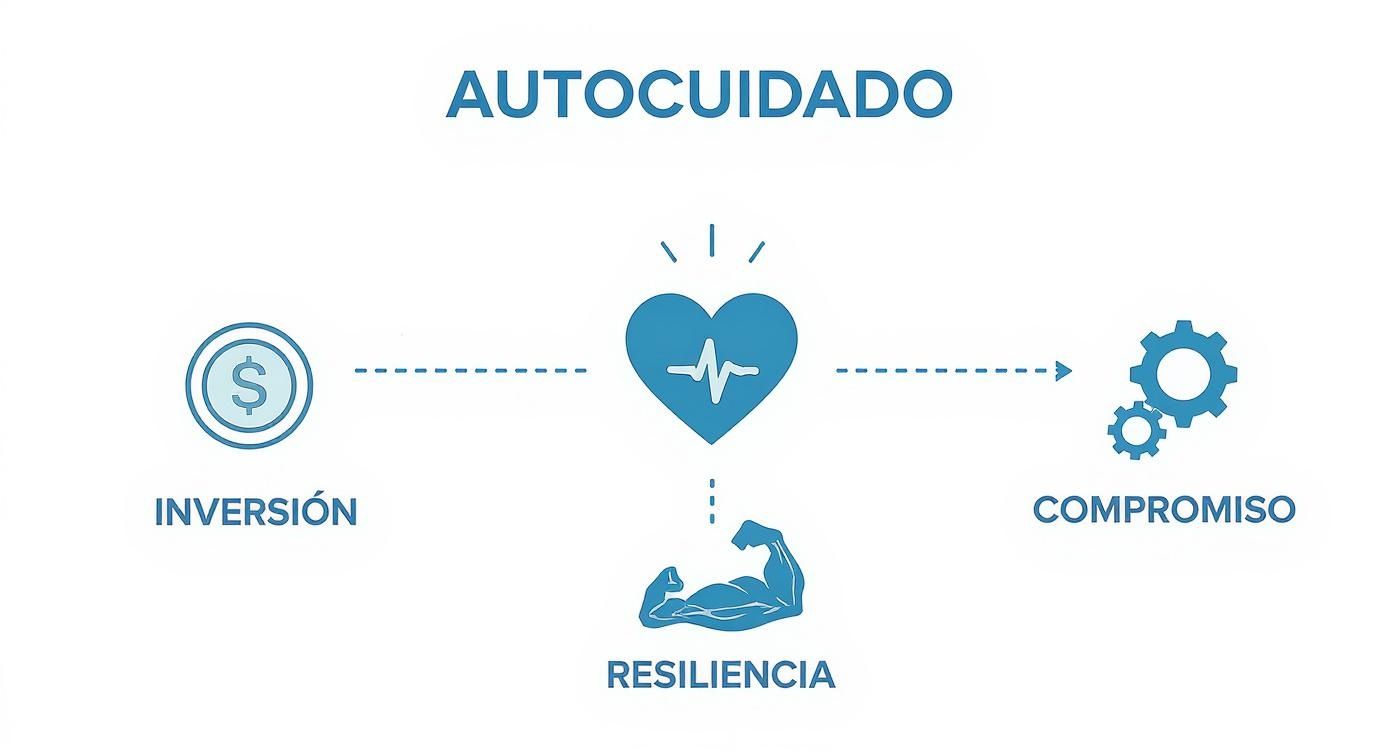
The visual demonstrates that these practices are not an expense, but the engine driving the strength and dedication of your talent.
3. Social self-care
Finally, there is the social pillar, which refers to the quality of our connections. We are social beings by nature, and a work environment with positive, supportive relationships is fundamental to well-being. Fostering camaraderie and mutual respect creates an essential emotional safety net.
You can cultivate it through:
Team-building activities: Organize informal events where teams can interact beyond work tasks. That's where trust is strengthened.
Open communication: Create safe channels for employees to voice their ideas and concerns without fear of retaliation. A team that feels heard is an engaged team.
Addressing these four pillars is the answer for anyone asking what it takes to achieve holistic well-being in their organization. A program that balances them not only improves individual health, but completely transforms the company culture.
How to overcome self-care barriers at work
Understanding that self-care is important is the first step, but putting it into practice clashes with the reality of Mexican work culture. We know this because, like you, we have seen leaders face very specific barriers: the perception that "there's no time" or that "always-on" culture that ends up glorifying exhaustion.
And no, these barriers are not harmless. They act as a handbrake on productivity and team morale.
When employees feel they cannot disconnect or that asking for a break is a sign of weakness, burnout stops being a risk and becomes a certainty. Leading the change means confronting these mindsets head-on.
Exhaustion as the main obstacle
In Mexico, fatigue is a decisive factor. Recent studies show something interesting: although interest in wellness is on the rise, the barriers to achieving it are enormous. The main one is exhaustion.
More than 70% of the population reports feeling stressed frequently, and half identify fatigue as the biggest obstacle to maintaining any wellness routine. Additionally, there is a key fact: two out of three Mexicans trust specialists and want to understand the science behind the recommendations they receive. You can read more about these self-care findings in Mexico to better understand the landscape.
This data tells us that solutions must not only be effective, but also efficient and backed by trust. It's not about adding more tasks to an overcrowded schedule, but about integrating wellness smartly.
Practical strategies for real change
Overcoming these barriers requires a proactive and empathetic approach from the company. It's not about giving a speech, but about implementing policies and providing tools that show a genuine commitment to the team.
Here are some strategies we've seen work in companies of all sizes:
Normalize conversations about mental health. Create safe spaces to talk about stress and well-being without it being a taboo. A leader who shares their own experience on how they manage stress inspires their entire team to do the same.
Promote true disconnection. This goes beyond simple advice. It means establishing clear policies regarding the right to disconnect, such as recommending not sending emails outside of working hours or setting up automated replies encouraging recipients to wait until the next business day.
Provide accessible and reliable resources. Offer wellness solutions that integrate easily into the workday, such as our Shiatsu chair or desk massages. These 15-minute breaks are highly valued, do not disrupt workflow, and deliver immediate, tangible relief.
For leaders, it is essential to learn how to reduce workplace stress, not only for themselves, but to be able to lead their teams by example.
Implementing self-care isn't about taking hours away from work; it's about restoring quality to the hours invested. It's a strategy for teams to work better, not more.
Leading this transformation not only positions the company as an attractive place to work, but as an organization that genuinely cares for the most valuable asset it has: its people.
The measurable benefits of investing in your team's well-being
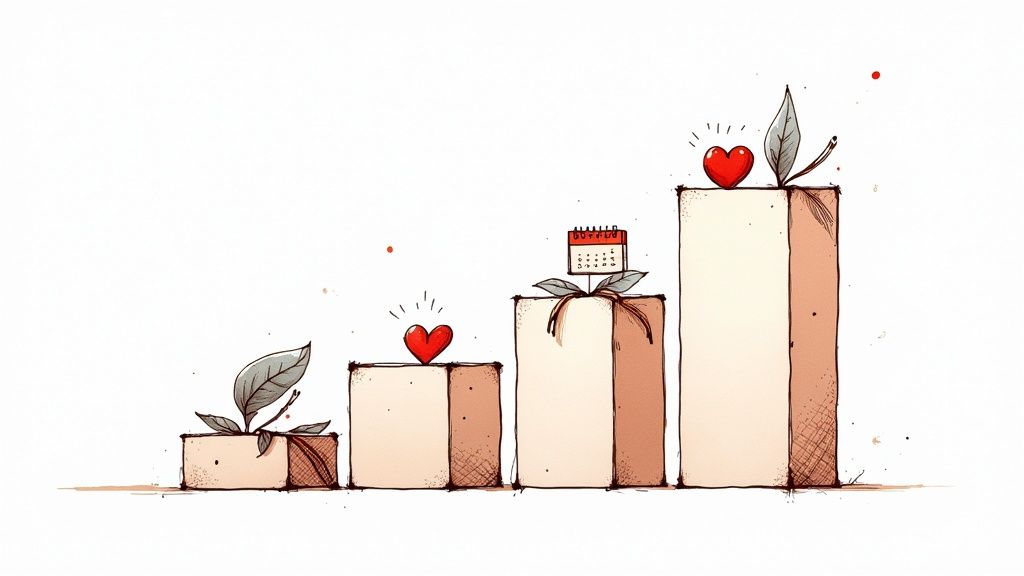
Talking about the importance of self-care is great, but as a leader, you need to see how it impacts your bottom line. Well-being is not an airy concept; it is an investment with a clear and measurable return that strengthens your company's financial and operational health.
When a team feels cared for, the ripple effect is undeniable. The energy and focus each person brings to their daily tasks multiply, creating a high-performance environment. Far from being an expense, every wellness initiative is a lever for growth.
Direct impact on your company's KPIs
Implementing concrete self-care actions translates into tangible improvements in the metrics that matter most to you. It's not just about having happier employees, but about building a more resilient, agile, and efficient organization.
Reduced absenteeism: Employees with high stress levels tend to get sick more often. Programs that help manage physical and mental tension decrease these unplanned absences, ensuring operations run smoothly.
Increased productivity: A well-rested team with a clear mind performs at its best. Self-care improves concentration and the ability to solve complex problems, directly impacting the quality and speed of work.
Better talent retention: In a competitive market, salary is no longer everything. An environment that prioritizes well-being becomes a key differentiator, reducing the high costs associated with employee turnover.
A stronger employer brand: A company known for taking care of its people naturally attracts top talent. This not only makes recruiting easier, but also positions your organization as an industry benchmark.
The following chart summarizes how wellness actions connect directly to business results.
Impact of self-care on business indicators
Self-Care Initiative | Direct Business Impact | Key Metric Affected |
|---|---|---|
Active breaks with massage | Reduction of physical stress | Absenteeism rate, fatigue reports |
Mindfulness programs | Improved focus and concentration | Project turnaround times, work quality |
Flexible scheduling | Increased commitment and loyalty | Talent retention rate, eNPS |
Stress management workshops | Strengthened resilience | Productivity per employee, workplace climate |
As you can see, each action has a direct, measurable consequence, demonstrating that well-being is a smart business strategy.
The evidence of well-being in action
At Zen to Go, we measure the impact of our programs, and the results are undeniable. Based on our bi-annual satisfaction surveys with corporate clients, the data speaks for itself.
A total of 79% of employees report a reduction in stress after participating in our massage programs. Furthermore, an incredible 99% feel the company values their well-being, and 95% would actively recommend the program to other companies.
This data confirms that a well-structured corporate wellness program not only lightens the load, but also strengthens team loyalty and engagement. The investment pays off with a more motivated staff and a solid culture, demonstrating time and again the true importance of self-care.
How to implement an effective self-care plan that people will love
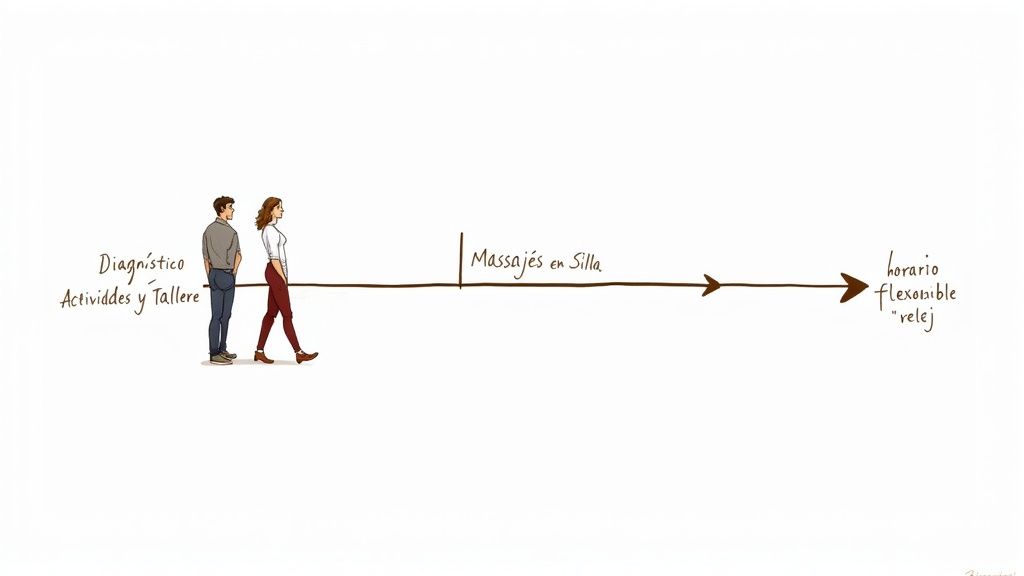
We've already established the benefits. Now it's time to move from theory to action, which is where many good intentions fall short.
Implementing a self-care plan is not about imposing activities, but about co-creating a strategy that resonates with what your team truly needs. A successful program feels like genuine support, not just another task on the to-do list.
The first and most important step is to listen. Before launching any initiative, you need an assessment to understand what's challenging your team. Anonymous surveys, group conversations, or suggestion boxes are simple yet powerful tools to identify stress triggers and find out what kind of wellness support they prefer.
This assessment will allow you to design a tailored plan, avoiding generic solutions. Understanding their needs is key to effective psychosocial risk prevention and ensuring every dollar invested yields a real return.
Designing a high-impact program
Armed with data, the next step is to choose activities that people value and that can be seamlessly integrated into the workflow. The key lies not in quantity, but in quality and ease of access.
Activities that work in the Mexican corporate environment:
Office massages: This is one of the most effective and highly valued solutions. Options like Shiatsu Chair massages or Desk massages are ideal because they require little space, don't interrupt workflow, and offer immediate results for reducing stress and muscle tension.
Workshops on emotional management and mindfulness: Giving people practical tools to handle everyday stress is an act of empowerment. Short sessions on breathing techniques, concentration, or emotional intelligence have a lasting effect.
Flexibility and disconnection policies: Encouraging a true balance between personal and professional life is one of the most powerful forms of self-care. Flexible hours, remote work options, and clear boundaries regarding the right to disconnect demonstrate a commitment that goes beyond talk.
Flexibility is a key pillar. At Zen to Go, we understand that every company is unique. That's why we tailor our services to accommodate everything from startups to large corporations with offices across various cities like Mexico City, Monterrey, and Guadalajara, handling all the logistics so you can focus entirely on your team's well-being.
Communication and leadership are key
You can have the best self-care plan in the world, but if leaders don't visibly champion it and you don't communicate it effectively, it will stay on paper.
Self-care isn't decreed; it's modeled. When leaders actively participate in initiatives and talk openly about the importance of caring for physical and mental health, they send a powerful message to the entire organization.
Strategies to ensure program adoption:
Clear and consistent communication: Announce initiatives ahead of time, explain why they matter, and share testimonials. Use all your channels: emails, posters, team meetings.
Participatory leadership: Invite managers and directors to be the first to sign up for a workshop or get a massage. Their example is the best promotion you can have.
Simple access: Make participating effortlessly easy. With our platform, for example, scheduling and registration are handled online, with automated SMS reminders so no one misses their session.
Implementing an effective self-care plan is an ongoing journey of listening, adapting, and committing. By doing so, you not only improve your people's health, but you also build an organizational culture that is stronger, more human, and prepared for the future.
The future of work is your team's well-being
The rules of the workplace game have changed. Today's top talent isn't just looking for a good paycheck; they want a workplace that values their well-being as individuals. The importance of self-care has shifted from being a simple perk to becoming a strategic pillar if you want to attract, retain, and empower top teams.
The companies that will lead tomorrow are those that understand that personal satisfaction and professional success are not two separate paths—they are fully connected. Supporting your employees in their well-being is the foundation for building an organization that is resilient, innovative, and above all, more human.
Sustainability through well-being
Investing in your team's well-being is not a trend; it is a core element of modern business culture. This investment translates into sustainable growth that goes far beyond quarterly numbers, creating a legacy of genuine loyalty and commitment.
Self-care is no longer optional. It is the key differentiator in a market competing for top talent. It is the clearest proof that a company doesn't just care about its bottom line, but about the people who make it possible.
And the data backs this up. According to recent figures from INEGI, the adult population in Mexico reports a life satisfaction level of 8.6 out of 10, placing special value on the freedom to make decisions about their own lives. This includes choosing self-care routines, and companies that make this path easier align themselves with a national priority. If you want to delve deeper, you can explore more about well-being in Mexico and its indicators.
Fostering a culture of self-care is undoubtedly the surest path toward a future where both people and the organization can thrive together. It is a direct investment in your people, your brand, and your long-term success.
Frequently asked questions about self-care at work
Here, we answer the questions that often come up among business leaders when considering the implementation of wellness programs. Our goal is to provide clear, direct answers to make your decision much easier.
How do I justify investing in a self-care program to leadership?
Speak their language: focus on return on investment (ROI). Don't present self-care as an expense, but as a business strategy that reduces absenteeism, boosts productivity, and, above all, improves talent retention.
You can use data like ours: 99% of employees who receive corporate massages feel that the company genuinely cares about them. That sentiment translates directly into loyalty and engagement—metrics every executive values.
My team says they "don't have time" for these activities. What should I do?
That's the most common objection, and the answer is simple: wellness isn't tacked on at the end of the day like another chore; it's integrated into the workday.
The key lies in efficient solutions that don't interrupt workflow. Think of our Desk massages, which allow employees to relax without leaving their workspace, or our 15-minute Shiatsu Chair massages. Promote these "micro-breaks" for what they truly are: a tool to recharge and work better, not a waste of time.
Which wellness activities make the biggest impact on a limited budget?
You don't need a fortune to start seeing results. Sometimes, the simplest approaches are the most powerful.
Practical workshops on stress management or mindfulness sessions have a big impact at a manageable cost. Chair massages, meanwhile, offer an excellent cost-benefit ratio because people immediately feel their value, and the results are tangible. Our programs are flexible: we can adapt the frequency and service type to your budget to ensure there is always a positive impact.
At Zen to Go, we are your partners in transforming well-being at your company. Since 2019, we have helped companies of all sizes build healthier, more productive cultures. Discover how our customized programs can give your team the energy it needs to thrive.
Visit us and request a no-obligation quote at https://www.zentogo.com.mx.