How to motivate the work team effectively and sustainably
Knowing how to motivate your work team goes far beyond handing out a year-end bonus. It is about creating an environment where the enthusiasm and engagement of each individual drive results day in and day out. In the end, as our experience has shown, a motivated team is any organization's most valuable strategic asset.
Why Motivating Your Team Today Is Vital
In the day-to-day of Mexican companies, maintaining high levels of motivation is no longer an optional "extra," but the true growth engine. When morale drops, productivity stagnates and, even worse, organizational culture begins to weaken.
Since 2019, at Zen to Go we have supported hundreds of teams, from startups to large corporations, and we have identified a clear pattern: demotivation stifles innovation and skyrockets turnover. It is increasingly urgent for leaders and HR teams to ask themselves how they are caring for employee engagement.
The Current Landscape of Motivation in Mexico
The statistics speak for themselves. According to a recent study, only 54% of Mexican workers report being satisfied with their current job. That leaves nearly half of the workforce with some degree of dissatisfaction—a perfect breeding ground for talent drain and low morale.
You can explore this scenario further in the report on job satisfaction in Mexico.
This data confirms what we see in the field: strategies focused solely on financial incentives are no longer enough. A more human, holistic approach is needed—one that addresses the emotional and developmental needs of each individual.
Beyond Productivity
A lack of motivation does not just harm financial metrics. Its consequences directly impact the day-to-day life of the organization:
Key talent drain: The most valuable contributors are often the first to seek new opportunities when they feel the company is not investing in them.
Tense work environment: An atmosphere steeped in discouragement sparks conflicts, blocks communication, and undermines creativity.
Deterioration of the employer brand: High turnover and dissatisfied employees damage the company's reputation, making it harder to attract new talent.
“A demotivated team doesn't just stop rowing; without realizing it, they might be punching holes in the boat. Investing in their well-being and motivation is the best way to ensure everyone rows in the same direction with energy.”
Before assigning blame, it helps to recognize that well-being and motivation are a shared responsibility. Improving the work environment is not a luxury, but a smart business strategy. For practical, actionable ideas, check out our guide on how to improve the work environment.
Building an Environment of Trust and Mutual Support
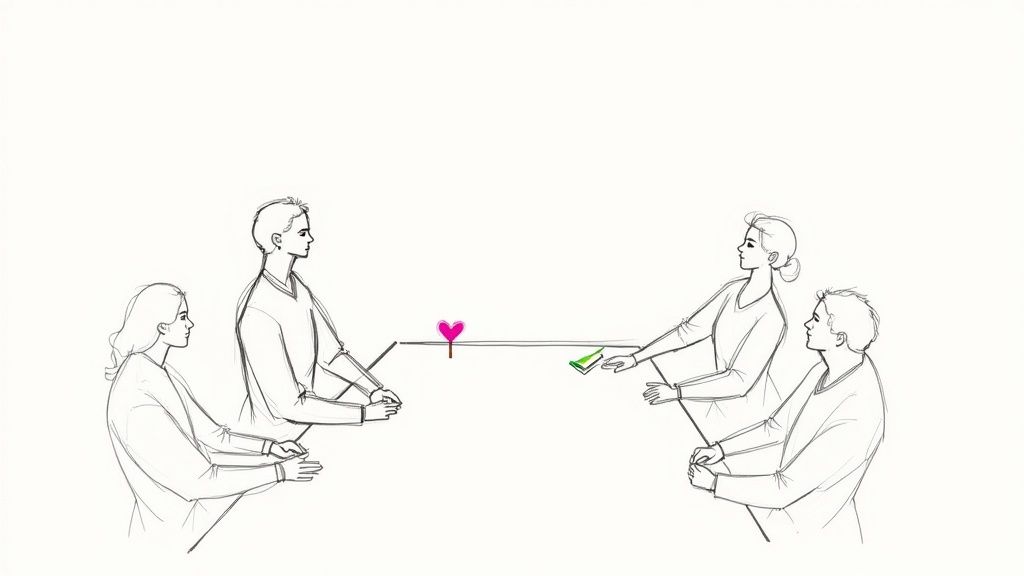
The foundation of a genuinely motivated team does not lie in year-end bonuses, but in something far more human: the quality of daily relationships. An environment where each person feels safe, valued, and, above all, heard is the fertile ground where motivation flourishes naturally.
When trust is the currency in the office, people aren't afraid to propose ideas, admit mistakes, or ask for help. This psychological safety is key. A team that trusts is a team that collaborates wholeheartedly, focused on finding solutions rather than pointing fingers.
Communication as the Pillar of Trust
Fostering open and honest dialogue is the first step, but it is not just about holding informational meetings. The key is creating channels where communication flows both ways, which means leaders must be as good at listening as they are at speaking.
From our experience with diverse companies, we have seen that transparency in decision-making—even the hardest calls—strengthens bonds like few other things. Communicating the "why" behind a strategy shift creates a sense of belonging and respect that money cannot buy.
Implementing a culture of continuous feedback is also essential. When feedback is delivered constructively and regularly, it stops being that awkward moment and becomes a tool for growth, both personally and for the entire team.
The Power of Genuine Recognition
Acknowledging great work goes far beyond a generic "congratulations to all" email. Recognition that truly makes an impact is specific, timely, and personal. Celebrating day-to-day small wins has a much deeper and longer-lasting effect than a single grand prize at the end of the year.
Here are a few practical ideas that we have seen work wonders:
Specific, public praise: During team meetings, take a minute to spotlight someone who did great work, explaining exactly what they did and why it was valuable.
Personal notes: A simple handwritten message or a direct chat message recognizing an effort can mean far more than formal recognition.
Milestone celebrations: Don't wait until the project ends. Celebrate significant progress, such as hitting a weekly goal or solving a complex problem.
These actions, though simple, send a clear message: "We see your effort and we truly value it".
Pillars of a Motivating Work Environment
To build an environment that is not only productive, but also healthy and motivating, it helps to focus on strategic pillars. This table summarizes key actions, their impact, and practical examples you can start implementing today.
Strategic Pillar | Direct Impact on Motivation | Practical Example |
|---|---|---|
Transparent Communication | Increases a sense of belonging and reduces uncertainty. | Monthly "Ask Me Anything" sessions with leadership. |
Consistent Recognition | Reinforces desired behaviors and validates individual effort. | Creating a dedicated Slack or Teams channel for peer-to-peer shoutouts. |
Psychological Safety | Fosters innovation and honest problem-solving. | Running "blameless retrospectives" after every project to learn from mistakes. |
Comprehensive Wellness Support | Lowers stress and shows the company cares about the individual as a person. | Offering mental health days or in-office chair massage programs. |
Integrating these pillars is an ongoing process, but every small action adds up to build a strong culture where people want to be and give their best.
Fostering an atmosphere of mutual support is also critical for the prevention of psychosocial risks—an issue we can no longer afford to overlook. If you want to dive deeper into how to protect your team, you can read our article on strategies for the prevention of psychosocial risks at work.
Boost the Professional Growth of Your People
An employee who feels their career is advancing is an employee who stays, commits, and innovates. Investing in your team's professional development is one of the smartest strategies for retaining talent, because the message is clear: “we believe in you and we want you to grow with us.”
Yet this goes beyond paying for a couple of courses. It is about being a true partner in people's careers, helping them build a purpose-driven path within the organization. It means sitting down to talk about their aspirations and mapping out challenging yet achievable development goals together.
Far Beyond Traditional Training
True growth happens when you blend theoretical learning with everyday practice. If you genuinely want to empower your team, you need to diversify development opportunities.
Some of the initiatives we have seen work brilliantly in the companies we partner with include:
Internal mentorship programs: Pairing new employees with experienced leaders or peers is pure gold. It builds trust-based connections and accelerates learning for the soft skills no manual can teach.
Strategic delegation of responsibilities: Assigning stretch projects that push people out of their comfort zones—while granting them autonomy to make decisions—is a display of trust that empowers and motivates.
Role rotation: Allowing employees to gain experience in other areas of the company broadens their business perspective and helps them uncover talents they didn't even know they had.
The Role of Soft Skills and Well-Being
A technical expert who is burned out or struggles to communicate cannot perform at even half their potential. That's why professional development today must be comprehensive. It needs to encompass technical competencies alongside soft skills and, naturally, tools to protect well-being.
Investing in your team's resilience, assertive communication, or stress management is not an expense. It is a direct investment in your company's ability to navigate uncertainty. A balanced team is a more creative, collaborative, and, ultimately, more loyal team.
Newer generations, in particular, will not compromise on this. They value an environment that prioritizes their mental health and personal development. To better understand these new rules of engagement, we recommend reading about the Gen Z demands your company should adopt.
Because in the end, showing a genuine interest in each person's holistic growth is one of the most compelling answers to the question of how to motivate your work team over the long haul.
Wellness as a Strategic Motivational Tool
Well-being is no longer just another perk; it has evolved into one of the most powerful tools for motivating a work team. It is no longer about checking compliance boxes, but about sending a clear, direct message to every team member: "you matter to us as a person, not just as an employee."
Implementing corporate wellness initiatives directly impacts the team's energy, morale, and resilience. Taking a pause to recharge isn't wasted time; it is a strategic investment in the team's capacity to tackle challenges with a better attitude and a clearer mind.
A Message You Can Feel in Your Body
When a company chooses to bring wellness into the office, it expresses appreciation in a way that can be felt—literally. Activities like corporate massage offer a restorative experience that breaks the monotony and relieves the physical tension accumulated from long hours in front of screens.
We have witnessed firsthand how a Shiatsu Chair or even an At-Desk massage session can transform an office atmosphere within minutes. It isn't just muscular relaxation; it's a caring gesture that reignites engagement. According to our satisfaction surveys, 95% of employees feel their company truly values their well-being when provided with this type of benefit.
Tailoring Wellness for Newer Generations
Focusing on well-being is especially critical for attracting and retaining younger talent. Generation Z in Mexico, for instance, places immense value on work-life balance, and its absence is one of the primary drivers of demotivation.
These young professionals, who will soon make up a third of the workforce, aren't looking for offices with foosball tables, but for flexible policies and a genuine commitment to their holistic health. You can read more about how workplace expectations are evolving and their impact on happiness at work.
How to Implement an Effective Wellness Program
Designing a wellness program doesn't have to be complicated. The key is starting with actionable initiatives and measuring their impact.
In our experience, flexibility is vital, especially for companies with hybrid teams or offices spread across cities like Mexico City, Monterrey, or Guadalajara. Solutions like Shiatsu Chair or At-Desk massages adapt seamlessly to any space or workplace dynamic without disrupting operations, as our certified therapists travel directly to your facilities.
A well-designed program doesn't just reduce stress (up to 83% based on our data); it strengthens corporate culture. If you want to know how to take the first steps, we invite you to explore our comprehensive guide on how to design corporate wellness programs that genuinely work.
From planning and internal communication to tracking outcomes, a strategic approach ensures that every wellness initiative translates into a more connected, healthy, and, of course, motivated team.
Leading by Example to Inspire Your Team
Team motivation is, to a large extent, a direct reflection of leadership. A manager who only barks orders from behind a desk will rarely inspire genuine commitment.
In contrast, a leader who gets involved, listens actively, and demonstrates the values they preach through action becomes a natural source of inspiration. This is not about having all the answers. On the contrary, it requires showing vulnerability, acknowledging missteps, and asking for help when needed. That authenticity builds an environment of psychological safety where team members feel comfortable taking calculated risks and driving innovation.
Empowering to Motivate
A motivated team is one that feels ownership over its work. The leader's role is not to micromanage every task, but to empower contributors, giving them the autonomy and trust to make decisions and take pride in their projects.
Strategically delegating responsibilities is one of the most effective tactics for motivating your work team. By doing so, you not only lighten your own workload, but you also convey a powerful message: "I trust your judgment and your ability to figure this out." This inspires a sense of accountability and pride that financial incentives can rarely match.
"A great leader is not someone who creates followers, but someone who develops more leaders. Their true job is to remove roadblocks and create the conditions for their team to shine."
This perspective shifts the traditional hierarchical dynamic. The leader evolves from a supervisor into a facilitator—someone whose primary mission is to ensure their people have everything they need to succeed. If you're interested in exploring how new generations are redefining leadership, we recommend reading our article on the future of leadership and Gen Z.
Fairness as a Catalyst for Collective Motivation
Inspiring leadership must also be fair leadership. It is critical that every team member, regardless of their role or tenure, feels valued and sees that opportunities and recognition are distributed equitably.
Yet equity goes beyond treating everyone the same; it means understanding individual needs to offer tailored support.
In Mexico, for example, tackling the gender gap in labor participation is both a pressing challenge and a tremendous opportunity. Data from the Labor Market Observatory shows that male participation stands at 74.8%, compared to just 45.3% for women. You can learn more about this topic in their labor market analysis.
Implementing flexible policies and fostering a genuinely inclusive environment isn't just the right thing to do; it unlocks the full potential of your talent, strengthening the team as a whole. Ultimately, human-centric, empathetic, and equitable leadership is the most powerful engine for building lasting motivation.
Frequently Asked Questions About Motivating Your Team
When working closely with business leaders and HR managers, the same questions constantly arise: how can we keep engagement alive day in and day out? Here are clear, straightforward answers based on what we've learned supporting companies across Mexico.
Why does incorporating wellness programs strengthen engagement?
Because they demonstrate through tangible actions that the company cares about its people. When an employee receives an in-office chair massage, they don't just unwind—they feel valued. According to our surveys, 95% of employees feel their company genuinely cares about their well-being through these programs, which deepens loyalty.How often should office massages be offered?
It depends on your goals and budget, but consistency is key. For lasting impact, we recommend starting on a biweekly or monthly basis. This embeds the benefit into the company culture rather than keeping it as a one-off event. The Shiatsu Chair format is ideal for this, as it requires minimal space and is highly versatile.How do you measure the real impact of these initiatives on productivity?
Beyond productivity—which can be hard to isolate—we recommend tracking indicators such as stress reduction and morale improvements. Our internal survey data shows an 83% reduction in stress and a 75% improvement in mood following sessions. These are tangible outcomes that directly influence workplace climate and employee engagement.
Strategies for Maintaining Long-Term Momentum
To make sure motivation isn't fleeting, it is vital to embed these actions into a continuous strategy.
Schedule recurring sessions: Our platform streamlines booking and attendee registration, complete with automated SMS reminders for your staff.
Communicate results: Share satisfaction and wellness data transparently. Seeing the positive impact motivates both leadership and employees.
Adapt and listen: Use ongoing feedback to fine-tune session frequency or experiment with new initiatives. Every company is unique, and what works for one may need adjustments for another.
Motivating a work team is a marathon, not a sprint. It is about nurturing a culture of care and recognition that can be felt every single day.
At Zen to Go, we are here to help you design a wellness program that aligns with your goals and transforms your team's culture. Taking the first step toward a healthier, more motivated team is easier than you think.