How to Create a Workplace Wellness Program: Practical Guide for HR in Mexico
For a workplace wellness program to truly work, the first step is to conduct an honest, thorough diagnosis of what your people actually need. Before launching any initiative, the key is to listen and analyze the data you already have. As HR professionals, we know that this is how you build a strategy that drives real impact, rather than just an isolated calendar of activities.
The First Step to a Successful Wellness Program: The Diagnosis
As HR leaders, we know what it's like to struggle to justify investments that don't have an immediate financial return. Pitching a wellness proposal without a solid diagnosis is like asking for a travel budget without saying where you're going; it's a vague idea that will hardly get executive sign-off.
But the conversation completely changes when you arrive with concrete data in hand.
You are no longer asking for an "expense"; you are proposing a strategic solution to problems that the business genuinely cares about: key employee turnover, unplanned absenteeism, or a drop in team productivity. This approach positions you as an ally who understands business metrics.
The Goldmine You Already Have in HR
You don't need ultra-expensive tools to get started. Chances are, the most valuable information about your people's well-being already lives in your own systems and reports. The trick is knowing how to connect the dots.
Climate or engagement surveys: Don't just settle for the final overall number. Filter the results by department, tenure, and role. Is the sales team reporting significantly higher stress levels than others? Do new hires feel disconnected from the culture?
Absenteeism and turnover data: Look for patterns. Are there absence spikes during certain months? Are resignations concentrated in a single department? Those are red flags for burnout or leadership that needs urgent support.
Exit interviews: These are a brutally honest source of information. Ask point-blank what could have improved their experience. Often, the answers point to a lack of balance, recognition, or well-being support.
NOM-035 compliance: Psychosocial risk factor questionnaires and assessments are an excellent guide. They tell you precisely where workload issues, lack of control, or even workplace violence exist.
In our experience working with HR teams in Mexico since 2019, we have seen how simply cross-referencing climate survey data with quarterly turnover numbers can uncover a silent crisis in an area that, on paper, appeared to be meeting its goals. If you want to better understand how these pieces fit into a comprehensive strategy, you can explore more about what workplace wellness is and why it is a smart investment.
This diagnostic process essentially follows three fundamental steps.
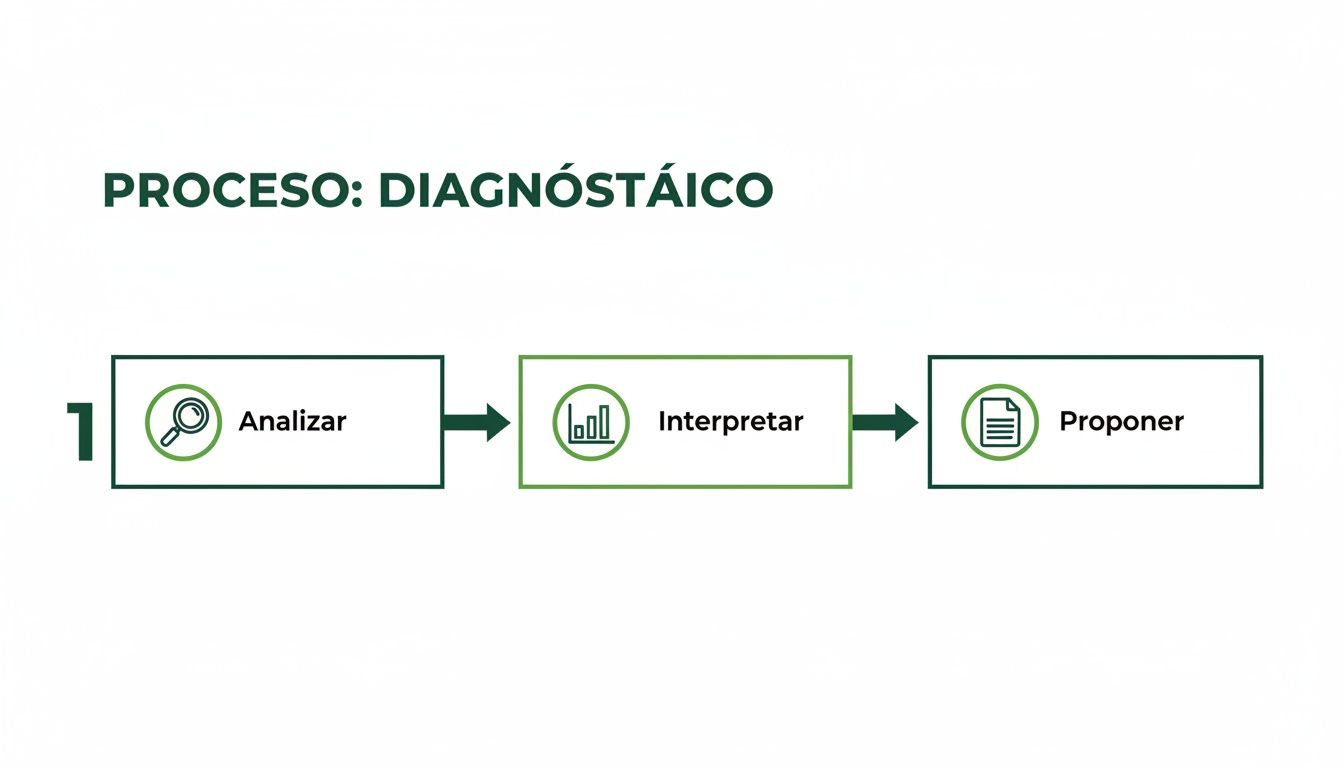
As you can see in the workflow, it all begins with analyzing the data you already have, followed by interpreting it to identify patterns, and ultimately building a value proposition that stands on its own.
From Data to Action
Once you gather and analyze all the information, the next step is translating it into specific needs. Wellness does not mean the same thing to a software engineering team spending hours in front of a screen as it does to a sales team facing daily rejection.
A wellness program cannot be a one-size-fits-all solution. It must be a tailored response to your people's real pain points. An accurate diagnosis is what sets a memorable initiative apart from an irrelevant expense.
For example, if your diagnosis reveals that the tech team suffers from back pain and eye strain, an initiative like in-office Shiatsu chair massages can make an immediate and visible impact. On the other hand, if the primary issue is financial stress, a personal finance workshop will be far more valued than a yoga class.
Building this business case with data will not only help you secure budget, but it will also give you the foundation to measure the program's success later on. You'll be able to say with absolute confidence: "We invested in 'X' to solve 'Y', and here are the results."
How to Define Objectives and Metrics That Truly Demonstrate Impact
A wellness program without clear goals is like throwing darts in the dark. You might hit something, but it will be pure luck. And as HR professionals, we know executive leadership doesn't invest in luck; they invest in measurable results.
That's why, once you have your diagnosis, the next step is translating those findings into goals that speak the language of business. This is where your role becomes 100% strategic.
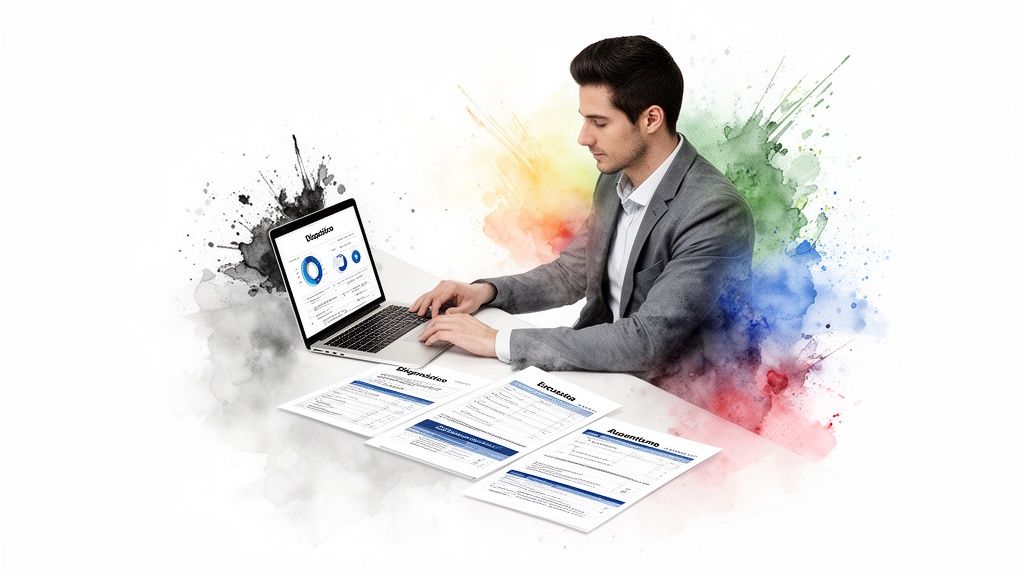
The key is moving past broad intentions like "improving the work environment." You need SMART objectives (Specific, Measurable, Achievable, Relevant, and Time-bound) that tie directly into company performance indicators.
From Findings to Strategic Objectives
Think about the concrete problems identified in your diagnosis and turn them into clear, targeted goals. It's simpler than it looks.
For example:
Finding: "High voluntary turnover in the engineering team, mainly due to stress and overload."
SMART Objective: "Reduce voluntary turnover in engineering by 10% over the next six months by implementing a stress management and active break program."
Or take this other case:
Finding: "Spikes in sick leave within the operations team during the last quarter."
SMART Objective: "Decrease unplanned absenteeism in operations by 15% by year-end through preventive health campaigns and on-site physical wellness days."
This approach completely transforms the conversation. You're no longer asking for budget for "nice-to-have activities"; you're presenting a solution to operational issues that cost money and drag down productivity.
To get executive leadership to listen, you have to speak their language. Translate ‘wellness’ into metrics that directly impact the bottom line: turnover, absenteeism, productivity, and engagement.
The KPIs That Truly Matter
Once your objectives are set, you need the right Key Performance Indicators (KPIs) to track your progress. The trick here is combining process metrics (Are people participating?) with impact metrics (Is that participation driving real change?).
You don't need to track everything. Pick the ones that best align with the objectives you established at the start. The right KPI mix will give you a compelling, data-backed narrative to present to leadership, proving that investing in wellness is one of the smartest business decisions they can make.
Selecting KPIs for Your Workplace Wellness Program
A guide to choosing the right metrics based on your company's goals, helping measure real impact on both business and people.
Program Objective | Primary KPI (Business Impact) | Secondary KPI (Employee Perception) | Suggested Measurement Frequency |
|---|---|---|---|
Reduce stress and burnout | Voluntary turnover rate | Pulse survey results (stress questions) | Quarterly |
Decrease absenteeism | Days lost to illness/stress | Perception of company support (climate survey) | Monthly / Quarterly |
Improve engagement | Participation rate in voluntary programs | eNPS (Employee Net Promoter Score) | Biannually |
Increase productivity | Productivity per team/department (if measurable) | Self-assessment of focus and energy post-activity | Post-event and Quarterly |
Strengthen a culture of care | Ratings on employer branding platforms | Satisfaction score (CSAT) for activities | Ongoing |
This table isn't a rigid rule; it's a starting point. Tailor your KPIs to what your company values and to the data you already have access to, allowing you to credibly compare before and after.
Process Metrics vs. Impact Metrics
It's essential to distinguish between the two types of indicators.
Process and participation metrics tell you whether your program is actually reaching people. They serve as your operational pulse check.
Participation rate: The percentage of employees attending an activity. If you offer a chair massage day, how many slots were booked?
Participation frequency: Is it always the same people, or are you managing to attract new profiles?
Satisfaction rating (CSAT): A simple post-event survey asking participants to rate their satisfaction from 1 to 5. At Zen to Go, for instance, we track this consistently and find that 94% of participants perceive high service quality.
Business impact metrics, on the other hand, are the ones that prove ROI and capture your CFO's attention.
Voluntary turnover rate: Compare this figure before and after your program, especially across critical departments.
Absenteeism rate: Measure the reduction in days lost to illness or stress.
Pulse survey results: Track shifts in specific questions regarding stress, engagement, or perceived support. A powerful stat we see in our programs is that 99% of participants feel the company values their well-being—a direct indicator of emotional salary.
Ultimately, it comes down to telling a story with data—a story that proves caring for your team isn't an expense, but the best investment for the business.
Designing a Tailored Wellness Program for Your Team
You have the diagnosis in hand and the objectives established. Now comes the exciting part: choosing the activities that will genuinely resonate with your people. A common mistake is launching generic initiatives without considering the needs you just uncovered. Trust me, it shows.
A wellness program that works isn't an all-you-can-eat buffet where everyone grabs whatever they can. Think of it more as a carefully planned tasting menu: every initiative has a purpose and contributes to a well-rounded experience.
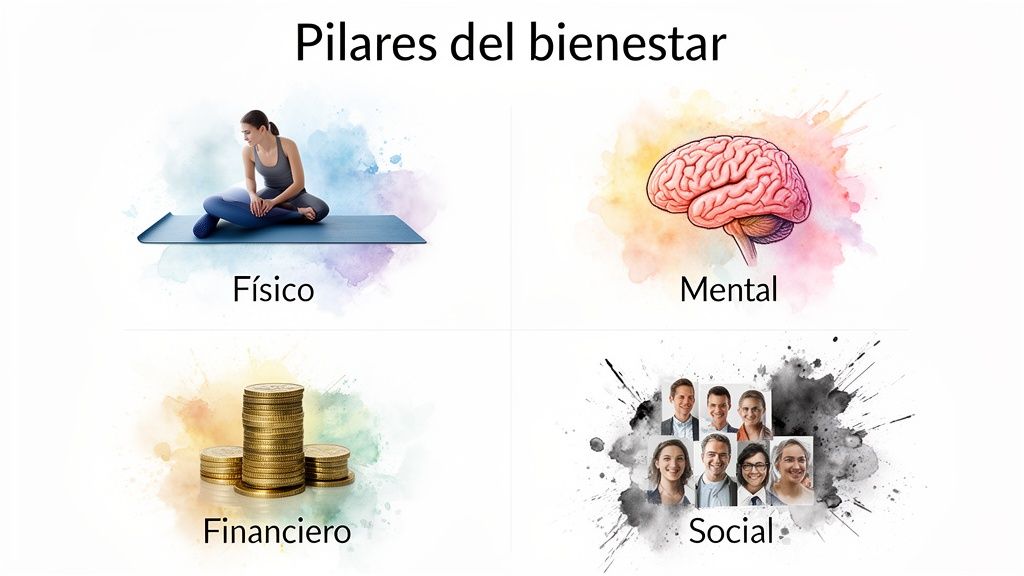
The Four Pillars of Corporate Wellness
To structure your program logically without letting anything slip through the cracks, we recommend focusing on four pillars. The goal isn't having thousands of activities in each, but offering a balanced mix that addresses the different dimensions of an individual's well-being.
Physical Wellness: The most visible and often the easiest to kick off. It focuses on health, energy, and preventing everyday aches and pains tied to desk jobs.
Mental and Emotional Wellness: More critical today than ever. Here, we tackle stress, anxiety, and burnout, equipping people with tools to navigate everyday emotions.
Financial Wellness: For many, this is the leading source of stress. Giving your team the tools and knowledge to manage their money fosters incredible loyalty.
Social Wellness: Centers on human connection, belonging, and the quality of workplace relationships.
The magic lies in how you blend actions across each pillar to build an annual calendar that maintains momentum and feels relevant to everyone, not just a select few.
Practical Ideas for Each Pillar
Let's bring these concepts down to earth with actionable examples that work well in Mexican companies, offering options for every budget and culture.
For Physical Wellness
This pillar goes far beyond a gym discount. It's about weaving movement and self-care directly into the workday.
On a low budget: Set up active breaks led by internal "ambassadors," organize group walks at lunchtime, or launch weekly step challenges. Highly effective, zero cost.
High visible impact: In-office massage days are undoubtedly among the most appreciated initiatives. In our experience at Zen to Go, Shiatsu chair massages deliver an immediate reduction in tension and stress. Best of all for HR, the logistics are minimal: no dedicated room or clothing changes needed, making high participation easy to achieve.
In Mexico, where workplace stress impacts 75% of workers, offering tangible solutions like corporate massages directly targets symptoms like back pain and anxiety. Companies that measure the ROI of these programs report noticeable gains in productivity and retention.
For Mental and Emotional Wellness
Here, the goal is offering practical everyday tools while destigmatizing mental health across the organization.
On a low budget: Host internal workshops on time management or beginner mindfulness. Create a dedicated Slack or Teams channel to share resources like podcasts and articles on emotional well-being.
As a strategic investment: Provide access to online therapy platforms. Book webinars led by licensed psychologists covering key topics like managing burnout or building resilience. These actions send a clear message: how you feel truly matters to us.
For Financial Wellness
Financial stress erodes focus and productivity. Helping your team build healthier financial habits directly boosts their engagement at work.
On a low budget: Invite an expert from a financial institution (they often do this free of charge) to deliver a session on saving, investing, or smart credit usage.
With a structured program: Offer access to 1-on-1 financial planning as part of your benefits package. Build a financial literacy program with modules ranging from basic budgeting to retirement planning.
For Social Wellness
We are social creatures, and a healthy work environment is vital. This becomes even more critical in hybrid setups, where connections can easily fade.
On a low budget: Encourage interest-based clubs (book clubs, running groups, board games). Host casual team breakfasts or celebrate birthdays in a more personal, thoughtful way.
To strengthen culture: Design team-building activities that go beyond the typical casual hangout. Promote corporate volunteering programs; they not only unite teams but also reinforce company purpose.
When designing your program, remember that your team's diversity is your greatest strength. Not everyone will enjoy everything, and that's okay. Consider the different generations and lifestyles represented in your organization. If you need more inspiration, check out our article on wellness activities for multigenerational teams.
The goal isn't to launch a flawless program on day one. It's about offering variety, listening to feedback, and refining as you go. That is how you build a wellness program that truly transforms culture.
Practical Implementation of Your Wellness Program
With your program designed and your goals established, it's time for the moment of truth: execution. This is where concepts turn into experiences that everyone can see and feel. As HR professionals, we know that a brilliant strategy can fall flat if implementation isn't seamless.
The secret isn't just launching activities; it's building momentum. It's about generating excitement, encouraging voluntary sign-ups, and ensuring every initiative runs smoothly without operational headaches for you and your team.
A Communication Plan That Builds Genuine Excitement
Well before the first activity takes place, the success of your program is already on the line. It starts with how you communicate it. A solid communication plan does more than just notify; it builds anticipation and connects the program directly to company culture.
Here are a few ways to make sure your message hits home:
Build anticipation: Don't roll everything out all at once. Start sharing teasers across internal channels a couple of weeks in advance. A simple "Ready to recharge?" can be enough to spark curiosity.
Segment your messaging: Different audiences need different angles. Present the KPI impact to executive leadership. For employees, highlight direct day-to-day benefits: "Less stress, sharper focus, and a well-deserved breather during your workday."
Use every channel at your disposal: Not everyone reads company emails. Leverage WhatsApp groups, office digital signage, team standups, and even physical posters so no one misses out.
Communication isn't just another box to check; it's the engine driving participation. An amazing program that goes unnoticed is wasted effort. Get people talking about it before it even begins.
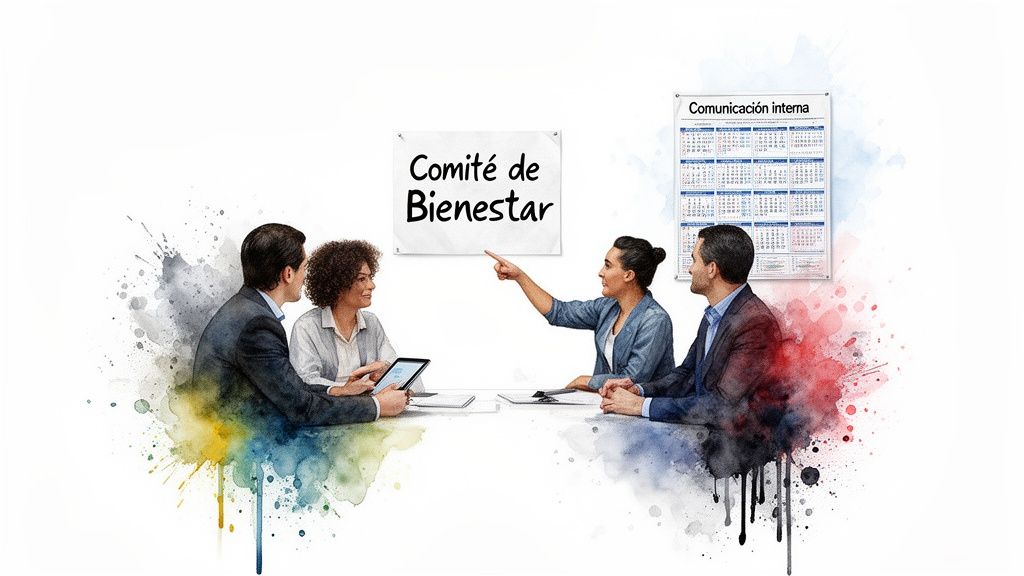
Build a Wellness Committee with Internal Ambassadors
Let's be realistic: you can't carry everything on your own. One of the most effective strategies we've seen is engaging employees across different departments as "wellness ambassadors." They become your eyes, ears, and, above all, the most authentic champions of the program.
A wellness committee helps you:
Validate ideas: They'll provide honest, unfiltered feedback on what activities their team members actually want.
Drive participation: They'll be the first to register and encourage teammates to join. Their energy is contagious.
Streamline logistics: They can assist with day-of logistics in their respective areas, lifting a significant operational burden off your shoulders.
Choose natural influencers who are genuinely enthusiastic about wellness. It doesn't need to be an official job title—just a dedicated group of champions who believe in the mission as much as you do.
Choosing the Right Vendor
Selecting the right partners is critical. A great vendor doesn't just deliver an activity; they act as an extension of your HR team. They simplify your workload and guarantee an exceptional experience for your people.
While working poverty has dropped, 82% of Mexicans place a higher value on good mental health than on a high salary. A well-rounded wellness program must extend beyond compensation alone. For HR leaders, partnering with vendors like Zen to Go—who provide digital booking systems and therapists with experience in premier hospitality—directly addresses the 38% of stress-induced concentration difficulties and produces positive ROI in 95% of cases. Learn more about the current landscape in this analysis on social law.
Use this checklist when evaluating vendors for your workplace wellness program:
Proven corporate track record: Have they worked with organizations like yours? Request case studies and references.
Vetted, certified professionals: How do they screen and select their staff? For example, at Zen to Go, all therapists hold verified credentials and undergo a rigorous selection process.
Frictionless HR logistics: Do they provide an online scheduling platform? Do they handle end-to-end setup? Your time is valuable; a vendor should save you work, not create more of it.
Flexibility and coverage: Can they support multiple office locations? Can they adapt to your team's schedules and specific needs?
Implementation is where your strategy comes to life. By communicating effectively, leaning on internal ambassadors, and selecting seamless vendors, you ensure your program doesn't just launch—it thrives.
How to Measure Real Impact and Drive Continuous Improvement
Launching a wellness program is a huge milestone, but as HR professionals, we know the real work is just getting started. To ensure your initiative doesn't end up as a one-off event and instead embeds itself into company culture, you need to measure, learn, and continually refine. This is where your strategic value shines, using data to show that wellness is an investment, not an expense.
Ongoing evaluation is what distinguishes a sustainable, long-term program from one that fizzles out after the first quarter. The goal isn't immediate perfection—it's continuous progress.
Feedback Is Your Compass
The most direct and genuine way to know if you're on track is simply asking your people. Post-activity satisfaction surveys are pure gold. They don't need to be lengthy; a few targeted questions will deliver all the insight you need.
Overall satisfaction: On a scale from 1 to 10, how satisfied were you with this activity?
Relevance: Did this initiative address a real need for you?
Perceived impact: How do you feel after participating? (e.g., more relaxed, more focused, more connected to the team).
Open suggestions: What could we improve, or what other activities would you like to see?
At Zen to Go, we track this systematically. Indicators like 95% of participants saying they would recommend the program provide clear proof of tangible value, helping us fine-tune future sessions.
Connecting the Dots with Business KPIs
Qualitative feedback is compelling, but to convince leadership and secure next year's budget, you must tie it back to the hard KPIs you outlined early on. This is where your analysis becomes vital.
Cross-reference participation figures with your core business metrics. Did the department with the highest attendance at chair massage sessions also see a dip in stress-related sick days that quarter? If so, you have a data-backed story ready to share.
A successful wellness report isn't just a list of completed events. It's a cohesive narrative demonstrating how investing in people drove positive movement across key business indicators.
This correlation is your strongest argument. It proves that an initiative targeting physical and mental well-being directly ripples into improved productivity and retention.
Presenting Results That Tell a Story
When it's time to put together your executive presentation, avoid simply dumping data onto slides. Your goal is to tell an accessible success story that brings major achievements to the forefront.
A reliable structure to follow:
Executive Summary: A concise paragraph highlighting core objectives, key initiatives, and the most compelling results.
Objectives Recap: Revisit your initial goals (e.g., "reduce turnover by 10%").
Key Results (the "What"): Showcase your KPIs visually: "Achieved an 85% participation rate and an average satisfaction score of 9.2/10."
Impact Analysis (the "So What"): Connect the dots: "This high participation correlated with a 15% decrease in reported stress levels, exceeding our initial target."
Testimonials & Qualitative Feedback: Include 2–3 anonymous yet impactful employee quotes to give the numbers a human voice.
Takeaways & Next Steps: Highlight forward-looking strategy: "What did we learn? How will we evolve the program next half?"
Continuous Improvement Is True Success
A workplace wellness program is never truly "finished." Employee needs shift, company priorities evolve, and the working environment changes. Leverage your data insights to adjust your roadmap. If an activity had low attendance, investigate why. If a workshop was a standout success, plan a part two.
The IMSS-Bienestar model achieved a 98.9% satisfaction rate in public surveys, proving the powerful impact of accessible healthcare initiatives. In corporate environments, where 75% of employees in Mexico suffer from stress, mirroring this philosophy is essential. Programs featuring verified practitioners and versatile setups (at-desk, Shiatsu chair) successfully transform company culture. With only 35% of workers familiar with NOM-037, HR is uniquely positioned to champion these initiatives and track their impact to defend ongoing investment. Explore more about the impact of these programs in the IMSS progress report.
At its core, creating a wellness program is about listening, taking action, measuring, and refining. This virtuous cycle establishes wellness not just as an HR project, but as an integral pillar of your company's identity and long-term success. If you suspect stress is a major factor in your organization, we invite you to try our stress test to evaluate levels across your team.
Frequently Asked Questions About Workplace Wellness Programs
Building a wellness program from the ground up is an exciting challenge, but it's completely normal to run into questions along the way. As strategic HR partners, we've supported hundreds of companies across Mexico and regularly encounter the same core concerns. Here are direct, practical answers rooted in real-world experience.
What is the minimum budget needed to start a wellness program?
You don't need a huge budget to take your first steps. The secret lies in starting with smart, highly visible, impactful actions, even at low costs. You can kick off with internal initiatives like volunteer-led active breaks, employee interest groups (running, book clubs), or skill-sharing sessions led by in-house talent.
If your goal is immediate, highly valued impact to build momentum, an on-site chair massage day is an unbeatable move. It's viewed as a premium perk, requires minimal logistical planning, and directly addresses physical tension. In our experience, many organizations start with a quarterly event. Once they see positive shifts in team morale and energy, they scale up to a monthly or bi-monthly cadence.
The key is to start, measure the impact, and use that data to justify greater investment down the road.
How do I convince executive leadership to invest in wellness?
The trick is speaking their language: data, efficiency, and return on investment. Stop framing wellness as a "morale booster" expense and present it as a strategic solution to high-priority business headaches.
Use data from your initial diagnosis to build an airtight business case. Instead of saying "we need a stress management initiative," frame it as: "Turnover in engineering cost us $X last year. A targeted program designed to tackle burnout can reduce that rate by 15%, translating to direct savings of $Y."
To win executive approval, your proposal must resolve an operational pain point. Tie wellness back to metrics like retention, absenteeism, and productivity. That is the conversation C-level executives want and need to have.
Leverage market statistics regarding stress and productivity losses in Mexico. Propose a pilot program in one specific team with well-defined KPIs. Measuring the before-and-after in absenteeism and engagement will provide irrefutable evidence of impact.
How do I measure the ROI of initiatives like in-office massages?
Measuring the Return on Investment (ROI) for initiatives like this requires pairing direct (quantitative) metrics with indirect (qualitative) indicators. Not every benefit is a hard balance-sheet figure, but everything can be evaluated.
Direct Metrics (Hard ROI): Track decreases in unplanned absences or medical leave following wellness events. If you track departmental productivity data, look for correlations between session participation and output gains. It's straightforward data analysis that yields compelling results.
Indirect Metrics (Soft ROI): Run pulse surveys to gauge improvements in team mood, perception of employer support, and stress reduction. Retention is another vital signal; ask departing employees in exit interviews whether the program positively influenced their overall experience. Our clients frequently use our attendance and satisfaction reports (showing 99% of employees feel the company values their well-being) as core qualitative evidence for their ROI reviews.
What activities work best in a hybrid work model?
Success in a hybrid model relies entirely on flexibility. It's about providing an accessible menu of options that work for team members regardless of location. The best strategy is a thoughtful combination of on-site and virtual initiatives.
In-office experiences—like corporate massages or shared team breakfasts—act as a major draw. They offer an enticing incentive for in-person days, fostering community and human connection that remote work can sometimes dilute.
For remote days, provide accessible digital experiences:
Live-streamed yoga or guided meditation sessions.
Webinars focused on stress management or financial health.
Subsidized access to virtual therapy platforms.
The bottom line is ensuring every team member, regardless of their physical location, feels supported and has access to high-quality resources that enhance their everyday routine.
Designing and sustaining a workplace wellness program is an evolving journey. At Zen to Go, we understand everyday HR challenges because we work alongside teams like yours every day. We're here to be more than a vendor—we want to be your strategic partner in transforming company culture, one wellness experience at a time.
Discover how our adaptable corporate massage solutions can streamline your logistics and drive measurable results for your organization. Visit Zen to Go and let's start building together.