What is occupational health and why is it key for your business?
When we hear the term occupational health, it's easy to think only of hard hats, safety vests, and "caution: wet floor" signs. And yes, that is part of the picture, but it's barely the tip of the iceberg.
Occupational health goes far beyond simply preventing accidents. It is the comprehensive discipline dedicated to making your workplace a safe and healthy space in every sense: physical, mental, and social.
What is occupational health in plain English?
Think of occupational health as the guardian of well-being in your company. Its mission isn't just to comply with a checklist of regulations to avoid fines; it's about building an environment where every person can bring their best self to work, without their physical or mental health paying the price.
This ranges from something as fundamental as chair ergonomics to prevent back pain, to comprehensive programs for managing the stress generated by today's pace of work. As leaders in corporate wellness in Mexico since 2019, we have seen that companies that understand this achieve more connected and productive teams.
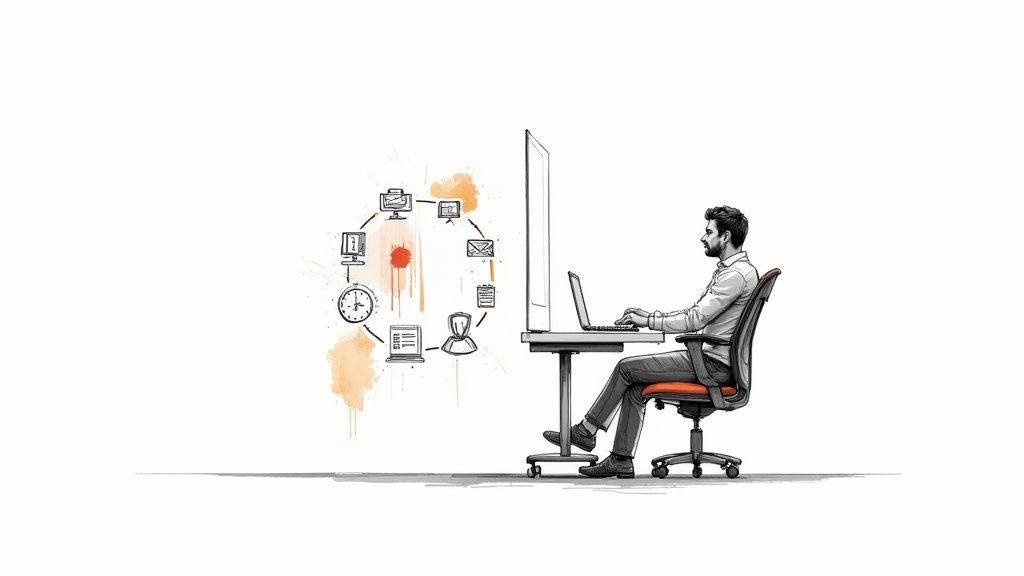
It goes far beyond accident prevention
Of course safety is a cornerstone, but the modern vision of occupational health is much broader. It looks at how working conditions affect a person's quality of life over the long term.
To better understand it, we can break down its approach into several key pillars.
This table breaks down the components of an effective occupational health program, showcasing its comprehensive scope.
Pillars of occupational health
Pillar | Primary focus | Practical office example |
|---|---|---|
Industrial hygiene | Prevent diseases caused by physical, chemical, or biological agents in the work environment. | Measure air quality, ensure adequate ventilation, and control noise levels. |
Workplace safety | Identify and eliminate conditions that can cause accidents (falls, impacts, cuts). | Properly mark hazard areas, keep aisles clear, and maintain equipment. |
Occupational medicine | Monitor employee health through medical exams and follow-up on conditions. | Conduct pre-employment and periodic medical exams to detect health issues early. |
Ergonomics | Adapt the workstation (furniture, tools, tasks) to the person's capabilities. | Provide adjustable chairs and desks to prevent poor posture and repetitive strain injuries. |
Occupational psychosociology | Address mental health risks, such as stress, burnout, and workplace harassment. | Implement stress management programs, define realistic workloads, and promote positive leadership. |
As you can see, occupational health answers a key question: how can we ensure that work is not only productive, but also adds to the well-being of our people?
Thinking about occupational health is a direct investment in your most valuable asset: your team. This investment translates into higher engagement, lower absenteeism, and a stronger, more resilient business.
At the end of the day, a well-implemented strategy strengthens culture, proves that the company truly cares about its people, and, as a result, builds loyalty and attracts top talent.
Why it's crucial in the Mexican workplace
In Mexico, understanding what occupational health is goes far beyond merely complying with legal requirements. It is a strategic necessity that directly impacts the success of any company.
If you think about it, the lack of well-structured wellness programs is the root cause of many of the headaches HR leaders and company executives face: relentless staff turnover, the constant struggle to attract top talent, and productivity that seems stalled.
Tackling occupational health head-on is not an expense; it is building a more competitive and, above all, more human company.
The challenge of informality and its impact
One of the greatest challenges in our country is the structure of the labor market itself. Let's be clear: informality is a complex issue affecting millions.
Recent data shows that of the nearly 60 million employed individuals in Mexico, barely 37% had formal access to occupational health services. With an informal employment rate of 54.4% as of March 2024, the reality is that more than half of the country's workforce lacks full access to accident prevention programs, training, or specialized medical care. You can consult the Secretariat of Labor and Social Welfare statistics to view the full numbers.
This situation places an enormous responsibility on the shoulders of formal businesses. They have the unique opportunity to become a true haven of well-being and safety for their teams, making a real difference in the quality of life of their employees.
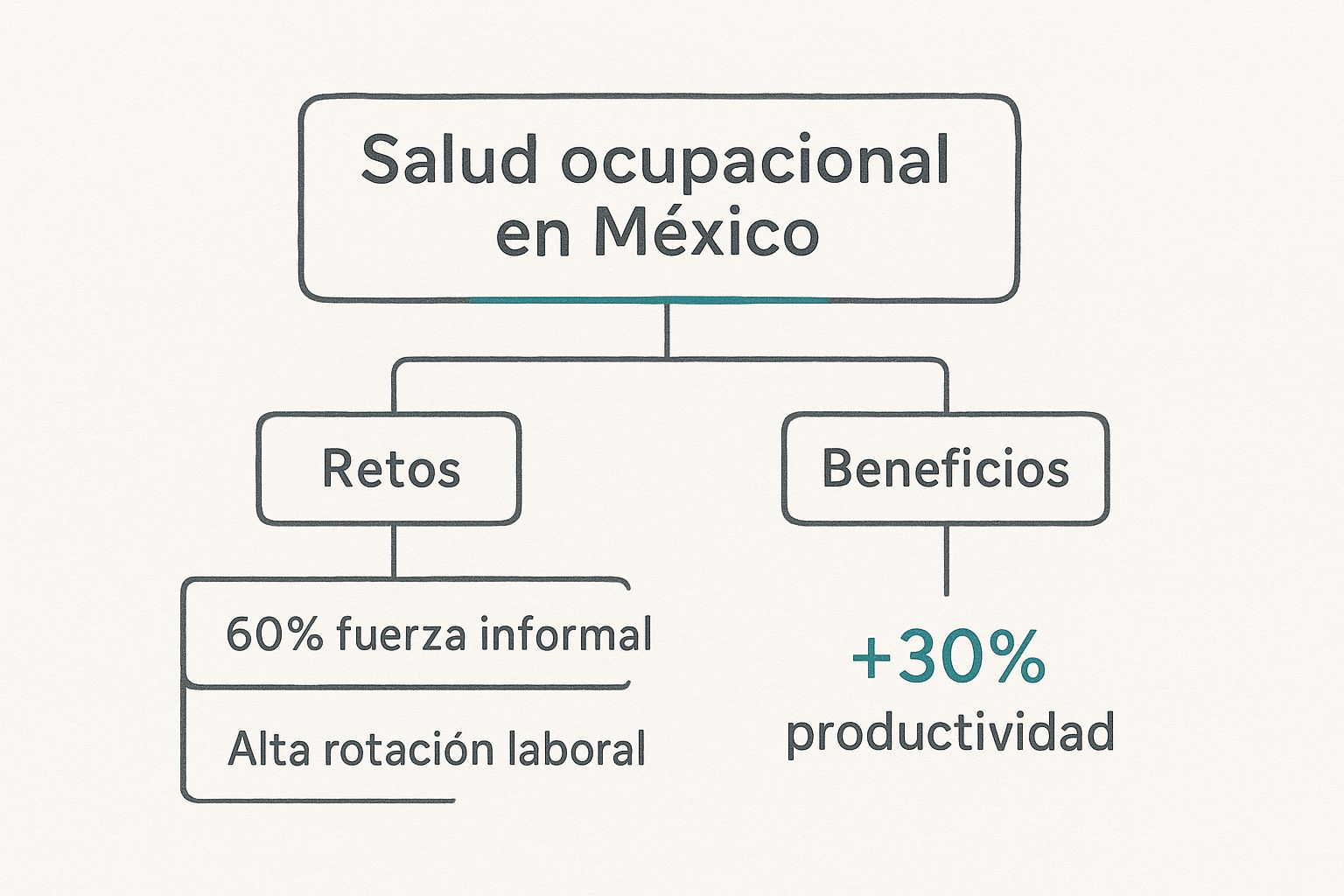
As the infographic summarizes, when a company decides to address challenges like high turnover, the benefits are tangible, starting with a noticeable boost in productivity.
A real competitive advantage
Ignoring occupational health comes with hidden costs that directly impact your business's bottom line.
Absenteeism, presenteeism (employees present at the office in body but mentally checked out due to stress), and low morale are clear symptoms of an environment that has neglected well-being. If you'd like to dive deeper, you can learn more about key burnout data in Mexico in our article.
Investing in the team's health is not an expense; it is a statement of principles. It proves you understand that sustainable success is built by taking care of people. A company that prioritizes well-being retains talent, inspires loyalty, and leads in its industry.
The four pillars of a successful occupational health program
For an occupational health strategy to work, it doesn't need to be complicated. In our experience helping companies improve their workplace environment since 2019, we have seen that the most effective programs rest on four clear, practical pillars.
Think of them as a roadmap any leader can follow to build a safer, healthier, and, consequently, much more productive work environment. It's not about imposing rules, but about building a wellness culture that is lived every day.
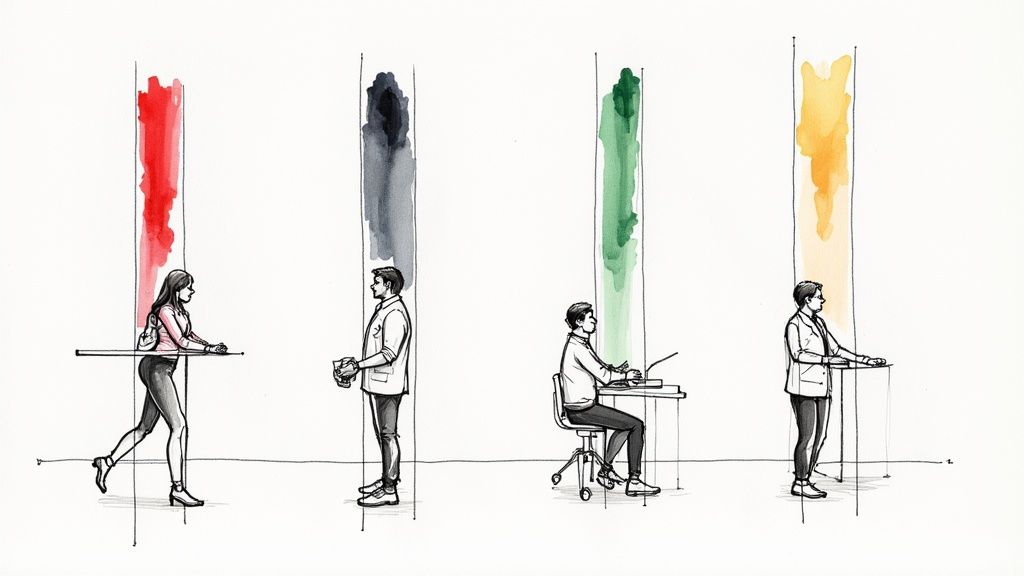
1. Physical risk prevention
This is the most visible pillar of occupational health. It focuses on everything that can cause physical harm, from the obvious—like preventing slips, trips, and falls—to subtler details that impact daily work.
In an office setting, this means ensuring ergonomic workstations to prevent injuries, proper lighting to avoid eye strain, and keeping common areas clear.
In sectors like construction or manufacturing, the risks are higher. It is estimated that in Mexico, at least 500,000 workers are exposed to crystalline silica, a mineral that can cause severe respiratory illnesses. Learning more about reemerging occupational hazards in Mexico helps illustrate the true scale of the problem.
2. Psychosocial and mental well-being
A safe work environment goes far beyond the physical realm. Mental health is just as important. This pillar focuses on identifying and mitigating factors that generate stress, anxiety, or burnout across the team.
Psychosocial well-being is the silent engine of an engaged, happy team. When employees feel mentally supported, their creativity, collaboration, and loyalty skyrocket.
This is where compliance with NOM-035 comes into play, which aims to do just that: prevent psychosocial risk factors. Actions such as establishing realistic workloads, fostering open communication, and promoting positive leadership are fundamental.
3. General health and hygiene
This pillar focuses on maintaining a clean and healthy workplace environment. But it goes far beyond simply having hand sanitizer nearby.
It includes ensuring good air quality, maintaining consistent cleanliness in common areas like restrooms and breakrooms, and providing easy access to basic hygiene supplies. A clean environment doesn't just prevent illnesses; it also sends a clear message: the company cares about the well-being of its people.
4. Prevention culture and training
Finally, no occupational health program can succeed if it doesn't become part of the company's DNA. It's not about keeping a manual locked away in a drawer; it's about empowering every employee.
This is achieved through consistent, accessible training. Teach your team how to adjust their chairs properly, recognize early signs of stress, or lift objects safely. When every individual understands their role, occupational health becomes a shared responsibility.
Implementing these fundamentals is the first step toward developing workplace wellness programs that create a genuinely positive impact.
The silent impact of stress and how to combat it
Workplace stress is one of the greatest saboteurs of productivity in the modern office. It's not just about "feeling pressured"; it's a factor that drains energy, stifles creativity, and fuels burnout.
It's like an invisible water leak: if left unchecked, it eventually damages your business's entire foundation. In Mexico, the statistics are more than a wake-up call; they're an alarm that no company can afford to ignore.
Workplace stress numbers that Mexico cannot hide
The pace of work has accelerated to levels that are already taking their toll. Recent data shows that 75% of Mexican workers have experienced some form of workplace stress. Worse still, an alarming 27% suffer from chronic stress.
According to the World Health Organization, these figures place us above global powerhouses like China and the United States. You can take a closer look at the state of workplace stress in Mexico and what it entails.
This translates into exhausted teams, diminished collaboration, and a much steeper uphill climb to reach goals. Ignoring it means allowing a silent thief to steal your people's potential.
Practical solutions for a real problem
The good news is that fighting office stress doesn't require overcomplicated solutions, but rather smart interventions that offer real relief. This is where initiatives like chair massages make a difference you can measure and, above all, feel.
Think of it this way: offering a 15-minute break with a professional therapist right in the office breaks the cycle of accumulated tension.
A chair massage is much more than just a perk. It's a strategic tool that sends a powerful message: "Your well-being matters to us, and we're giving you the space to recharge."
This practice not only relieves physical tension in the neck and shoulders, but it also provides a crucial mental break. As we've seen across hundreds of companies, the most effective solutions are the ones you can physically feel.
A tangible boost to morale and energy
When an employee returns to their desk after a wellness break, they don't just feel more relaxed. They feel seen and valued. At Zen to Go, we see this every single day.
These types of initiatives create a noticeable domino effect:
Improves morale: A happier team communicates better and collaborates more effectively.
Recharges energy: Helps beat the afternoon slump and maintain focus.
Strengthens loyalty: Demonstrates a genuine commitment to people's health through actions, not just words.
Incorporating these breaks is a simple, high-impact way to manage one of the greatest risks to modern occupational health. If you want to dive deeper, we invite you to read our tips on how to manage workplace stress to be happier at work.
How to roll out your occupational health plan step by step
Moving from theory to action doesn't have to be complicated. This guide is designed to help HR and wellness leaders launch an occupational health plan logically and effectively, without needing a massive budget. The secret isn't aiming for perfection on day one. It's starting with concrete actions that build a solid foundation.
1. Initial assessment: where do we stand?
Before mapping out a route, you need to know where you currently stand. The first step is a simple assessment to identify your team's specific risks and pain points.
Observe your office: Are the chairs truly ergonomic? Does the lighting cause eye strain by the end of the day? Are there loose cables or blocked walkways?
Talk to your people: Send out anonymous surveys or simply have informal chats. Ask what causes them the most stress or physical discomfort. Their answers are pure gold.
Review existing data: Take a look at absenteeism records. Do you notice any patterns? Are absences concentrated in certain departments or seasons of the year?
2. Define clear, achievable goals
With your assessment in hand, it's time to set realistic goals. Forget vague objectives like "improving well-being." Be specific.
A good goal isn't "reduce stress." It's "decrease stress-related absenteeism by 15% over the next six months" or "achieve 80% team participation in at least one wellness break per week."
Having metrics like these will allow you to track whether your efforts are working and justify the investment to leadership.
3. Design simple yet high-impact programs
You don't need to reinvent the wheel. Start with initiatives that are easy to implement and deliver visible results quickly.
Active breaks and ergonomics: Organize brief stretching sessions (5–10 minutes) a couple of times a day. Teach your team essentials like properly adjusting their chairs and monitors.
Wellness days: Dedicate one day a month to health. You can invite a nutritionist for a talk or bring services like on-site chair massages directly to the office. In fact, a chair massage is the active break that restores your team's energy and carries a very powerful cultural impact.
Open communication: Create safe channels for employees to talk about their workloads and stress levels without fear of retaliation. Sometimes, the best tool is simply listening.
4. Communicate, train, and engage everyone
An occupational health plan cannot be a secret Human Resources project. For it to work, everyone needs to feel like a part of it.
Clearly communicate the goals and benefits of each initiative. Offer short, to-the-point training sessions on topics like stress management or postural hygiene. A key tip: appoint "wellness ambassadors" across different teams to help spread the enthusiasm.
5. Measure, adjust, and celebrate wins
Finally, set up a system to measure the impact of your actions. Re-run surveys, review absenteeism metrics, and, most importantly, ask for continuous feedback.
Use that information to fine-tune the plan. Stay flexible. And don't forget to celebrate every small milestone to keep motivation high.
A smart investment in your people and your business
It's time to stop viewing occupational health as a mere expense or a legal obligation. The real shift happens when you recognize it for what it truly is: your greatest competitive advantage. Investing in your team's well-being delivers a clear, measurable return.
A well-thought-out strategy reduces turnover, attracts top talent, skyrockets productivity, and, above all, strengthens your employer brand from the inside out.
When an employee feels genuinely cared for, their engagement and loyalty multiply. That's not a slogan; it's a business reality.
Our own experience with corporate clients confirms this. According to the semi-annual satisfaction surveys we conduct after rolling out wellness programs with Zen to Go, the data speaks for itself:
83% of employees report a significant reduction in stress.
95% feel that their company genuinely cares about their well-being.
These numbers prove that caring for your people isn't just the right thing to do—it's the smartest business move you can make today. A healthy, motivated, and focused team is the engine driving real growth.
If you're interested in exploring further, we share concrete ideas in our article on how to improve the work environment.
Answering your questions: occupational health FAQs
Here are straightforward answers to those key questions you've likely asked yourself when exploring how to roll out a wellness program in your company.
Is my company legally required to have an occupational health program?
Yes, absolutely. In Mexico, the Federal Labor Law and several Official Mexican Standards (NOM) establish very clear responsibilities for all employers. The most well-known is NOM-035, which focuses on psychosocial risk factors.
Requirements scale depending on the size and industry of each company, but the core principle applies to all: no business is exempt from the responsibility of caring for its people.
What is the difference between industrial safety and occupational health?
This is a very common question. Look at it this way: industrial safety is the first line of defense. It focuses on preventing immediate, visible accidents: a slip, a cut, a strike. Its mission is to stop the incident from happening today.
In contrast, occupational health takes a much broader, long-term view. It aims not only to prevent accidents, but to promote a complete state of sustained well-being (physical, mental, and social). It prevents illnesses that develop over time and fosters an environment where people can thrive.
Safety prevents today's accident; occupational health protects tomorrow's quality of life.
Do I need a massive budget to get started?
Not at all. This is one of the biggest myths holding many companies back. You can start building a culture of well-being with low-cost actions that deliver an enormous impact.
Here are a few ideas to get you started:
Organize active breaks: Encourage quick 5-minute stretching breaks. They cost nothing and reignite energy.
Offer basic training: A simple ergonomics workshop on adjusting chairs and monitors can prevent chronic back pain.
Implement flexible services: Solutions like our Shiatsu Chair Massages adapt to your budget and space. You can start with a session for a specific team and measure the impact. It's a tangible, highly valued benefit performed fully clothed.
At Zen to Go, we know every company is different. That's why we help you design wellness programs that feel authentic, take care of your team, and strengthen your business. Discover how we can bring wellness to your office.