Discover: What Massage Therapy Is and Its Benefits for Your Business
Have you ever wondered if an office massage is just a luxury or a real business tool? As an HR leader, you know the answer goes beyond mere relaxation. Massage therapy serves to measurably improve the physical and mental health of employees, directly impacting stress reduction, contracture relief, and anxiety alleviation.
What is massage therapy and why is it a strategic tool for HR?
As an HR leader in Mexico, your day-to-day is a battle on multiple fronts: compliance with NOM-035, fighting burnout, and the constant pressure to improve engagement and curb turnover. In this scenario, massage therapy is not just another perk, but a tangible and effective solution to tackle these challenges at their root.
Far from being a simple relaxing massage, massage therapy is a set of therapeutic techniques applied by hand to treat muscle aches and promote comprehensive well-being. When brought into the corporate environment, its purpose expands. It becomes a pillar of emotional salary and a key piece in building a genuinely healthy organizational culture.
Beyond wellness: massage therapy as a business tool
The right question for an HR professional is not just what is massage therapy used for?, but how does it impact my key indicators? The answer lies in its dual function:
For the employee: It functions as immediate relief. It eases the physical tension accumulated after hours in front of a computer and the mental stress generated by the workload. This translates into an employee who feels genuinely cared for. In our experience, 99% of participants feel that the company values their well-being after a session.
For the company: It becomes an investment with a visible return. A less stressed team is more focused, creative, and productive. Furthermore, it helps prevent absenteeism due to musculoskeletal ailments and strengthens the employer brand—a decisive factor in attracting and retaining talent.
Integrating massage therapy into your wellness strategy sends a powerful message: your people are the most important asset, and their health is a business priority.
At Zen to Go, we have worked with hundreds of HR teams and have seen firsthand how a well-implemented massage program stops being an expense and transforms into a smart investment in human capital. It is a concrete action that demonstrates commitment, strengthens culture, and, most importantly, generates results you can proudly present to management.
The real impact of massage therapy on productivity and stress
Stress and burnout are not abstract concepts for an HR department; they are real operating costs reflected in turnover, absenteeism, and a drop in productivity. Understanding what massage therapy is good for in this context is key: it is a proven tool to mitigate these costs and strengthen organizational health from within.
The mechanism is surprisingly direct and measurable. A therapeutic massage session has an immediate physiological impact: it helps reduce levels of cortisol, the hormone directly associated with stress. When cortisol drops, the body leaves that constant state of alert that consumes energy and clouds concentration.
At the same time, massage therapy stimulates the release of serotonin and dopamine. These neurotransmitters are responsible for regulating mood, creating feelings of well-being, and improving focus. For your team, this translates into greater mental clarity, better problem-solving abilities, and a more positive and collaborative work environment.
Connecting physiology with business metrics
As an HR professional, your challenge is to translate these individual benefits into a tangible impact for the company. The connection is clearer than it seems:
Reduction in presenteeism: An employee with back contractures or mental exhaustion may be physically in the office, but their productive capacity is minimal. Massage therapy alleviates these ailments, allowing the team to be truly present and focused.
Decreased absenteeism: Tension headaches, lower back pain, and chronic fatigue are common causes of missed work. By offering a preventive and corrective solution, you reduce leaves of absence due to ailments linked to work stress.
Improved decision-making: A less stressed brain is a more efficient brain. Teams that manage their stress better make fewer mistakes and are more innovative.
In our experience working with HR teams of various sizes across Mexico, we have seen how consistent massage therapy programs become a cornerstone for stress management. The data confirms it: at Zen to Go, we have measured a 79% stress reduction in participants of our corporate programs.
This infographic summarizes the direct impact of massage therapy on key metrics monitored by Human Resources.
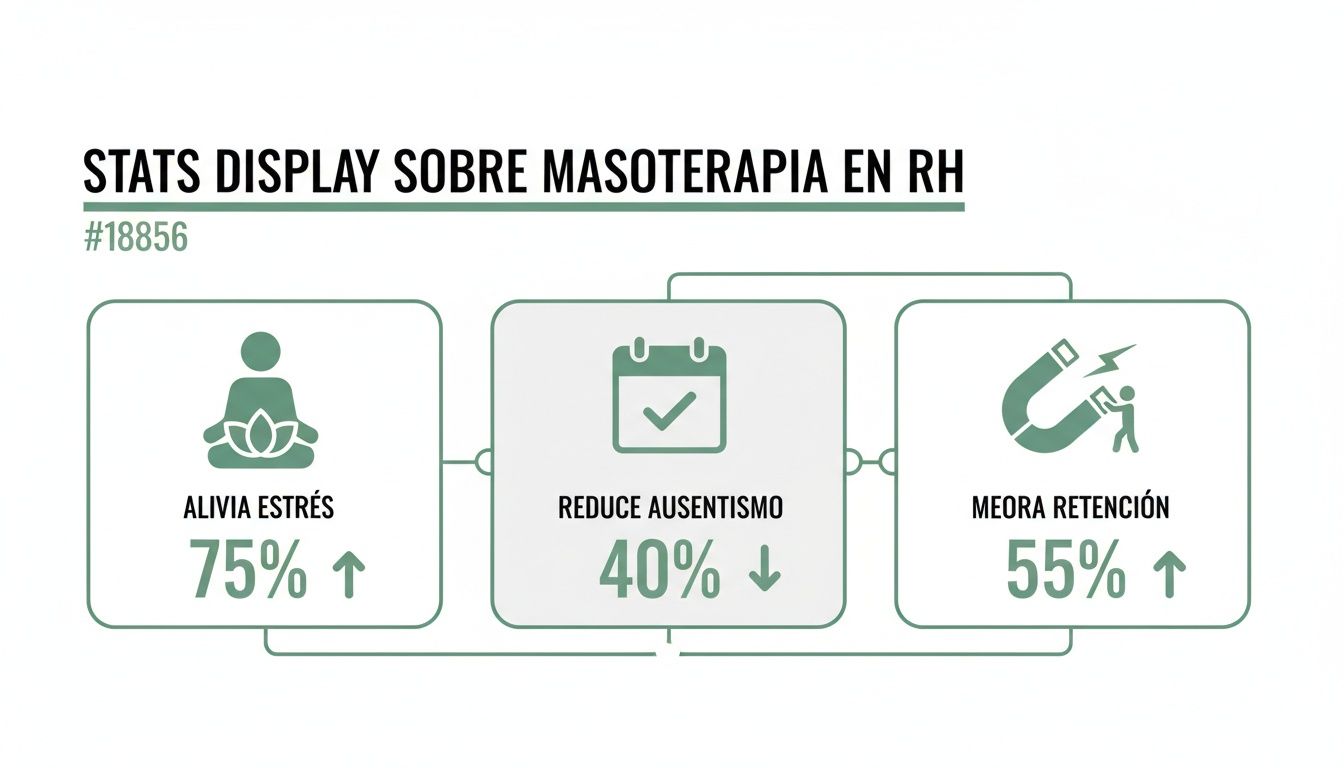
The visualization demonstrates how a single initiative can relieve stress, positively impact attendance, and strengthen talent engagement.
Evidence supporting the investment in wellness
The effectiveness of massage therapy is not merely anecdotal; it is backed by concrete data. According to Gympass's 2023 Wellness Barometer, 80% of employees in Mexico consider wellness a non-negotiable priority when choosing an employer. Offering tangible benefits like massage therapy becomes a key retention factor.
In addition, studies documented by Harvard University confirm that a massage session of just 15 minutes in the workplace can increase job performance by 25%.
The evidence is compelling: implementing a massage program is not an expense, but a strategic investment in the efficiency and resilience of your team. It is one of the most effective ways to demonstrate a real commitment to well-being while boosting business results. Learn more about how massages for stress can be a key element in your talent management strategy.
Choosing the most effective types of massage for your office
As an HR professional, you know that the success of any initiative depends on its ease of implementation. Corporate massage therapy does not have to be a logistical headache. It’s not about setting up a spa, but about finding modalities designed for the pace and limitations of the modern office.
The goal is to strike the perfect balance: maximum impact on well-being with minimal operational disruption.
The key is to select techniques that directly tackle the most common desk-job ailments—that tension in the neck, shoulders, and back—without employees having to be away for long or worry about changing clothes. This eliminates barriers and encourages more people to participate.
Shiatsu chair massage: HR's favorite choice
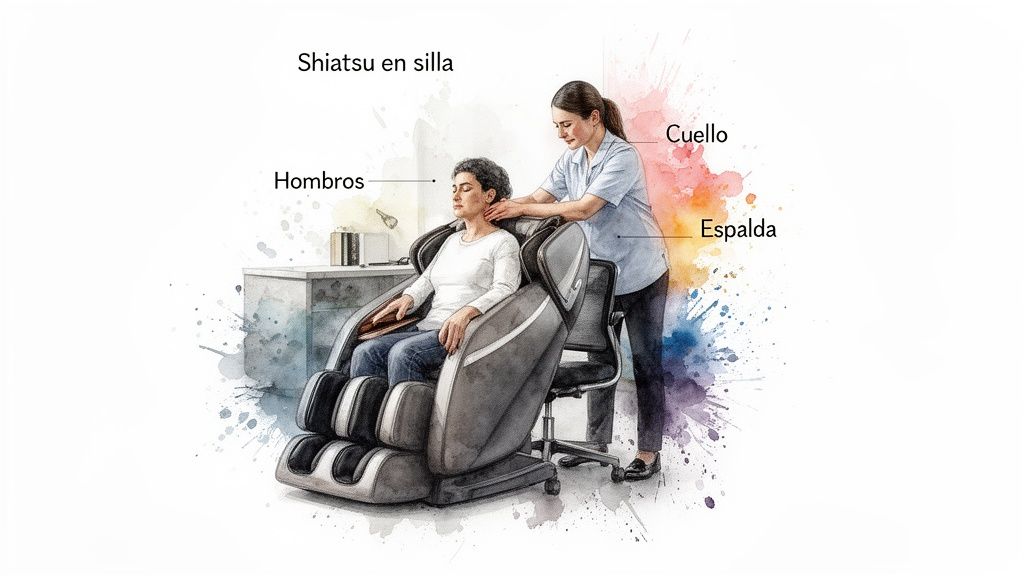
When a talent leader asks us where to start, our recommendation is almost always the same: Shiatsu chair massage. This modality has become the gold standard for corporate wellness in Mexico for a very simple reason: it works, and it is easy to implement.
It is an incredibly practical solution. It is performed in an ergonomic chair that the therapist can set up almost anywhere: a small meeting room, a quiet corner of the open space, or even an unused private office.
Zero complications: The employee remains fully clothed, which eliminates any discomfort and keeps everything streamlined.
Targeted focus: Sessions last between 15 and 20 minutes, enough time for a certified therapist to apply pressure to key points on the back, neck, shoulders, and arms.
Instant results: Despite the short session length, relief is felt immediately. Employees return to their desks renewed, with less tension and greater mental clarity.
This modality directly answers the question of what massage therapy is good for in a demanding environment: offering a fast, effective physical and mental "reset" that recharges the team's energy.
In our experience at Zen to Go, the ease of implementing chair massage is its biggest advantage for HR. You don't have to worry about coordinating long breaks or managing complex spaces, making the program sustainable over the long term.
Desk massage: the ultra-flexible alternative
For companies with very limited space or those looking for an even less disruptive option, desk massage is a fantastic alternative. Here, the therapist goes directly to each person's workspace.
The technique concentrates primarily on the neck, shoulders, and upper back—precisely the areas that suffer most from computer posture. Although it is a shorter intervention, around 10 to 15 minutes, its impact on team morale is exceptionally high.
It represents a gesture of direct, personalized care that surprises and delights employees. It is ideal for heavy workload periods, month-end closes, or as positive reinforcement to recognize the team's efforts.
Defining the best option for your culture
Choosing between one modality or the other depends on your program's objectives, your office layout, and your company culture.
To help you decide, here is a simple comparison table:
Feature | Shiatsu Chair Massage | Desk Massage |
|---|---|---|
Duration | 15–20 minutes | 10–15 minutes |
Required space | A semi-private 2x2 m area | None, adapts to the employee's desk |
Focus level | Full back, neck, shoulders, and arms | Neck, shoulders, and upper back |
Ideal for | Recurring wellness programs and events | One-off initiatives and team recognition |
Perceived impact | High, feels like a dedicated break | Very high, perceived as a personalized gesture |
Both options provide a practical solution for integrating the benefits of massage therapy into the workday routine. By understanding their differences, you can design an initiative that your team will not only value, but that is also easy to manage and justify to leadership.
How to implement a successful massage therapy program step-by-step
Launching a wellness initiative that actually works doesn’t have to be a burden on your HR team. A well-designed massage therapy program should be simple to manage while generating an impact everyone notices.
Here is your roadmap to roll out a service your employees will love and leadership will see as a smart investment, not an expense.
In our experience working with People & Culture teams across Mexico, we’ve learned that the success of a wellness program depends on its operational ease. If it’s complicated, it gets abandoned. That's why we broke the process down into four practical steps so you can launch it seamlessly.
1. Justify the investment with data
The first step is to present the business case to leadership. Move away from just talking about "relaxation" and start speaking the language of business: return on investment (ROI). Your argument should focus on how massage therapy moves the key indicators HR cares about.
Less absenteeism: Explain how relieving muscle ailments and tension headaches can reduce sick days. An employee who feels physically well doesn’t need to take time off.
Higher productivity: Lean on hard data. For instance, the Harvard study showing a 25% increase in performance after massages lasting just 15 minutes. A less stressed team concentrates better and makes fewer mistakes.
Better talent retention: Position massage therapy as a key component of the emotional salary. In such a competitive job market, perks that show the company genuinely cares are a powerful differentiator in convincing your top talent to stay.
Your pitch should be straightforward: "Investing X amount in this program will help us reduce turnover and absenteeism costs while driving productivity. It’s not an expense; it’s a strategy to care for our most valuable asset."
2. Keep logistics as simple as possible
Once you have the green light, the next challenge is implementation. And here, simplicity is key. You don’t need a massive space or nightmarish logistics.
Where do we do it? There’s no need to build a spa. A rarely used small meeting room, an unoccupied private office, or even a quiet corner in a common area will work perfectly. For a service like Shiatsu chair massage, you only need about a 2x2 meter space.
How often? Consistency is far more important than intensity. It is a thousand times better to offer regular 15-minute sessions once a month than one mega-event once a year. This creates a wellness habit and keeps the benefit top of mind for everyone. The ideal frequency can be monthly or biweekly, depending on your budget and goals.
3. Communicate to build excitement
Participation success depends on good internal communication. Sending a single email isn't enough. You need to build excitement and make it clear what massage therapy is good for.
Create a launch campaign: Use your usual channels (email, Slack, office posters) to announce the new benefit. Focus on results: "Ready to say goodbye to month-end stress?" or "Get ready to recharge your energy in 15 minutes."
Make sign-ups easy: Implement a super simple online registration system. Tools like the ones we offer at Zen to Go allow employees to pick their time slot in a couple of clicks and send automatic reminders so nobody forgets.
Educate on the benefits: Share bite-sized information. Explain how a 15-minute massage can improve their focus, relieve that nagging back pain, or simply make their day better.
If you are looking for inspiration on how to frame this benefit, explore how a massage service integrates into a comprehensive corporate wellness strategy.
4. Measure the impact to prove value
Finally, for the program to be sustainable long term, you must measure its results. And no, this doesn’t require endless surveys or complex data analysis.
Pulse surveys (before and after): Ask a simple question before the session: "On a scale of 1 to 10, what is your stress level right now?" And the same question right after. This data point, while simple, is very powerful. At Zen to Go, we have measured a 79% stress reduction using this method.
Qualitative feedback: Request brief testimonials. Questions like "How do you feel after your massage?" or "Would you recommend this program to your coworkers?" will give you valuable quotes for your reports. In fact, our data shows that 95% of participants would recommend the program.
By following these four steps, you will transform a good idea into a successful, sustainable wellness program with a measurable impact that strengthens your people management strategy.
Massage therapy as a tool to comply with NOM-035
For any HR leader in Mexico, NOM-035 is not just a regulation; it is the roadmap to building healthier work environments. But there is a gap between policy and practice, and that is where massage therapy stops being a simple perk and becomes a strategic, measurable tool.
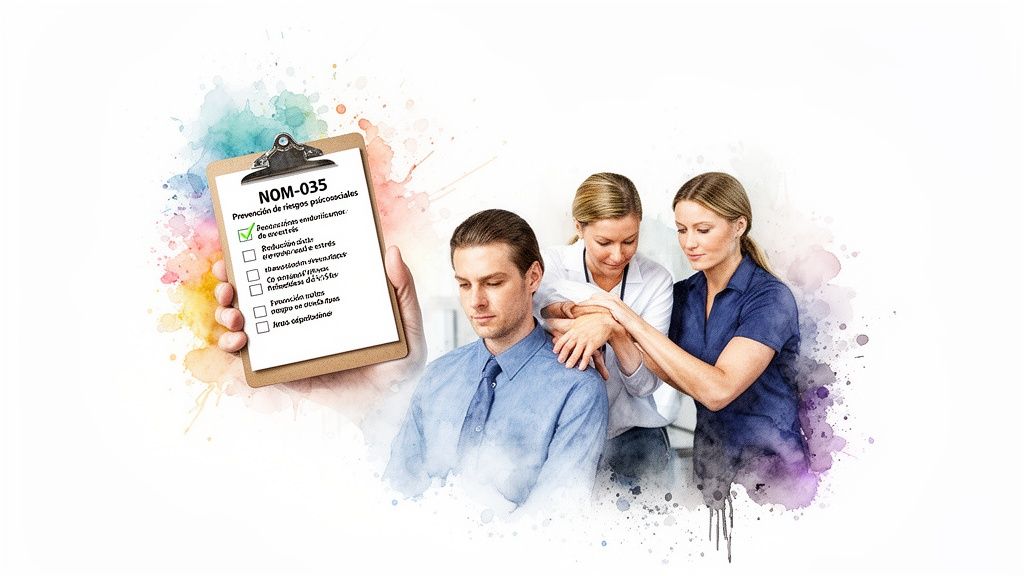
Implementing an office massage program is a concrete action to prevent psychosocial risk factors, one of the standard's core pillars. It's not about gifting relaxation, but about directly targeting the physical manifestations of stress, anxiety, and fatigue that NOM-035 seeks to mitigate.
By offering massage therapy sessions regularly, the message is clear and demonstrable: the company is actively committed to creating a favorable organizational environment.
Connecting the dots: massages and the pillars of NOM-035
The regulation requires identifying, analyzing, and preventing. A good corporate massage program directly impacts several of these critical areas.
Workloads: Tension built up in the neck, shoulders, and back is the physical imprint of an excessive workload. Massage therapy eases that tension and provides a restorative break that helps employees better manage pressure.
Work hours: Hours spent in front of a screen take a toll, both physically and mentally. A 15-minute session can act as an energetic "reset," improving concentration and breaking the cycle of exhaustion.
Organizational climate: While it doesn’t resolve conflicts directly, it does disarm people. A less stressed team is in better spirits, has more patience, and is more open to assertive communication. This undoubtedly contributes to a better work climate and reduces daily friction.
A massage therapy program becomes tangible evidence of the actions your company is taking to comply with the standard. It is an initiative you can document and present in audits as part of your prevention plan.
From expense to investment in compliance and culture
Framing massage therapy within your NOM-035 strategy completely changes the conversation with management. You are no longer asking for a budget for a "luxury"; you are proposing a strategic investment with a dual return:
Regulatory compliance: You help mitigate penalty risks and demonstrate a proactive commitment to your people's health.
Culture building: You strengthen the perception that the company truly cares about holistic well-being. That is a pillar of the emotional salary and a key factor for talent retention.
In our experience working with HR teams, we’ve seen that companies that integrate physical wellness into their compliance strategy achieve deeper, more sustainable results. Ultimately, massage therapy serves to do much more than relieve back pain. It is a powerful tool to build a more resilient, healthy organization in compliance with one of the most important people management regulations in Mexico.
Professional wellness: the key role of the massage therapist in Mexico
As an HR leader, your peace of mind depends on knowing that any vendor entering your office is safe, professional, and reliable. This is essential, especially when considering a massage therapy program, because corporate wellness in Mexico is no longer a passing trend—it is a rapidly consolidating sector.
Interest in these solutions continues to rise. According to recent data, the spa market in Mexico reached a value of $122.39 million USD in 2023 and is projected to grow at an annual rate of 7.5% through 2032. You can read more about the growth of the wellness industry in Mexico and see how this trend is shaping employee expectations.
This growth demands a much higher standard of quality. It is no longer enough to offer a "quick relaxing massage." Today, companies need the guarantee that the service will be delivered by qualified personnel who understand corporate dynamics and the required discretion.
The importance of having a certified massage therapist in your office
The difference between an amateur and a professional massage therapist is night and day, especially when the service is delivered on-site. A certified therapist not only masters the techniques to safely relieve muscle tension; they also understand the anatomy and physiology required to adapt the massage to each person without ever jeopardizing an employee's health.
At Zen to Go, we understand that trust is the foundation of any strategic partnership with HR. That’s why our screening process is extraordinarily rigorous and designed to give you complete peace of mind.
"In our experience working with HR teams of all sizes in Mexico, we have learned that the therapist's quality defines the success of the program. A professional service doesn’t just relax—it builds trust and shows genuine care on the part of the company."
Our validation process: your safety is the top priority
Ensuring a high-quality and completely safe service is our number one commitment. Every massage therapist who joins our team goes through an exhaustive vetting filter that includes:
Credential verification: We require certificates and diplomas verifying their professional training in massage therapy. No exceptions.
Verifiable experience: We require a minimum of three years of experience, ideally in high-end environments such as luxury hotel spas.
Interviews and practical tests: We evaluate both their hands-on skills and their communication and professional demeanor. We look for people who know how to connect, not just massage.
Background checks: We conduct background checks to ensure a safe, trustworthy environment for your employees.
This process allows us to guarantee that each session is not only effective, but conducted with the highest level of respect, ethics, and professionalism. By choosing a provider with such a validation standard, you ensure that your team's well-being—and, of course, your company's reputation—remains protected.
Frequently asked questions about corporate massage therapy
We know that as an HR leader, your time is valuable and you need concrete answers to make decisions. Here are the most common questions we get when evaluating a massage therapy program, based on our direct experience with hundreds of companies in Mexico.
How much office space do I need for the sessions?
This is, without a doubt, the easiest hurdle to overcome. For a modality like Shiatsu chair massage, you only need a corner measuring about 2x2 meters. It can be an unused small meeting room, an empty office, or even a quiet corner in a common area. Forget about setting up a spa; the key here is practicality.
How often do you recommend massages to see results?
Consistency beats intensity. To truly feel a shift in the work climate and a drop in overall stress, our recommendation is a monthly or biweekly cadence. This transforms the program from an isolated event into an anticipated, sustainable benefit that people value.
From experience, we know that regularity is what anchors the perk in the company culture. It’s what makes employees truly perceive it as an investment in their well-being.
And how do I measure the program's return on investment (ROI)?
Justifying the investment is key, and measuring the impact doesn’t have to be complicated. You can do it with simple yet powerful tools:
Pulse surveys: Something as simple as asking participants their stress level (on a scale of 1 to 10) before and after the session. It is a direct metric that provides compelling data.
Absenteeism monitoring: Check if there is a correlation between launching the program and a drop in sick days related to muscular ailments or stress. The numbers don’t lie.
Qualitative feedback: Gather short, direct testimonials. A question like "Would you recommend this program?" gives you a very clear sense of engagement and satisfaction. Our internal data, for example, shows that 95% of participants would recommend it without hesitation.
At Zen to Go, we understand that wellness should be easy to manage and have a measurable impact. Let us be your partner in building a healthier, more focused, and productive workplace culture. Discover how our corporate massage programs adapt to what your company needs.