Breathing techniques for relaxation: a guide for your team
Breathing techniques for relaxation are one of the most effective and simplest tools we have to manage stress in real time. These are very specific exercises designed to regulate air intake and output with a clear goal: calm the nervous system, lower muscle tension, and clear the mind. And the best part is that it only takes a few minutes.
Why your breath is the best ally against stress
Let's be honest, the pace of the office can be overwhelming. Between meetings, deadlines, and a never-ending inbox, it's easy to feel overloaded. What if I told you that the most powerful tool to regain calm is with you all the time?
Yes, it's your own breath.
When stress spikes, the body kicks into autopilot: breathing becomes short and rapid, the heart races, and muscles tense up. It's the classic "fight-or-flight" response. That's exactly where mindful breathing comes in. By taking control and breathing deeply and slowly, you're sending a direct signal to your brain to turn down the alarm a notch or two.
This simple act has physiological effects that you can feel almost instantly:
Lowers heart rate: Helps your heart return to a state of calm.
Decreases blood pressure: Contributes to an overall feeling of relaxation throughout the body.
Improves oxygenation: More oxygen reaches your brain, translating to greater mental clarity and better focus.
Releases built-up tension: Relieves that uncomfortable stiffness in the neck, shoulders, and back.
It isn't magic, it's pure physiology. As corporate wellness allies, we've seen how this practical strategy helps any team member navigate the day's challenges. Think of it as an active break that requires nothing more than a couple of minutes of intention.
The power of a mindful pause in the workday
Integrating small moments to breathe deliberately can completely change the dynamic of your day. Imagine a team member about to head into a key presentation. Instead of getting consumed by nerves, they take two minutes to take a few deep breaths. The result: they enter the meeting much more centered and composed.
This skill is essential for building well-being and resilience in any work environment.
The simple act of consciously directing airflow directly impacts our state of relaxation, from mind to muscles. Breathing that engages the diaphragm is the first step toward "shutting off" the automatic stress response.
In Mexico, this awareness is growing. We see it in the companies we partner with: teams are actively looking to care for their mental health and manage pressure in healthier ways. That's why we've put together a comprehensive guide on how to reduce work stress.
Fostering a culture where taking a minute to breathe is seen as a productivity tool—and not as a waste of time—is one of the best investments you can make in your company's human capital.
Sometimes, the simplest solutions are the most effective. Here is a comparison table with techniques that anyone can apply at their desk to regain their center in the middle of chaos.
Quick breathing techniques for daily life
A comparison of simple techniques to use in the office, highlighting their primary benefit and the best time to use them.
Breathing Technique | Primary Benefit | Ideal For |
|---|---|---|
Box Breathing (4-4-4-4) | Enhances focus and calms the mind. | Before an important meeting or a task that requires concentration. |
Diaphragmatic Breathing | Deep relaxation, reduces physical tension. | When you feel anxiety or tension building up in your body. |
Physiological Sigh | Immediate relief from acute stress. | Right after receiving a stressful email or unexpected news. |
Alternate Nostril Breathing | Balances energy and promotes mental clarity. | Mid-afternoon, to combat mental fatigue and recharge your batteries. |
Remember, it's not about doing them all, but about finding what works best for each person in each moment. Experimenting is key.
Breathing exercises you can do at your desk
The good news is that you don't need a special space, athletic clothes, or even much time to recharge. Your own desk can become your personal corner of calm. Here, we guide you through a few breathing techniques designed specifically for the pace of office life.
These are discreet yet incredibly powerful tools that your team can integrate into their daily routine, even while checking emails or waiting for a video call to start.
Diaphragmatic breathing to calm the nerves
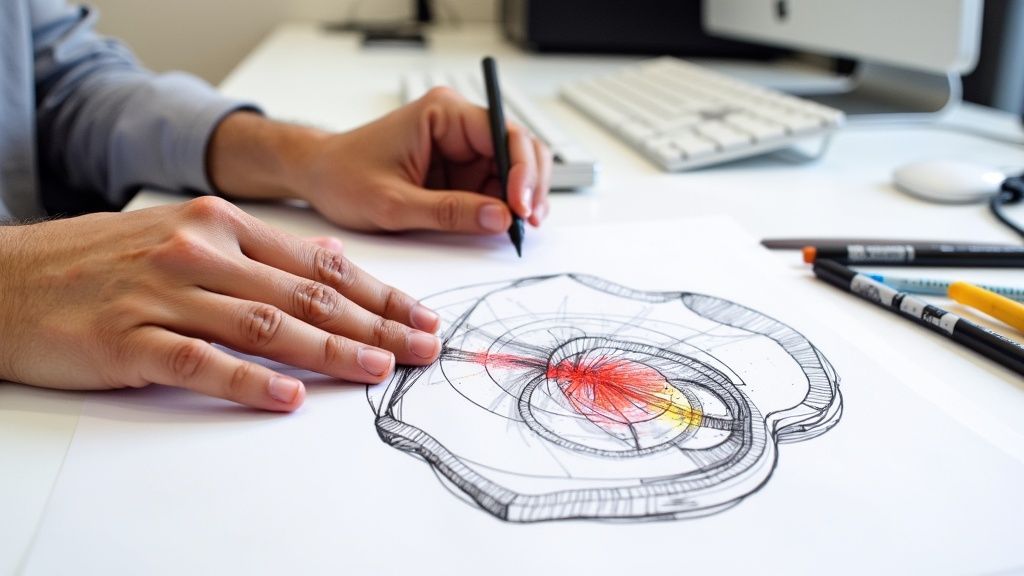
This is, without a doubt, one of the most basic and effective breathing techniques for relaxation. With everyday stress, it's common for us to breathe very shallowly, using only the upper chest. Diaphragmatic, or belly, breathing forces us to use our full lung capacity, sending a strong calming signal to the entire nervous system.
It's perfect for those moments right before an important client call or when you feel tension building up in your shoulders.
How to practice it without anyone noticing?
First, sit with your back straight but not tense. Make sure both feet are flat on the floor.
Place one hand on your abdomen, right below your ribs.
Inhale slowly through your nose, feeling your abdomen expand and gently push your hand outward. Your chest should barely move.
Exhale slowly through your mouth, noticing your abdomen contract and your hand return to its place.
Repeat this cycle 5 to 10 times. Focus on the sensation of the air flowing in and out.
Box breathing to regain focus
Do you feel like your team has a thousand tasks at once and doesn't know where to start? Box breathing, also known as four-square breathing or 4-4-4-4, is their best ally to cut through mental noise and refocus.
Its rhythmic structure helps regulate the nervous system and synchronize mind and body. The result is a state of calm alertness. There's a reason it's a favorite technique of high-performance athletes and professionals.
The method is very simple:
Inhale through your nose while mentally counting to four.
Hold the air in your lungs for a count of four.
Exhale slowly through your mouth while counting to four.
Keep your lungs empty for a count of four.
Completing this full cycle 4 or 5 times is enough to anchor you in the present.
4-7-8 breathing for deep relaxation
This technique, popularized by Dr. Andrew Weil, is ideal for high-pressure moments, such as before a board meeting or a difficult conversation. It works almost like a natural tranquilizer for the nervous system.
The specific pattern of this breath helps significantly oxygenate the body and noticeably lower the heart rate.
Follow these steps:
Exhale completely all the air from your lungs through your mouth, making a gentle whooshing sound.
Close your mouth and inhale quietly through your nose while counting to four.
Hold your breath while counting to seven.
Exhale completely through your mouth, making that whooshing sound, while counting to eight.
Repeat the entire cycle three more times. It's a powerful tool; feeling a little lightheaded at first is normal, so it's best to start slowly. For those looking to manage more intense spikes of tension, we've prepared a guide with more breathing exercises for anxiety that complement these practices perfectly.
How to make mindful breathing a habit in your team
Knowing different breathing techniques for relaxation is a great first step, but a good idea only works if put into practice. And that's where the real challenge lies for leaders and HR managers: how do we go from an isolated exercise to a habit that truly integrates into team culture?
The key isn't found in complex programs or massive investments. Believe us, we've seen it time and again since 2019, collaborating with companies across Mexico: small actions, repeated over time and led by example, are what generate real change. It's about consistency, not intensity.
Practical strategies to make breathing part of the day-to-day
Integrating mindful pauses doesn't have to be a workflow disruption. On the contrary, done right, it enhances it. The idea is for these moments to feel so natural that they become part of the workday's DNA, rather than "just another task."
Here are some concrete ideas we've seen work wonders across our clients' teams:
Start meetings with a minute of calm. Before diving headfirst into the agenda, invite everyone to take 60 seconds for a guided breath. It's a simple gesture that helps people "land" in the meeting, with a more present mind and less background noise.
Schedule "micro-wellness pauses." Use shared calendars to block out short 5-minute reminders, a couple of times a day. You can call them "Breathing Pause" or "Zen Moment." This legitimizes taking a rest and gives people permission to disconnect without feeling guilty.
Create friendly visual reminders. A sticky note or a small infographic near the coffee maker or break room can make all the difference. A simple "Have you breathed today?" is a subtle yet effective nudge.
When leaders don't just approve of these small gestures, but actively practice them, they prove that wellness isn't just talk, but a real priority.
"The goal isn't to add more to-dos to your team's list, but to integrate tools that make the day-to-day more manageable and less stressful. Mindful breathing is one of those skills that, once learned, serves you both inside and outside the office."
Building a healthy culture starts by leading by example
Let's be honest: the adoption of any new habit in a company depends almost entirely on leaders visibly practicing it. When a manager begins a meeting with a breathing exercise or speaks openly about how they use these techniques to manage pressure, it sends a tremendously powerful message to the entire team.
The effect is almost immediate. Not only does collective tension drop, but collaboration improves and trust is strengthened. It creates an environment where it's safe to say "I need a break," fostering an organizational culture that is much more human, healthy, and ultimately, more productive.
The process of building positive habits at work has a lot in common with doing so in personal life. If you want to delve deeper into the topic, you can find very helpful ideas in our article on how to encourage good habits at home; many of them can be seamlessly adapted to the corporate environment.
The real impact of breathing on team productivity
Implementing wellness practices like breathing techniques for relaxation is a great first step. But, as a team leader, you're probably asking yourself: how does this translate into business results? It's a completely valid question, and the connection is much more direct than it seems.
When an employee learns to manage their stress through breathing, they don't just feel better—they work better. It's pure physiology. Mindful and controlled breathing improves brain oxygenation, which directly impacts concentration capacity. Suddenly, tasks that used to drag on due to distractions or mental fatigue move along more smoothly.
And there's more. A less stressed team is a more creative team. Chronic stress puts us into a sort of "tunnel vision," limiting our ability to think outside the box. By releasing that burden with active breathing breaks, we free up mental resources to solve complex problems and generate new ideas.
From individual calm to collective results
At Zen to Go, we've seen this effect firsthand. It's not a theory—it's real data from our corporate clients backing up this connection.
Based on our semiannual satisfaction surveys, this is what we've measured among employees at companies that implement wellness programs with us.
Impact of Our Corporate Massages on Employees
Metric | Result |
|---|---|
Reported stress reduction | 83% |
Mood improvement | 75% |
Feels the company values their well-being | 95% |
Would recommend the program to other companies | 97% |
This isn't just a wellness metric; it's an indicator of productive potential. Less stress is associated with reduced absenteeism and lower employee turnover, two of the largest hidden costs for any company.
And how can you start measuring this impact in your own organization? You don't need complex systems. You likely already have the tools:
Work climate surveys: Before starting, measure stress levels. After implementing wellness pauses, measure again. Include specific questions about the perception of support from the company.
One-on-one feedback sessions: Create a safe space in your check-ins to ask directly: how are you feeling? Are these tools helping you? Qualitative feedback is gold.
Existing productivity metrics: Review the KPIs of participating teams. Are there improvements in efficiency or the quality of delivered work after implementing these practices?
Measuring these results not only justifies the investment in wellness, but also gives you hard data to keep building a healthy and productive culture. Well-designed workplace wellness programs offer a return that goes far beyond relaxation.
To take it to the next level, combine these breathing techniques with deep work and habit-building practices. That way, you help your team consolidate the benefits and integrate them sustainably into their daily routine.
Combine breathing with other wellness practices
Once your team has gotten the hang of breathing techniques for relaxation, the next step is weaving this powerful tool into a much more comprehensive wellness strategy. Think of mindful breathing as the foundation of a house; it's essential, but the benefits multiply when combined with other practices that care for both body and mind.
It's like a ripple effect. Someone who learns to breathe more deeply and slowly becomes much more receptive to the benefits of other activities, creating a virtuous cycle of well-being that shows in everyday life.

Synergies for wellness you can feel
It's not about packing an already tight schedule. The key lies in finding smart, practical combinations that flow naturally with the office routine. With small, strategic adjustments, the results can be huge.
Here are a few ideas we've seen work wonderfully in the companies we partner with:
Breathing and gentle stretching: Encourage your people to take a couple of minutes to combine diaphragmatic breathing with neck, shoulder, and back stretches. It's a super-effective way to release accumulated physical tension after hours in front of the computer.
Breathing and mindfulness: Promote the use of guided meditation apps, either during lunch or on a mid-afternoon break. A 5 to 10-minute session that blends mindfulness and breathing can recharge your mental battery like you wouldn't believe.
Breathing and light movement: Organize short, mindful walks—around the office or, even better, outdoors. The idea is to walk while paying attention to the rhythm of your breath. It helps clear the head and gets blood circulating better.
"Mindful breathing sets the stage. When the nervous system is calm, the body and mind are much more receptive to any other wellness practice, from a simple stretch to a relaxing massage."
The perfect complement to release built-up stress
This is where a service like ours truly makes a difference. Breathing techniques for relaxation are great for handling stress in the moment, but we all know that tension builds up physically. It turns into knots in the back and stiffness in the neck.
Our corporate massages, available both At-Desk and in a Shiatsu Chair, are that perfect complement. Picture this: while our certified therapists work to work out those stress knots, your employees can practice their breathing in a much deeper and more effective way. The chair format is ideal for events and requires little space, while the desk option integrates seamlessly into the workflow without disruptions.
Massage helps the body "let go" of physical tension, which in turn allows the mind to relax and breath to flow with total freedom. This synergy is the key to moving from momentary relief to a state of relaxation that truly lasts.
We see ourselves as your strategic ally in building a sustainable wellness culture—one that genuinely cares for people holistically. If you want to explore this approach further, we invite you to read about other relaxation techniques for stress you can implement at your company.
Clearing up doubts: key questions about breathing in the office
We know that when proposing new wellness initiatives, questions always come up. It's completely normal. As your corporate wellness allies, we've gathered the most common questions we hear from managers and employees to give you clear, straight-to-the-point answers.
The goal is to take the mystery out of breathing techniques for relaxation and give you the confidence to start rolling them out to your team today.
How much actual time do you need to invest to see results?
Here comes one of the best parts: you don't need to block out hours on the calendar. A few minutes a day can completely change the game. In fact, starting with short pauses of 2 to 5 minutes, once or twice a day, is much more sustainable than trying an extra-long session every once in a while.
The key is consistency, not duration. Encouraging your team to take three minutes before an important meeting or right after lunch is more than enough to start noticing tangible benefits in their focus and calm.
And what do I do with team skeptics?
Skepticism almost always comes from thinking this is something "too spiritual" or, worse, a waste of productive time. The best strategy is to approach it from science and performance.
Explain to them that controlled breathing isn't magic—it's pure biology. It's a physiological tool to regulate our body's response to stress.
Based on our experience, the most effective way to convince people is through example and results. Invite them to try a simple exercise, like box breathing, and have them notice how they feel afterward. Once they experience that feeling of mental clarity firsthand, the resistance will fade on its own.
Does this really work for everyone?
Yes! Breathing is universal. While it's true that some people connect with the practice faster, breathing techniques for relaxation are incredibly accessible tools for everyone, regardless of age, physical fitness, or whether they've ever tried it before.
The trick is to offer different options. That way, each person finds what works best for them. Some will prefer the structure of 4-7-8 breathing, while others will find immediate relief in simple diaphragmatic breathing. There's no one-size-fits-all recipe.
Can a simple breath really improve the work environment?
Absolutely. When people have a practical way to manage their own stress, irritability in the team drops and communication flows better. A more serene team is, by definition, a more collaborative and empathetic team.
By encouraging these pauses, you aren't just investing in each person's well-being. You are actively building a healthier, more resilient, and more positive organizational culture. It's a small change with an enormous collective impact.
At Zen to Go, we know that every company is different. That's why we design wellness programs tailored to you, combining the deep relaxation of our corporate massages with practical tools like these. We're here to help you transform your company culture, one pause at a time.
Discover how we can create a customized program for your team at https://www.zentogo.com.mx.