Benefits of massage therapy for building healthier and more productive teams
Can you imagine a tool that not only reduces your team's stress, but at the same time boosts their productivity? Those are the benefits of massage therapy when applied to the corporate environment: a strategic investment in your most valuable asset—your people—not an occasional luxury.
What Massage Therapy Is and Why It's Key for Your Company
Massage therapy goes far beyond a simple massage. It is a set of therapeutic techniques designed to relieve pain, release muscle knots, and improve overall well-being through the professional manipulation of the body's soft tissues.
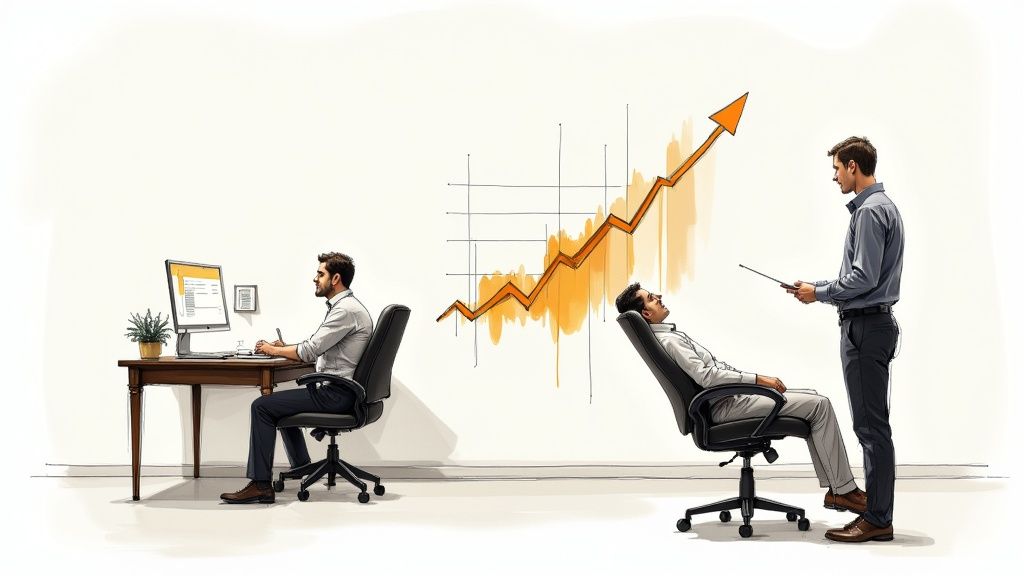
Now, let's think about the context of an office in Mexico, where long hours in front of a screen are part of everyday life. Here, massage therapy becomes a direct solution to problems we all know too well: that persistent neck pain, the tension built up in the shoulders, or the mental exhaustion carried over week after week.
By implementing a massage therapy program, you're not just offering a moment of relaxation. You are tackling the root of several challenges that directly impact team performance and morale.
Beyond Relaxation: A Boost to Comprehensive Well-Being
Since we started in 2019, at Zen to Go we have seen firsthand how companies that adopt massage therapy notice tangible changes. And it's not just about employees feeling "pampered," but about feeling cared for and, above all, valued.
This focus on comprehensive well-being has a direct and measurable impact. The main benefits we have achieved with diverse teams are:
Immediate stress reduction: A 15-minute session can lower cortisol levels (the infamous stress hormone), helping employees feel calmer and more centered.
Relief from physical discomfort: Directly combats muscle tightness and aches caused by sedentary postures, preventing long-term problems and improving day-to-day comfort.
Improved mood and morale: By releasing endorphins, massages encourage a more positive attitude and strengthen interpersonal relationships, creating a much healthier work environment.
Corporate massage therapy works like a physical and mental "reset." It allows employees to take a necessary break to recharge their energy, return to their tasks with more clarity, and feel genuinely supported by their company.
Interest in these practices is growing at an impressive pace in Mexico. To give you an idea, the spa industry reached a value of approximately $122.39 million USD in 2023, with a projected annual growth rate of 7.5% through 2032. This boom is due to greater awareness regarding the importance of wellness.
Implementing these programs is a clear sign that your organization actively cares about the health of its people. Exploring an in-office massage service is the first step toward building a solid and lasting culture of wellness, with benefits reflected in every aspect of the business.
The Physical Effects Your Team Will Feel Immediately
Office work leaves physical marks we all know all too well: a stiff neck after a long meeting, tense shoulders after hours in front of the screen, and that back pain that seems like a constant companion. The benefits of massage therapy are felt right from the first session, offering tangible and much-needed relief.
Think of muscle tension as a kink in a hose that stops the flow of water. In a very similar way, muscle knots block circulation and energy, causing pain and fatigue. A professional massage works to release those "knots," allowing everything to flow as it should again.

The immediate result is a feeling of lightness and well-being that your employees carry with them for the rest of the day. This relief not only improves their comfort, but also allows them to regain focus on their tasks, now free from painful distractions.
Direct Relief for Accumulated Muscle Tension
Prolonged postures at a desk are the leading cause of contractures in the neck, shoulders, and lower back. Massage therapy focuses right on these critical areas, applying specific techniques to release accumulated tension in muscle fibers.
This process not only relieves pain, but also improves flexibility and range of motion. An employee who can move without stiffness is an employee who is more comfortable, active, and, above all, less prone to long-term injuries.
Based on our experience, we have observed that neck tension relief is one of the most valued effects. Many employees tell us how their tension headaches decrease after a session, a very common issue in high-demand environments.
Improved Circulation to Combat Fatigue
Have you noticed how the team's energy drops in the afternoon? It is often due to poor circulation, aggravated by sitting for hours on end. Massage acts as a true boost for the circulatory system.
By improving blood flow, a greater supply of oxygen and nutrients is delivered to the muscles and, of course, to the brain. This revitalizing effect helps to:
Combat afternoon drowsiness and keep the mind alert.
Reduce the feeling of heaviness in the legs and arms.
Accelerate recovery from general muscle fatigue.
In short, a brief massage session can be more effective than another cup of coffee for recharging team energy in a healthy and sustainable way. For those looking to dive deeper, there are many resources that explore the multiple benefits of a relaxing massage and its impact on daily well-being.
Injury Prevention and Posture Correction
Chronic pain doesn't appear overnight; it is the result of poor postural habits repeated day after day. Massage therapy doesn't just treat symptoms, it also plays a vital preventive role.
By relaxing overloaded muscles, it becomes easier to adopt a more ergonomic and healthy posture. A certified therapist can identify muscle imbalances and provide focused care, helping to prevent repetitive strain injuries (RSI), such as carpal tunnel syndrome. In fact, the physical benefits of massage therapy are broad, including relieving muscle tension and, in some cases, contributing to the management of hip pain and other discomforts stemming from a sedentary lifestyle.
Investing in your team's physical health is directly investing in your company's operational continuity and efficiency. A healthier team is a team that is more present, focused, and energized.
The Mental and Emotional Impact Beyond Relaxation
A stressed team is less creative, less collaborative, and, at the end of the day, less decisive. Although the physical effects of a massage are felt almost immediately, the benefits of massage therapy on a mental and emotional level are just as powerful. In the long run, in fact, they take much deeper root in a company's culture.
Think of it as a "reboot" for your team's operating system. Between deadlines, back-to-back meetings, and day-to-day pressure, the mind gets overwhelmed. A massage acts as that strategic pause that lets you restart the system, clear out the "RAM," and get back to operating with more clarity and efficiency.
And this isn't just perception. The process has a very clear and direct biological basis. A professional massage doesn't just feel good; it triggers a cascade of biochemical reactions that flip the switch in the body.
The Chemistry of Well-Being in Action
When an employee receives a massage, two key things happen on a hormonal level. First, it helps lower levels of cortisol, better known as the stress hormone. When cortisol builds up, it is directly linked to anxiety, lack of focus, and chronic burnout.
At the same time, massage stimulates the release of serotonin and dopamine. These are the neurotransmitters that make us feel good, happy, and motivated. The formula is simple: less of what drains us, more of what keeps us going.
Working with hundreds of teams, we've found that this wellness pause goes beyond simple rest. It is a direct investment in mental clarity, creativity, and the construction of a psychologically safer and more positive work environment.
From Relaxation to Emotional Resilience
A team with better mental health is a stronger team. Employees equipped with tools to manage their stress develop greater emotional resilience. This means they are better prepared to face daily challenges, adapt to changes, and collaborate more effectively under pressure.
Imagine the sales team preparing for the end of the quarter. Or the development team about to launch a new product. Tension is sky-high. An in-office massage therapy session can be just what they need to:
Improve focus: By reducing the "mental noise" of stress, employees can better focus on complex tasks and make sharper decisions.
Foster creativity: A relaxed mind is a mind more open to new ideas and solutions that weren't on the table. Massage creates the mental space for that spark to appear.
Boost team morale: Sharing a positive wellness experience brings people together. It fosters a sense of camaraderie and demonstrates that the company genuinely cares about them.
According to our semiannual satisfaction surveys, 79% of employees who participate in our corporate wellness programs report a significant reduction in stress. This figure isn't just a wellness metric; it is a key indicator of the productivity potential unlocked when you look after your people's mental health. Massage therapy isn't just about relaxing muscles—it's about strengthening minds.
How Massages Translate into Productivity and a Positive Work Environment
Now, let's talk about what can be measured. The physical and mental benefits of massage therapy are the starting point, but as a leader, you're probably asking yourself: how does this translate into my business's key performance indicators? The answer is quite simple: a team that feels good works better. Period.
The connection between well-being and performance isn't a happy coincidence; it's a cause-and-effect relationship. When an employee is freed from shoulder tension and mental stress, their ability to focus on complex tasks skyrockets. This is one of the most obvious benefits of massage therapy we have seen across companies of all sizes.
A clear mind and a pain-free body are synonymous with greater efficiency. Instead of struggling with a stiff neck or a head clouded by anxiety, the employee can dedicate all their energy to what matters: solving problems, creating, and collaborating.
Reducing Absenteeism and Presenteeism
Chronic pain and exhaustion are two of the usual suspects behind workplace absenteeism. A regular massage program works as a preventive measure, helping reduce those physical ailments that often lead to medical leave.
But there is an even costlier ghost: presenteeism. We're talking about employees who are physically in the office, but their minds are elsewhere due to stress or physical discomfort. They produce less, make more mistakes, and can negatively affect team morale. By improving their overall well-being, massage therapy directly combats this phenomenon, ensuring your team isn't just there, but truly present and engaged.
Based on our semiannual satisfaction surveys, the impact of Zen to Go corporate massages is clear: 79% of employees report reduced stress, 99% feel the company values their well-being, and 95% would recommend the program to other companies. This demonstrates the direct effect on team morale and engagement.
These numbers are not just wellness metrics; they reflect a team that feels supported and is, therefore, more motivated to give their best.
Increased Focus and Concentration
Think of concentration as a muscle. If it's fatigued by constant stress, its performance plummets. A 15-minute massage session acts as a reset that recharges that muscle, allowing employees to return to their desks with a fresh perspective and greater attention span.
This mental "reboot" is crucial in environments demanding high creativity and problem-solving. By turning down the volume on mental noise, employees can:
Make clearer, more strategic decisions.
Solve complex problems more nimbly.
Maintain productivity throughout the workday, not just in the first few hours.
This boost in individual focus adds up, creating a multiplier effect on the entire team's productivity.
Improved Talent Retention
In today's job market, the benefits that truly make a difference are those that show a genuine interest in the person, not just the employee. Offering in-office massage therapy is a strong signal that your company invests in the overall health of its people.
These types of initiatives strengthen loyalty and a sense of belonging. An employee who feels cared for is far less likely to entertain outside offers. In fact, wellness programs are an increasingly decisive factor in attracting and retaining top talent.
At the end of the day, massage therapy isn't an expense; it is a strategic investment with a very clear return. It fosters a positive work environment, strengthens company culture, and translates into a healthier, happier, and more productive team. If you're interested in exploring further, we recommend our article on how to improve the work environment with concrete actions.
How Do You Implement a Massage Therapy Program in Your Office?
Bringing the benefits of massage therapy to your company doesn't have to be a headache. Quite the opposite. Implementing a wellness program like this is much simpler than most HR leaders or office managers imagine, especially when you have a partner that understands corporate pacing.
The key isn't to set up a makeshift spa, but to integrate smart, efficient wellness pauses that make a real impact without disrupting the workflow. It's about designing a program that adapts to your office, not making your office adapt to the program.
The first step is breaking the myth that extensive infrastructure is needed. With solutions designed specifically for the workplace, you can deliver a top-quality experience with minimal logistics and results you feel immediately.
Choosing the Ideal Format for Your Team
Every office has its own dynamics, and wellness solutions should reflect that. At Zen to Go, after working with hundreds of companies in Mexico, we have proven that flexibility is the secret ingredient for success. These are the two formats that work best in the corporate world:
In a Shiatsu Chair: This is our most popular and versatile option. The employee sits comfortably in an ergonomic chair (fully clothed), and the session focuses right where daily tension builds up: back, neck, shoulders, and arms. It's perfect for special events, wellness days, or as a recurring benefit everyone looks forward to.
At the Desk: This format is efficiency turned into wellness. Our certified therapist goes directly to the employee's workstation and performs the massage in their own chair. These are 15-minute sessions that require zero additional space, allowing the team to get an energy reset without significantly disrupting their workday.
Choosing one or the other, or even a combination of both, will depend on your goals, your team's rhythm, and your available space. Both are designed to deliver the maximum benefit in the shortest time possible.
A successful program doesn't impose; it integrates. By choosing formats that don't require long absences or complex preparations, you remove barriers and get more people to participate and feel grateful.
The Logistics: Step by Step and Hassle-Free
Once you choose the format, the rest flows surprisingly smoothly. As your strategic partner, we take care of all the management so you only need to focus on sharing the good news with your team. Here is how we handle it at Zen to Go:
We define the details: Together, we agree on the frequency (weekly, biweekly, monthly, or for a one-off event?), session duration, and how many therapists are needed to serve your team without rushes or delays.
Easy online booking: We give you access to an online scheduling system so each employee can choose the time slot that suits them best. The system even sends automated SMS reminders, reducing no-shows and making organization easier for everyone.
At your facilities: Our certified therapists arrive at your office equipped with everything needed. Whether in Mexico City, Monterrey, Guadalajara, or other cities, we make sure all you need to designate is a quiet corner for the magic to happen.
Adaptability for Companies of Any Size
It doesn't matter if you're a fast-growing startup or an enterprise with multiple locations. A massage therapy program should be able to scale with you. The flexibility is complete. We can serve 20 people during a special event or 500 employees on a recurring basis; the model adjusts to your needs.
Designing and implementing workplace wellness programs that work is our specialty. The secret lies in starting with a pilot plan, measuring the impact with clear metrics, and then expanding the initiative based on the results and what your own people tell you. Corporate massage therapy is not a one-size-fits-all solution; it is a tailored tool for your team's well-being.
Frequently Asked Questions About Workplace Massage Therapy
We know that as an HR leader or office manager, the idea of implementing a new wellness program always comes with questions. That's completely normal. You want to make sure the investment makes sense, that logistics aren't a headache, and that the impact is real.
That's why we've compiled the most common questions our corporate clients ask us. We answer them straightforwardly and without fluff, so you can envision how this initiative can work (and succeed) in your company.
How much space is needed for the massage sessions?
This is usually the first question, and the answer is surprisingly simple: very little. You don't need to adapt a spa room or permanently sacrifice any space. Our services are designed to fit the modern office.
For the Shiatsu chair massage, which is the most popular option, we only require a quiet corner of approximately 6x6 feet (2x2 meters). It can be a small meeting room that isn't in use, an area in the cafeteria, or even a corner in a common area.
For desk massages, the required space is zero. Our therapists go right to each employee's desk, delivering an ultra-effective session without anyone having to get up from their chair.
Flexibility is key. We adapt to your space so logistics are never an obstacle.
Don't massages disrupt the workday too much?
Quite the contrary. They are designed to be a productive pause, not an interruption. Sessions are brief and straight to the point, generally lasting between 15 and 20 minutes. This time is more than enough for a certified therapist to release built-up tension and recharge an employee's energy.
Think of it as an investment in the upcoming hours of work. An employee who takes 15 minutes to reset their mind and body returns to their tasks with sharper focus, more creativity, and a much more positive attitude. In practice, this short break combats presenteeism and raises the quality of work performed for the rest of the day.
At Zen to Go, we have perfected the timing to maximize impact without disrupting operations. It is a strategic pause that adds to productivity, rather than taking away from it.
What types of companies can implement this program?
Any company looking to invest smartly in the well-being of its people, regardless of size or industry. We have had the pleasure of working with agile startups, multinational corporations with offices across multiple cities, and SMBs that understand their team is their most valuable asset.
Our programs are fully scalable. We can organize a wellness day for a team of 20 at a special event or manage a recurring program for over 500 employees. The key is adapting to your needs and budget.
How often are sessions recommended?
The ideal frequency depends on your goals and the stress levels your team manages. Based on our experience, these are the schedules that yield the best results:
Monthly: An excellent starting point. It works as a highly anticipated perk that helps keep morale high and manage stress on a regular basis.
Biweekly: Ideal for teams facing high pressure levels or spending long hours in sedentary postures. It helps prevent tension from building up more effectively.
Weekly: The premium option for companies looking to position wellness as a central pillar of their culture. It creates a deep and sustained impact on workplace atmosphere and productivity.
For one-off events: Perfect for closing out a successful quarter, health and wellness weeks, conferences, or as an activation to ease tension before a major launch.
Are there any contraindications we should keep in mind?
Your team's safety and well-being are our top priority. While massage therapy is safe for the vast majority of people, there are certain medical conditions that require caution or are direct contraindications.
Our certified therapists are trained to identify these situations and always ask key questions before each session to ensure a safe experience. For more details, you can review the information on which medical contraindications cannot be treated.
Transforming your company culture starts with concrete actions that show genuine care for your team. A massage therapy program is one of the most direct and appreciated ways to do so.
At Zen to Go, we are ready to be your strategic partners on this journey. Discover how our corporate wellness solutions can adapt to your company and take well-being to the next level.