Solutions for workplace stress in the technology sector: A practical guide for HR
The solutions for workplace stress in the technology sector range from implementing flexible schedules and active breaks to wellness programs that actually work, such as office massages. As an HR ally, we know your goal is to break the culture of hyperconnectivity and constant pressure to transform the work environment into a space that truly cares for its people.
Why stress in your tech team is a ticking time bomb
The Mexican tech sector is all about innovation and speed, but that pace comes at a hidden cost that, as an HR leader, you are likely starting to notice. The pressure to meet sprints, product launches, and that always-on mentality (always-on) creates the perfect atmosphere for burnout.
And this is not just a simple "that's how the tech industry is". Stress has become an operational risk that can be measured. It is not a personal problem of an employee, but a crack in organizational culture that directly affects your turnover, absenteeism, and engagement KPIs. Each exhausted developer or absent manager due to burnout translates into delays, lower-quality code, and ultimately, a reduced capacity to innovate.
The real cost of ignoring your team's fatigue
When a team lives under constant pressure, the first symptoms are almost invisible. You may notice some apathy in daily meetings or sharper communication in Slack channels. But very soon, these small details turn into problems that do show up in your reports:
Increased absenteeism: Employees who request sick days more frequently, usually due to mental fatigue.
Increased turnover: The most valuable talent, especially senior profiles, is the first to seek less toxic environments.
Drop in engagement: Participation in company initiatives decreases, and commitment to objectives feels weaker and weaker.
To better understand how these symptoms translate into direct costs for the company, we have prepared a table that connects team burnout with the indicators that worry you as an HR professional.
Impact of workplace stress on key HR indicators
Stress symptom in the team | Affected HR indicator | Hidden cost to the company |
|---|---|---|
Mental exhaustion and apathy | Low productivity | Delays in projects, lower quality in deliverables, and loss of competitiveness. |
Irritability and poor communication | Bad work environment | Internal conflicts, lack of collaboration, and a toxic organizational culture. |
Demotivation and lack of commitment | High turnover | Recruitment costs, loss of institutional knowledge, and overload on the remaining team. |
Physical fatigue and health problems | Increased absenteeism | Operational interruptions, lower team capacity, and higher medical expenses. |
As you can see, what starts as a well-being problem ends up being a business problem. Ignoring it is not an option if you want to maintain a competitive and healthy team.
In this context, the statistics on workplace stress in Mexico paint a picture we cannot ignore. In fact, the country leads the world in this problem, with an alarming 75% of workers suffering fatigue for this reason, a figure that surpasses powers such as China and the United States. If you are interested in exploring the data more in-depth, you can learn more about workplace stress statistics in our dedicated article.
In our experience working with HR teams of various sizes in Mexico, we have seen how unmanaged stress in tech teams eats away at culture. It starts as a silent problem and ends up affecting the company's ability to attract and retain the talent needed to grow.
This scenario not only compromises the well-being of your people, but also complicates compliance with key regulations such as NOM-035. That's why addressing workplace stress in the tech sector is not a luxury; it is a strategic necessity to protect your most valuable asset: your teams. Learn more about the alarming figures on workplace stress that confirm the urgency to act now.
How to effectively diagnose stress levels in your teams
Before launching any wellness initiative, you need data that speaks for itself. As an HR professional, you know that to justify budget proposals to management, perceptions and good intentions are not enough. You need a clear diagnosis that demonstrates the real magnitude of the problem.
It is about transforming stress from a "feeling" into a measurable and actionable indicator.
The good news is that this process does not have to be complicated or overwhelming. In fact, it is very likely that you already have most of the information you need at hand. The key is knowing where to look and how to connect the dots between compliance, what your teams feel, and daily metrics.
Beyond the NOM-035 questionnaire
Complying with NOM-035 is an excellent starting point, but it cannot be the end of the road. This regulation is fundamental for identifying the psychosocial risk factors that, in the tech sector, are often very evident: workloads that overflow, little autonomy over tasks, and workdays that stretch to eat away at personal life.
However, to have a complete and up-to-date picture, it is vital to complement NOM-035 with more agile and direct tools.
Anonymous pulse surveys: These are short, frequent, and most importantly, anonymous. This invites honesty. Include direct questions that give you a real thermometer of the team's feelings at that moment.
Focus groups with leaders: Organize confidential sessions with team leads and managers. They are on the front lines and are the first to notice behavioral patterns that betray stress: irritability, lack of concentration, or communication that becomes strained.
Analysis of operational metrics: Dive into the data you already have. A sustained increase in overtime hours, a higher error rate on key projects, or a spike in vacation requests due to "tiredness" are not coincidences; they are clear symptoms of a team at its limit.
By crossing these three sources, you move from a simple compliance assessment to a comprehensive diagnosis that allows you to see where it hurts the most and why.
In our experience working with HR teams, we have found that the most revealing questions are the simplest. A question like: "On a scale from 1 to 10, how likely do you feel it is to disconnect mentally from work at the end of your day?" can tell you much more than a 50-item questionnaire.
This diagram makes it clear: constant pressure leads to burnout and, if unaddressed, ends in talent flight. It is a vicious cycle that you can and must interrupt with timely diagnoses.
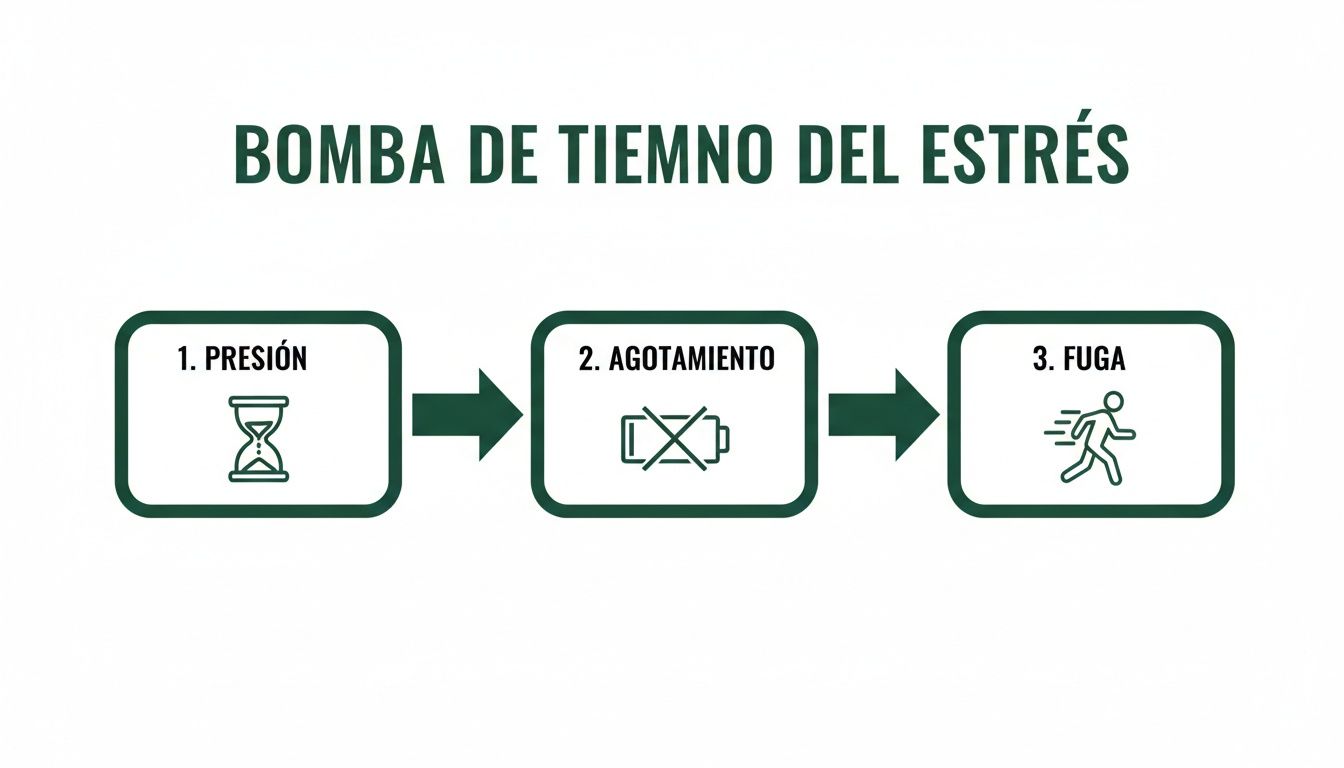
As the image shows, intervening at the pressure stage is crucial to prevent stress from escalating and becoming a talent retention problem.
The importance of acting proactively
Data from the tech sector in Mexico does not lie. According to the Mental Health Barometer of Workers in Mexico, 36% of employees feel tension or anguish regularly. But the most revealing part is this: the same study found that 30% of teams rated with low or medium risks on NOM-035 showed high levels of stress and anxiety in more specialized tests.
This confirms the urgency of going beyond basic compliance. You can consult the complete study on the rise of workplace stress to delve deeper into the phenomenon.
A good diagnosis will not only provide you with a solid foundation to design solutions for workplace stress in the technology sector that truly work but will also arm you with the arguments needed to secure budget and support from management.
If you are looking for practical tools to get started, we recommend exploring this stress measurement test, which can be an excellent complement to your internal surveys.
Designing a wellness program that your tech teams truly value
Generic solutions like placing fruit in the kitchen or sporadic yoga classes rarely work with the analytical mindset of technology teams. Let's be honest, to create a program with real impact, you need to go further. You need to offer solutions that directly address their true pain points: the lack of autonomy, the difficulty in disconnecting, and the need for a clear professional growth path.
As an HR professional, your challenge is not only to design an attractive strategy but also to ensure it feels like a genuine tool for improving their day-to-day lives. In our experience, the most successful programs are built on three fundamental pillars that tech teams do value.
Flexibility and autonomy: the true emotional salary
For a developer or a data engineer, autonomy is not a luxury; it is an indispensable condition for entering that state of flow where productivity soars. Constant interruptions and rigid schedules are their worst enemies.
Schedules that truly are flexible: It is about managing their energy, not just their time. If someone is more productive at 10 p.m., give them the confidence to structure their day that way, as long as objectives are met.
Clear hybrid work policies: Define what is expected of remote work. A good hybrid model reduces transportation stress and multiplies focus.
"Focus Days" without meetings: Implement a meeting-free day each week—Wednesdays work very well. This allows teams to dive into complex tasks without interruptions, reducing frustration and increasing satisfaction.
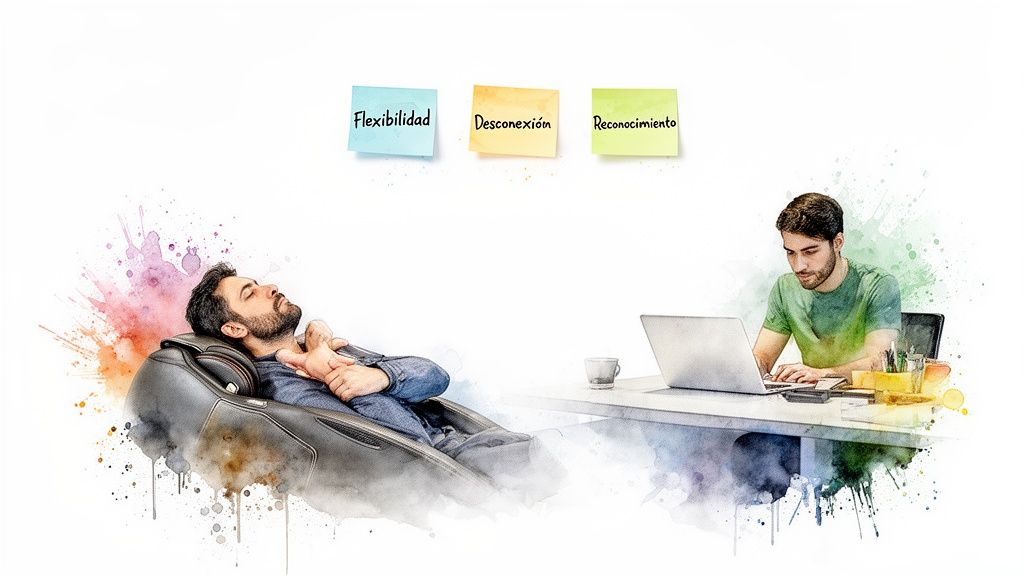
The image reflects exactly the balance sought with a well-designed program, where work and recovery can coexist healthily.
Disconnection and physical recovery
Spending hours in front of a screen generates a physical and mental tension that accumulates. This is where tangible, easily accessible solutions make a huge difference. Promoting the right to disconnect is key.
In our experience working with HR areas all over Mexico, we have seen that the most valued benefits are those that provide immediate relief and do not require the collaborator to make a significant logistical effort.
One of the most powerful solutions for workplace stress in the technology sector is active breaks that truly recover. Office massages are the best example. A 15-minute session in a Shiatsu chair or directly at the desk not only does not interrupt the flow but breaks the cycle of muscle tension and visual fatigue. It is a break that recharges energy for the rest of the day.
If you want to delve into how to put something like this together, you can check out our guide on how to create a workplace wellness program that fits your needs.
Meaningful development and recognition
Tech talent is ambitious. They value professional growth above many other things. Feeling stagnant is a direct source of stress and demotivation.
Internal mentoring programs: Connecting junior developers with senior leaders not only accelerates learning but also creates bonds of loyalty and belonging.
Training budget: Offer an annual individual budget for courses, certifications, or conferences. This shows that the company actively invests in their development.
Recognition of real effort: Don't just celebrate successful launches. Also recognize the hours of research, solving a tricky bug, or good collaboration on a difficult project.
Finally, one of the solutions that provides the most peace of mind is offering your teams access to major medical expense insurance. It's a tangible way to reduce the stress caused by concerns about their health and that of their families.
How to integrate well-being into daily operations without dying in the process
You already have the diagnosis and a design for a wellness program that looks amazing on paper. But let's be realistic: as an HR professional, your biggest fear is that a great strategy will die due to poor execution. Or worse, that it becomes another administrative burden for you.
The success of any wellness initiative does not lie in adding more tasks but in choosing solutions that take work off your plate. The secret lies in operational ease. A successful implementation feels light, both for you and the teams. When well-being becomes a complication, it creates more stress than it seeks to resolve.
A practical checklist for frictionless implementation
Execution is everything. Before you hit play on the program, review these points. They will help you anticipate the most common obstacles we have seen in hundreds of HR teams in Mexico.
Inspiring communication, not forcing it. The way you present the program defines its reception. Forget the corporate tone and focus on the "What's in it for me?". Communicate the benefits directly, clearly, and humanly. Instead of "Q3 wellness initiative", try something like "Your break to recharge before the next release".
Leaders as ambassadors, not as gatekeepers. Support from team leads is crucial. They are the ones who need to actively promote the breaks and, above all, participate. If a team leader is the first to receive a chair massage, it sends a powerful message to everyone: "taking care of oneself is allowed and important".
Simple and centralized logistics. You can't be wasting time coordinating suppliers, dates, and payments separately for each initiative. Look for partners who offer unified management and simplify your life.
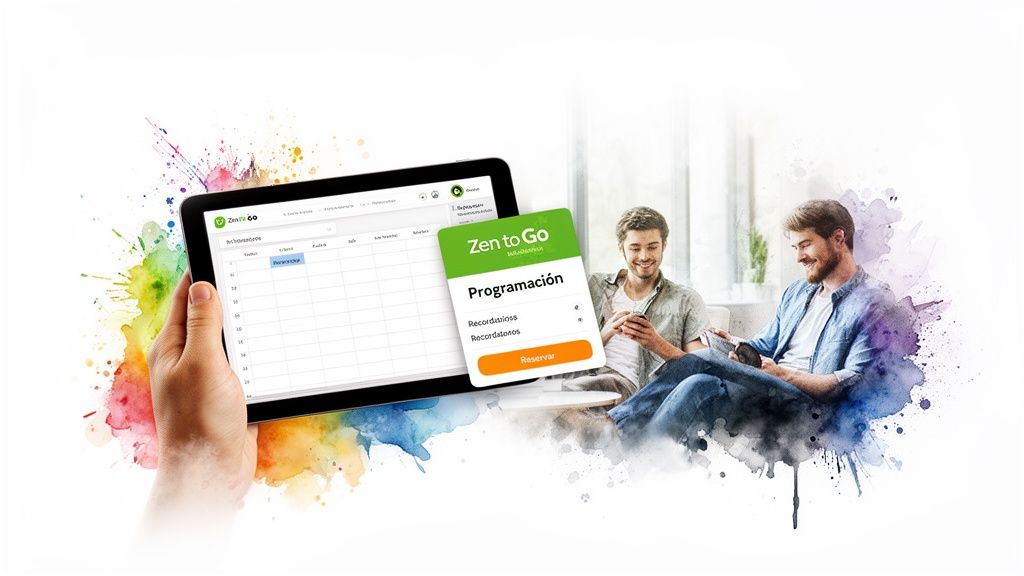
From our experience at Zen to Go, we understand that your time is precious. That's why we designed a platform where you can schedule wellness days, manage employee registrations, and receive automatic reminders. All from one place, without juggling.
A practical case of an implementation that works
Imagine this: a software development company in Guadalajara is two weeks away from a critical delivery. The tension is palpable. As the People & Culture manager, you decide to implement one of the most effective and quick solutions for workplace stress: a Shiatsu chair massage day.
With a partner like Zen to Go, the process is this simple. You enter our platform, choose the date, select the number of employees, and send the invitation. Each person books their own 15-minute slot via a link, avoiding overlaps and the mess of manually coordinating schedules.
On the day of the event, our therapists arrive ready to provide that much-needed energy boost for the team.
The result is a team that feels valued, a visible reduction in stress, and most importantly, zero operational burden for you. This demonstrates that well-being is not just possible, but can also be incredibly easy to integrate right when it is most needed.
And how is this measured? Justifying the investment in well-being to management
So that your wellness program doesn't remain a good intention (and loses its budget in the next quarter), you need to demonstrate its value with data. With solid data. As an HR leader, you know management needs to see a clear return on investment (ROI) to continue betting on an initiative.
The million-dollar question is: how do we translate something as human as "less stress" into numbers that directly impact the business?
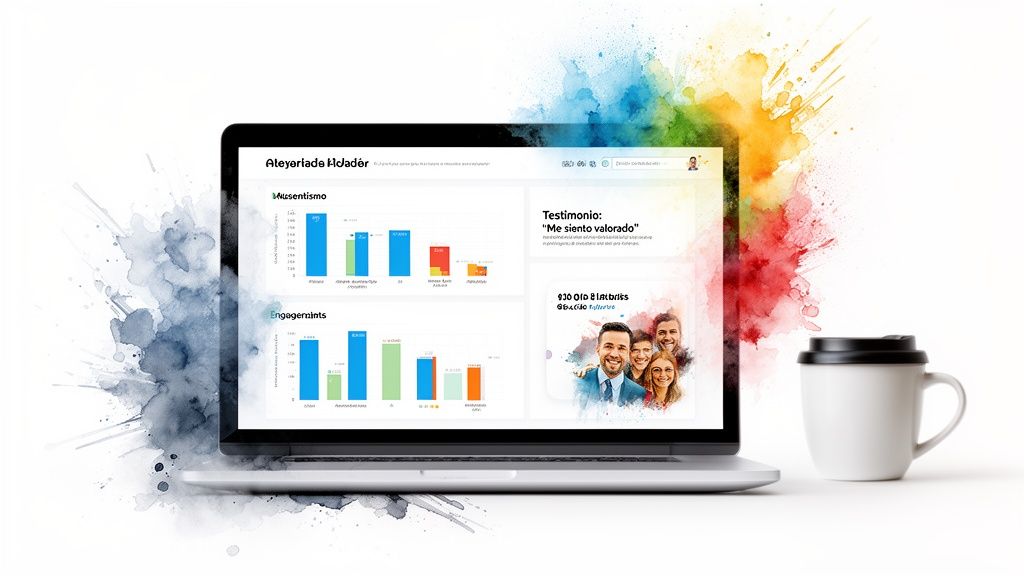
It is about going beyond the typical satisfaction survey. The objective is to build a wellness dashboard that combines quantitative metrics (those that speak to Finance) with qualitative ones (those that speak to the heart of the culture) to tell a complete, powerful, and above all, convincing story.
Quantitative metrics: the data that speaks the language of business
These are the indicators that connect well-being with the financial and operational health of the company. They are your best argument for seeing the program not as an expense, but as a strategic investment.
Reduction in voluntary turnover rate: This is the key metric. Calculate your turnover rate before and after implementing the program. A decrease, even by a couple of points, represents a huge savings in recruitment, selection, and training costs.
Decrease in absenteeism days: Monitor unplanned absences, especially those reported due to minor illnesses, fatigue, or "mental health days". Less absenteeism means more productive hours and more stable teams to meet sprints.
Increase in productivity (by proxy): Measuring productivity in development or creative roles is a challenge, we know that. But you can use indirect indicators such as the speed of project delivery (velocity in agile teams) or the reduction in the error and bug rate reported by the QA team.
Qualitative indicators: the data that gives soul to the strategy
The numbers tell part of the story, yes, but it is the perceptions and experiences of your people that provide the human context that ultimately convinces any leader.
Sentiment analysis in climate surveys: Don't just stick to a score of 1 to 10. Use tools to analyze open comments and detect if words like "exhausted", "pressured" dominate, or if, on the contrary, more words like "valued", "focused", and "motivated" start to appear.
Internal testimonials and success stories: Collect short phrases and stories. An anonymous testimonial saying "the massage breaks helped me finish the release without feeling burned out" is incredibly powerful. Much more than any graph.
Program recommendation index (internal NPS): Simple as that. Ask participants how likely they are to recommend a specific initiative to their colleagues. A high NPS validates the quality and relevance of what you are offering.
A practical example for your next presentation: "Before the wellness program, our turnover in the QA area was 25% annually. Six months after implementing flexible schedules and bi-weekly chair massage sessions, turnover has dropped to 18%. This represents an estimated savings of $XXX,XXX pesos in recruitment and onboarding".
Here you have a quick guide to start translating your actions into measurable results and presenting them convincingly to the company management.
Metrics to measure the ROI of your wellness program
Metric | How to measure it | Example of impact in the tech sector |
|---|---|---|
Turnover Rate | Compare the % of employees who leave voluntarily before and after the program (quarterly/annually). | A 7% reduction in the turnover of senior developers can save over $1,500,000 MXN annually in replacement costs. |
Absenteeism | Monitor the number of days of unplanned absence per employee/team. | Reducing 1 average absence day per employee per year in a team of 100 people equals recovering 800 hours of productive work. |
Productivity (proxy) | Measure delivery speed in sprints (Agile teams) or the error rate (bugs) reported post-launch. | A team that receives active breaks can improve its velocity by 10-15% and reduce critical bugs that delay projects. |
eNPS | Ask periodically: "On a scale of 0 to 10, how likely are you to recommend working here to a friend?". | Increasing eNPS from 20 to 40 points strengthens your employer brand, attracting top talent organically and reducing headhunting costs. |
Benefit usage | Record the % of participation in each initiative (massages, yoga, workshops). | If 80% of the DevOps team actively participates in massage breaks, it is a clear indicator that the initiative meets a real need. |
Connecting these points will allow you to demonstrate that caring for your people is not just "the right thing to do" but also the smartest thing for the business.
In our experience at Zen to Go, we have consistently measured the impact of our programs. According to our biannual satisfaction surveys, 99% of employees who participate in our wellness days feel that the company truly values their health.
That's no small data point. It is a direct indicator of the perception of your employer brand.
In the end, justifying this investment is not about defending an expense. It's about demonstrating, with numbers and stories, how caring for your people is the most cost-effective strategy for business growth.
Frequently asked questions about workplace stress in technology
We know that as an HR leader, you have many questions when implementing real solutions for stress in the tech sector. Here we go straight to the point with the questions we get most often in our daily work with companies like yours.
How do I convince my director that investing in massages is profitable?
The key is to speak their language: that of Return on Investment (ROI). Forget about presenting it as a "wellness expense" and frame it for what it is: a strategic investment to reduce operational costs.
Use the data you already have on the table. Connect the cost of the massage program with the potential reduction in turnover rate. For example: "Investing $X in massage days can help us retain just one senior developer, saving us over $300,000 MXN in recruitment and onboarding costs". This way, it ceases to be a nice to have and becomes a retention tool with a direct and measurable impact on the budget.
What do I do if my teams don’t participate in activities due to lack of time?
That is a clear symptom that the company culture implicitly punishes breaks. The solution is not to pressure them to participate but to integrate well-being in a way that does not compete with sprint deliveries. This is where operational ease becomes your best ally.
The most effective solutions are those that require "low effort" from the employee. For example, Spa Shiatsu or desk massages are ideal because they last just 15 minutes and don’t require the person to change clothes or be absent for long. It’s a restorative break that integrates seamlessly into the work routine, proving that the company actively facilitates their recovery.
Does a wellness program truly help comply with NOM-035?
Yes, directly and proactively. NOM-035 requires you to identify, analyze, and prevent psychosocial risk factors. Things like workloads that exceed the employee’s capacity or extreme work hours are everyday occurrences in the tech sector.
A well-designed wellness program—including active breaks, massages, and clear disconnection policies—is not just a nice extra. It is one of the most effective preventive measures you can implement. By offering these tools, you are demonstrating with concrete actions that the company cares about and addresses the mental health of its teams. And that, in the end, is the spirit of the regulation.
At Zen to Go, we understand the complexity of your role and that you need practical, measurable, and functional solutions. Since 2019, we have been helping companies across Mexico transform their work culture, one break at a time.
Discover how our corporate wellness programs can help you reduce stress and empower your teams.