Occupational health in Mexico: The ultimate guide for HR leaders
Occupational health in Mexico is much more than paperwork and regulations; it is a strategic discipline designed to protect and, above all, enhance the physical, mental, and social well-being of your collaborators.
For Human Resources leaders like you, it is one of the most powerful tools for building resilient teams, reducing absenteeism, and ultimately strengthening your employer brand in an increasingly competitive talent market.
Understanding occupational health beyond compliance
For many HR professionals in Mexico, the phrase "occupational health" brings to mind images of inspectors, safety manuals, and the dreaded compliance with Official Mexican Standards (NOMs).
And yes, that part is fundamental. But seeing it solely as a legal obligation is to miss the bigger picture. It’s like having a race car and only using it to go to the supermarket. Occupational health, in essence, is one of the most powerful levers for strategic talent management.
Think of it this way: every time a collaborator is absent due to stress, suffers from back pain due to a bad chair, or feels "burned out" (burnout) from work overload, it's not just an individual problem. It's a symptom that directly affects the indicators that matter most to you:
Productivity: A healthy and safe team is a focused and efficient team. It’s that simple.
Employee turnover: An environment that cares for its people becomes a place where they want to stay.
Talent attraction: New generations no longer just seek a good salary; they actively research companies with a solid wellness culture.
Work climate: Safety, both psychological and physical, is the foundation of trust, engagement, and collaboration.
The new approach for modern HR
In our experience working with HR teams of various sizes in Mexico since 2019, we have seen a very clear shift in mindset. Talent leaders no longer ask whether they should invest in the well-being of their people, but how to do it intelligently and, above all, measurably to justify the budget.
Today, occupational health is the bridge that connects regulatory compliance with creating an exceptional employee experience. It’s no longer just about avoiding accidents, but about building an environment where people can thrive.
Current challenges, such as burnout in hybrid work models or managing mental health, have put the spotlight on a proactive approach. It's no longer enough to react to problems. The key is to anticipate them.
This means that caring for your people is not an expense. It is undoubtedly the best investment you can make for the future of your organization.
The legal framework of occupational health in Mexico: what you need to know
For an HR leader, laws and Official Mexican Standards (NOMs) may seem like a maze. Let’s be honest, they can be a bit intimidating sometimes. However, understanding the legal framework of occupational health in Mexico doesn't have to be a titanic task.
The key is to see it not as a manual of rules, but as a map that guides you to protect your people and, at the same time, shield the company. Let’s think of the NOMs as the foundations that support a solid and safe culture of well-being.
The legal pillars you need to know
Everything starts with the Federal Labor Law, which establishes the obligation of employers to ensure the safety and health of their collaborators. But it is the Official Mexican Standards, issued by the Ministry of Labor and Social Welfare (STPS), that translate that obligation into concrete actions.
Instead of overwhelming you with an endless list, let's focus on the NOMs that are part of daily talent management in Mexico.
Below, we have prepared a summary table with the most important standards, their objectives, and what key action you should take as a Human Resources leader. Think of it as your quick compliance guide.
The essential NOMs of occupational health for HR in Mexico
A practical summary of the most important standards, their purpose, and the key action you should implement for compliance.
Official Mexican Standard (NOM) | Main purpose | Key action for Human Resources |
|---|---|---|
NOM-030-STPS-2009 | Establish preventive safety and health services at work. It is the base standard that requires you to identify and manage risks. | Conduct a comprehensive risk assessment and design an annual program to systematically address them. |
NOM-035-STPS-2018 | Identify, analyze, and prevent psychosocial risk factors such as work stress, burnout, and violence. | Apply the questionnaires, analyze the results by area, and create an action plan to mitigate the identified risks. |
NOM-036-STPS-2018 | Prevent ergonomic risks, specifically those related to the manual handling of loads, to avoid musculoskeletal injuries. | Evaluate tasks that involve lifting loads, train personnel on safe techniques, and provide the necessary support equipment. |
Ignoring these regulations has a real and tangible cost. In Mexico, occupational health faces a monumental challenge with over 270,000 reported workplace accidents annually, according to IMSS data. This figure not only reflects the vulnerability of workers, but also the economic impact on companies, which can be devastating.
Think of it this way: complying with the NOMs is not just to avoid a fine; it’s a direct investment to reduce operational costs, decrease turnover, and improve your team's productivity.
From standards to daily practice in HR
Knowing what the law says is the first step, but the real challenge for HR is translating it into actions that people experience and feel in their everyday life. You don’t need to be a legal expert to get started.
For NOM-035, for example, an excellent starting point is to apply the questionnaires that the standard provides. The results will give you a clear map of where the red flags are in your organization. If you want to go beyond simple compliance, we recommend our comprehensive guide on how to comply with NOM-035 and promote psychosocial well-being.
In the case of NOM-036, the key is observation and training. Are your warehouse or logistics teams lifting weights correctly? Do they have the right tools? Sometimes, a simple training on lifting techniques can prevent costly injuries and weeks of absenteeism.
In addition to these regulations, do not forget the implications of data privacy policies in Mexico when handling medical or personal information of employees. Confidentiality is a pillar of trust.
Ultimately, understanding this legal framework positions you as a strategic ally who not only cares for people but also protects the business. You demonstrate with facts that health and safety are not an expense, but an essential component for success.
Identifying workplace risks in the modern office
As a Human Resources professional, you know perfectly that the biggest risks in today’s work are not always the most obvious. Gone are the days when occupational health focused almost exclusively on evident dangers, such as heavy machinery or chemical handling. Today, in the modern and hybrid office, the true enemies are much more subtle, silent, and often underestimated.
These dangers do not cause spectacular accidents, but they do slowly erode well-being, productivity, and work climate. From your role, you have the privileged vision to detect these signals before they become serious problems, such as chronic absenteeism or the turnover of key talent.
Let’s explore the three major fronts of risk that your teams face every day.
The silent enemy of poor posture
Ergonomic risks go far beyond lifting heavy boxes. In today’s office environment, the main issue is prolonged immobility and poor posture, a topic that surged with the massive adoption of remote work.
Think of that recurring complaint about back or neck pain in team meetings. That’s the famous "home office back," a clear symptom that something is not right.
The most common causes we see in our experience working with companies in Mexico are:
Inadequate chairs: Whether at home or in the office, a chair that does not provide lumbar support is a recipe for disaster.
Poorly placed monitors: Working with your head bent downwards for hours to see a laptop screen causes tremendous neck strain.
Workdays without breaks: Remaining seated for more than eight hours without moving affects circulation, lower back, and even concentration.
These factors, which seem like small details, add up and can lead to musculoskeletal injuries, one of the leading causes of work incapacity in the country. Understanding what ergonomics in the workplace is and how to apply it is the first step to protect the physical health of your collaborators.
When the mind is the battleground
Psychosocial risks are perhaps the greatest challenge for occupational health in Mexico today. NOM-035 put this topic on the map, but the reality is that burnout, stress, and anxiety are silent epidemics that directly affect your HR metrics.
The hyperconnectivity of hybrid work has blurred the boundaries between work and personal life. That Slack message at 9 p.m. or the weekend email are symptoms of an "always on" culture that drains anyone.
A "burned out" team is not a committed team. Burnout is not an individual failure of time management; it is an organizational problem that arises from unsustainable work overload, lack of recognition, or poor leadership.
Identifying these risks requires active listening. Has irritability increased in a team? Do you notice key collaborators disconnected or apathetic? These are not "bad attitudes"; they are red flags.
The physical risks we do not see
Finally, there are subtle but constant physical risks in any office. They are not as dramatic as a fall, but their daily impact is significant.
The most common ones are:
Visual fatigue: Poor lighting, excessive screen glare, and lack of visual breaks cause headaches, dry eyes, and generalized fatigue.
Indoor air quality: Poorly ventilated spaces can increase the spread of diseases and create a sense of lethargy that impacts the team's energy.
Constant noise: A noisy office environment hinders concentration and subtly raises stress levels throughout the day.
Recognizing these three types of risks allows you to shift from a reactive role to a proactive one. It’s not about becoming an inspector, but rather a strategic observer who connects people’s well-being with business outcomes.
How to design an occupational health program that truly works
Translating theory into action is the great challenge for any HR leader. We know that identifying risks is crucial, but how does that knowledge translate into a tangible plan that generates real impact on your people and, in turn, on business indicators?
Designing an occupational health program in Mexico that truly works is not about launching isolated initiatives. It’s about building a coherent, measurable, and above all, human system.
The starting point: a diagnosis flavored with your culture
Before moving any piece, you need a clear map of the terrain. That map is the risk assessment. And no, it’s not just to meet a NOM-030 requirement; it’s your strategic tool for understanding where the real pain points are in your organization.
For this map to be effective, it must go beyond a simple checklist. It needs to be a living process that involves your people.
Combine numbers with stories: Yes, apply the NOM-035 questionnaires. But then sit down to chat. Organize focus group interviews or launch anonymous pulse surveys. Sometimes, a hallway conversation reveals more than any form.
Walk around the office or plant: Do people get up to stretch? Are the chairs a joke? Are there always complaints about the air conditioning or lighting? The details of day-to-day operations speak volumes.
Take a look at your own data: Review absenteeism, turnover, and incapacity indicators. Is there a pattern? Are certain teams or roles more affected? Those numbers tell a story that you need to listen to.
This deep dive into reality will allow you to prioritize. You might discover that your biggest risk isn’t the uncomfortable chair, but the brutal stress that the finance team experiences each month-end closing.
Defining objectives that your financial director can understand
With your diagnosis in hand, it's time to translate findings into objectives that even management can understand and applaud. This is where your role becomes 100% strategic.
Forget saying "we want to improve well-being". Instead, try something like:
"We are going to reduce workplace stress incapacity by 15% in the next semester".
"The goal is to decrease customer service turnover by 10% this year".
"We need to improve by 20 points on the 'work-life balance' indicator in the next climate survey".
These objectives not only provide you with a clear goal but are your best argument to justify the investment. They demonstrate that your health program is not a pretty expense but a solution to very concrete business problems.
The following diagram simplifies the three major fronts of risk you should monitor in your company.
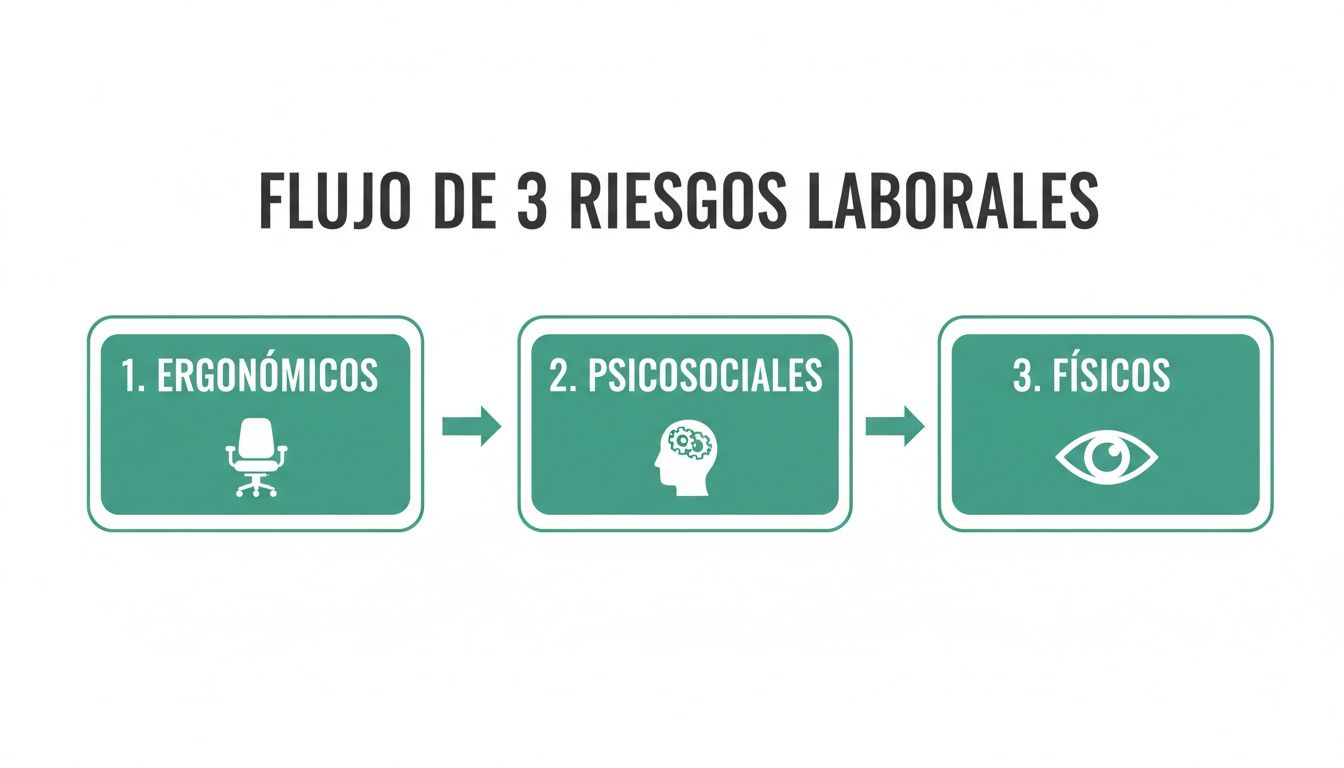
Keeping these three fronts in mind helps you build a comprehensive program that leaves no loose ends, addressing both visible risks and those that quietly harm.
Involving everyone, from intern to director
An occupational health program designed and locked in the HR office is destined to fail. You need allies.
Creating a Health and Safety Committee is an excellent way to formalize this support. Invite leaders from different areas, but above all, invite people on the front lines. They are the ones who live the operation day to day, and their ideas are gold.
To ensure the program truly connects with well-being and does not remain just compliance, it’s key to master effective communication. You need to know how to clearly and persuasively sell the benefits.
An successful program is one that is co-created with the people. Ask them what they need. Perhaps they value guided active breaks more than a nutrition workshop. Listening is the most powerful tool you have.
Finally, design initiatives that are attractive and easy to adopt. Instead of another mass email, launch a fun internal campaign about the importance of breaks. Organize "wellness weeks" with activities such as stress management workshops, mindfulness sessions, or chair massages.
In our experience, the initiatives that work best are those that feel like real support, not just another obligation. When collaborators perceive that the company genuinely cares for them, commitment skyrockets.
The bridge between corporate wellness and occupational health
This is where the HR strategy truly shines. For a long time, corporate wellness was seen as a "nice extra", a pleasant benefit but not essential. But in today’s Mexico, with the framework of occupational health, that vision is now outdated.
A well-designed wellness program has become your most intelligent and humane tool for complying with regulations. And more importantly, to build a culture of genuine care that is felt in the hallways. It’s no longer an expense; it’s a strategic investment in your people.
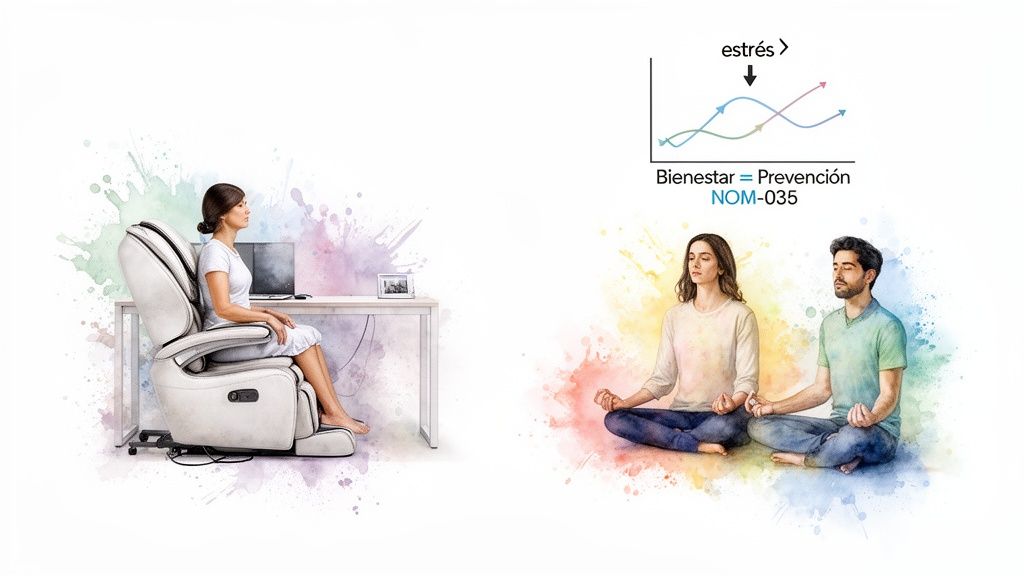
From "nice to have" benefit to strategic tool
Think of it this way: NOM-035 requires you to identify and prevent psychosocial risks. What is a chair massage program if not a direct and tangible way to combat accumulated stress? And what is a mindfulness session if not a practical tool to help your people manage their daily mental load?
Every wellness initiative becomes a measurable preventive action. You stop offering a "plus" to start tackling the root of the risk factors that impact productivity, work climate, and that, by law, you have the responsibility to manage.
The Mexican reality makes it even more urgent. Mexico remains one of the countries with the highest working hours, averaging 2,226 hours annually per employee. This culture of intensive work feeds an epidemic of stress that, according to IMSS data, already affects 75% of the workforce. If you want to understand the magnitude of the challenge, you can delve into how workplace stress impacts businesses in Mexico in this Wellhub analysis.
The measurable impact of well-being on occupational health
At Zen to Go, working hand in hand with HR areas across the country, we have witnessed firsthand how these initiatives translate into hard data.
A well-implemented corporate wellness program not only boosts morale. It reduces absenteeism due to stress, improves concentration, and becomes a pillar of emotional salary, helping you retain the talent that costs you so much to attract.
For example, after implementing corporate massage programs, we have measured very consistent results that validate this connection:
99% of collaborators feel that the company actively values their well-being.
We achieved an average reduction of 79% in stress levels reported by participants.
95% of employees would actively recommend the program to their peers.
These are not just pretty numbers for a report. They are KPIs that demonstrate a clear return on investment and a proactive compliance with your occupational health responsibilities.
Practical initiatives and their direct connection
To ground this further, let’s see how different wellness programs connect directly with the specific risks you face in your daily operations.
This table will help you visualize how each wellness action becomes a mitigation tactic.
Wellness initiatives and their direct impact on occupational health
A clear comparison of different wellness programs, their ease of implementation, and the specific risk they help mitigate.
Wellness Initiative | Main risk mitigated | Ease of implementation for HR | Practical example |
|---|---|---|---|
Shiatsu chair massages | Stress (Psychosocial Risk) and muscle tension (Ergonomic Risk) | High (easy to coordinate, requires no special spaces) | 15-minute sessions in a common office area during month-end closing week. |
Mindfulness Workshops | Burnout and lack of concentration (Psychosocial Risk) | Medium (requires scheduling and ensuring participation) | Virtual one-hour workshop on "Focus Techniques in Hybrid Work". |
Active Break Classes | Sedentary lifestyle and injuries from poor posture (Ergonomic Risk) | High (can be done virtually or in the office) | Short 5-minute videos sent via Slack twice a day for teams to stretch. |
Mental health consultations | Anxiety and depression (Psychosocial Risk) | Medium (requires hiring a provider and ensuring confidentiality) | Access to an online therapy platform as part of the benefits package. |
By integrating these initiatives, you stop putting out fires and start building a firewall. Occupational health transforms from a list of obligations into a living strategy that strengthens your organizational culture from within.
How to measure the impact of your health and safety strategy
As an HR leader, you know perfectly well that your work must be visible to be valued. An occupational health program in Mexico may feel like a success in the hallways, but for management to see it as a strategic investment, you need to speak their language: data.
Measuring impact goes far beyond ticking a compliance box. It’s about connecting your wellness actions with the KPIs that move the business needle. It is the final step that consolidates your role as a key partner driving results, not just managing personnel.
Metrics that speak the language of business
To present a solid business case, you need to focus on indicators that management understands and values. Put aside compliance reports for a moment and focus on these high-impact metrics:
Absenteeism rate: This is one of the most direct and easy-to-understand indicators. Are your initiatives to prevent stress or improve ergonomics causing people to miss work less? It’s a question with a numerical answer.
Voluntary turnover index: A work environment that cares for its people is a place where they want to stay. Simple. If people stop leaving, it’s a powerful indication that your strategy is working.
Cost of incapacity: Analyze how much absenteeism due to stress, musculoskeletal injuries, or burnout costs the company. Demonstrating a reduction here is an irrefutable financial argument.
eNPS (Employee Net Promoter Score): Would your collaborators recommend the company as a good place to work? If this score rises after implementing your program, you have clear evidence that the work climate has improved.
Collecting and presenting information
You don’t need an expensive software to get started measuring. The key is discipline and consistency. Before launching any initiative, establish a clear baseline. You need a picture of the "before" to compare it with the "after".
Your goal is to tell a story with data. It’s not just about presenting numbers in a table but explaining what they mean for the business. For example: "By reducing absenteeism by 5%, we save X hours of productivity, which equals Y pesos".
A very practical way to take the pulse of the organization is through direct assessments. In fact, you can apply a stress measurement test and get a clear picture of the psychosocial well-being of your teams before and after intervention.
When presenting your results, think like a director: clear, visual, and straight to the point. Use simple charts that show trends and highlight key achievements with bullet points. That way, you demonstrate that occupational health is not a cost center but a driver of efficiency and commitment that directly impacts profitability.
Frequently asked questions about occupational health for HR leaders
As an HR leader, you undoubtedly face continuous questions about how to manage health and well-being in your company. Here we address some of the most common questions with clear and direct answers, designed to give you the confidence you need in your day-to-day.
If I am an SME, do I have to comply with all the NOMs of the STPS?
No, not all, but yes with the fundamental ones. The application of several NOMs depends directly on the size of your company and, above all, on the level of risk that your operations imply.
However, there are standards like NOM-035 (which addresses psychosocial risks) that are mandatory for all workplaces. What changes is the level of demand based on your number of collaborators. The most intelligent thing to do is to start with a basic diagnosis to identify which are the critical standards for your business and focus on them.
How can I justify the budget for a wellness program?
You have to translate wellness into the language of business. Instead of asking for money to "improve the work climate", present a business case with hard data.
Calculate how much voluntary turnover, absenteeism due to stress, or incapacity is currently costing you. Then, project how a well-focused wellness program can reduce those costs by 10% or 15%.
Your most powerful argument is this: “Investing X pesos in this program will save us Y pesos in turnover and absenteeism, generating a tangible return on investment.” Demonstrate that it is not an expense but a direct investment in team productivity.
What should I do if I detect a case of burnout in a collaborator?
Act with empathy but also in a structured manner. The first step is to approach the person privately to offer your support and listen to their situation without making judgments.
At the same time, you need to analyze the organizational causes. Is it a systematic work overload? Is there a lack of clarity in the roles? Is the leadership style failing? Burnout is rarely an individual problem; it is almost always a symptom of something larger in the team or culture. If you have the opportunity, offer resources such as access to psychological support.
Do chair massages in the office really help me comply with NOM-035?
Yes, and in a very direct and visible way. NOM-035 requires you to implement actions to prevent psychosocial risk factors, and work stress is the main one.
A chair massage program is a preventive and tangible action that directly attacks the physical and mental tension accumulated from the workload. It not only helps reduce stress (in our experience, up to 79%), but sends a very powerful message to your people: the company actively cares about their well-being. It’s a practical and highly valued way to materialize compliance with the standard.
At Zen to Go, we have helped hundreds of HR teams in Mexico integrate wellness as a strategic tool for occupational health. If you are looking for an easy-to-implement solution with measurable impact on your people, we are here to be your allies.
Discover how our corporate wellness programs can transform your workplace.