What is NOM 035 and how to apply it in your company
If you have heard about NOM 035 and it sounded like another bureaucratic procedure, this guide is for you. Think of it this way: the Mexican Official Standard NOM-035 is not a checklist, but a roadmap for companies in Mexico to learn how to identify, analyze, and prevent those psychosocial risk factors that, although invisible, directly impact the health and productivity of your team. We are talking about situations as common as chronic work stress or burnout.
Dismantling NOM 035 once and for all
Far from being a simple obligation to avoid fines, NOM 035 is actually a very powerful tool to build a healthier and, above all, more resilient organizational culture. Its true spirit is not about sanctioning but inviting companies to place the well-being of their employees at the center of the strategy.

Imagine your team is a high-performance engine. If you constantly expose it to overloads, poor communication, or a tense environment, it’s natural for its performance to drop and, sooner or later, it could fail. The standard works like that preventive maintenance manual: it helps you spot and fix problems before they become critical.
What is the true scope of the standard?
To understand it well, you need to know that NOM 035 focuses on two key areas that every company must address:
Psychosocial risk factors: These are all those conditions in the work environment that can provoke stress, anxiety, or emotional imbalance in people. They include excessive workloads and endless hours to unclear leadership or lack of recognition. You can delve deeper into psychosocial risk factors at work in our article dedicated to the topic.
Favorable organizational environment: This is nothing more than creating an environment where people feel safe, valued, and part of something. It involves having effective communication, fair workloads, and real opportunities for growth. It’s about transitioning from "survive however you can" to "here we all grow together".
To fully grasp the standard, here we leave you a summary of its key components, which are the foundation of any compliance strategy.
Pillar | Description | Main Objective |
|---|---|---|
Identification and Analysis | Assess the conditions of the work environment through questionnaires and diagnoses to detect risk factors. | To have a clear map of the "red flags" or areas of improvement in the organization. |
Prevention | Develop and implement policies and programs to mitigate identified risks and promote a favorable environment. | Act before problems arise, fostering a culture of care and communication. |
Intervention | Provide support and follow-up to employees who have been exposed to severe traumatic events at work. | Provide tools and attention for the recovery of the team's mental health. |
These three pillars are not isolated; they function as a continuous cycle that allows the company to adapt and improve constantly.
Their implementation did not happen overnight. The Mexican Official Standard NOM-035 was officially published on October 23, 2018, but its application was gradual. The first stage started in 2019, and the second, which completed all obligations, came into force on October 23, 2023, consolidating its total mandatory nature for all workplaces in Mexico.
Understanding this standard is the first step to transforming your company's culture, shifting from a reactive approach to a proactive one in talent and well-being management.
Identifying psychosocial risks in your office
The phrase "psychosocial risk factors" may sound like consultant jargon, something technical and distant. But the reality is that these are situations we have all seen (or lived) in the daily life of a Mexican office.
Think of it this way: if you overload an engine and never provide maintenance, sooner or later it will stop. The same happens to the engine of your company: your team. Those silent cracks in labor culture, if not addressed, end up generating a very real and measurable impact on motivation, health, and, of course, productivity. NOM 035 simply invites us to name them and act.
Warning signs you cannot ignore
For any leader or HR manager, the key is to translate the concepts of the standard into concrete situations. It's not about looking for convoluted problems, but rather learning to observe the daily dynamics that might be wearing down your employees.
Here we explain the most common psychosocial risks, but with examples that might sound familiar:
Excessive workloads: This is the classic situation of the employee who always stays late, receives emails outside their hours, or is assigned humanly unachievable goals. Keep an eye; this is not a sign of “commitment”, but of an imbalance that only leads to burnout.
Lack of control over work: Imagine someone on your team who has no autonomy to make decisions about their own tasks. That lack of trust and freedom to propose or execute ideas is pure poison for creativity and initiative.
Negative leadership: A leader who manages through fear, who does not recognize achievements, or who does not communicate objectives clearly creates an environment of uncertainty and distrust. This type of leadership is one of the factors that most rapidly affects the workplace climate.
Exhausting work hours: This goes beyond staying late one specific day. We are talking about a culture where shifts of more than eight hours are the norm and shift rotations do not allow for real rest, affecting the balance between personal and work life.
Recognizing these patterns is not about finding blame. It’s about opening an honest conversation on how to improve the environment for everyone. It’s the first step to building a workplace where people not only are productive but also feel safe and valued.
If you are wondering how the stress generated by these factors could be impacting your team, a good self-assessment tool can provide you with a lot of clarity. We invite you to learn more with our stress test, a simple way to identify areas of opportunity. At the end of the day, the key is to prevent before having to remedy.
Your company's obligations based on employee numbers
One of the most frequent questions our clients ask us is: “Ok, I understand the standard, but what do I need to do in practice?”. The answer is simpler than it seems: not all companies have the same responsibilities. NOM 035 is designed to be scalable, adapting its requirements to the real size of your team.
The key is not to see this as an endless task list but as a clear map to start acting. It doesn’t matter whether you lead a small business or a large corporation; there is always a defined starting point for you.
Companies with up to 15 employees
If your team is small, the standard focuses on the fundamentals: creating a solid base for prevention and support.
Prevention policy: The first step is to establish in writing, implement, and above all, communicate to everyone a clear policy for the prevention of psychosocial risks. It is vital that everyone knows it.
Complaint mechanisms: Your team needs to know that there are safe and confidential channels to voice concerns about practices that go against a favorable environment. Trust is fundamental.
Identification of critical cases: Your main obligation is to identify employees who have experienced severe traumatic events during their work and refer them for professional medical attention.
Companies with 16 to 50 employees
For medium-sized workplaces, the obligations expand. In addition to fulfilling everything mentioned above, you have to go a step further in diagnosis.
Identification and analysis of risks: It is now mandatory to apply the standard’s questionnaires. The objective is to identify and analyze the psychosocial risk factors in your team to have a clear map of where the red flags are.
Control measures: With your analysis results in hand, you must adopt concrete measures to prevent and control those risks. For example, if you detect systematic work overload, it’s time to review processes and responsibilities.
Medical exams: Medical exams and psychological evaluations should be conducted for employees who need them, either due to exposure to risks or situations of workplace violence.
Companies with more than 50 employees
Larger organizations carry the highest level of responsibility. All the previous obligations are added to one that is crucial:
Evaluation of the organizational environment: In addition to measuring risk factors, you must carry out a complete evaluation of the environment. This implies thoroughly analyzing aspects such as the sense of belonging, clarity in functions, and, very importantly, the quality of leadership.
The following diagram helps you visualize the most common psychosocial risks that NOM 035 seeks to prevent, such as work overload, negative leadership, or lack of autonomy.
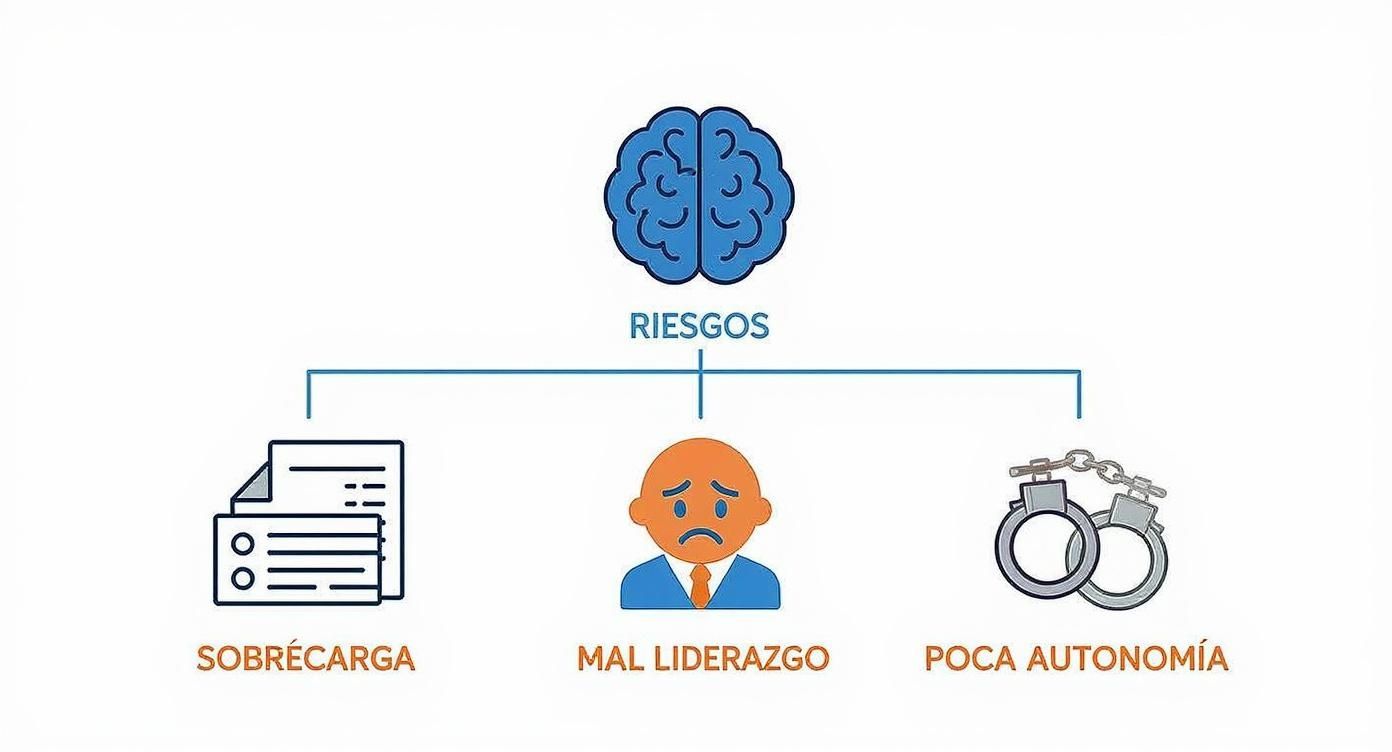
Putting a face to these elements helps to understand that they are not abstract concepts but real situations that directly impact the health and performance of your people.
Complying with the standard is an essential part of occupational health management, ensuring that work is not only productive but also safe and sustainable for everyone.
The majority of workplaces in Mexico fall into one of these three categories, with companies having more than 50 employees facing the most complex requirements. It is fundamental to understand that NOM 035 is not an isolated requirement; it is part of a broader spectrum of responsibilities that every company must consider to protect its people and its operation, covering other types of regulatory compliance that are also relevant.
The benefits of adopting NOM 035 as a philosophy
Many companies see NOM 035 as just another procedure, a checklist to avoid fines. But that view falls short. Adopting its principles as a work philosophy is, in reality, one of the smartest business decisions a leader can make.
At Zen to Go, we have seen since 2019 how companies that proactively invest in the well-being of their people reap benefits that go far beyond mere "compliance".
Beyond preventing fines
When an organization truly commits to the principles of NOM 035, the impact is felt in key business metrics. It’s not just about having a good environment, but about building a real and sustainable competitive advantage.
Lower turnover and absenteeism: A team that feels cared for and valued is a team that wants to stay. Investing in mental health reduces burnout and, with it, the absences and turnover of talent that are so costly to replace.
Increased productivity and creativity: Chronic stress is the enemy of innovation. A safe and supportive work environment unleashes employees' potential, allowing them to focus on solving problems and generating new ideas instead of just surviving the workday.
Strengthening of the employer brand: In such a competitive labor market, a culture of well-being becomes your best calling card. Companies that genuinely care for their people attract and retain the best available talent.
Implementing NOM 035 is a direct investment in the most valuable asset of any company: its people. A healthy, motivated, and committed team is the engine that drives growth and resilience in the business long-term.
Caring for your employees' mental health translates into tangible return on investment, reflected in team loyalty and the quality of their work. To understand how these actions integrate into a broader strategy, you can explore the keys to developing a successful workplace wellness program in your organization.
How Zen to Go helps you prevent work stress
The theory and documents are important, but action is what truly transforms a work environment. This is where Zen to Go becomes your strategic and tangible ally to comply with NOM 035, moving from paper to practice.
One of the central goals of the standard is to prevent work stress, one of the most damaging and common psychosocial risk factors. Our corporate massage programs are designed precisely to address this problem at its root, in a simple, effective manner, and received very well by teams.
A practical solution for your team's well-being
You don’t need to remodel your offices or invest in complex programs. We bring well-being directly to your premises, adapting to your work pace and the space available, whether you have a single location or multiple offices in cities like Mexico City, Monterrey, and Guadalajara.
Our solutions are a direct and measurable preventive measure.
On Shiatsu Chairs: This is our most popular and versatile modality. We just need a small space to set up our ergonomic chairs, and employees receive a relaxing massage without needing to undress. It’s ideal for wellness days, corporate events, or as a revitalizing break during the day.
At Desk: Efficient and uninterrupted. It allows employees to relax while continuing to work. Our certified therapists work directly at the employee's location, focusing on the neck, shoulders, and back to relieve accumulated tension.
We understand that every company is unique. That’s why our corporate wellness programs are flexible and designed to fit your objectives, whether you seek to reduce absenteeism, improve workplace climate, or simply offer a benefit that your team truly values.
The results of implementing these wellness breaks speak for themselves. Based on our semiannual satisfaction surveys with corporate clients, the impact is clear: 79% of employees report a reduction in stress after the sessions.
More importantly, 99% feel that their company values their well-being, which directly strengthens the favorable organizational environment required by NOM 035. This kind of action demonstrates a genuine commitment that goes beyond mere words.
By integrating these active breaks, not only are you complying with a recommendation, but you are also investing in the resilience and motivation of your people. To learn more details about how it works, you can explore our corporate massage service and discover the option that best suits your culture.
Practical steps to implement the standard today
Now that you have a clear overview, it's time to move from knowledge to action. Implementing NOM 035 doesn't have to be an overwhelming process. With a clear roadmap, any company can start building a healthier and more productive work environment from today.
The first step, and the most important, is to see this implementation not as a bureaucratic burden, but as a real opportunity to listen to your team and strengthen your culture.
A roadmap to get started
To keep you on track, we propose a very simple action plan with four fundamental steps. This approach will help you lay the foundation for effective and sustainable compliance.
Conduct an honest self-diagnosis: Before applying any questionnaire, observe your workplace climate. Do people constantly stay late? Is there open and fluid communication with leaders? Identify those areas that, by intuition, you already know need attention.
Designate a responsible person or internal committee: To prevent the initiative from getting diluted, appoint a person or a small group to lead the project. This team will be the engine that drives communication, applies evaluations, and follows up on actions.
Communicate with complete transparency: Talk to your team. Explain to them simply what NOM 035 is and, more importantly, why it’s valuable for the company and for them as individuals. An informed team is a participative and committed team.
Seek strategic allies: You don't have to do everything on your own. To implement effective and high-impact preventive measures, like stress management, relying on experts can make all the difference.
"NOM 035 is not just about complying with a document, but about starting a continuous conversation about well-being. It’s the starting point for creating a workplace where people want to be and give their best."
Although since 2023 the standard is completely mandatory, the reality is that many companies still face high levels of stress. This happens because it's not enough to identify problems; a real commitment to preventive measures is required. If you want to delve deeper into this topic, you can find more details in recent research on occupational health in Mexico.
We address the most common questions about NOM 035
To wrap up, let's get practical. We have gathered the questions that always arise in companies about NOM 035. Here we provide clear and direct answers.
Is NOM 035 mandatory for all companies?
Yes, it is mandatory for all workplaces in Mexico, regardless of their size. What changes are the responsibilities you have based on your number of employees (up to 15, from 16 to 50, and more than 50).
What happens if my company does not comply?
Non-compliance can be costly. The Federal Labor Law provides for fines ranging from 250 to 5,000 Units of Measurement and Updating (UMA). This is a significant financial impact that is better to avoid.
Is implementing it very costly?
No, it doesn’t have to be. Many initial actions, such as creating and disseminating your prevention policy, are more about organization and communication than about a large investment. The real cost will depend on the measures you decide to implement, but the smartest thing is to see it for what it is: an investment in your talent.
Is just applying the questionnaires enough for compliance?
No, and this is one of the biggest confusions. The questionnaires are only the diagnosis. True compliance lies in analyzing those results and taking concrete actions to improve what you found. Without a plan of action, the questionnaires are just paper.
Do I need an external consultant for this?
No, it is not mandatory, but it can be a great help, especially if you do not have an experienced HR team on the topic. A strategic ally guides you to ensure the process is correct and effective, saving you time and potential mistakes.
At Zen to Go, we firmly believe that a healthy and motivated team is the foundation of any successful company. If you are looking for an ally to create a positive work environment and comply with NOM 035 practically and tangibly, you are in the right place.
Discover how our wellness solutions can transform your company