What is ergonomics in the workplace and why is it key for your business?
Imagine asking your team to run a marathon in shoes two sizes too small. Inevitably, pain, frustration, and performance well below their potential will appear. Something similar happens when the workspace does not fit the people: ergonomics at work is simply the art of designing an environment that fits your team, not the other way around.
A well-configured desk supports the spine, relieves tension, and enhances daily performance, preventing injuries that can cost dearly in both well-being and productivity.
What are the goals of ergonomics at work?
The goal is clear and dual: to protect the health of your collaborators while fine-tuning each process so that the business performs better.
Prevent musculoskeletal disorders that cause unexpected absenteeism.
Adjust tools and postures to each task so that each role can unleash its maximum potential.
Here’s a simple summary in a table.
Quick summary of workplace ergonomics
Element | Description |
|---|---|
Definition | Discipline that adapts the workspace to the capabilities and needs of each collaborator. |
Goals | Prevent injuries, reduce fatigue, and boost efficiency in daily tasks. |
Benefits | Lower absenteeism, greater productivity, and a sustainable general well-being environment. |
With this summary in mind, it is easier to understand why it is worth investing in ergonomic adjustments for your office.
The evidence is compelling: just in 2023, there were 18,489 occupational diseases reported in Mexico, and more than half were related to musculoskeletal disorders due to ergonomic deficiencies. Learn more about this data.
To delve deeper into risk factors such as stress and your obligations as a company, we recommend reviewing our NOM-035 guide.
Ergonomics is not an expense; it is a strategic investment that directly reflects on your team’s health and your company’s productivity.
Identifying critical points in your area and applying necessary adjustments is the first step. Your team and your results will thank you.
Basic principles of ergonomics at work
Workplace ergonomics was born out of the need to optimize tasks and equipment during World War II. Over time, this discipline combined the study of human movement with intelligent space design, with a clear objective: to align the workstation with the characteristics of the body.
Essentially, it is about adapting desks, chairs, and tools to the users to minimize tension and poor postures. The result is a boost in productivity and a decrease in breaks due to injuries or discomfort.
For example, a technology company in Mexico City implemented adjustable height desks and ergonomic chairs. In just a few months, they recorded a 30% reduction in absenteeism due to muscular discomfort. A concrete solution to a real problem.
Verify the height of the table and the alignment of the monitor.
Adjust the depth and height of the seat.
Optimize lighting and free up the workspace.
Origin and evolution
In the mid-20th century, researchers noticed that a poorly placed steering wheel caused fatigue in pilots. This was the starting point for a preventive approach that gave rise to user-centered design: observing how the body responds to each movement.
Later, professionals from various fields joined forces to create safer workstations. A case in an office in Mexico demonstrated the impact: investing $2,500 MXN per person in ergonomic equipment generated savings of $15,000 MXN annually in health expenses and disability days.
"Investing in ergonomics is taking care of your people and protecting your results. We see it every day with our clients."
The key relationship: body, tasks, and environment
To understand how these three elements connect, you can follow these steps:
Observe each collaborator’s natural posture when performing their tasks.
Analyze the most frequent movements they make throughout the day.
Adjust the furniture and workflows based on what you find.
This preventive method is up to 60% more cost-effective than addressing injuries once they appear. Moreover, it promotes a culture of well-being and prevention throughout the company.
How to apply these principles in your company
The starting point can be as simple as gathering a team with people from Operations, IT, and Human Resources. In a brief 2-hour workshop, they can map out critical tasks and detect the most uncomfortable postures.
Invite your collaborators to point out their discomfort; they are the experts in their roles.
Test prototypes or demos of furniture before making a large purchase.
Review progress after 30 days and adjust as necessary according to the results.
This approach not only prevents ailments more effectively but also strengthens team commitment and establishes a culture of continuous improvement.
Practical principles for improving ergonomics
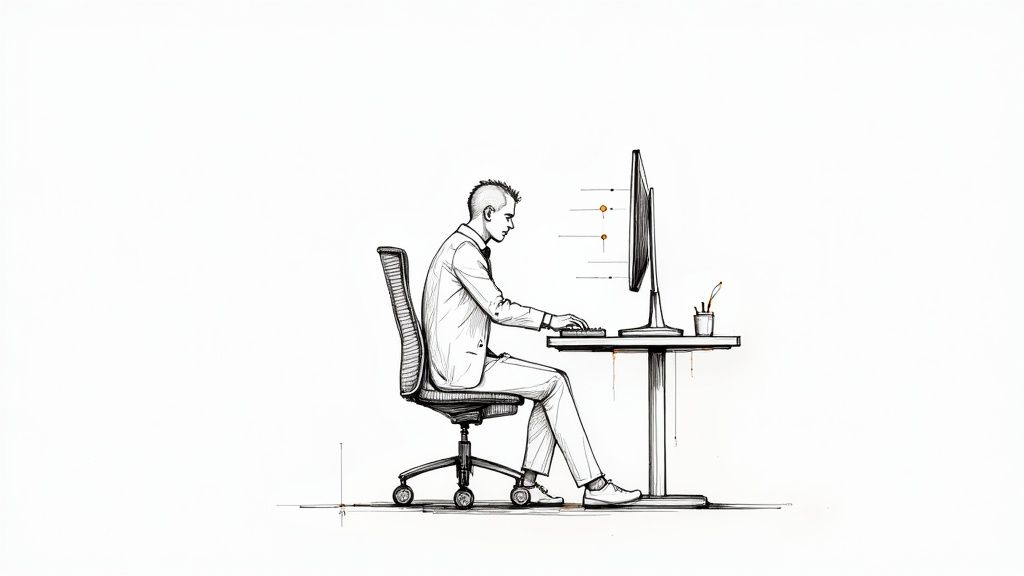
Tuning the ergonomics of your office is like calibrating a car’s engine before an important trip. A well-adjusted car avoids failures and travels further. Likewise, a workstation tailored to its user prevents injuries and keeps the team productive and motivated.
To achieve this, five essential elements are needed:
Participatory ergonomics: Involve your team in the diagnosis and proposals for improvement.
Continuous assessment of workstations: Conduct regular checks of table height, screen, and seat angles.
Intelligent space design: Place frequently used tools within reach to minimize unnecessary movements.
Correct postural alignment: Ensure a natural position for the back, neck, and wrists to avoid tension.
Safe movements and active breaks: Encourage stretching and changing positions to avoid muscle stiffness.
Participatory ergonomics in action
When the team is involved from the beginning, they feel a sense of ownership over the change, and improvements are adopted naturally. Studies in the health and automotive sectors show that this practice can reduce workplace injuries by up to 25%. Discover more about these findings.
"When the team contributes solutions, improvements are adopted with more enthusiasm and last over time," says a wellness manager we collaborate with.
Continuous assessment of workstations
A simple weekly checklist is enough to detect mismatches before they turn into a problem. Combine it with brief internal surveys to identify discomfort in real-time. Additionally, services like chair massages from Zen to Go relieve tension preventively, without interrupting workflow.
We invite you to read how chair massage revitalizes the team in minutes and improves the work environment:
Learn about our active pause method with chair massage
Intelligent space design
A well-thought-out workspace balances functionality and comfort. Placing desks near natural light reduces visual fatigue. Separating collaboration areas from concentration zones helps avoid distractions. Modular furniture, in turn, facilitates quick adjustments without the need for major renovations.
Practical case: participatory workshop
In a company in Monterrey, we organized a 3-hour workshop with representatives from several areas. Each team mapped their daily routines and identified discomfort points. With simple proposals like lumbar supports and footrests, they managed to reduce complaints of pain by 40% in just one month.
These ideas, often low-cost, demonstrate that when solutions come from the team itself, they generate a strong sense of belonging and mutual care.
Your ally in well-being
At Zen to Go, we guide you step-by-step to create a healthier office. Our certified therapists bring well-being directly to your company, whether with Shiatsu chair massages or desk massages. A recurring program allows you to measure the impact and consolidate your culture of well-being.
Companies that implement our corporate massage programs report a 79% reduction in stress and 99% of collaborators feeling that their company values their well-being.
Start your ergonomic wellness plan with Zen to Go today.
The silent risks lurking in your office
In day-to-day life, small design flaws in a workstation accumulate. What starts as a minor annoyance can, over time, become chronic pain that we dangerously begin to consider "normal".
Understanding workplace ergonomics means learning to spot these risks before they manifest and, above all, acting to prevent them from affecting your team's morale and productivity.
The figures in Mexico are clear: only 22% of employees feel that their company invests enough in ergonomic equipment, while a striking 74% admit to suffering from pain at their workplace. Worse yet, 37% of workers were absent on average 11 days due to ailments linked to poor ergonomics. You can delve deeper into this data in this report from Prevencionar.com.
The most common complaints are old acquaintances in any office:
Lower back pain: That constant tension in the lower back from sitting for hours in the same position.
Cervical tension: Stiffness in the neck and shoulders, which often leads to headaches, caused by tilting the head toward a poorly positioned monitor.
Carpal tunnel syndrome: Tingling or pain in the wrists from typing without proper support.
Visual fatigue: Irritated eyes, blurred vision, and tiredness from screen glare and lack of visual breaks.
How does this affect your team in practice?
When a collaborator feels pain, their ability to concentrate plummets.
"After a day with a stiff neck, my productivity moves at a snail's pace," a consultant analyst in Guadalajara mentioned to us.
The team’s morale erodes when discomfort becomes part of the routine. It is a silent enemy that causes:
A noticeable increase in absenteeism.
Cascade delays in project delivery.
Less commitment and, in the long run, higher employee turnover.
Impact | Mexico data (2024) |
|---|---|
Absenteeism | A 37% absence rate, averaging 11 days for these causes. |
Productivity | A reduction of up to 40% in tasks requiring high concentration. |
Team morale | A 68% reported low motivation due to physical discomfort on a continuous basis. |
Real cases from Mexican companies
Examples abound. An accounting firm in Mexico City saw their absences due to back pain increase by 25% before deciding to change their chairs.
In Monterrey, a marketing firm reduced complaints of discomfort by 30% simply by implementing adjustable height desks.
Chronic pain is a direct trigger for burnout. Learn more about the connection between physical discomfort and work-related stress and burnout in our article.
Identifying these red flags is the first step. The second, and most important, is to start measuring the impact of the improvements you implement.
The consequences for the health and mood of the team
Chronic physical wear does not stay confined to the body; it directly impacts mental health and the work environment. The persistence of these discomforts can escalate to anxiety, creating a tense and uncollaborative work atmosphere.
Moreover, turnover accelerates. When employees feel that the company does not care for their well-being, they start looking for relief elsewhere. To have a clear diagnosis, start measuring:
Level of pain reported in anonymous internal surveys.
Days lost due to absenteeism linked to these ailments.
Number of internal complaints about discomfort in the workplace.
Turnover indices and employee satisfaction.
By monitoring these indicators, your company will be able to implement ergonomic solutions with almost surgical precision. These metrics are the basis for justifying and adjusting well-being services such as Zen to Go's corporate massages.
Next steps for your company
This doesn’t have to be complicated. Start by defining priorities based on the most common ailments reported by your people and assign someone responsible for follow-up.
Then, plan concrete interventions: changes in furniture, the implementation of active breaks, or the integration of chair or desk massages.
With a clear schedule and metrics to measure the before and after, you will start to see real changes in the health and productivity of your team within weeks.
Don't wait any longer. Start today and completely transform the physical and mental well-being of your people.
How ergonomics boosts well-being and productivity
Implementing ergonomics at work is much more than buying comfortable chairs. It is like tending a garden: if you prepare the soil well, give each plant the space and light it needs, and remove weeds in time, the harvest will be abundant and healthy.
An ergonomically designed work environment not only prevents "pests" like back pain or eye strain but nurtures an atmosphere where teams can simply flourish.
The direct link between comfort and performance
When a person feels physically comfortable, their mind is freed up to focus on what really matters: their tasks. Constant pain is a silent but very powerful distraction that drains mental energy and limits the ability to solve complex problems.
Conversely, a well-adjusted workstation eliminates those unnecessary frictions and allows concentration and creativity to flow effortlessly. The result is a more focused, efficient team with a lower likelihood of making errors due to exhaustion.
A driver for motivation and workplace atmosphere
Investing in ergonomics is a clear and tangible message for your team: "We care about your well-being." And that gesture, which seems so simple, has a profound impact on morale and commitment.
When employees perceive that their company actively invests in their health, they feel valued and respected. That perception translates directly into greater loyalty, a better workplace atmosphere, and a significant reduction in employee turnover.
We have seen it in our corporate clients: ergonomic improvements, even small ones like adjusting monitor heights, generate positive conversations and reinforce a culture of mutual care.
The return on investment of a healthy team
Ergonomics is not an expense; it is a strategic investment with a measurable return. Each day of absence due to a musculoskeletal injury represents a loss of productivity and associated costs.
Companies that implement effective ergonomic programs report:
Less absenteeism: Decreased days lost due to back, neck, or wrist pain.
Greater productivity: Teams that work without discomfort are up to 25% more efficient in their tasks.
Lower medical costs: Reduces the need for consultations or treatments for work-related injuries.
Better quality of work: More focused collaborators make fewer mistakes and deliver higher-level results.
In summary, the definition of what ergonomics is at work is understood by its capacity to create a virtuous cycle: taking care of your people boosts their performance, and a high-performing team strengthens the business. It is the foundation for building sustainable well-being and lasting productivity.
Effective ergonomic solutions with Zen to Go
Understanding what ergonomics is at work is not enough: real change occurs when we bring those concepts to daily life. At Zen to Go, we have accompanied dozens of companies and demonstrated how a couple of well-thought-out adjustments can transform the mood and health of an entire team.
Getting started doesn’t have to be a challenge. It involves combining the physical environment with smart breaks that break postural routines and nurture the energy of each collaborator.
Practical adjustment of furniture
Every workstation is unique, and you don’t need renovations or large investments to improve the experience. With small personalized modifications, the difference is noticeable from day one.
The ideal chair: Ensure feet are flat on the ground and knees form a 90-degree angle. A firm lumbar support prevents overload in the lower back.
Desk height: Just enough for arms to form a 90-degree angle while typing without hunching shoulders. If the furniture is fixed, a footrest provides the missing support.
Monitor position: Place the top edge of the screen at eye level or just below. This avoids straining the neck and prevents cervical discomfort.
Active breaks and stretching exercises
Our bodies are not designed to be still for eight hours straight. Active breaks revive circulation, oxygenate muscles, and clear the mind in just minutes.
A couple of breaks of 5 to 10 minutes every hour do not interrupt workflow; on the contrary: they renew it.
"We have found that teams incorporating stretching breaks report greater mental clarity and less fatigue by the end of the day. It’s a minimal time investment with a huge return in well-being."
Invite your team to try these movements on the spot:
Neck stretches: Gently tilt the head toward each shoulder.
Shoulder rotations: Draw slow circles forward and backward.
Wrist flexions: Stretch your arms in front of you and move your hands up and down.
These simple gestures translate into more motivation and, ultimately, into greater productivity. A body free of tension keeps the mind focused, and that always reflects in superior performance.
Corporate massages: Zen to Go's comprehensive solution
To take a step further and relieve accumulated tension, nothing beats an office massage. At Zen to Go, we design services that seamlessly fit into the workday, regardless of the size or nature of the company.
Our certified therapists travel to Mexico City, Monterrey, or Guadalajara with everything needed to offer a moment of wellness to your team.
At the Desk: An express massage for neck and shoulders, efficient and without interruptions, allows employees to relax while continuing to work.
In a Shiatsu Chair: Our most popular option. It is performed over clothing, requires little space, and is ideal for relieving tension in the back, neck, and arms.
Reserving is very easy: each person schedules online and receives an SMS reminder, reducing the administrative burden on HR.
Companies that already include our massages see a 79% reduction in stress and 99% of employees feeling that their company values their well-being. To learn more about our corporate massage service, visit our website.
Below is a comparative summary of each solution, its benefits, and what’s needed to implement it.
Comparison of ergonomic solutions
Solution | Benefits | Requirements |
|---|---|---|
Furniture adjustment | Prevents chronic pain. Improves posture and concentration in the long term. | Individual review of each workstation. Possible investment in chairs or supports. |
Active breaks | Increases energy and reduces mental fatigue. Improves circulation. | Supportive culture from leadership. Reminders to take breaks. |
Zen to Go massages | Immediate relief from muscle tension. Reduces stress and improves morale. | A small space for the Shiatsu chair. Online scheduling coordination. |
Combining these three proposals creates a solid and sustainable well-being ecosystem. Start by adjusting the furniture, encourage movement with active breaks, and culminate with the relaxing experience of a massage. This way, you will take care of your team comprehensively and achieve real results.
Common questions about ergonomics in the office
When a company decides to implement a wellness program, it is normal for very specific questions to arise about what workplace ergonomics is and, above all, how to put it into practice without making mistakes. Here we answer the most frequent questions so that you can make strategic and well-informed decisions for your team.
How do I know if a workstation has ergonomic risks?
It all starts with something as simple as observing. Take some time to watch how your collaborators work: what postures they adopt, what movements they repeat over and over. Pay attention to the details of day-to-day activities.
But don’t stop there. Approach them and ask directly. A brief chat can reveal much more than hours of analysis; they know best where they feel tension or discomfort. With that information, you can use a checklist to measure key aspects like chair height, the distance to the monitor, and whether arms form a correct angle.
What is the most important thing when choosing new furniture?
The key word is adjustability. It’s not about buying the most expensive but the most adaptable. Look for chairs with adjustable lumbar support, desks that allow height changes, and monitor stands that align with each person’s line of sight.
A practical tip: before making a large purchase, get a couple of trial models. Invite your team to use them for a few days. Their opinion is the most valuable guide to ensuring the investment not only looks good but really works to enhance their comfort and productivity.
From experience, we know that involving the team in the choice of furniture not only guarantees better adaptation but also boosts their commitment to new ergonomics practices. They feel heard and part of the solution.
Is there really a return on investment in this?
Absolutely. The return on investment (ROI) is clear and can be measured in the reduction of both direct and indirect costs. Companies that invest in ergonomics notice almost immediately a drop in absenteeism due to musculoskeletal injuries, which are one of the main causes of lost workdays in Mexico.
But the benefit goes beyond that. A team working without pain is a more concentrated and efficient team. It has been measured that improvements in productivity can reach up to 25%. This demonstrates that ergonomics is not an expense; it is a smart investment that takes care of your people and directly reflects on business results.
At Zen to Go, we help you integrate wellness solutions that go hand in hand with your ergonomic efforts. We relieve muscle tension and reduce accumulated stress directly in your office. Discover how our corporate massage programs can transform your work culture.