NOM-035 and psychological well-being: a practical guide for HR
Complying with NOM-035 is not just about applying questionnaires and keeping papers in a filing cabinet. For a strategic HR area, it is the perfect opportunity to transform psychosocial well-being and build an organizational culture that truly works. Real compliance does not reside in a document, but in concrete actions that reduce stress, improve the work environment, and make your best talent want to stay.
Understanding NOM-035 beyond the obligation
As an HR leader in Mexico, you have surely dealt with the complexity of NOM-035. The conversation usually stays on guidelines, documentation, and how to avoid fines. But what if I told you that this is only half the story?
In our experience working with HR teams of different sizes in Mexico, we have seen that the true power of the regulation appears when we stop seeing it as a burden and start using it for what it is: a roadmap to create healthier workplaces and, therefore, more productive ones. The question is not "how do I comply?" but "how do I use this tool to make my team genuinely better?".
When compliance becomes a strategy, it stops being an expense and becomes a direct investment in your people.
From paper to daily reality
Since NOM-035-STPS-2018 became fully mandatory in October 2020, a real change in how we manage psychosocial risks was expected. The truth is that the landscape is mixed.
Many reports reveal that a lot of companies, especially the SMEs that employ more than 52% of the personnel in Mexico, have remained stuck in "paper compliance." That is, they fill out forms, but there is no action plan behind it to change anything fundamentally.
It has even been seen that the official questionnaires, on their own, do not always clearly identify employees in a high psychological risk situation. You can delve deeper into the challenges this entails and discover more about psychosocial risk management in Mexico to understand the depth of the problem.
The strategic play for HR
Here is where talent leaders face a challenge, but also a great opportunity. If we stay only in bureaucracy, we will miss real problems such as burnout, stress from workload, or ineffective leadership.
NOM-035 is not the goal; it is the vehicle. Its real purpose is to open the conversation and actions regarding psychosocial well-being, a key pillar to reduce turnover, absenteeism, and increase engagement.
Thinking of the NOM-035 compliance psychosocial well-being in an integrated way means connecting what you find in your assessments with practical and ongoing initiatives. It is right here where corporate wellness programs, such as active breaks or chair massages, stop being a "nice extra" and become tactical tools to directly tackle the risks you have already identified.
How to conduct an effective psychosocial risk assessment
The first practical step to comply with NOM-035 is the assessment. But let’s be honest; this is not just about "applying questionnaires." It is the key moment where you truly listen to your organization. Doing it right makes the difference between obtaining a bunch of confusing data and having a clear roadmap to improve the work environment.
The success of this stage depends almost entirely on one thing: trust. If your employees do not understand why you are asking them this or, worse, fear reprisals, the answers will not be honest, and the entire exercise will lose its meaning.
Preparing the ground: communication is key
Before even thinking about sending the first questionnaire, you need to launch an internal communication campaign. The goal is very clear: to generate peace of mind and ensure that as many people as possible genuinely participate.
What should your message include? Simple and direct:
The why: Explain in simple words that this is part of NOM-035, an official regulation aimed at creating healthier work environments for everyone.
Confidentiality: Emphasize, repeat, and guarantee that responses are anonymous and confidential. It is vital that people feel safe to respond with total honesty.
The end goal: Make it clear that the purpose is to identify areas of opportunity to improve the work environment, workloads, and leadership. It is not about evaluating people but understanding the system.
The next steps: Tell them what will happen next. Mention that the results will be analyzed to create concrete action plans and that the overall findings will be shared with the team.
This approach transforms a requirement that sounds bureaucratic into a real wellness initiative. The initial paperwork becomes the foundation for genuinely improving the employee experience.
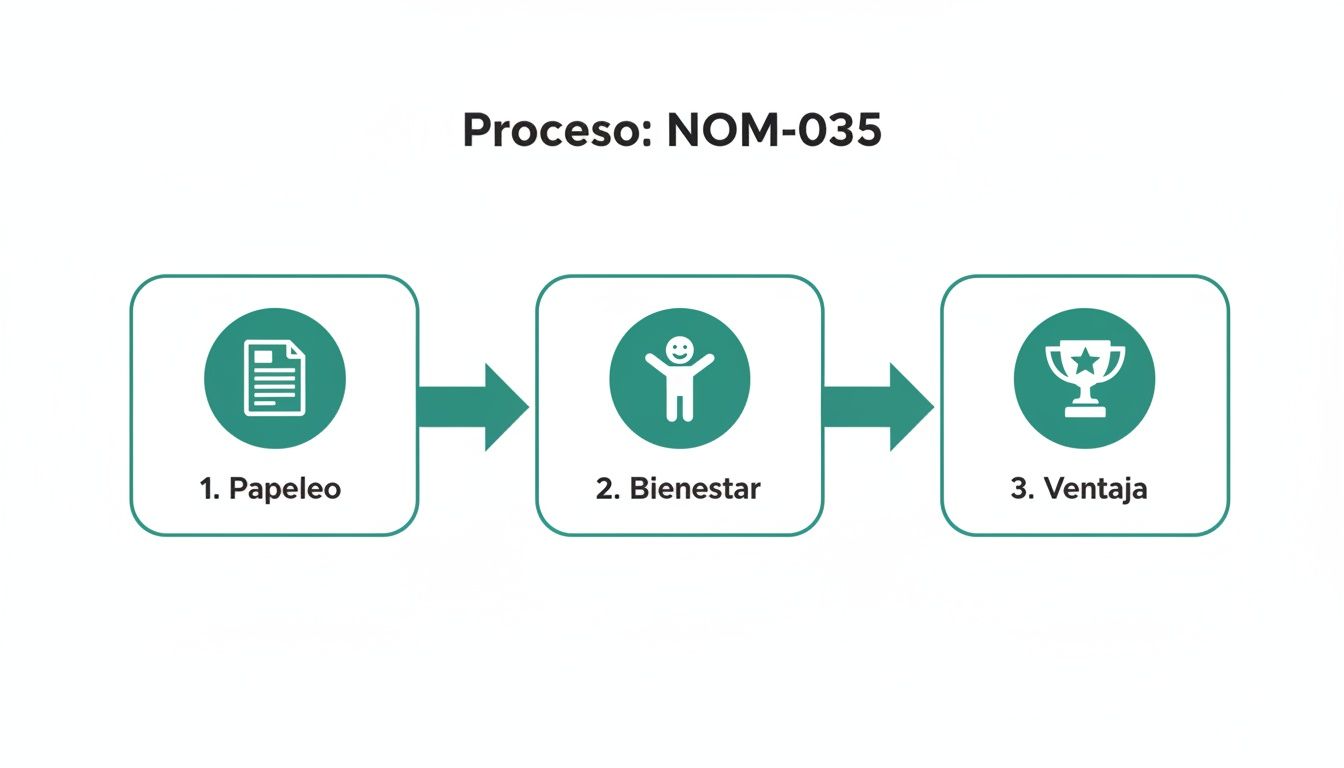
As the flow shows, complying with the regulation is just the starting point. If you manage it strategically, it leads to tangible well-being and real competitive advantage for the company.
Reference Guidelines in the real world
The regulation talks about Reference Guidelines II (for workplaces with 16 to 50 employees) and III (for more than 50). These questionnaires measure factors that, when translated into office situations, are the daily bread:
Workloads: Do people feel that time never suffices? Are workdays constantly extended?
Lack of control over work: Do they have autonomy to organize their tasks, or do they feel everything is imposed without room for maneuver?
Negative leadership: Is feedback unclear or aggressive? Do bosses fail to recognize effort?
Negative relationships at work: Are there tensions, gossip, or lack of support among colleagues?
Workplace violence: Are there situations of harassment or mistreatment?
When analyzing the results, you will not only see numbers but the reflection of these dynamics. If you want to delve deeper into how these elements manifest, we invite you to explore our guide on psychosocial risk factors in the workplace.
Common error to avoid: Applying questionnaires without context. Sending a mass link via email without prior communication is the recipe for low participation and unreliable responses. Take the time to explain, answer questions, and create an open environment.
Recent evidence shows that the underlying problem NOM-035 seeks to address remains critical in Mexico. Human capital analysis indicates that almost half of workers have experienced workplace harassment, and four out of ten report being victims of violence in their jobs. Additionally, following the implementation of the regulation, more than 15,000 cases of burnout have been diagnosed, and resignations due to excessive workloads grew by more than 50% in the last year recorded by Inegi. These data demonstrate that minimum compliance is not enough; practical interventions are needed to truly impact the organizational climate.
How to design an intervention plan that really works
You already have the results of your NOM-035 assessment. Now comes the part that defines everything: transforming that data into concrete actions that genuinely improve your team's psychosocial well-being. An effective intervention plan is not a generic document; it is a tailored roadmap that tackles the root causes of the risks you identified.
The objective is not just to put a checkmark in compliance but to generate a visible change in day-to-day life. If the assessment indicated high workloads, your plan must go beyond a simple email asking for "better organization." You need practical solutions that alleviate pressure and prevent burnout.
Prioritizing the red flags
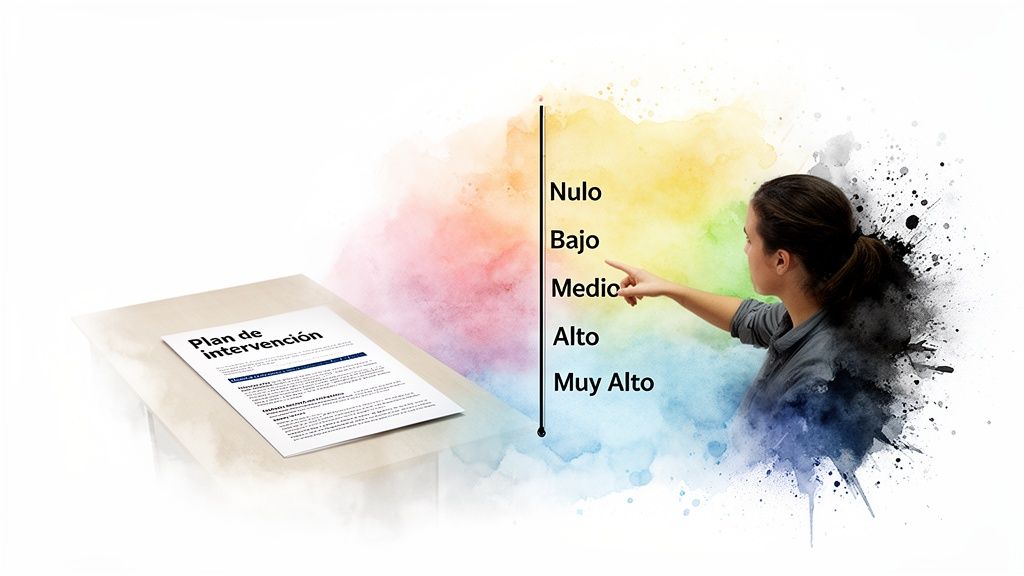
The first step is to prioritize. You cannot (and should not) try to fix everything at once. Review your results and focus on the domains with the highest scores, that is, where the risk is Medium, High, or Very High. Did leadership score low? Is the workday the main problem? That is where you should concentrate your initial efforts.
In our experience working with HR areas, the most common factors tend to be workloads and negative leadership. These two elements have a domino effect on nearly all other aspects of the work environment. Addressing them directly often generates the greatest positive impact in the shortest time possible.
Concrete actions for each level of risk
Your intervention plan should be tiered, with specific actions for each detected risk level. To keep you from getting stuck in theory, here’s a table with realistic and applicable ideas, from the simplest to the most structured.
Examples of actions by psychosocial risk level
Risk level | Description of the environment | Suggested control actions |
|---|---|---|
None or Low | Congratulations! It means your environment is favorable and safe. The goal here is to maintain and reinforce what is already working. |
Reinforce the risk prevention policy.
Internal communication campaigns to recognize good practices.
Actively promote work-life balance.
| | Medium | There are clear areas of opportunity that now require attention to prevent escalation. Now is the time to act preventively. |
Workshops on time management and productivity.
Introduction of guided active breaks to reduce tension.
Informative sessions on NOM-035 and help channels.
| | High or Very High | A decisive, visible, and structured intervention is required. The risks are evident and affect well-being and operation. |
Leadership development programs (communication, feedback).
Review workloads with leaders in each area.
Implementation of a structured workplace wellness program.
|
As you can see, the actions become more robust as the risk level increases. For High or Very High levels, an isolated workshop is not enough; you need a comprehensive program. If you're looking for inspiration, you can consult ideas for creating your own effective workplace wellness program.
At this level, tangible actions such as chair massages in the office are an excellent tactical tool. They not only directly address stress and accumulated muscle fatigue but also send a powerful message: the company actively cares about the physical and mental well-being of its people.
The proven link between climate and psychosocial risk
This is not just about perceptions. Studies conducted in Mexico using NOM-035 methodology have demonstrated a direct and measurable connection between psychosocial risk factors and the organizational climate.
A study conducted in a university center found that 32% of workers presented a medium to high risk, with the most critical domains being workload, work hours, and leadership. The conclusion was clear: a better social climate results in lower psychosocial risk.
For you, as an HR professional, this confirms that every initiative that improves the work environment directly contributes to NOM-035 compliance. Integrating recurring wellness programs, such as corporate massages or active breaks, which we facilitate at Zen to Go, is not an expense but a preventive and corrective action with evidence behind it.
Your intervention plan thus becomes a living tool that generates an impact that employees feel, value, and appreciate.
The art of documenting: your continuous compliance log
Now that you have an intervention plan in place, let's talk about that part that keeps many HR professionals awake at night: documentation. And let’s be honest, it’s not about filling a filing cabinet with papers to "comply." It is about building a living management system that demonstrates a real commitment to psychosocial well-being and that, of course, gives you peace of mind before a possible STPS inspection.
Compliance is not a one-time event; it is a cycle. The key is to organize the information in such a way that it is easy to consult and update, but above all, that it serves you to make better decisions.
Your checklist of indispensable documents
Having everything in order and at hand is crucial. Think of your NOM-035 folder as the flight log of your wellness strategy. When the labor authority arrives, they will want to see evidence that you followed the entire process, from diagnosis to action.
Here we leave you a table so nothing slips through the cracks. It is a practical summary of what the STPS may request from you during an inspection, so you can quickly audit your own compliance.
Checklist of mandatory documentation for NOM-035
Required document or evidence | What is it for? | Practical tip for HR |
|---|---|---|
Policy for preventing psychosocial risks | This is your company’s statement of principles. It defines the commitment to create a favorable environment and the prevention mechanisms. | Do not use a generic template. Ensure that it is signed by management and that all employees know it. Make it part of the onboarding. |
Assessment results (diagnosis) | This is the evidence that you identified the risk factors. Include the questionnaires applied and your analysis of results. | Store results anonymously and confidentially. Prepare an executive summary for management with the 3 main red flags. |
Intervention and follow-up plan | This is your roadmap. Detail the actions, responsible parties, and dates to address the risks you detected in the assessment. | Connect each action to a business KPI. For example, if you implement massages to reduce stress, measure their impact on absenteeism in that area. |
Evidences of implemented actions | This is proof that your plan did not remain on paper. These may be attendance lists, photos of events, or wellness program reports. | Create a digital folder for each initiative. If you hire a chair massage program, ask your provider, such as Zen to Go, for usage reports and satisfaction surveys. |
Keeping these documents organized is not just for passing an audit. It gives you a clear view of the progress of your initiatives and helps you justify the budget for future wellness programs.
Turning compliance into a cycle of improvement
The true NOM-035 compliance and psychosocial well-being is achieved when the process becomes part of your annual HR calendar, not when you apply the survey every two years and forget about it.
A very common mistake is to see NOM-035 as a project with a start and end date. In reality, it is a management system that must be integrated into daily operation, just like safety and hygiene or training.
To make this happen, create an annual follow-up schedule. A simple but powerful document that will help you plan and ensure actions remain alive throughout the year.
First Quarter (Q1): Conduct the assessment or review last year’s results. Present your findings to leaders and the board.
Second Quarter (Q2): Launch the initial actions of the intervention plan. This could be the start of leadership workshops or a pilot program of active breaks.
Third Quarter (Q3): Measure the initial impact. Apply pulse surveys, review turnover and absenteeism KPIs, and adjust the plan based on feedback.
Fourth Quarter (Q4): Communicate progress to the entire organization. Plan actions for the following year and ensure the budget to continue.
Measuring success beyond questionnaires
For management to see the value of your efforts, it is vital to connect NOM-035 actions with the indicators already on the decision-making table. Success is not measured by just reducing a score on a questionnaire but by its tangible impact on the health of the business.
Here’s the key to linking your initiatives with key KPIs:
Tightening turnover: Do the areas with higher participation in wellness programs have a lower rate of voluntary resignation? Cross-reference the data.
Decreased absenteeism: Compare days absent due to stress or illness in a before-and-after period of implementing your plan.
Improvement in eNPS (Employee Net Promoter Score): Include questions about wellness in your climate surveys to see if perception improves over time.
Increased productivity: Although it is more difficult to measure, you can correlate participation in programs with the fulfillment of goals in specific teams.
When you present your results this way, you stop talking only about complying with a regulation and begin to speak the language of business. You demonstrate that investing in psychosocial well-being is one of the smartest and most profitable decisions the company can make.
Integrating well-being as a pillar of your NOM-035 strategy
We have already traveled the path of diagnosis, planning, and documentation of NOM-035. But this is where everything makes sense. Here is where the regulation stops being a paper obligation to become part of the DNA of your culture.
The most real and sustainable compliance with NOM-035 is not that which is filed away in a folder but that which is lived and felt in the hallways. It is about making the leap: from merely mitigating risks to actively promoting psychosocial well-being.
Well-being as a mitigation tool
Look back at the results of your assessment. Did it reveal that workloads are a high-risk factor? Or that accumulated stress is affecting certain teams? Right here is where corporate wellness programs stop being an "expense" to transform into a strategic and direct investment.
Imagine this scenario: the finance department reports sky-high stress levels, especially during month-end closings. Instead of just documenting it, you decide to implement a recurring chair massage program exactly during those critical dates.
Suddenly, the action is no longer just a pleasant benefit; it is a tangible control measure. You are directly addressing one of the symptoms (physical and mental stress) of the risk you already identified (workloads).
The true NOM-035 compliance psychosocial well-being is achieved when your well-being actions directly respond to the detected risks. It is the difference between offering generic benefits and designing a care strategy that solves real problems.
The direct connection with organizational culture
When well-being initiatives are consistent and visible, they root themselves in the culture. A weekly active breaks program or a quarterly massage day sends a much stronger message than any internal communication.
These types of actions demonstrate with facts that the company cares about the balance and health of its people. And this not only helps you comply with the letter of the regulation, but it also impacts metrics that matter to the entire business:
Reduces turnover: A Deloitte study indicates that for every peso invested in mental health, a return of up to four pesos in productivity can be obtained. People stay where they feel cared for.
Improves engagement: Employees who feel their company values their well-being are more engaged. Our internal data at Zen to Go shows that 99% of participants feel this support.
Strengthens employer branding: You become a place where people want to work, making it easier to attract top talent without much effort.
If you are interested in deepening this approach, our guide on preventing psychosocial risks offers a broader perspective on how to build a safer and healthier work environment from the ground up.
A strategic ally to make things happen
As an HR professional, your time is gold, and you have a thousand fronts open. The idea of organizing the logistics of a recurring wellness program can sound overwhelming. This is where a strategic partner like Zen to Go makes all the difference.
We handle the operation from start to finish: from coordinating certified therapists to setting up the online registration platform for your employees. This frees you up to focus on what you do best: talent strategy and results analysis.
Focusing on well-being also involves implementing effective strategies to reduce workplace stress and improve well-being in day-to-day life, and an ally can help you implement them without adding extra load to your team.
In our experience working with HR leaders in organizations of all sizes, we have seen how this collaboration transforms good intentions into real action. We facilitate making well-being a constant, not an isolated event.
At the end of the day, integrating well-being is not the last step to comply with NOM-035. It is the engine that keeps compliance alive and turns it into a true competitive advantage.
Addressing concerns: Frequently asked questions about NOM-035 and workplace well-being
We have covered the entire journey to comply with NOM-035: from the initial assessment to how to integrate wellness programs that genuinely work. But we know that in the daily life of Human Resources, the questions that arise are very concrete.
This last section is for you. Here we answer the most common questions that talent leaders ask us, with direct and practical responses. All based on our real experience, helping Mexican companies navigate this process with much more confidence.
Is complying with NOM-035 the same as having a wellness program?
No, and this is a fundamental distinction. Complying with NOM-035 is a legal obligation. Its focus is on identifying, analyzing, and preventing psychosocial risk factors. The goal is clear: to create a work environment that is safe from a psychological perspective.
A wellness program, on the other hand, is a proactive and voluntary strategy that seeks to actively promote the comprehensive health of employees (physical, mental, and emotional). It is not just about preventing the bad, but about building and enhancing the good.
Think of it this way: NOM-035 helps you lay the foundation for a safe and habitable house. A wellness program is what turns it into a home, a place where people truly want to be and grow.
Both concepts, of course, are deeply connected. A good wellness program is one of the most powerful tools for mitigating the risks that the regulation obliges you to identify. If your assessment reveals high stress levels, implementing chair massages is a wellness action that directly supports your regulatory compliance.
How often should I apply the regulation questionnaires?
The Federal Labor Law sets the tone: evaluations of psychosocial risk factors must be conducted at least every two years. This is the minimum requirement for your company to remain compliant.
However, as your strategic ally in HR, we recommend not waiting two years if you detect significant changes in the organization. It is worth considering applying the questionnaires, or even shorter pulse surveys, if something like the following occurs:
A major restructuring: mergers, mass layoffs, or drastic changes in management.
A notable increase in turnover or absenteeism: these are red flags, early indicators that something is wrong in the work environment.
Changes in work modalities: for example, a massive transition from face-to-face to a hybrid or remote model.
The key is to use the assessment as a real-time thermometer, not just a formality to comply with every two years.
What if an employee refuses to answer the questionnaires?
Participation in NOM-035 questionnaires is a worker's right, not an obligation. You cannot force anyone to respond, nor can you take reprisals if they choose not to.
If you face a low participation rate, do not see it as an act of rebellion, but as a symptom of something deeper. Generally, a poor response is due to two major reasons:
Lack of trust: employees do not believe their answers will truly be anonymous and fear negative consequences.
Lack of relevance: they do not understand the purpose of the survey or, worse, feel that the company will do absolutely nothing with the results.
The solution is not to pressure but to reinforce communication. Re-explain the purpose, guarantee confidentiality with facts, and most importantly, demonstrate with past and present actions that their opinion does indeed provoke changes.
Does a small company also have to comply with everything?
NOM-035 applies to all workplaces without exception, but obligations do change depending on the number of employees. This is something that often generates a lot of confusion.
Here we break it down for you simply:
Up to 15 employees: The obligations are more basic. You must have a prevention policy, adopt measures to prevent risks, and disseminate reporting channels. It is not mandatory to apply the questionnaires.
From 16 to 50 employees: In addition to the above, you are now required to identify and analyze psychosocial risks. For this, the Reference Guide II is applied.
More than 50 employees: All obligations apply. This includes identification and analysis with the Reference Guide III (which is more extensive) and the obligation to conduct medical evaluations for workers exposed to workplace violence or severe risks.
The path toward true NOM-035 compliance and psychosocial well-being is a marathon, not a sprint. It requires commitment, a good strategy, and the right tools. At Zen to Go, we fully understand the operational and human challenges you face. We are here to be that strategic ally that facilitates the implementation of wellness programs that not only comply with the regulation but also build a culture where your team can thrive.