Corporate massages in the manufacturing industry: a guide to reducing stress and turnover
As a Human Resources professional in the manufacturing industry, you know that a corporate massage is much more than just a simple benefit. It is a tactical tool to combat the physical and mental wear that your operational staff experiences every day. When well implemented, it directly impacts the reduction of turnover, absenteeism, and occupational risks related to fatigue.
The real challenge of well-being in the production floor
Talking about well-being in an office is one thing; bringing it to the production floor is an entirely different game. As an HR leader in manufacturing, you know this better than anyone. You not only manage productivity goals but also deal with the human impact of rotating shifts, repetitive movements, and the constant pressure to keep the line moving.
This operational reality generates wear that goes beyond simple fatigue. It reflects in metrics that undoubtedly keep you awake at night:
Increase in employee turnover: Especially in the first months, when the body is just adapting to the physical demands.
Increase in absenteeism: Often linked to muscle pain, chronic fatigue, or the dreaded burnout.
Safety risks: A fatigued or in pain employee simply does not have the same level of concentration, which increases the likelihood of accidents.
Compliance with NOM-035: The workload and the factors of the physical environment are psychosocial risks that you have the obligation to manage.
In our experience working with HR teams from dozens of manufacturing companies in Mexico, we have seen how a well-designed corporate massage program for the manufacturing industry ceases to be an "expense" and becomes a strategic investment. We are not talking about a luxury but rather an operational necessity.
It is a tangible action that tells your team: "We understand the physical effort you make every day, and we are here to take care of you". This message is incredibly powerful for strengthening emotional salary and loyalty.
Of course, implementing something like this in a plant requires impeccable logistics, but the benefits are compelling. A well-adapted program becomes a pillar for creating a safer, more human work environment and, consequently, a more productive one. It is one of the most direct ways to demonstrate that the company truly values the well-being of its people.
How to land a massage program on the production floor
Implementing a corporate massage program in the manufacturing industry is not like doing it in an office. Here, there is no room for improvisation. Bringing well-being to the production floor requires clockwork logistics that integrates into the rhythm of operations without interrupting a minute of productivity.
The secret, after years of experience in all types of plants, is in the planning and in choosing the right modality from day one.
Undoubtedly, the most effective and practical solution for this environment is the Shiatsu chair massage. Why? Because it is designed for the reality of a plant.
It is quick: Each session lasts between 10 and 15 minutes. It is the perfect time for a break that recharges batteries without disrupting line schedules.
It is practical: No one has to take off their uniform, and no oils are used. Any logistical complications are eliminated, and compliance with safety regulations is maintained.
It is effective: The massage focuses precisely where operational staff accumulates the most tension: upper back, neck, shoulders, and arms. It goes straight to the problem.
Once the modality is defined, the real challenge is operational coordination. The program must be woven into the complex network of shifts and spaces in the plant.
The logistics of shifts and spaces: the great challenge
The greatest fear of any production manager is clear: to affect the quorum on the line. Therefore, the program cannot be rigid; it must be a glove tailored to the operation. In our experience, there are two models that work wonderfully:
Fixed stations in break areas. The chair is placed in a safe and easily accessible area, such as the cafeteria or designated rest areas. Staff can come during their scheduled breaks, using their free time voluntarily.
Direct coordination with supervisors. "Passes" are assigned that line leaders distribute rotationally and in a controlled manner. This ensures that only one or two staff members are absent at a time, keeping operations smooth and without surprises.
This approach should be replicated without exception for all shifts: morning, afternoon, and especially night. The latter usually reports higher levels of physical fatigue and is often the most forgotten in wellness initiatives.
If you want to better understand how these models adapt, we recommend exploring the various modalities of our corporate massage service.
The manufacturing industry in Mexico is an economic pillar, with exports exceeding 852 billion pesos in 2023. But this productive engine faces levels of physical stress and turnover that directly impact costs and efficiency. This is where well-executed wellness programs cease to be an "expense" and become a strategic investment.
This diagram simplifies the chain of consequences that a wellness program seeks to interrupt.
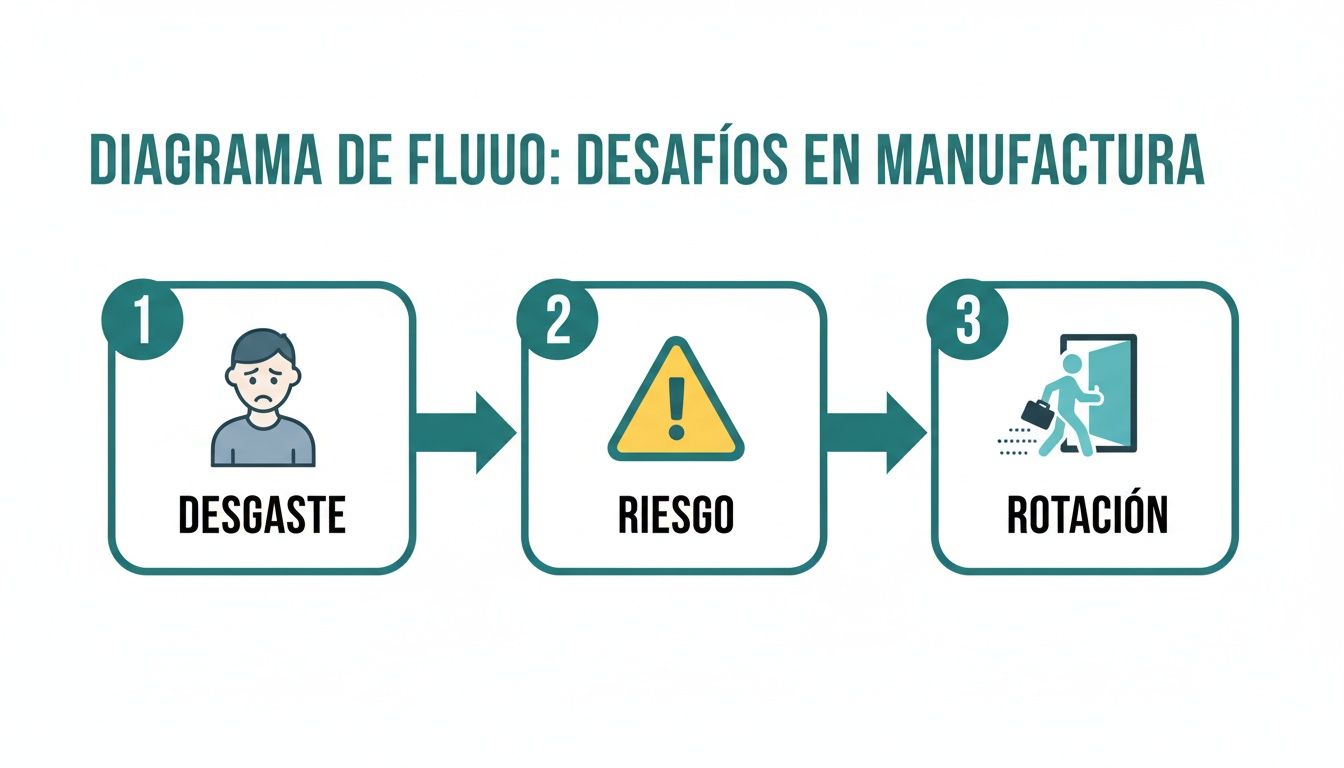
Seeing this progression, it becomes clear that addressing physical wear is not just a benefit for the employee. It is a preventive measure against operational risks and the costly talent drain represented by employee turnover.
Creating a realistic action plan
So you can present a solid and grounded proposal to your board, here is a basic checklist with the essentials:
Identify safe and viable spaces: Look for areas of at least 2x2 meters, that are well-ventilated, with as little noise as possible, and, crucially, far from heavy machinery or forklift routes. Safety is non-negotiable.
Define a smart frequency: You don’t have to start with a daily program. Begin with a monthly or bi-weekly session to measure impact, team acceptance, and adjust logistics on the go.
Communicate clearly and through the right channels: Forget mass emails. Use the channels that your staff actually sees: bulletin boards in the cafeteria, 5-minute safety talks at the beginning of the shift, and, most importantly, the support of supervisors and team leaders. They are your best allies.
A well-executed massage program in the plant does not interrupt but revitalizes. It is a strategic pause that translates into greater focus, fewer mistakes, and a team that feels genuinely valued by the company.
Industrial safety and compliance with NOM-035: killing two birds with one stone
In the manufacturing industry, safety is not an option; it is the foundation of the entire operation. As an HR professional, you know perfectly well that any new initiative, no matter how good, must first pass the industrial safety filter. The key question is: how to introduce a corporate massage program in the manufacturing industry without adding a single risk, but rather strengthening safety?
The answer lies in meticulous planning and choosing a partner who truly understands your environment. You cannot afford for an external provider to enter your plant without a deep knowledge of regulations. Therefore, it is essential to work with companies that guarantee a rigorous selection and training process for their therapists. At Zen to Go, this is a non-negotiable point; every specialist understands how to move and act in an industrial setting.
A direct bridge to compliance with NOM-035
Beyond physical safety, this type of program becomes a powerful tool for complying with NOM-035. The regulation requires you to identify and mitigate psychosocial risk factors, and the physical wear of operational staff is one of the most evident and tangible.
A massage program addresses several fronts directly:
Fatigue and chronic stress: It serves as a primary preventive measure. It offers a restorative break that truly reduces the accumulated physical and mental load during the shift.
Musculoskeletal pain: Relieves tensions arising from repetitive movements or forced postures, which are a constant source of stress and distraction.
Improved concentration: An employee who feels physical relief can maintain a higher level of attention to their tasks. This not only improves productivity but is a crucial factor in reducing the likelihood of workplace accidents.
Implementing massages in the plant is not just a "wellness" benefit; it is a corrective and preventive action that you can document in your NOM-035 compliance plan. You demonstrate to authorities and your team that the company is taking concrete steps to care for their holistic health.
To delve deeper into how these actions align with the regulation, you can consult our complete guide on what NOM-035 is and its practical implications.
The final pillar of safety is the strategic location of the massage stations. These should always be installed in designated safe areas, away from heavy machinery, forklift routes, or high-risk areas. Spaces like cafeterias, break rooms, or training areas are ideal as they ensure a controlled environment where the only focus is the recovery of the employee.
By integrating safety and regulatory compliance, the program becomes undeniably valuable.
The communication that transforms a benefit into a perceived value
It is pointless to have the best wellness program if no one is aware of it, does not understand its purpose, or, worse, does not feel it is valuable to them. In the manufacturing industry, this challenge is even greater. Here, access to email is limited, and digital communication is not always the way.
For corporate massages not to remain simply an additional "benefit" but become a value that people truly appreciate, it is essential to master effective communication. The key is very simple: deliver the message where the people are, using the channels they actually consume in their daily lives.
This means thinking beyond the typical corporate email and deploying a multichannel strategy that works on the production floor.
Activating the correct channels on the floor
After implementing programs in dozens of plants, we have repeatedly seen what truly works for people to participate and value the initiative. There are no secrets, just proven tactics:
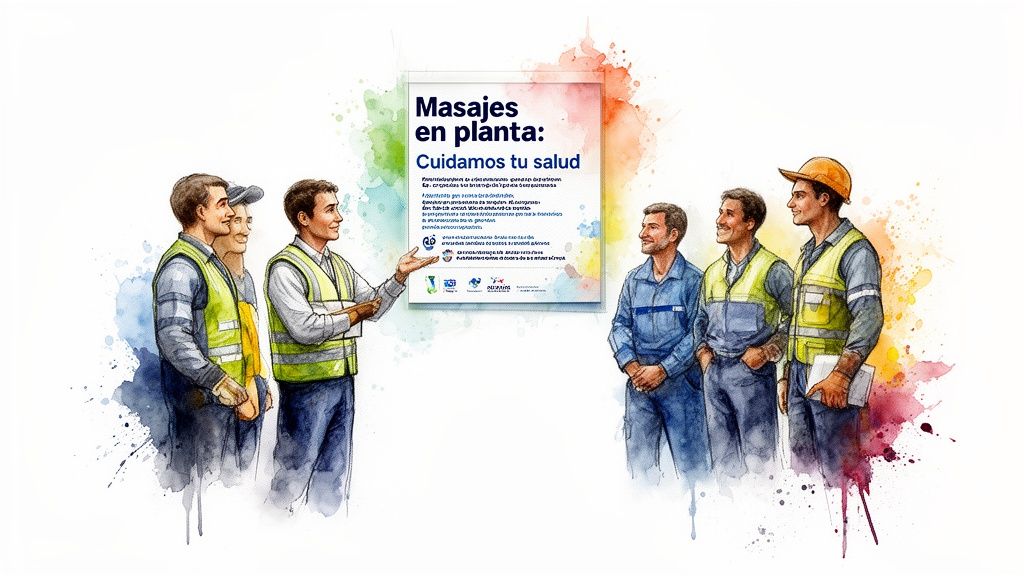
Visual communication at key points: A well-placed sign in the cafeteria, locker rooms, or near the time clocks has a direct impact. The message should be simple and to the point: "The company cares about you. Take advantage of your recovery massage this week".
Strategic verbal announcements: 5-minute meetings at the beginning of the shift are pure gold. When the supervisor communicates the program verbally, the message lands with incredible force. It is direct validation from their immediate leader.
Supervisors as ambassadors: They are your main allies on the floor. It is crucial to train them not only to announce but also to explain why, resolve doubts, and encourage their people to participate. Their support lends credibility and trust to the entire program.
The message that truly connects with operational staff
As important as the where is the how you communicate. The approach cannot be "a free massage"; that sounds like just a gift. The message must be a tangible recognition of the physical effort that everyone makes every day.
Frame the program as a tool to care for their health and prevent injuries. Connect it with their long-term well-being: "This is a way to thank you for your work and help you finish your day with less fatigue and pain".
This small change in discourse transforms everything. It is no longer just a simple benefit, but a key piece of the emotional salary. When an employee feels that the company truly invests in their physical health, commitment and loyalty surge.
Ultimately, what we seek is for the buzz on the floor to be positive, for people to talk about it, and to encourage each other. That is the organic adoption that ultimately maximizes the impact on the work climate.
How to measure the return on investment of your wellness program
As an HR leader, you know that justifying a budget is no easy task. For your corporate massage initiative in the manufacturing industry not to be seen as a "nice expense" but as a strategic investment, you need to speak the same language as management: that of return on investment (ROI).
The good news is that a well-implemented wellness program is profitable. The key is to define your indicators (KPIs) before starting. You cannot demonstrate that something improved if you do not clearly know what your starting point was.
Quantitative metrics to justify the investment
Hard data is your best ally. Before launching the program, collect figures from the last 6 to 12 months in these areas. Then, measure again 3 and 6 months after starting the massage sessions to compare the "before and after".
Absenteeism rate: Calculate the percentage of workdays lost due to absences, especially those related to musculoskeletal pain, tiredness, or fatigue. A reduction here is money that the company directly saves.
Voluntary turnover rate: Measure how many operational employees decide to leave. Replacing someone is very expensive: there are recruitment, training costs, and the inevitable learning curve. Demonstrating a decrease, no matter how small, has a huge financial impact.
Incident and accident reports: Analyze the frequency of minor incidents and workplace accidents. A less fatigued and more focused staff is a safer staff. This is a strong argument for any plant manager.
In a sector like manufacturing, which employs more than 4.2 million people in Mexico, the evidence is starting to become clear. Companies in the automotive sector, for example, have reported a 25% reduction in complaints about muscle pain and a 15% increase in operational efficiency after implementing on-site massages.
The qualitative impact that translates into numbers
Of course, not everything can be measured in dollars and cents directly. But the impact on the work climate is just as crucial, and ultimately, it also has financial consequences.
A team that feels cared for is a more committed and productive team. The corporate massage is one of the most powerful tools to improve emotional salary and the perception that the team has of the company.
To measure this impact, you do not need complex tools. Rely on these two:
Work environment surveys (pulse type): Launch short and anonymous surveys before starting and repeat them after some time. Don’t complicate things, include direct questions like: "Do you feel that the company cares about your physical well-being?" or "How satisfied are you with the benefits the company offers?".
Focus groups with supervisors: They are the barometer of the production floor. Talk to them. Ask them directly if they have noticed changes in their teams' morale, collaboration, or overall energy during shifts.
When you combine hard data on absenteeism and turnover with the positive results from surveys and feedback from supervisors, you have an irrefutable business case. You will be demonstrating that investing in the well-being of your people is not only the right thing to do but the smartest thing for the operation.
If you need a broader framework to structure these metrics, our guide on how to create a workplace wellness program can give you an excellent starting point.
The most common questions about massages in the manufacturing industry (and direct answers)
We perfectly understand that bringing an initiative like corporate massages to a manufacturing plant raises very specific questions. As HR allies, we have listened to and addressed these concerns in the field, working directly in all types of plants. Here we answer the most frequently asked questions with the transparency and practical approach you need.
How do you get a massage program into the plant without stopping the production line?
This is undoubtedly the million-dollar question. And the answer is in two words: flexibility and surgical planning. Stopping operations is not an option; we are crystal clear on that.
Express Format: We use the Shiatsu massage chair. It allows for 15 minute sessions that focus intensely on the back, neck, and shoulders. They are so quick and effective that they fit seamlessly into breaks.
Logistics that adapt: The most common tactic is to coordinate sessions to coincide with already scheduled breaks. Another option that works great is to create rotating stations; line supervisors manage the flow, sending small groups without ever affecting the quorum.
No complications: Staff do not need to take off their uniform, and we do not use oils. This eliminates any delays or preparations that complicate logistics.
The objective is simple: the program adapts to the pace of your plant, not the other way around.
Is it safe to have external therapists inside the plant?
Safety is non-negotiable. And a professional provider must guarantee that from the first contact.
At Zen to Go, for example, all our therapists go through a very rigorous selection process that includes background checks. Not only that, they receive specific training on how to move and act safely in industrial environments. Before the first day, our logistics team coordinates with your safety manager to understand the protocols, risk zones, and Personal Protective Equipment (PPE) requirements.
Choosing a provider that understands industrial safety regulations is not an extra; it is a basic requirement. It ensures that the program adds well-being without adding a single risk to your operation.
Does this benefit really help reduce turnover?
Yes, and in a significant way. Operational staff greatly values benefits that directly address their physical wear. It is one of the most powerful emotional salary tools you can offer.
A massage program sends a message that needs no translation: "We understand the physical effort you make, and we care about your health". In a highly competitive labor market for plant staff, this differentiator strengthens loyalty and sense of belonging. In fact, studies in the sector have shown that well-executed wellness programs can reduce turnover by up to 18%. It directly impacts your recruitment and training costs.
And how much does it cost? How do I justify the investment?
The cost is much more accessible than people imagine and, of course, varies according to frequency and the number of employees. But the most important thing is that the investment is justified with a clear business case, using your own data.
To get it approved by management, focus on return on investment (ROI):
Calculate your current costs: Put a number to how much absenteeism due to physical ailments and voluntary turnover of operational personnel costs you.
Project the savings: Set a conservative reduction target (a 10%, for example) in both indicators thanks to the program.
Compare the numbers: The savings generated in productivity and operational efficiency almost always exceed, and by a long shot, the cost of the service.
In this way, you stop talking about an "expense" and start talking about a smart investment in the health of your people and the efficiency of your plant.
At Zen to Go, we have perfected the logistics to bring well-being to complex environments like those in the manufacturing industry. We understand your challenges and know how to design a program that works for your team and your operation.
Discover how we can adapt our programs to the needs of your plant at Zen to Go