Workplace stress in Mexico: A statistics guide for HR leaders
The workplace stress statistics in Mexico are an impossible wake-up call for any Human Resources leader to ignore. They are not just cold numbers; they speak of burnout, valuable talent that escapes, and productivity that fades day by day within our teams.
When we say that 75% of workers have felt the weight of workplace stress, we are not talking about a bad week. We are describing the reality of three out of four people in your organization. For you, as the talent manager, this number is the starting point of very concrete challenges: high turnover, absenteeism, and a work environment that feels tense and uncollaborative.
The workplace stress landscape every HR leader should know
As a talent strategist, you know very well that stress goes far beyond a workload peak. It is a silent and persistent enemy with consequences that can be directly measured in the income statement. Before designing any well-being program that truly works and helps you move your KPIs, the first step is to understand the magnitude of the challenge we face in Mexico.
In our experience working with HR teams of different sizes in Mexico, we have seen how these data transform the executive conversation. What was once a "soft" topic or a nice-to-have becomes a strategic priority. Because a stressed team does not innovate, does not collaborate, and ultimately, does not meet goals.
Statistics that put numbers to burnout
To start building a solid business case and justify the investment in the health of your people, data are your best allies. They validate what you already perceive in the hallways or in meetings and give you compelling arguments to present to management.
Here we leave you a table with the rawest data to understand the situation at a glance.
X-ray of workplace stress in Mexico (key data)
Indicator | Percentage / Relevant Data |
|---|---|
General prevalence of workplace stress | 75% of workers in Mexico suffer from it. |
Chronic stress (risk of burnout) | 27% of employees face it chronically. |
Global ranking | Mexico ranks among the top places globally. |
This table is not just a summary; it is evidence of a silent crisis occurring within offices and production plants across the country.
And if an image is worth a thousand words, this infographic sums it all up.
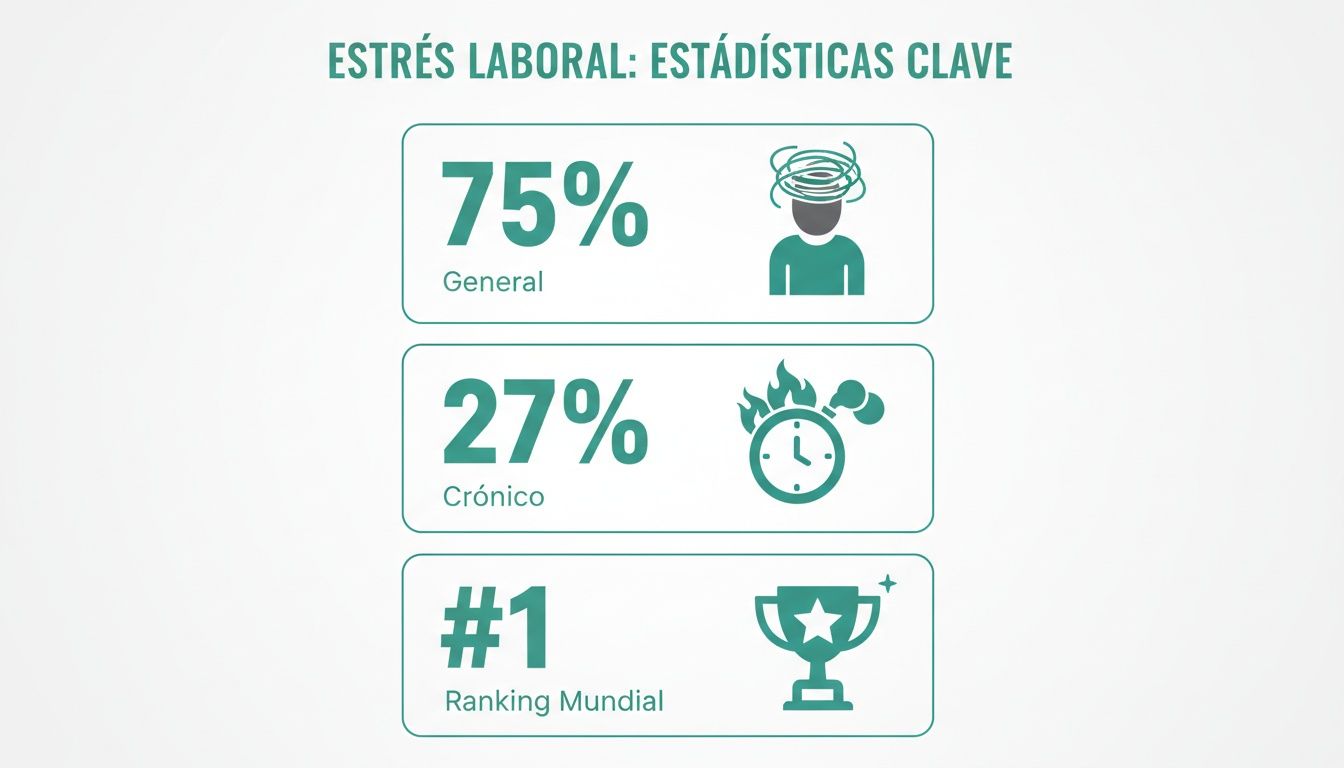
What we see here confirms that workplace stress is not just a problem for some. It is a phenomenon that affects the vast majority and that, for more than a quarter of the talent, has become a chronic condition that robs energy and potential. The urgency to act is evident.
Workplace stress can no longer be seen as the cost of doing business. It is a drain on talent, productivity, and well-being that no modern company can afford to ignore.
Data from the Mexican Social Security Institute (IMSS) paint a similar picture. Their reports confirm that 75% of the working population has experienced workplace stress and that 27% deal with its chronic version, which continues to place us in an alarming position globally. If you want to delve deeper, you can explore more data about workplace stress in Mexico.
Understanding these workplace stress statistics in Mexico is just the beginning. Throughout this guide, we will give you tools to translate these numbers into tangible costs for your company and, above all, into a concrete action plan. One that allows you to build a culture of well-being that protects your people and, consequently, your organization.
How to translate statistics into real costs for your company

The workplace stress statistics in Mexico we reviewed are alarming, without a doubt. But their true power to convince management lies in translating them into the only universally accepted language in business: money. As an HR leader, you know perfectly well that a stressed employee is not just an individual having a tough time; they are a blinking red light on your key performance indicators (KPIs).
The financial impact of stress does not always jump out at you in the income statement. It disguises itself as operational costs that, if not examined closely, seem simply like "the normal cost of doing business". But the reality is that these ghost expenses are silently draining your company's profitability.
Absenteeism: the visible cost of discomfort
Absenteeism is the most obvious and measurable consequence. Each day an employee is absent due to illness, burnout, or medical appointments linked to stress, the company pays a salary for work that is not being done.
But the real cost goes far beyond payroll. It involves having to redistribute tasks, which inevitably overloads other team members—raising their own risk of stress—and can cause delays in projects that are crucial for the business.
Presenteeism: the silent thief of productivity
Much more expensive and harder to quantify is presenteeism. This phenomenon occurs when employees are physically present at their job (or online), but their minds are elsewhere. They are exhausted, unfocused, and unmotivated.
An employee in "presenteeism" mode:
Makes more mistakes: Which requires extra time and resources to correct.
Takes longer to complete tasks: Their productivity drops, affecting delivery times.
Does not actively participate: Their ability to innovate, propose ideas, or collaborate is reduced to zero.
Generates a bad work atmosphere: Their negativity and apathy can be quite contagious to the rest of the team.
Presenteeism is like having a slow but steady water leak in the company's finances. It does not cause an immediate flood, but over time, the structural damage is immense and very expensive to repair.
The combined impact of absenteeism and presenteeism is brutal. In fact, the IMSS itself has noted that the increase in stress is directly linked to a rise in disabilities. Anxiety and depression disorders now account for more than 12% of work-related disabilities in recent years, resulting in millions in losses for Mexican companies. You can learn more about the impact on public health and productivity and how it affects organizations.
Turnover: the cost of losing valuable talent
Finally, the most drastic consequence of chronic stress is employee turnover. When a good employee resigns due to burnout, not only do you lose their experience and knowledge; you activate a significant chain of expenses.
The cost of replacing an employee does not end with their severance pay. You have to add:
Recruitment costs: Job postings, HR team time, interviews.
Training costs: The time and resources invested in onboarding the new team member.
Learning curve: The period in which the new employee is not yet 100% productive.
Loss of institutional knowledge: Business secrets and key relationships that leave with the resigning employee.
When you add these three factors—absenteeism, presenteeism, and turnover—the workplace stress statistics in Mexico cease to be an abstract data point. They become a solid financial argument to demonstrate that investing in well-being is not an expense but an essential strategy to protect the financial and operational health of the organization.
To understand stress in Mexico, we must go beyond the desk
To truly move the needle on the workplace stress statistics in Mexico, superficial solutions are not enough. As an HR leader, you know that to address a problem at its root, you first need to understand what is feeding it. Stress in the Mexican office is not an accident; it is the result of cultural and structural factors that are very much ours.
Going beyond individual workload is key. It is about analyzing the system's patterns that create the perfect breeding ground for burnout and stress. Shifting the conversation from "the employee does not know how to manage their stress" to "what are we doing as an organization that generates this stress?" is the first major step toward real change.
The culture of endless workdays
Year after year, Mexico ranks among the OECD countries where the most hours are worked. This culture of "presenteeism" glorifies long workdays as if they are synonymous with commitment, when in reality, they are often just a signal of inefficiency and a direct ticket to burnout.
This mentality creates a silent but constant pressure on employees to stay late, even if they have already completed their tasks. The result is that the balance between personal and work life fades away, a factor directly linked to the increase in chronic stress.
For HR, the challenge is twofold: on one hand, changing this mindset in the heads of leaders and, on the other, implementing policies that reward productivity by objectives, not hours at the desk.
The lack of well-thought-out wellness programs
Although corporate wellness is in vogue, the reality is that very few companies approach it strategically. Many initiatives remain isolated actions, like a nutrition talk or an occasional yoga class, which, while valuable, do not address the underlying problem.
An effective wellness program is not a collection of isolated activities. It is a comprehensive strategy that stems from a clear diagnosis, with measurable objectives and the full backing of management.
The lack of structured programs leaves employees without tools or formal resources to manage stress. This only perpetuates a cycle in which the employee feels alone, and the company does not take its part of the responsibility in creating a healthy environment.
The outstanding issue: evaluating psychosocial risks
This is where NOM-035 comes into play. More than a legal obligation, this standard is a powerful diagnostic tool for any HR department. However, its application remains a pending issue in much of the Mexican business landscape. If you want to delve deeper, you can check out our complete guide on what NOM-035 is and how to apply it.
The absence of formal evaluations of psychosocial risks means that companies operate blindly. They do not know which teams are overloaded, which leadership styles are toxic, or which internal policies are generating friction and discomfort.
This gap is exacerbated by the country's labor context. National statistics indicate that more than half of the workforce, between 50% and 56%, operates informally, without access to social security or stability. And of the formal companies, only an estimated 20% to 30% implement mental health programs or conduct these risk assessments. You can read more about how Mexico leads in hours worked and workplace stress to understand the full context.
In our experience working with HR teams throughout Mexico, we have seen that organizations that proactively apply NOM-035 obtain a clear map of their weaknesses. This allows them to design effective surgical interventions instead of spending budgets on initiatives that do not respond to the real needs of their people.
The HR action plan to build a culture of well-being
Knowing that the workplace stress statistics in Mexico are a red flag is one thing; having a clear plan to act is quite another. As an HR professional, your role is to be a change agent, that bridge that transforms concern into strategic action.
It is not about launching isolated initiatives and hoping something works. The goal is to weave a solid and sustainable culture of well-being that is felt in day-to-day life.
The ideal starting point, which many companies still see as a formality, is NOM-035. Instead of being merely a bureaucratic obligation to avoid fines, it should be used for what it really is: a powerful diagnostic tool.
From obligation to diagnosis with NOM-035
NOM-035 forces you to ask, listen, and measure. Think of it this way: its questionnaires give you a detailed map of the psychosocial risk factors affecting your organization.
Is the problem the workload in the finance department? Is it toxic leadership in the sales team? Or is it a lack of recognition that is felt in all the hallways?
Without this diagnosis, any wellness program is like throwing darts with your eyes closed. In our experience working with all types of HR teams, we have seen a clear pattern: the most successful companies are those that use the results of NOM-035 to design surgical interventions, targeting the budget precisely where it hurts the most (and where it will have the greatest impact).
Once you have the map, the next step is to design a program that is realistic and high-impact, even if the budget is not large. The key is to understand and enhance the emotional salary.
Designing wellness programs with real impact
The emotional salary is everything an employee receives beyond their salary that genuinely improves their quality of life. Today, it is a decisive factor in whether the best talent chooses you and, above all, decides to stay.
A good wellness program can be an intelligent mix of the following initiatives, always adapted to your diagnosis and budget:
Mental health support: Offering access to psychological therapy, either through agreements or specialized platforms, is one of the most valued benefits today. Period.
Flexibility and real balance: Implementing hybrid work policies, flexible hours, or compressed workweeks directly addresses one of the roots of stress: endless workdays.
Recognition programs that are felt: Creating formal systems to celebrate achievements and efforts has a direct impact on motivation and the sense of belonging.
Active breaks and physical well-being: Initiatives like on-site massages or yoga classes not only relieve physical tension. They send a powerful message: the company cares about the holistic health of its people.
Justifying the investment in well-being to management is much easier when you speak their language. It is not an expense to "make people feel good"; it is an investment to reduce turnover, absenteeism, and low productivity costs that we have already analyzed.
A solid culture of well-being also becomes your best tool for Employer Branding, attracting and retaining talent in this competitive market. It is not just about taking care of those who are already there but about turning your company into a magnet for top professionals.
To start gauging your organization, tools like a stress measurement test can give you a quick, actionable first glimpse of how your teams feel.
A strategic ally to implement real solutions
Since 2019, we have been working hand-in-hand with HR teams across Mexico. If there is one thing we have learned, it is that the real challenge is not understanding that stress exists but finding and implementing solutions that truly work, that are felt in day-to-day life, and that can be measured. The numbers are alarming, yes, but the million-dollar question is always the same: how do we move from statistics to concrete action?
We perfectly understand the pressure you are under: budgets need to be justified, results demonstrated, and the logistics of any initiative coordinated, all while the fires of day-to-day life keep burning. What you need the least is a provider that complicates your life. You need strategic allies.
This is precisely where a tangible wellness program, like the one we have perfected at Zen to Go, stops being just "another benefit" to become a tool that directly addresses the problems we have just discussed.
Directly and visibly addressing stress
Our on-site massage services, whether in our famous S reclining chair or directly At the Desk, are designed for one thing: to directly tackle the physical and mental symptoms of stress. They are a high-impact intervention that people feel immediately.
Instant relief: A 15-minute massage can break the cycle of accumulated tension, relieve that well-known back and neck pain, and literally clear the mind to move forward.
No logistics for HR: We take care of absolutely everything. From the platform for everyone to schedule their slot to coordinating our certified therapists. Your team just has to communicate the good news.
A powerful cultural message: Offering these kinds of active breaks sends a clear signal to the entire company: "We care about your well-being, and we really do, with actions".
Implementing such a program helps build a culture of genuine care, not just talk. It is an action that is seen, felt, and appreciated, strengthening the emotional salary and making your company a place where people want to be.
Results you can present to management
The best part is that the impact of these initiatives can be measured. Based on our biannual satisfaction surveys, we have collected hard data that demonstrate that this works:
79% of participants report a reduction in stress immediately after their session.
99% feel that their company values their well-being by offering this benefit.
95% of employees would recommend the program to their colleagues.
These numbers turn a wellness initiative into a business tool. They allow you to demonstrate a clear return on investment in workplace climate, engagement, and retention. It’s simple: when an employee feels cared for, their commitment and productivity skyrocket.
Furthermore, these actions are a key pillar in the prevention of psychosocial risks, perfectly aligning with what NOM-035 requires. If you are interested in delving deeper, we invite you to read our article on how to build an effective strategy for the prevention of psychosocial risks in your company.
At the end of the day, combating the worrying workplace stress statistics in Mexico requires practical solutions that work for real teams and budgets.
The next step is yours: transform your company from within
The workplace stress statistics in Mexico we reviewed paint a picture that you surely recognize. Every percentage is an echo of the challenges you manage every day. But behind every figure, which sometimes scares, there is a real opportunity for you as a Human Resources leader: to lead a change that is truly felt in the hallways.
These data are not a sentence. They are an invitation to act. It is time to stop putting out fires and start building a system that prevents them. You hold the opportunity to be the one who designs a more humane, more resilient work environment and, as a direct consequence, a much more productive one.
From statistics to strategy
To move the needle, good intentions are not enough; a concrete first step is needed. A company’s culture does not change overnight, but it can change with courageous decisions and constant actions. Investing in the well-being of your people is not a secondary expense or a luxury. It is the smartest business move you can make today.
In doing so, you are safeguarding the most important asset of your organization: the talent, creativity, and commitment of your employees. It is an investment that translates, almost immediately, into lower turnover, greater engagement, and an employer brand that attracts the best.
An ally to initiate that change
In our experience supporting companies throughout Mexico, we know that the first step is often the hardest. Therefore, the final message is not one of pressure but of encouragement. You are not alone on this journey.
Think of this guide not as a final point but as the beginning of a new conversation in your company. A conversation about how to collectively build a better place to work. And when you decide to take that first step, seek allies who understand your challenges, both operational and human.
The change starts with a decision. Yours. To put well-being at the center of the business strategy and demonstrate, with facts, that caring for your team is the best way to care for the company.
At Zen to Go, we have seen how simple actions like an office massage program can be the spark that ignites a much larger transformation. Never underestimate the power of a small step to initiate a great movement.
Resolving Human Resources questions
As your allies, we know that questions about how to implement a wellness program that truly works are as real as the stress statistics. Here, we address the three concerns we hear most often in our day-to-day engagements with HR leaders.
How do I justify a wellness program if the budget is limited?
This is the million-dollar question. And the answer is not to ask for more, but to demonstrate value with less.
The key is to start with a surgical pilot. Instead of a massive annual plan, propose a quarter-long intervention in the area with the highest turnover or absenteeism. The trick is to measure the impact and speak to finance in their language: return on investment (ROI).
Here’s how it looks in practice:
Direct savings: "If with this pilot we reduce absenteeism by 10% in this area, we save ‘X’ pesos in payroll and overtime. It’s a safe bet".
Fewer mistakes: "A less stressed team makes fewer errors. Let's measure the team's productivity before and after. The numbers will speak for themselves".
Protecting talent: "The cost of replacing a single person from this team can finance the entire pilot. We are investing to not lose our key people".
Our experience tells us that a high-impact initiative with straightforward logistics, like a chair massage program, generates results that are so visible they facilitate the conversation for acquiring larger budgets later on.
Besides NOM-035, what else can I do to measure stress easily?
NOM-035 is your official X-ray, but you cannot wait for the next appointment to know how the patient is doing. You need to constantly and swiftly take the pulse of the organization to detect problems before they become crises.
Some ideas that work very well:
Pulse surveys: Super short questionnaires (3 to 5 key questions) every month or two. Direct questions about workload, leader support, and overall well-being. It’s quick, it’s anonymous, and it gives you a clear trend.
Key questions in one-on-ones: Train your leaders not to only talk about tasks. Including questions like "How do you feel about your workload this week?" or "What has drained you the most lately?" opens conversations that reports do not reveal.
Anonymous well-being box: A simple, digital or physical channel where people can raise their hand without fear. Sometimes, the most valuable information comes from there.
These actions provide the "fine print", those qualitative data that give context to the formal metrics and allow you to act before it is too late.
How do I ensure that wellness initiatives reach hybrid teams?
The hybrid model is not a trend; it is the new reality. Therefore, "one-size-fits-all" wellness programs are no longer sufficient. The key today is flexibility and omnichannelity.
Not everything can be in-person, but neither should everything be digital. You need an intelligent mix:
In-person events that are worthwhile: Use office days for what truly matters: connecting. Activities like corporate massages, mindfulness workshops, or team breakfasts make going to the office an experience, not an obligation.
Digital benefits for all: Offer access to telemedicine platforms, meditation apps, or online therapy sessions. This way, everyone can take care of themselves from wherever they are, at their own pace.
Menu of options, not a fixed plate: Instead of a rigid program, give your people the freedom to choose what best fits into their lives, whether from home or at the office.
A wellness program that works in a hybrid environment understands that each person lives a different reality and provides the tools to take care of themselves, no matter where their laptop is plugged in.
At Zen to Go, we have designed our services to be that perfect, easy-to-implement solution that answers these questions. We help reduce stress with measurable results, adapt to hybrid models, and provide you with the data to justify the investment. Discover how we can be your ally in building a culture of well-being.