How to Reduce Employee Turnover with Wellness: A Practical Guide for HR
Reducing employee turnover with wellness programs is not only possible, it is one of the smartest strategies you can implement as a Human Resources leader. Initiatives that tackle burnout and stress at the root, such as corporate massages or well-designed active breaks, strengthen the emotional salary and radically improve the work environment.
At the end of the day, this makes your collaborators feel genuinely valued and, therefore, they choose to stay.
The real cost of turnover and the strategic role of wellness
If you work in Human Resources in Mexico, you undoubtedly experience this reality every day: the talent drain. Every time a valuable collaborator resigns, a costly and exhausting machinery is set in motion that goes far beyond the severance pay. It is a cycle that seems endless and, as a strategic ally of the business, you know it directly affects productivity and team morale.
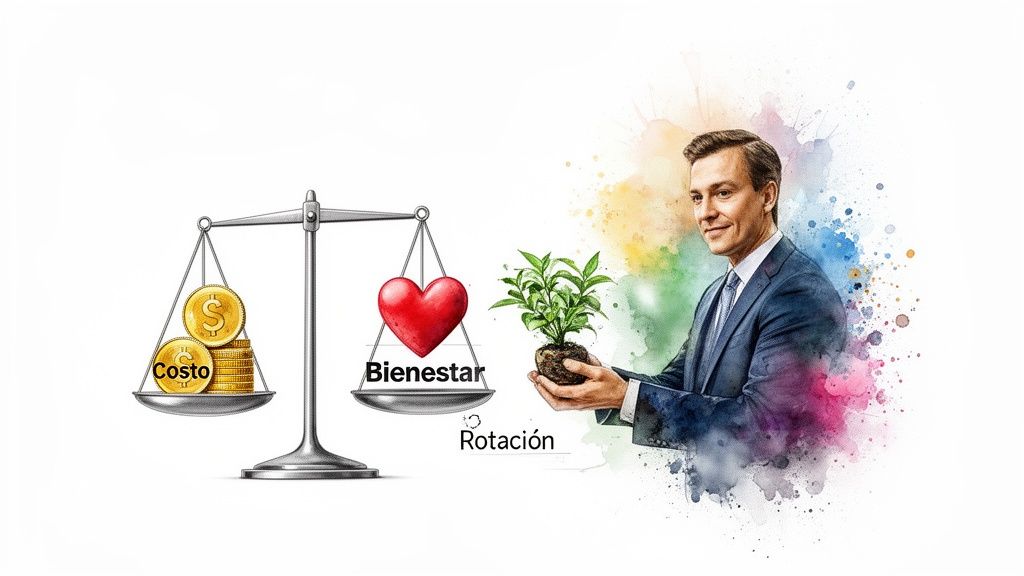
The situation in our country is a real challenge. According to various studies, Mexico has one of the highest employee turnover rates in Latin America, around 17% annually. This translates into enormous costs for companies. The good news is that corporate wellness programs have proven to be one of the most effective tools for turning this trend around.
Beyond the visible numbers
The cost of replacing someone is not just what you spend on a recruiter. There are hidden costs, those that are not always visible in the budget, but that bleed the organization from within:
Loss of productivity: Let’s be honest, a new member takes months to reach the efficiency level of the one who left.
Team overload: The teammates who stay have to absorb the extra work. The result is simple: more exhaustion, burnout, and, potentially, more resignations.
Impact on the work environment: When people see a revolving door, an atmosphere of instability and uncertainty is generated. Trust is eroded.
Loss of key knowledge: Experience goes away, the "secrets" of the business, that knowledge that is not in any manual and that is almost impossible to replace.
In our experience working with HR teams of various sizes in Mexico, we have seen time and again that burnout and chronic stress are the main catalysts for voluntary turnover. An exhausted collaborator, who feels the company does not care about their well-being, is a collaborator who already has one eye on LinkedIn. To go further, here you can explore other talent retention strategies that perfectly complement wellness initiatives.
"A study by Wellhub found that the vast majority of people (87%) remain loyal to their company if it shows a greater commitment to their work well-being".
Wellness as a business tool
Sometimes, justifying the budget for a wellness program feels like an uphill battle. Management may see it as an "extra expense" or a nice to have benefit. Our mission is to change that perception. Corporate wellness is not a luxury; it is a strategic investment with a measurable return.
A well-designed wellness program, that gets straight to the point with initiatives like office massages or stress management workshops, directly tackles the causes of turnover:
Combats stress at its root: Initiatives like the massages we offer at Zen to Go have been shown to reduce stress levels by up to 79%. A healthier environment is an environment where people want to be.
Strengthens emotional salary: When an employee feels that their company invests in their physical and mental health, their commitment and loyalty skyrockets. It is a clear message: "we care about you".
Builds a positive culture: Wellness becomes a pillar of organizational culture, helping you attract and, above all, retain the best talent in the market.
Understanding wellness from this perspective allows you to build a solid business case. You are no longer asking for money to "make people feel good". You are requesting resources to solve a critical business problem: high employee turnover.
How wellness impacts key turnover indicators
To make it even clearer, let’s see how wellness actions directly translate into measurable improvements. This table summarizes the connection between common turnover causes and the wellness solutions we implement at Zen to Go.
Turnover Indicator | Main Cause | Corporate Wellness Action | Expected Outcome |
|---|---|---|---|
Increase in voluntary resignations | Burnout and chronic stress (burnout) | Recurring chair massages and stress management workshops | Reduction of cortisol levels and improvement in mood |
Decrease in satisfaction index (eNPS) | Perception of lack of support from the company | Guided active breaks and themed wellness days | Increase in engagement and perception of care from the company |
Reduced average length of stay | Lack of work-life balance and toxic culture | Mindfulness programs and flexible hours for wellness | Strengthening the emotional salary and improving the work environment |
High replacement cost | Talent drain to competitors with better benefits | Competitive and tangible wellness benefits package | Greater loyalty and lower likelihood of looking for other job opportunities |
As you can see, each action is designed to solve a specific problem. This is not about isolated benefits, but about a comprehensive strategy that strengthens the organization from within, caring for its most valuable asset: its people.
Perform a diagnosis for an effective wellness program
Before investing a single peso in a wellness program, you need to know where it hurts. Launching wellness initiatives without a prior diagnosis is like prescribing medication without knowing the symptoms; it may not do harm, but it is almost certain not to solve the underlying issue. And as an HR professional, your time and budget are too valuable to waste on guesswork.
The objective is crystal clear: understand the root causes of stress, burnout, and ultimately, voluntary turnover within your organization. You need hard data and real testimonies to build a program that not only is well-received but generates a real impact on retention.
Listen to your team’s voice
The most valuable information lies within your teams. The key is to combine quantitative and qualitative methods to have a complete, 360-degree view of the state of wellness in your company.
Pulse surveys, but done well: Forget about long and tedious questionnaires. Implement short and frequent polls (perhaps monthly or bi-monthly) with direct questions about wellness.
Analysis of HR data you already have: Your own systems are a gold mine. Cross-reference voluntary turnover and absenteeism information by department, by leader, and by seniority. Do you notice any patterns?
Focus groups or "coffees with HR": Create a safe and confidential space. Here, small groups of collaborators can share their experiences and perceptions without filters. It’s where the numbers come to life.
When analyzing the data, look for connections. Is there any department with spikes in absenteeism due to illness? Is turnover higher in teams with specific leadership? Those clues are pure gold for your diagnosis.
Key questions for your diagnosis
The quality of your questions will define the quality of your answers. Instead of the typical "Are you stressed?", you need to go deeper. Here are some examples you can adapt:
On a scale from 1 to 10, how manageable do you feel your current workload?
Do you feel you have the time and resources to take real breaks during your workday?
What factor (if any) contributes the most to your stress at work? (You can provide options: workload, deadlines, team relationships, lack of clarity, etc.).
What type of wellness initiative would help you recharge the most in the office?
In our experience working with HR teams in Mexico, we have seen that often the most desired solutions are not the most expensive. Sometimes, something as simple as a quiet space to disconnect or a 15-minute chair massage can have a much greater impact than a complex benefit that no one uses.
Interpreting the findings to take action
Okay, you have the data. Now it’s time to connect the dots.
Imagine your analysis reveals that the IT department has the highest turnover rate. Then, in the focus groups, its members repeatedly mention "back pain" and "visual fatigue" from the long hours in front of the screen.
Bingo! There you have a clear starting point. Instead of a generic "healthy living" program, you can propose a super-focused initiative: bi-weekly chair massages directly in their area to relieve muscle tension, combined with ergonomics workshops and active breaks.
This data-driven approach not only ensures your wellness program is relevant, but gives you solid arguments to justify the investment to management. If you’re looking for a practical tool to measure burnout levels, a work-related stress test can be an excellent first filter.
Ultimately, this diagnosis allows you to move from reactive (replacing those who leave) to proactive. It helps you create a work environment where people choose to stay because they feel heard, cared for, and valued.
Design a wellness strategy focused on retention
With the diagnosis in hand, it’s time to translate the data into concrete actions. Designing a wellness plan that truly curbs turnover is not about throwing initiatives into the air, but about building a coherent strategy with clear objectives that directly connect with the needs you’ve already identified. This is where your role as an HR leader becomes one of an architect of the employee experience.
The key is simple: every action must be tied to a business outcome, which in this case is retaining your talent. You are not just "offering benefits"; you are implementing solutions to real problems, such as burnout in your sales team or physical tension in the development area.
From data to SMART objectives
Before deciding between massages, yoga, or mindfulness workshops, define what you want to achieve exactly. The SMART framework (Specific, Measurable, Achievable, Relevant, and Time-bound) is your best ally to stay on track and, more importantly, to demonstrate the value of your program.
A vague objective like "improving wellness" is useless because it cannot be measured. Instead, a SMART objective looks like this:
Objective: Reduce voluntary turnover in the IT department by 15% over the next 12 months by implementing a bi-weekly chair massage program and guided active breaks.
This approach gives you a clear direction and allows you to justify the budget in a language that management understands: that of measurable impact.
Choosing initiatives that actually work
With your objectives clearly defined, you can now choose the right tools. Not all companies need the same thing, and what works for one may not work for another. In our experience, the combination of different types of initiatives creates a much more solid and effective wellness ecosystem.
The process that leads you to these decisions is fundamental. It’s not about guessing, but about following a logical flow based on what your people have told you.
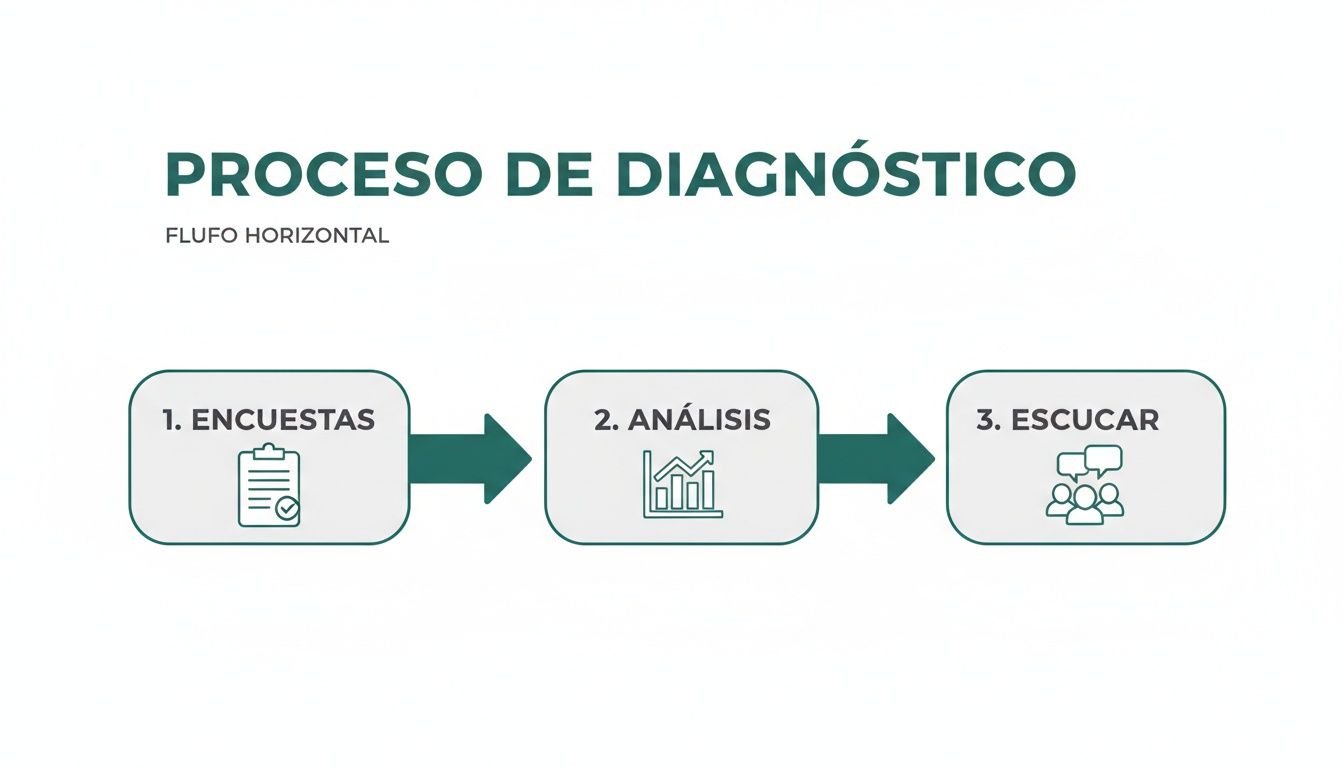
This cycle of Survey > Analyze > Listen is your insurance against wasted resources. It ensures that the initiatives you choose are those that your team truly needs and will value.
When designing your plan, it is vital to consider all the strategies to improve workplace wellness in a comprehensive way. Think of a menu of options that covers different areas:
Physical Wellness: This is where corporate massages in chairs or on tables come in, one of the most valued solutions for its immediate impact in relieving accumulated physical stress. You can also include active breaks, exercise challenges, or agreements with gyms.
Emotional and Mental Wellness: Stress management workshops, mindfulness sessions, access to psychological therapy, or webinars on emotional intelligence are key to combating exhaustion and burnout.
Social Wellness: Team-building activities, corporate volunteering, or simply creating spaces for interaction strengthen bonds among teams and radically improve the work environment.
If you’re looking for more ideas, our blog has a detailed guide to create a workplace wellness program that you can adapt to your company.
Budget and ROI: the business case for management
Presenting the project to management is your time to shine. The trick is to not talk about costs, but about investment. Your proposal must demonstrate how every peso invested in wellness will translate into significant savings and increased productivity.
Crunch the numbers. Calculate the current cost of your turnover (recruitment, training, learning curve, lost productivity) and project the savings you will achieve by meeting your SMART objective. For example, if reducing turnover by 15% saves you $500,000 pesos a year, and your wellness program costs $150,000, the return on investment is more than evident.
In our experience with Mexican companies, we have seen how well-targeted programs, such as corporate massages, manage to reduce turnover and improve the work environment tangibly. This investment not only cares for the talent you already have, but also positions you as an attractive employer brand for new generations, who no longer negotiate the work-life balance.
Get to work: launch and communicate your wellness program
You already have the diagnosis and the strategy. Now comes the good part, the moment of truth: moving from paper to action. Trust me, a flawless implementation and communication are what distinguish a wellness program that truly makes an impact from one that gets lost in another email. As an HR colleague, you know that the devil is in the details and, above all, in how you "sell" the idea to your people.
The trick is to generate expectation and make participation ridiculously easy. Here you become a kind of conductor, coordinating suppliers, leaders, logistics, and communication so that everything sounds in perfect harmony. The goal is to create an experience that people remember.
Choosing the right provider (and why you can’t go wrong)
Think about it: the wellness provider you choose will be the visible face of your program. It’s a critical point. Don’t look for a simple service vendor, look for a strategic partner who understands your headaches and, more importantly, guarantees bulletproof quality in every session.
At Zen to Go, for example, we take this personally. Our filter for selecting therapists is excessively strict because we know that a single bad experience can destroy the credibility of the entire program. Each therapist has a minimum of 3 years of proven experience and undergoes multiple assessments, from psychological tests to a meticulous reference verification.
A tip from colleague to colleague: when evaluating providers, do not let yourself be guided solely by the price. Ask without fear about their selection processes, what continuous training they provide for their people, and what experience they have in Mexico with companies of your size or industry. A good partner alleviates problems, they do not create them.
A communication plan that truly connects
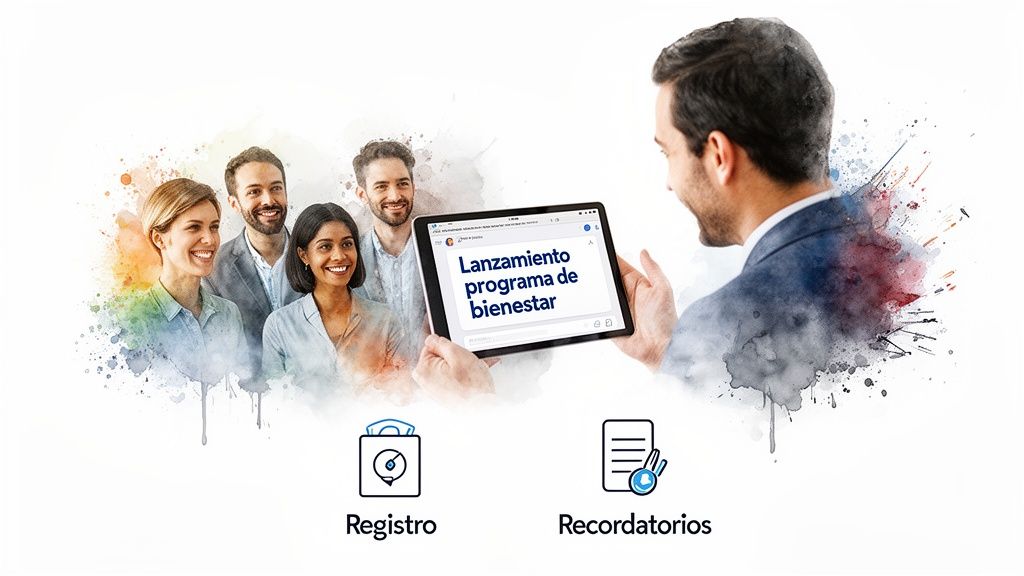
Please, don’t just send a mass email one day before. To ensure that people sign up and participate, you need to create a small internal campaign that sparks curiosity and excitement. Think of a phased launch, as if it were a movie:
Phase 1 (The teaser - 2 weeks before): Launch an intrigue campaign. Utilize your internal channels, whether it’s Slack, Teams, or office bulletin boards, with short messages like: “Ready to recharge? Something incredible is on the way”.
Phase 2 (The big announcement - 1 week before): Now, reveal all the details. An email from the CEO explaining the "why" of the initiative and how it connects with the company culture has a huge impact.
Phase 3 (Call to action - 3 days before): Open registrations and send clear reminders with super simple instructions. This is where good logistics and a user-friendly platform make all the difference.
Effective communication directly answers the question everyone is asking: “What’s in it for me?”. Speak in their language and focus on tangible benefits: “Say goodbye to that back pain” or “Learn to calm your mind before the final delivery”.
Launch checklist for your wellness program
To ensure nothing slips through the cracks in the whirlwind of launch, here’s a simple but powerful checklist. Use it as your roadmap to ensure that every piece is in place.
Phase | Specific Task | Responsible (example) | Status (pending/in progress/completed) |
|---|---|---|---|
Planning | Confirm dates and times with the provider. | Ana Pérez (HR Coordinator) | Completed |
Planning | Reserve physical spaces for the activities. | Juan García (Facility Manager) | Completed |
Communication | Design and schedule "teaser" campaign. | Sofía López (Internal Communication) | In progress |
Communication | Draft and get approval for the official announcement email. | Ana Pérez (HR Coordinator) | Pending |
Technology | Set up and test the registration platform. | Zen to Go Provider / IT | Completed |
Leadership | Information session with leaders to ensure their support. | Ana Pérez (HR Coordinator) | Pending |
Launch | Send communication for opening registrations. | Sofía López (Internal Communication) | Pending |
Launch | Monitor registrations and resolve any doubts from collaborators. | Ana Pérez (HR Coordinator) | Pending |
Post-Launch | Send post-event satisfaction surveys. | Zen to Go Provider | Pending |
Post-Launch | Analyze participation data and initial feedback. | Ana Pérez (HR Coordinator) | Pending |
This checklist is just a starting point. Feel free to adapt it, add more details, and assign clear responsibilities to ensure everything runs smoothly on the day of the event.
Leadership: your main promoter (or detractor)
You can have the most incredible program in the world, but if bosses and directors do not participate or mention it, its impact will fall short. Leading by example is key; there is no other way. When a director signs up for a massage session or a manager actively participates in a mindfulness workshop, they send a powerful message to their team: “Taking care of yourself is important, and you have permission to do so”.
Involve them from day one. Ask them to be the first to register and directly encourage their teams to take advantage of the opportunity. Their support is crucial to legitimize the program and break the invisible barrier of "I don’t have time".
Simplify logistics for you and everyone
Let’s be honest, as an HR professional, you already have a thousand plates in the air. Managing the wellness program cannot be another headache; it needs to be agile, intuitive, and if possible, automated.
Solutions like our platform at Zen to Go are designed just for that: to relieve you of the operational burden.
Imagine a system where people register online with two clicks, receive automated reminders in their email, and you, from your computer, have a dashboard with all participation metrics in real time. This not only saves you hours of emails and Excel sheets but also radically improves the collaborator's experience and boosts program adoption. Technology needs to be your best ally so you can focus on what really matters: analyzing results and planning the next steps in your wellness strategy.
Measuring impact and demonstrating the ROI of wellness
Justifying the budget is undoubtedly one of the biggest challenges we face in Human Resources. We know it firsthand. It's not enough to have a wellness program that people love; you need to demonstrate with clear and compelling numbers that this investment is generating a tangible return for the business.
If you don’t, you risk your initiative being perceived as a "nice expense" rather than the strategic tool that it truly is.
The objective here is twofold. On one hand, measure the real success of your program to adjust and improve it along the way. On the other, build an airtight business case that allows you not only to maintain the budget but even increase it in the future. Let’s break down how you can translate wellness results into the language that management understands: that of ROI.
The KPIs that tell the whole story
To know if you are on the right track, you need the right metrics. Forget about vanity indicators like the "number of registrants". While these are useful to measure adoption, they do not tell you anything about the real impact on retention. The key is to focus on the KPIs that are directly connected to business objectives.
Here are the indicators that, in our experience, best demonstrate how wellness helps reduce employee turnover:
Voluntary Turnover Rate: This is your star indicator. It measures the percentage of employees who choose to leave the company on their own initiative. Compare it before and after implementing the program, and if you can, segment it by department. Do you notice a decrease in areas with higher participation? There you have a powerful piece of information.
Employee Net Promoter Score (eNPS): The classic question: "Would you recommend working here to a friend or family member?" A wellness program that people truly value tends to boost this indicator because it improves the overall perception of the company as a workplace.
Engagement Levels: Lean on your pulse or work climate surveys to measure commitment. Questions about motivation, satisfaction, and a sense of belonging will give you a clear pulse on whether the environment is improving.
Absenteeism Rates (due to illness or stress): A less stressed team is a healthier team. A reduction in absences, especially unplanned ones, is a clear sign that your program is working and, moreover, generating direct savings.
The power of before and after
The simplest and most effective way to demonstrate impact is with a comparative analysis. You need a "snapshot" of your KPIs before launching the first wellness initiative. This will be your baseline, your starting point.
Once the program is underway (ideally wait a semester or a year to see clear trends), take a second "snapshot" of the same indicators. The difference between both images will tell a very powerful story by itself.
At Zen to Go, for example, we constantly measure the impact of our services. When we can report that 99% of employees who receive corporate massages feel that their company values their well-being, or that we have achieved a 79% reduction in stress among participants, we are providing HR with hard data for their business case.
These are not just nice numbers. They are proof that the program is moving the needle in terms of perception and emotional health of the team, factors that are directly linked to the decision to stay at the company.
Presenting results that convince
Your report for management cannot be a boring, number-filled Excel spreadsheet. It has to be visual, clear, and straight to the point. Think like a marketer selling your best product.
Here is a simple but very effective structure for your results presentation:
The Challenge (The "Why"): Start by reminding them of the problem you set out to solve. "Our turnover rate in the IT area was 25%, costing us X pesos per year".
The Solution (The "What"): Briefly describe the wellness program implemented. "We launched a program of bi-weekly massages and mindfulness workshops focused on this department".
The Results (The "Impact"): This is where you shine. Use bar or line charts to show the before and after of your KPIs. "After 6 months, turnover in IT dropped to 18%".
The ROI (The "How Much"): Now, translate those results into money. "This reduction of 7% in turnover represents an estimated savings of Y pesos in recruitment and training costs".
Qualitative Testimonials and Feedback: It's not all about numbers. Accompany hard data with a couple of powerful anonymous quotes from employees. "Since we have the massages, I feel that I can truly recharge and face the week with a different attitude".
By presenting the information this way, you are not only showing numbers, you are telling a success story. You demonstrate that you understood a business problem, proposed an intelligent solution, executed it well, and most importantly, generated measurable ROI. This is how wellness stops being an expense and consolidates itself as a strategic pillar in talent management.
Make wellness a pillar for your people to stay
Throughout this guide, we have seen step by step that reducing turnover with wellness programs is not a distant idea, but a clear, measurable business strategy, and above all, humane. From the initial diagnosis to measuring ROI, each stage was designed for you, as an HR leader, to become a real change agent within your company.
Wellness is no longer a "nice to have". It is now the pillar of a culture that not only attracts but also enchants and convinces the best talent to stay. It is not an expense, but the smartest investment you can make: the one you make in your people.
At Zen to Go, we understand that your role goes far beyond administration. It is about building those workplaces where people choose to be, grow, and give their best. That’s why we are not just a provider; we are a strategic ally that accompanies you with high-impact solutions, such as our corporate massages, designed to be easy to operate for you and deeply valued by your teams.
Allow us to help you build that solid, human, and resilient culture that will make you stand out in Mexico's competitive job market.
Because a team that feels cared for is a team that chooses to stay.
Frequently Asked Questions about wellness and employee turnover
As an HR leader, it’s normal to have doubts when proposing a new strategy. We understand the pressure to deliver results, the limited time, and the many fronts you have open. That’s why we’ve gathered the most common questions our clients ask us so you can have clear and straightforward answers.
What’s the minimum budget I can start with?
There is no magic number, but the good news is that you don’t need a million-dollar budget to generate real impact. The key is to start intelligently and scalably.
You can launch a pilot program focused on the department with the highest turnover or the one reporting the most stress. Starting with bi-weekly chair massages for this specific group can be very accessible and will allow you to measure concrete results in a controlled environment.
In our experience at Zen to Go, we have designed successful programs for companies of all sizes. The important thing is to adapt the frequency and type of service to your current financial capabilities. This way, you ensure a high return on investment.
How do I ensure that employees actually participate?
Participation is not luck; it is the result of a well-executed strategy based on three pillars: co-creation, communication, and ease.
Involve your people: Don’t impose the program. Launch brief surveys to ask them what types of activities they would value most. When people feel they are part of the decision, their commitment skyrockets.
Communicate the "why": Clearly and consistently explain the direct benefits for them. A message like "Release back tension after the meeting" connects much more than simply "We invite you to the wellness day".
Make it easy: Logistics cannot be a barrier. Tools like the Zen to Go platform, which allows online registrations and sends automatic email reminders, eliminate any friction. Signing up takes them seconds.
The role of leadership is crucial. When a manager or director is the first to sign up and encourages their team, it sends a powerful message: "Taking care of yourself is a priority, and you have permission to do so".
How long will it take to see results in turnover?
The impact of a wellness program has two speeds. Improvements in work climate, team energy, and the perception that the company cares are felt almost immediately. In fact, our data shows that 99% of collaborators who receive corporate massages feel that their company values their well-being from the very first session.
However, the direct effect on turnover rate is a medium-term result. Generally, it takes between 6 and 12 months of a consistent program to observe positive and measurable trends in talent retention. Consistency is your best ally; continuously measuring will allow you to adjust the strategy and demonstrate the long-term value of your investment in people.
At Zen to Go, we are your strategic ally to transform your work culture. We help you implement high-impact wellness programs, such as our corporate massages, designed to be easy to operate for you and deeply valued by your teams. Let us help you build that workplace where people choose to stay.