Wellness for technology companies: A practical guide for HR leaders in Mexico
The wellness for technology companies has ceased to be a "nice to have" benefit and has become a key piece of the talent strategy. As an HR leader in Mexico, you know that the challenge goes beyond offering snacks and a ping pong table. It’s about designing programs that truly address the physical and mental well-being of teams, something fundamental to combat burnout, curb high turnover, and attract that specialized talent that defines the sector.
The real challenge of wellness in the tech sector in Mexico
In the fast-paced Mexican technology ecosystem, the pressure to innovate and the endless hours in front of a screen create the perfect breeding ground for chronic stress. If you lead a People & Culture area, you are surely familiar with this image: exhausted people, difficulty disconnecting, and a constant trickle of valuable talent leaving in search of better conditions.
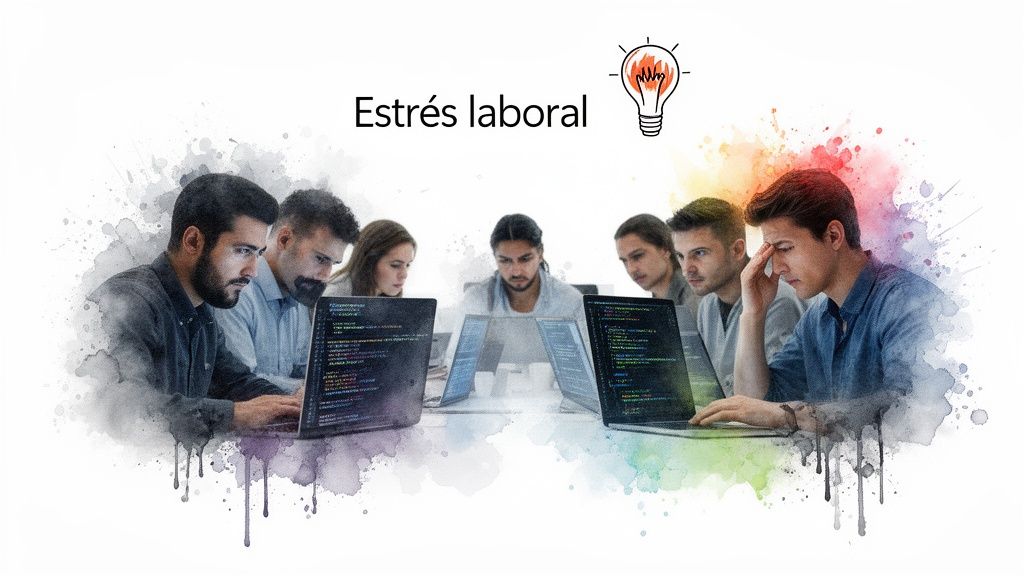
The challenge is twofold. On one hand, you have the mission of caring for your people to keep them motivated and productive. On the other, you need to build an Employee Value Proposition (EVP) that truly stands out in such a competitive job market. This is where a well-designed wellness program for technology companies becomes a tangible competitive advantage.
Beyond generic benefits
Let's be honest: traditional wellness solutions often do not connect with what a tech profile needs. A developer immersed in code for hours values solutions that do not disrupt the workflow, while a project leader may need tools to handle the stress of impossible deadlines.
In our experience working with HR teams in Mexico since 2019, we have seen that the success of a wellness program lies in its ability to adapt to the culture and routines of the team, not the other way around.
The goal of this guide is to give you a clear and practical path. We want to share with you what we have learned at Zen to Go by collaborating directly with technology companies so that you can:
Design a tailored strategy: That responds to the real pain points of your collaborators, from software engineers to product teams.
Justify the investment: We will show you how to measure and present the ROI in terms of productivity, engagement, and, above all, talent retention.
Implement without friction: Offering you straightforward logistical solutions that naturally integrate into the day-to-day of a technology company.
We know that workplace stress in this sector has its own rules. Therefore, we have delved into effective solutions for stress in the tech sector that can serve as a starting point for you. Throughout this guide, we will give you the tools to build a program that not only complies with NOM-035 but transforms well-being into a pillar of your culture.
How to diagnose the real needs of your tech team
Before launching any initiative for wellness for technology companies, there is a key question that every HR leader must ask themselves: what does my team truly need? Investing in a generic program without prior diagnosis is like developing an app without researching the end user: it is doomed to have low adoption and a null return on investment.
In the tech world, where each role has its own challenges, understanding these nuances is everything. A wellness program that does not address a real pain point becomes noise, just another message that everyone ignores on Slack and in corporate emails.
Active listening beyond the annual survey
The first step is to collect data, of course, but not just any way. You need to go beyond the typical workplace climate survey to obtain insights that actually serve some purpose. In our experience, the best view comes from combining quantitative with qualitative data.
Anonymous and highly focused surveys
Anonymity is key to obtaining honest answers. Design short and specific questionnaires, aligned with the psychosocial risk factors of NOM-035. This not only helps you comply with regulations but gives you a clear map of where the stress points are.
From Zen to Go, we always recommend including open-ended questions. A simple "What activity would help you disconnect and recharge during your day?" can reveal much more valuable ideas than a predefined options list.
Focus groups by specialty
Organize short talks (virtual or in-person) with well-defined groups: one focus group with backend developers, another with the QA team, and one more with product managers. Their pain points are different. While some experience visual and mental fatigue from extreme concentration, others deal with the pressure of launches and team coordination.
These conversations will allow you to capture the language and day-to-day situations that a mass survey simply cannot.
Analyze the data you already have at home
Many times, the answers are in the information you already handle in your daily management. The trick is knowing how to cross-reference the data to find patterns.
Absenteeism rates: Do you notice spikes in absences in certain teams immediately following a sprint or an important launch? That is a warning sign of burnout.
Turnover rates: Analyze why people are leaving. If in exit interviews you hear phrases like "lack of balance" or "excessive workload," you already have a clear starting point.
Use of current benefits: How much are the benefits you already offer utilized? If the gym is underutilized, it might be because people prefer activities that do not require commuting or that they can do during short breaks.
Checklist of key questions for your diagnosis
To make this process easier for you, here are some questions you can adapt for your surveys or focus groups. It's not just about measuring stress but understanding what solutions they would value. If you want to go deeper, you can use a stress measurement test as a complementary tool.
On a scale from 1 to 10, how would you rate your energy level by the end of the day?
What barriers (time, workload, schedules) do you encounter to participate in wellness initiatives?
Do you prefer individual activities that you can do at your own pace or group activities for socializing?
What type of break would help you be more productive? (E.g: a walk, a 10-minute meditation, a 15-minute massage session).
If you could change something about your daily routine to improve your well-being, what would it be?
Collecting this information will give you a clear and data-driven mandate. With these insights, you'll be able to move from assumption to strategy, designing a wellness program that your team not only needs but also values and actively uses.
Designing a flexible and appealing wellness program for tech professionals
Once you have the diagnostic data in hand, it’s time to move from insights to action. You now have a clear picture of what your team needs, so the challenge now is to build a value offering that truly connects with them. And in the tech sector, the key word is flexibility. A rigid, one-size-fits-all program simply will not work.
The key to success for a wellness program for technology companies is to offer a kind of "menu" of options that fits the different roles, schedules, and work modalities. Because, let’s be honest: not everyone needs the same thing at the same time.
The following diagram shows exactly that step: how to transform a general diagnosis into concrete ideas, something fundamental before you even think about designing your program.
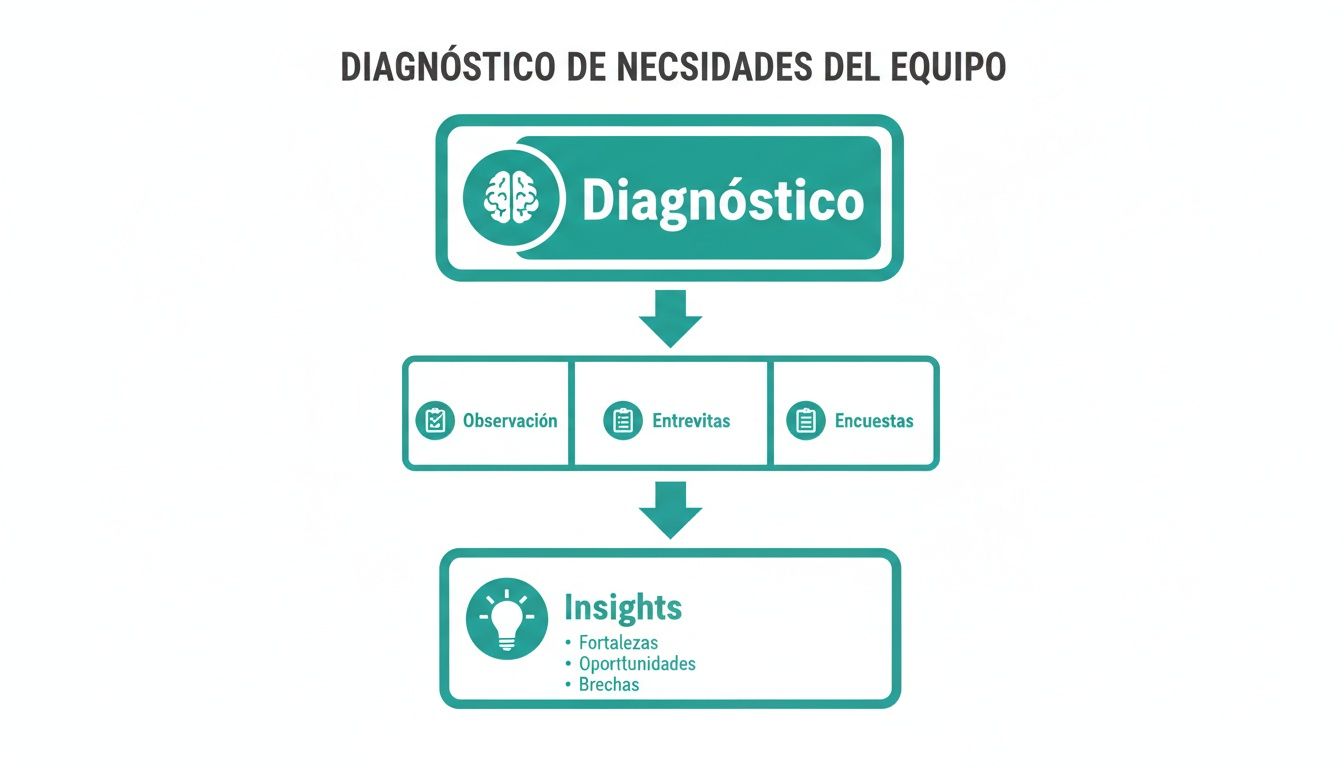
Having this process clear helps to understand that every piece of data you collect, whether from a survey or a focus group, must translate into personalized and tangible actions.
Creating a multichannel wellness menu
The hybrid reality is here to stay; there’s no turning back. Therefore, your wellness strategy must reflect this, providing fair and equitable support to both those who go to the office and those who work from home. This is where an intelligent combination of physical and digital solutions makes all the difference.
From our experience at Zen to Go, we have seen that certain modalities work wonders in tech environments due to their low level of interruption and high impact.
Desk massages: They are the perfect option for development and engineering teams. They last between 10 and 15 minutes, are done in their own place, and do not require the person to leave what they're doing for too long. It’s a micro-pause that combats postural tension without breaking their flow of concentration.
Shiatsu chair sessions: Ideal for days with many people in the office, integration events, or to celebrate the closure of a sprint. They create a very visible meeting and relaxation point, generating a super positive perception of the work environment.
Digital wellness solutions: For your remote collaborators or those who prefer to self-manage their wellness, it's key to integrate access to online therapy platforms, meditation apps, or virtual fitness classes. This ensures that no one is left out.
And of course, a comprehensive program must also consider the physical environment. Providing appropriate furniture and accessories is essential to prevent common injuries.
Which modality is best for my team?
To help you decide, here’s a comparison table summarizing which service best adapts to the operational needs and culture of your team.
Comparison of wellness modalities for technology companies
Evaluate which type of wellness service best adapts to the operational and cultural needs of your tech team.
Modality | Ideal For | Key Advantages for HR | Implementation Example |
|---|---|---|---|
Desk Massage | Development, engineering teams, and roles with high concentration. | Minimal interruption, high perceived ROI. | Bi-weekly 10-minute sessions per collaborator, scheduled by team to avoid affecting sprints. |
Chair Massage | Event days, project closures, high-traffic weeks in the office. | Creates a visible "wellness hub", encourages social interaction. | A "Wellness Corner" during the quarterly "All-Hands" with 2 therapists for 3 hours. |
Digital Wellness | 100% remote teams, collaborators in different time zones. | Scalable, equitable, and offers 24/7 flexibility. | Subscription to a meditation app and access to 3 online therapy sessions per quarter. |
Guided Active Breaks | Teams that spend long hours in meetings or sedentary work. | Encourages movement, prevents injuries, improves team energy. | A 15-minute break led by a physiotherapist via Zoom before the weekly team meeting. |
Each option has its moment and place. The smartest strategy is often to combine a couple of them to cover the different needs and work styles coexisting in your company.
Structure your program by clear pillars
To make your offering easy to communicate and understand, I recommend organizing it into three pillars. This way, each collaborator can quickly identify what they need and choose what suits them best.
1. Physical Well-Being
Here the focus is on alleviating the challenges of sedentary work and recharging energy.
Examples: Corporate massages (chair, desk), guided active breaks, physical activity challenges, ergonomics workshops.
2. Mental and Emotional Well-Being
The goal is to provide tools to handle stress, prevent burnout, and strengthen resilience.
Examples: Access to online psychological therapy, mindfulness workshops, guided meditation sessions, talks on stress management.
3. Social and Community Well-Being
This pillar aims to strengthen connections among teams, especially in hybrid models where it’s easy to disconnect.
Examples: Integration events with a wellness touch, outdoor team-building activities, creation of interest clubs (reading, sports, etc.).
The key data for retention: A well-designed program is not a luxury; it's a strategic necessity. According to a recent report from Wellhub, 87% of employees in Mexico would consider leaving a company that does not actively support their well-being. The figure speaks for itself about the urgency to act.
When designing your “menu,” don’t obsess over having dozens of options. It’s much better to start with two or three strong initiatives per pillar that you know respond to the data you have already collected. This will allow you to launch something solid, measure the impact, and then scale it intelligently. The key is to offer meaningful options rather than overwhelming with alternatives.
How to implement your program without dying in the process (and without operational friction)
A great idea for wellness for technology companies can fall apart due to poor execution. As an HR professional, you know logistics is everything. Your time is gold, and you need any new initiative to integrate smoothly, almost invisibly, into day-to-day operations.
This section is your field guide to achieving that. Here’s no theory, just steps and practical advice to ensure that the implementation of your program is not only a success but also makes your life easier.
The key: a strategic ally, not just a supplier
The first step, and the most important, is to choose a partner who understands your operation. You are not just looking for someone to send therapists; you need an ally who cares about logistics as much as you do.
In our experience working with People areas across Mexico, we have seen that operational ease is what truly makes a difference between a program that people use and one that just creates more work.
A good ally should make your life easier by providing:
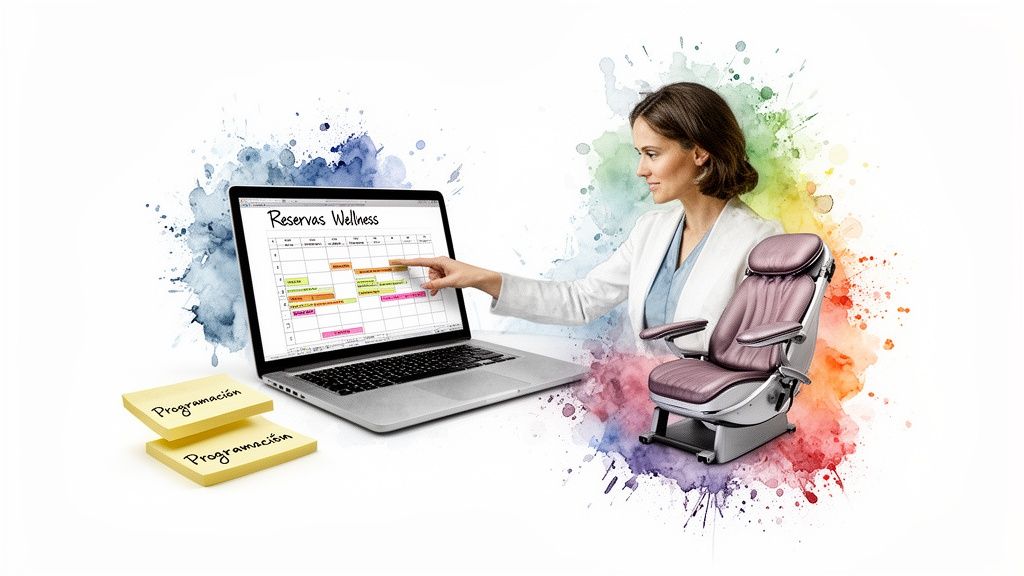
Online booking systems that work. Forget about shared Excels and endless email threads. A platform where people can see availability and schedule with a few clicks is non-negotiable. This frees you from manual management.
Automated communication. The system should send reminders via email or calendar. This minimizes absences and ensures that everyone is informed without you having to chase anyone.
Real flexibility. Your partner should understand that each office is its own world. They should adapt to your spaces, schedules, and team culture, not the other way around.
A wellness program must feel like a benefit, not an administrative burden. If signing up is a hassle or the logistics are confusing, people won’t use it, no matter how incredible the initiative is.
Logistical coordination for each modality
Each service has its nuances. Planning ahead prevents interruptions and ensures that the experience is good for everyone, both for participants and non-participants.
For Shiatsu chair massages:
Designate a "Wellness Corner". Look for a semi-private yet accessible space. A small meeting room or a low-traffic corner of a common area works perfectly. You don't have to isolate it completely, but you should avoid having it in a high-traffic area.
Think about the flow of people. If you have two or more therapists, ensure there is space for a small waiting line without blocking hallways.
Communicate the space in advance. Inform everyone where the massage area will be, so those who need absolute silence can avoid the area.
For desk massages:
This modality is a gem for tech teams because the interruption is minimal. The therapist approaches directly to each person's workspace.
Plan by areas or floors. To be more efficient, coordinate with your provider so the therapists work by areas. For example, from 10 AM to 12 PM on the development floor and from 12 PM to 2 PM in the product area.
Use a visual identifier. Something as simple as a colored post-it on the monitor can indicate who has a session scheduled. This allows the therapist to identify them without interrupting others.
Generate excitement: communication is everything
Success depends on how you sell the program internally. It’s not enough to send a mass email; you need to create a small campaign that arouses curiosity and excitement.
Here’s a base template you can adapt, designed for the tone of a technology company.
Launch email template
Subject: Your break to recharge energy is coming to the office 🚀
Hello, team:
We know that the pace is intense and that your focus is key to everything we achieve. That's why we want to ensure you have the tools to truly disconnect and recharge your batteries.
We are excited to announce our new wellness program. We start with [Name of the service, e.g., Chair Massage Sessions] right here in the office.
Why are we doing this?
To relieve physical tension from long hours in front of a screen.
To provide a mental break that helps you return to your tasks with more clarity.
Because your well-being is our priority.
How does it work?
These are [Duration, e.g., 15 minutes] sessions focused on the neck, back, and shoulders. Perfect for relieving stress without interrupting your day.
🗓️ When? Next [Date] from [Start Time] to [End Time].
📍 Where? In [Specific Place, e.g., the "Creativity" meeting room].
👉 [Link to the booking system] 👈
Spaces are limited, so don’t miss out!
We hope you enjoy!
Regards,
The People & Culture Team
Adapt this message for your Slack or Teams channels. Use GIFs, emojis, and a friendly tone. Remember, how you present the initiative is as important as the initiative itself. A good operational implementation is the silent engine that makes a great wellness strategy truly work.
How to measure the ROI of your program and communicate its success
For your wellness program for technology companies to be seen as an investment rather than an expense, you need to speak the language of the business: return on investment (ROI). Demonstrating its value is what secures the budget and ensures that the initiative isn't just a one-time thing.
As an HR leader, you know perfectly well that vanity metrics — like the number of massages you provided — do not tell the whole story. The true power comes when we cross-reference the program data with the indicators that truly keep management and your own department awake at night.
Beyond participation: the metrics that truly matter
To build an unassailable business case, the key is to correlate who participates in wellness initiatives with how certain organizational KPIs move. The question isn’t how many attended, but rather what changed for those who did?
In our experience, here are some data cross-references that are incredibly revealing:
Voluntary turnover: Compare the turnover rate between employees who actively use the program against those who don’t. A notable difference is a powerful argument for talent retention.
Absenteeism days: Check if teams with greater program adoption record fewer days of absence due to illness or stress. Less absenteeism equals more productivity, plain and simple.
Work climate results (eNPS): Segment your climate survey responses. Do frequent participants in wellness sessions have a higher Employee Net Promoter Score? This data directly connects well-being with engagement.
Team productivity: Although more complex to measure, you can observe if teams that adopt wellness breaks, like desk massages, report a higher perception of focus or meet their sprints with less friction.
Visualizing impact: a dashboard for management
You don't need sophisticated software to showcase your findings. A simple dashboard in a spreadsheet or a clear presentation can tell a very convincing story.
At Zen to Go, we have measured that after participating in our programs, collaborators report an average reduction of 79% in their perceived stress levels. This is the kind of tangible data that helps management connect investment with a human and business outcome.
Your report should be visual and to the point. Include graphs that show trends before and after implementing the program. For example, a timeline showing how turnover rates drop as participation in the wellness program rises.
Communicating success to the entire organization
Demonstrating ROI to management is only half the job. It’s crucial to communicate the results to the entire company to reinforce the program's value and encourage more people to participate. This shows the team that the company not only says it cares about them but also invests and measures the impact of that care.
Here are some communication tactics that work very well:
Share anonymous testimonials: Post short, anonymous quotes from collaborators in your internal channels. A "Thanks to the massages, I was able to finish the report without back pain" carries more weight than any statistic.
Show aggregated data: Instead of pointing to individuals, communicate collective achievements. "This quarter, as a team, we achieved a X% reduction in our reported stress levels.".
Create simple infographics: A visual chart showing "Hours of wellness invested" or "Total participants" can have a significant impact on office screens or on Slack.
The growth of the sector supports this vision. The corporate wellness market in Mexico reached a value of USD 847.8 million and is projected to reach USD 1,504.0 million by 2033. This compound annual growth rate (CAGR) of 5.90% demonstrates that companies, especially in technology, are recognizing that investing in wellness is a fundamental business strategy. You can explore the complete analysis of the wellness market in Mexico for more details.
Ultimately, measuring and communicating success closes the loop. It not only validates your role as an HR leader, but transforms wellness for technology companies from a "nice-to-have" benefit into an essential pillar of organizational culture. If you want to see examples applied to another demanding sector, we invite you to read our article on corporate wellness in the fintech sector.
Answering questions: frequently asked questions about wellness in tech companies
We know that launching a wellness program for technology companies brings many questions. As your allies in this mission, we have gathered the most common doubts leaders in HR and People & Culture raise. Here are straightforward and practical answers, born from our experience in the tech sector battlefield in Mexico.
How do I convince management to invest if the budget is limited?
This is undoubtedly the million-dollar question. The secret is to flip the conversation: instead of presenting wellness as an expense, show it as a smart investment to avoid a much greater cost: the cost of doing nothing.
Your best argument will always be hard data. Calculate how much it costs your company to lose a single specialized technology talent. Add up the recruitment costs (headhunters, platforms), the time invested by the team in interviews, the entire onboarding process, and the learning curve until the new person is 100% productive. That figure will almost always be overwhelmingly higher than the cost of a good wellness program.
Our recommendation is to start with a pilot. Don’t ask for a huge annual budget. Instead, propose a high-impact, cost-controlled initiative, like a quarterly chair massage day. Measure the results with pulse surveys before and after. A successful pilot is your best business case for justifying a larger investment in the future.
My teams are hybrid or remote, how do I offer something equitable?
In flexible work models, equity doesn’t mean giving everyone the exact same thing. It means providing options of equivalent value that fit each person's reality. The strategy needs to be omnichannel.
For those going to the office: Maximize the impact of in-person services, such as desk massages or chair massages. These are tangible benefits that make the commute to the office worth it.
For remote teams: Manage partnerships that give them access to digital benefits. Some ideas we have seen work wonders are credits for online therapy platforms, subscriptions to meditation apps, or sending wellness kits home on key dates.
For everyone: Organize quarterly or biannual events where the whole team can meet. These meeting points are the perfect opportunity to offer the same in-person benefits to everyone, reinforcing cohesion and a sense of belonging.
The most important thing here is to communicate clearly that the company cares about everyone equally, regardless of where they work from.
Developers are skeptical and usually don’t participate, how do I increase adoption?
This is a classic challenge in the tech world. To win over the more analytical, and let’s be honest, skeptical profiles, you have to speak their language: data, logic, and efficiency.
First, forget generic communication. Instead of talking about "relaxation," frame the benefits in terms of performance: improved concentration, reduced visual fatigue, and prevention of postural injuries (like carpal tunnel syndrome).
Second, lean on technical leaders. A message from the CTO or a respected Tech Lead recommending the initiative will carry much more weight than a mass email from HR. They are the true influencers in their teams.
Finally, logistics is crucial. Offer modalities that do not interrupt their "zone." 15-minute desk massages are perfect for this because they don’t require them to leave their spot or abruptly cut their workflow. A first experience impeccable in quality and operational simplicity will generate the best possible marketing: word of mouth within the development team itself.
At Zen to Go, we understand that each company is a universe. That’s why we design flexible wellness programs that adapt to your team’s culture and logistics, helping you build a solid business case and execute it without friction. Discover how we can be your strategic ally in corporate wellness.