Wellness Programs for Hospitals: Practical Guide for HR
Let’s be clear: welfare programs in hospitals are not a "plus." They are a strategic talent management tool to protect the physical and mental health of staff who live under extremely high levels of stress. It's not just about offering generic benefits, but about implementing concrete solutions—from active breaks and chair massages to psychological support—to curb burnout, improve the work environment, and, above all, retain the specialized talent that is the heart of any health institution.
The burnout of healthcare staff is no longer a secret
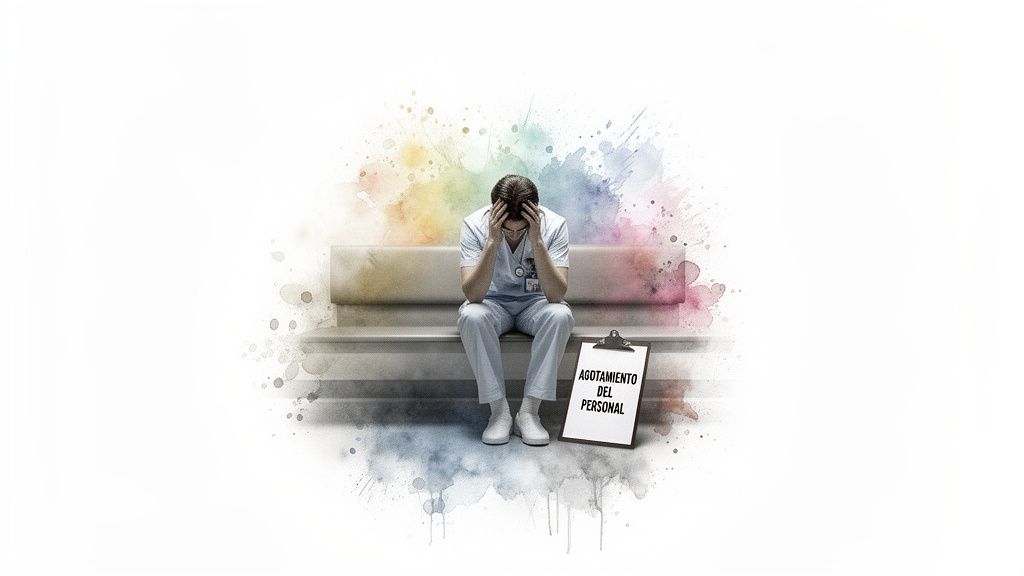
If you work in Human Resources within the health sector, you know perfectly well that the burnout of clinical staff has ceased to be a risk and has become an operational crisis of everyday life. The pressure is constant, the shifts are endless, and the emotional burden is simply brutal. Burnout is no longer the exception; it has become the norm.
This reality has a direct impact on the indicators that most keep HR and hospital management awake at night. Chronic fatigue increases the likelihood of medical errors, jeopardizing patient safety and the reputation that has been so costly to build. To make matters worse, it spikes absenteeism and turnover rates, a very expensive problem when we talk about clinical staff who have taken years to train.
In our experience working with HR teams throughout Mexico, we have seen that replacing a specialized nurse or a resident doctor can cost up to 150% of their annual salary. This does not include recruitment time, training, and the learning curve of the new employee.
More than a benefit, a pillar of risk management
Implementing welfare programs in hospitals is no longer a luxury benefit, it is a fundamental business strategy. It has become a key tool for risk management and, of course, an essential component to comply with NOM-035, which requires us to identify and prevent psychosocial risk factors.
Let’s consider a scenario that surely sounds familiar:
The emergency nursing team, chaining double shifts.
The residents, struggling against lack of sleep and academic pressure.
The administrative staff, dealing with the anxiety of relatives and internal bureaucracy.
Without a real support system, burnout is inevitable. The consequences not only poison the work environment, but they also have a tangible financial cost. Burnout is not an individual problem; it is the symptom of an entire system under stress. If you want hard data on this phenomenon, I recommend checking out the key data that every company should have about burnout in Mexico.
The proactive approach that HR needs
As strategic allies of Human Resources, we understand the pressure of having to justify every peso of the budget. That’s why the mindset needs to change: it’s not about "spending" on welfare, but about "investing" in operational continuity, in service quality, and in retaining the talent that keeps the hospital afloat.
A well-designed program does not just provide a momentary breather. It shows staff that the institution values their health as much as that of their patients. And that is a powerful statement that strengthens commitment, reduces talent drain, and, at the end of the day, protects the most valuable asset any hospital has: its people.
How to diagnose the real needs of your health team
Launching a welfare program without prior diagnosis is like prescribing a treatment without listening to the patient’s symptoms. From HR, we know that resources are limited and every initiative must have a real impact. Therefore, the first step—and the most crucial—is to implement a process of active listening that goes beyond assumptions and gives us concrete data.
In a hospital, the typical workplace climate survey falls short. We need tools that capture the particularities of the sector: the emotional exhaustion of dealing with others' pain, the fatigue of night shifts, or the pressure of making life-or-death decisions.
The objective is clear: to design tailored solutions that staff feel are genuine support, not just another corporate activity that takes away their valuable time.
Anonymous surveys that do ask the important questions
Anonymity is crucial for obtaining honest answers, especially in a hierarchy as marked as that of a hospital. Digital surveys are ideal because they allow for segmenting results by area (emergencies, operating room, inpatient floor) without compromising anyone's confidentiality.
Forget about generic questions. Go straight to the core of their daily experience. Here are some examples that we’ve seen work very well:
About emotional exhaustion: "What activity or situation during your workday causes you the most emotional exhaustion?"
About physical recovery: "What type of support or resource would help you recover better between long shifts?"
About real logistics: "If you had 15 free minutes during your shift for a wellness activity, when would be the most realistic time of day for you?"
About barriers: "What is the main obstacle that prevents you from taking care of your own wellbeing at work?"
These questions will give you direct insights into what they need and, above all, when they need it. This way, you can design welfare programs for hospitals that truly integrate into the operation, rather than compete with it.
Focus groups to understand the nuances
Surveys give you the "what," but focus groups provide you with the "why."
Organizing short sessions, lasting 30 to 45 minutes, segmented by role is an incredibly powerful tactic. The concerns of a first-year resident are not the same as those of a nursing chief with 20 years of experience or those of the cleaning staff.
In our experience, separating these groups allows the conversation to flow with more honesty. A resident may not feel comfortable sharing their exhaustion level in front of their attending physician, but among their peers, the story is different.
The tone should be conversational, not interrogative. The objective is simple: to understand their reality in order to provide solutions that truly value. The quality of this diagnosis is directly proportional to the success of the entire program.
This is a fundamental principle, very similar to how major public health programs are structured to address specific needs. For example, the expansion of the IMSS-Wellbeing Program was based on detailed analyses of infrastructure and personnel shortcomings, achieving a user satisfaction rate of 97.8% thanks to its structured approach. If you want to delve deeper, you can consult the program details here.
To have a more structured baseline, you can rely on specific tools before implementing any action. If you’re looking for a practical guide, we recommend using a validated test to measure stress in your teams.
Remember: this diagnosis is not a bureaucratic procedure. It is the foundation upon which you will build a program that staff not only uses but appreciates.
Designing a welfare program for a 24/7 environment
A hospital never sleeps. Therefore, the welfare programs designed for its staff should not sleep either.
The 9 to 5 office mindset simply does not apply here. As strategic allies of HR in the health sector, we have learned that the key to success in a 24/7 environment is flexibility and adaptability. It is about building a welfare portfolio that integrates into the operation, not competes with it.
The challenge is enormous: how to provide real support to a team that works rotating shifts of 8, 12, and even 24 hours, including nights, weekends, and holidays? The answer lies in designing high-impact interventions that are accessible precisely at the times and places where staff need them most.
The fundamental process to start is simple but powerful: listen, analyze, and then design.
This tripartite approach ensures that every initiative responds to a real need identified in your team. We set aside generic solutions that don’t connect with their day-to-day and start creating tangible value.
Modular interventions that work in hospital chaos
In our experience working directly with HR areas from various hospitals in Mexico, we have identified that a modular and decentralized program is the only way to achieve real outreach. The idea is to bring welfare to the employee, not wait for them to travel or sacrifice their little rest time.
Here are some of the most effective interventions we've implemented:
Rotating Shiatsu chair massage stations: Imagine a professional massage station that is set up for a few hours in the break area on the third floor during the afternoon shift. The next morning, that same station moves to the emergency nursing area. This itinerant model ensures that all floors and shifts have access to the benefit, reducing physical tension quickly and effectively.
Mindfulness accessible via QR code: Stress in a hospital is acute and unpredictable. Placing QR codes in strategic areas (cafeterias, locker rooms, staff lounges) that direct to guided mindfulness sessions lasting 5 or 10 minutes can be a lifesaver. A surgeon can use it to center themselves before a complex operation or a nurse to decompress after a difficult situation with a patient.
Active breaks during shift changes: Shift changes are times of high tension and transfer of critical information. Implementing active breaks of 10 minutes guided by a physiotherapist just before or after this moment helps to release accumulated tension, improve posture, and rejuvenate the incoming team.
Flexibility is not an option; it is a requirement. A successful program is one that understands that the needs of the intensive care team at 3 a.m. are radically different from those of the administrative staff at 12 p.m.
When choosing what to implement, it is helpful to compare options not only by their impact but also by their logistical feasibility within the walls of a hospital.
Comparison of welfare interventions for hospital staff
Type of Intervention | Feasibility in Hospitals | Potential Impact | Key Requirements |
|---|---|---|---|
Chair Massage | High | Immediate reduction of physical stress and muscle tension. Improvement of mood. | Small and quiet space (3x2 m). Provider with strict hygiene protocols. Shift scheduling logistics. |
Guided Active Breaks | High | Relief of postural tension, prevention of injuries, re-energization of the team. | Coordination during shift changes. Certified physiotherapist. Adaptable common space. |
Mindfulness and Meditation | Very High | Management of acute stress, improvement of concentration, emotional resilience. | Minimal. Can be implemented via QR codes, app, or short group sessions. |
1:1 Psychological Support | Medium | Deep support for burnout, secondary trauma, and chronic stress. | Confidentiality guaranteed. Flexible schedules (virtual or in-person). Provider specialized in health personnel. |
Nutrition Workshops | Medium | Improvement of eating habits to endure long and demanding shifts. | Content adapted to rotating schedules. Short and practical formats (micro-learnings). |
Each option has its place. The magic is in combining interventions that are logistically easy with others of greater depth, creating a support ecosystem that truly works.
Adaptation to high-specialization areas
Each unit within a hospital has its own culture and its own stress factors. Therefore, personalization is essential to achieve engagement from the team. You cannot offer the same thing to everyone and expect it to work.
For operating room staff, for example, who spend hours standing in forced postures, specific stretches and chair massages for the back and neck have an immediate and highly valued impact.
For the emergency team, exposed to constant emotional stress, rapid emotional management tools such as mindfulness and access to psychological support are priorities.
Finally, for the inpatient staff, who exert significant physical effort moving patients, sessions focused on postural hygiene and injury prevention are crucial.
The key is to return to the diagnosis you made at the beginning. Cross the "needs" data with the "operational characteristics" of each area. This way, the program feels pertinent and valuable, demonstrating to staff that the organization truly understands and cares about the specific challenges of their function.
The logistics of implementing welfare without interrupting the operation
For many HR professionals in the health sector, the biggest barrier to implementing welfare programs in hospitals is not the staff's lack of interest or management's resistance. It is a much more tangible challenge: the logistics.
How do you bring real support to an environment that never stops, without interrupting critical operations?
We understand this challenge perfectly. Coordinating welfare actions in a 24/7 environment with shifts of 8, 12, and even 24 hours sounds like a mission impossible. But with a strategic approach and the right tools, it is totally feasible. The key is simple: the program must adapt to the hospital, not the other way around.
Our experience working with HR teams throughout Mexico has taught us that logistical success depends on three pillars: schedule management that includes everyone, the creative use of the spaces you already have, and choosing a provider that truly understands your reality.
Schedule coordination for rotating shifts
The first mistake we see is thinking of a fixed schedule. For a program to be fair, it has to cover all shifts. This includes night and weekend shifts, which are often the most exhausting and, paradoxically, the most forgotten.
The solution is a modular and rotating schedule. For example, if you offer chair massages, the provider can be there on Monday for the morning shift, Wednesday for the afternoon shift, and Friday for the night shift. This rotation ensures that, throughout a month, all staff have the opportunity to participate, regardless of their schedule.
This is where an online scheduling platform becomes your best ally. It allows staff to reserve their 15 minutes in advance, giving them control and visibility. For you in HR, it automates the process, eliminates manual lists, and provides valuable data on peak hours.
Including night and weekend staff is not a minor detail. It is a powerful signal that the organization values everyone on their team equally. This strengthens commitment and reduces that sense of inequity that causes so much harm.
Finding viable spaces within the hospital
"We don’t have space" is an objection we often hear. The reality is that hospitals are full of underutilized spaces that can be temporarily transformed into small oases of wellbeing. You don't need a permanent spa room; you just need creativity and flexibility.
Here are some practical ideas that we’ve seen work wonders:
Empty Consulting Rooms: Many consulting rooms are not used 100% of the time. Coordinated with the medical area, a consulting room can easily host a massage chair or a meditation session.
Small Meeting Rooms: During certain hours, these rooms are free and offer the privacy needed for a relaxation session.
Rest Areas: A quiet corner in the staff break area may be sufficient to set up a Shiatsu chair massage station, which requires a minimum space of 3x2 meters.
The key is that the space guarantees privacy and compliance with hygiene protocols. An experienced provider will know how to operate discreetly and efficiently, using disposable materials and clinical-grade sanitization techniques.
This commitment to infrastructure and the wellbeing of staff echoes the large investments made at the national level. For example, in 2023, the approved budget for the IMSS-Wellbeing program was 20,628.2 million pesos, intended to strengthen hospitals and improve staff conditions. You can learn more about how this investment supports the health sector.
Checklist for selecting the right provider
注意: Not every corporate wellness provider is prepared for the challenge of a hospital. Your provider should be a logistical partner, not another operational burden for you.
Use this checklist to choose wisely:
Proven experience in the health sector: Have they worked before in clinics or hospitals? Ask for concrete references.
Strict hygiene protocols: Does their staff follow clinical-level sanitization standards? Accept nothing less.
Real operational flexibility: Can they adapt their schedules to rotating, night, and weekend shifts without making excuses?
Simple scheduling platform: Do they offer an online tool that makes life easier for staff to reserve and for you to manage?
Certified and insured staff: Do all their therapists have valid certifications and civil liability insurance?
Autonomous logistics: Can their team set up and operate with minimal supervision, understanding the need to never interrupt operations?
Choosing the right provider frees you from micromanagement and allows you to focus on strategy, with the peace of mind that execution is in the hands of experts who understand the culture and demands of a clinical environment.
How to measure ROI and justify the investment to management
As Human Resources professionals, one of the most complex conversations we have is about the budget. For a wellness program in a hospital to get the green light, we need to stop talking about feelings and start speaking the language of management: data, results, and return on investment (ROI).
Framing wellness as a "nice to have" is the quickest path to rejection. The correct strategy is to frame it as a smart investment that directly impacts the indicators that most concern senior management: operational efficiency, profitability, and, of course, the quality of patient care.
The key is to translate the benefits of a healthier team into financial and operational metrics. It is about building a compelling story with numbers, demonstrating that taking care of your staff is one of the most profitable business decisions the hospital can make.
KPIs that matter to senior management
The success of your proposal depends on focusing on the right metrics. Although 99% of collaborators in our programs feel that the company values their wellbeing, management needs to see how that feeling translates into tangible results for operation.
Focus on these key indicators, which are true pain points:
Nursing staff turnover rate: This is one of the highest and most challenging costs to manage. Measure turnover before and after implementing the pilot program.
Absenteeism index due to incapacity: Track the days of absence due to illness, stress, or burnout. A reduction, even if small, represents a direct saving in replacement costs and productivity loss.
Work climate survey results: Compare scores in key dimensions such as engagement, satisfaction, and perception of organizational support.
Medical errors or safety incidents: It’s sensitive data but fundamental. A decrease, no matter how small, can correlate with a less fatigued and more focused staff.
It’s not just about measuring happiness. It’s about measuring how a healthier and more engaged team directly impacts operations. The goal is to connect wellbeing with clinical excellence.
Translating results into tangible savings
Once you have the data, the next step is to put a price tag on it. This is the moment of truth, where the investment is truly justified.
Calculate the real cost of turnover:
Investigate how much every nurse or doctor resignation costs the hospital. It’s not just severance pay; consider recruitment costs (advertising, HR time), selection, hiring, training, and productivity lost while the new employee reaches their maximum potential. If preventing just one resignation covers the annual cost of the program, you already have a solid business case.
Quantify absenteeism:
Calculate the daily cost of an absence. This includes the salary of the missing employee, plus the cost of paying overtime to cover for them or the efficiency loss if the position is temporarily vacant. Multiply that cost by the number of absentee days you managed to reduce.
This quantitative approach transforms the conversation entirely. You are no longer asking for an expense; you are presenting a clear opportunity for savings and optimization. This business logic is universal and applies in high-pressure sectors. In fact, it’s the same logic that tech companies use to retain talent, as you can see in our analysis on corporate wellness in the Fintech sector.
Building a compelling business case
Your presentation to management should be a clear, direct, data-driven story. Start with the problem (high turnover rates, absenteeism), present the solution (the wellness program you designed), and close with projected results or, better yet, the actual results from the pilot (concrete savings and improvement in KPIs).
The health sector in Mexico operates on a massive scale. In 2023 alone, private establishments registered 2,275,770 hospital discharges, operating with an infrastructure of 5,251 operating rooms. In this demanding context, efficiency and staff focus are not a luxury; they are a critical operational necessity.
If a wellness program can reduce the fatigue that leads to errors or the need for rehabilitation of the staff itself, the investment justifies itself. To better understand the scale of the sector, you can explore the complete statistics of the private health sector.
By presenting your case this way, you demonstrate that you understand the business priorities and that you have a concrete plan to contribute to the financial and operational health of the hospital. Thus, wellness ceases to be an expense and becomes what it really is: a strategic and profitable investment.
We resolve your doubts: frequently asked questions about wellbeing in hospitals
We know that launching a welfare program in a hospital environment raises questions. It’s a world apart, with challenges that a traditional office can’t even imagine. That’s why we’ve compiled the doubts most frequently posed by HR leaders in the health sector, with direct responses drawn from our field experience.
How do we implement a welfare program if the budget is limited?
This is the million-dollar question. And fortunately, the answer does not lie in having a blank check but in strategy. You don’t need massive investment for the impact to be noticed.
The trick is to start with high-impact, low-logistics-cost actions. Forget about setting up a complete gym. Instead, leverage the resources you already have. For example, stress management workshops conducted by the hospital's own psychologists or active breaks guided by your physiotherapy team.
Another tactic that works wonders is negotiating a pilot program with a specialized provider. Choose a high-tension area, such as emergencies or intensive care, and obsessively measure the results. That hard data will be your best argument to justify a larger investment to management.
The staff is exhausted and overwhelmed; are they really going to participate?
Participation is not given; it is earned. And it depends on three key factors: it must be relevant, it must be accessible, and leadership must set an example.
If the activities you offer truly respond to the needs identified in your diagnosis (relevance), you already have their attention. The next step is to bring welfare to their workplace (accessibility).
In our experience with hospitals, it is infinitely more effective to bring a 15-minute massage station to the inpatient floor than to expect staff to go down to a common room. Convenience is everything in a non-stop environment.
Finally, example leads. If nursing leaders and lead physicians use and promote the services, the rest of the team sees it as permission to take care of themselves, not as yet another task on their endless list.
What type of provider should we look for in a hospital?
Note here: not every corporate wellness provider will work. A hospital has rules, rhythms, and demands that exist nowhere else.
You need a strategic partner that shows, through actions, that they understand the health sector. The non-negotiable criteria you must demand are:
Certified and insured staff. All therapists must have valid certifications and civil liability insurance. No exceptions.
Hospital-grade hygiene protocols. They must know and apply sanitization protocols that meet the standards of your institution.
Real operational flexibility. Their ability to adapt to rotating, night, and weekend shifts is not an "extra"; it is the foundation of their service.
Logistics that relieve work, not add to it. They should offer a simple scheduling platform that frees you, not complicates your life.
Always ask for references from other hospitals or clinics. It’s the only way to ensure they know how to navigate such a complex environment without interrupting operations.
How does a wellness program align with NOM-035 in a hospital?
A well-designed wellness program not only aligns but is one of the most powerful and visible tools to comply with NOM-035. It is, in practice, a preventive and control measure that directly addresses psychosocial risk factors.
Healthcare staff is exposed to extreme conditions: brutal workloads, very long shifts, and constant exposure to traumatic events. All of these are red flags for the regulation.
Interventions such as psychological support, stress management workshops, or chair massages to relieve physical tension are concrete actions that mitigate the consequences of these risks.
Documenting the implementation and participation in these programs is your tangible proof to the Ministry of Labor and Social Welfare (STPS). It demonstrates that the hospital is taking proactive measures to care for its people’s mental health, going beyond mere compliance to create a genuinely safer work environment.
At Zen to Go, we understand that wellbeing in a hospital is not a luxury; it is an operational necessity. Since 2019, we have been allies of HR teams in Mexico, designing flexible and high-impact programs that adapt to the complex reality of the health sector. If you are looking for a partner that understands your challenges and provides solutions that work, you are in the right place. Learn more about what we do at Zen to Go.