How to Create a Workplace Wellness Program: Practical Guide for HR in Mexico
For a workplace wellness program to truly work, the first step is to conduct an honest and thorough diagnosis of what your people need. Before launching any initiative, the key is to listen and analyze the data you already have. As Human Resources professionals, we know this is how a strategy is built that generates real impact, not just a calendar of isolated activities.
The first step for a successful wellness program: the diagnosis
As HR leaders, we know what it’s like to struggle to justify investments that do not have an immediate financial return. Coming in with a wellness proposal without a solid diagnosis is like asking for a budget for a trip without saying where you are going; it's a vague idea that is unlikely to get the green light from management.
But the conversation changes completely when you come in with concrete data in hand.
You are no longer asking for an "expense"; you are proposing a strategic solution to problems that actually matter to the business: the turnover of key people, unscheduled absenteeism, or the drop in productivity of a team. This approach positions you as an ally who understands the metrics of the business.
The gold mine you already have in HR
You don’t need expensive tools to get started. Most likely, the most valuable information about the well-being of your people already resides in your own systems and reports. The trick is knowing how to connect the dots.
Climate or engagement surveys: Don’t just focus on the final number. Filter the results by area, seniority, and role. Is the sales team reporting much higher stress levels than the others? Do new hires feel like they don’t connect with the culture?
Absenteeism and turnover data: Look for patterns. Are there spikes in absences during certain months? Do people who resign concentrate in a single department? These are red flags of burnout or leadership that needs urgent support.
Exit interviews: They are a brutally honest source of information. Ask directly what would have improved their experience. Many times, the responses point to a lack of balance, recognition, or support for their well-being.
Compliance with NOM-035: Questionnaires and evaluations of psychosocial risk factors are an excellent guide. They precisely tell you where the problems of workload, lack of control, or even workplace violence are.
In our experience working with HR teams in Mexico since 2019, we've seen how the simple act of cross-referencing information from a climate survey with turnover data from a quarter can reveal a silent crisis in an area that, on paper, seemed to be meeting its goals. If you want to better understand how these pieces fit into a complete strategy, you can explore more about what workplace wellness is and why it is a smart investment.
This diagnostic process essentially follows three fundamental steps.
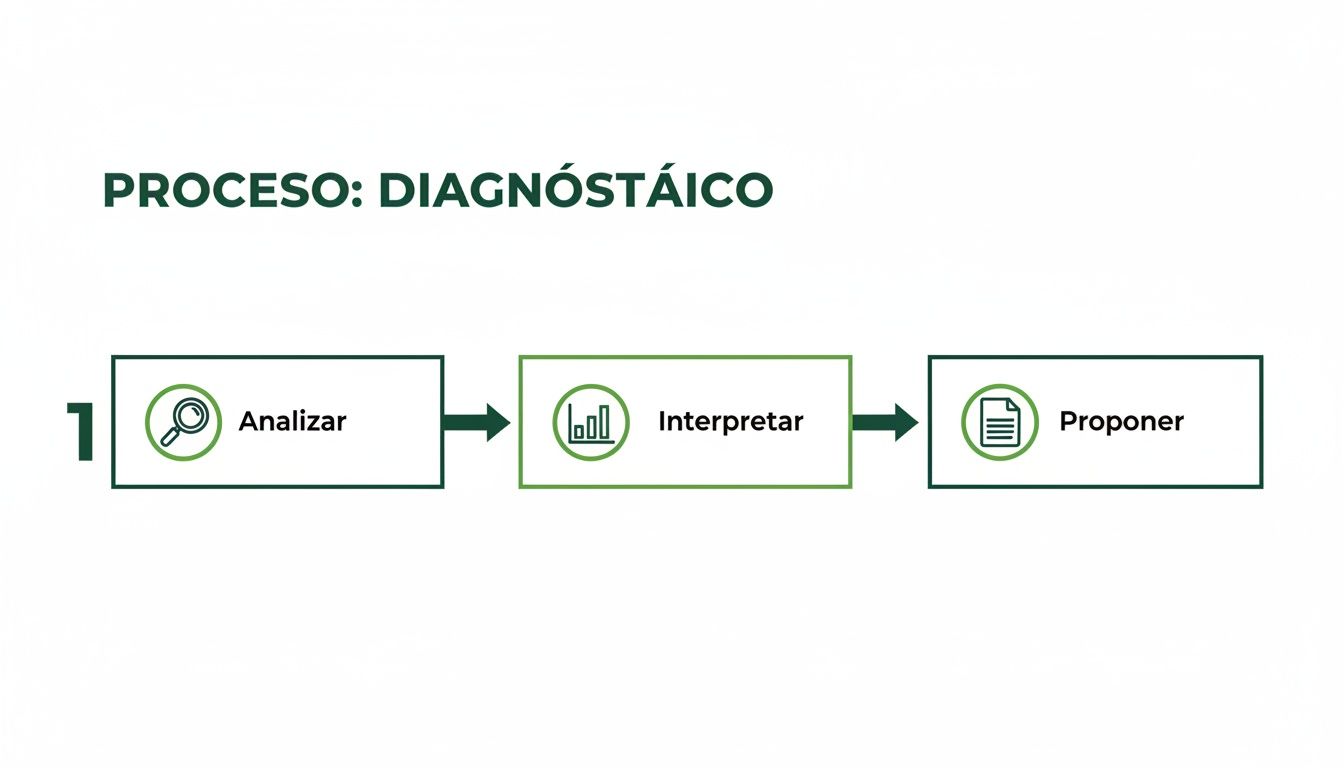
As you can see in the flow, it all starts with analyzing the data you already have, then comes the interpretation to find patterns, and finally, you build a value proposal that stands on its own.
From data to action
Once you gather and analyze all the information, the next step is to translate it into specific needs. Wellness does not mean the same thing for a team of developers who spend hours in front of a screen as it does for a sales team that faces rejection every day.
A wellness program cannot be a generic solution. It must be a tailored response to the real pain points of your people. A precise diagnosis is what differentiates a memorable initiative from an irrelevant expense.
For example, if your diagnosis reveals that the technology team suffers from back pain and visual fatigue, an initiative like Spa Massages in the Office can have an immediate and very visible impact. But if the main issue is financial stress, a workshop on personal finance will be much more valued than a yoga class.
Building this business case with data will not only help you secure the budget, but it will also give you the foundation to measure the success of the program later on. You can say with confidence: "We invested in 'X' to solve 'Y', and here are the results".
How to define objectives and metrics that truly demonstrate impact
A wellness program without clear objectives is like throwing darts in the dark. You might hit something, but it will be pure luck. And as HR professionals, we know that management does not invest in luck; they invest in measurable results.
This is why, once you have your diagnosis, the next step is to translate those findings into goals that speak the language of business. Here is where your role becomes 100% strategic.
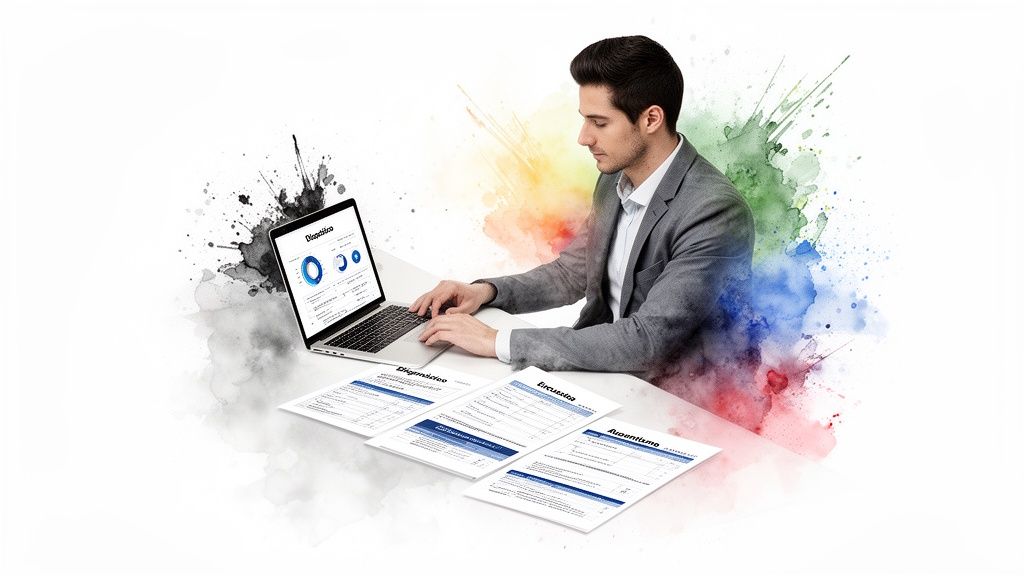
The key is to move away from general intentions like "improve workplace climate". You need SMART goals (Specific, Measurable, Achievable, Relevant, and Time-bound) that connect directly with the company’s performance indicators.
From findings to strategic goals
Think about the concrete problems you identified in your diagnosis and turn them into a goal with a name and surname. It’s simpler than it seems.
For example:
Finding: "High voluntary turnover in the technology team, primarily due to stress and overload".
SMART Goal: "Reduce voluntary turnover in the technology area by 10% over the next six months by implementing a stress management and active breaks program".
Or this other case:
Finding: "Spikes in absenteeism due to illness in the operations area during the last quarter".
SMART Goal: "Decrease unplanned absenteeism in operations by 15% by the end of the year through preventive health campaigns and physical wellness days in the office".
This approach completely changes the conversation. You are no longer asking for a budget for "nice activities", but you are presenting a solution to operational problems that cost money and affect productivity.
For management to listen to you, you have to speak their language. Translate 'wellness' into metrics that directly impact the income statement: turnover, absenteeism, productivity, and engagement.
The KPIs that really matter
Once you have your goals, you need the right Key Performance Indicators (KPIs) to measure your progress. Here the trick is to combine process metrics (is the team participating?) with impact metrics (is that participation generating real change?).
You don’t have to measure them all. Choose the ones that best align with the objectives you set out initially. The right combination of KPIs will give you a powerful data-driven story to present to management, demonstrating that investing in wellness is one of the smartest business decisions they can make.
Selecting KPIs for your workplace wellness program
A guide to choose the right metrics according to your company's objectives, helping to measure the real impact on the business and the people.
Program Objective | Primary KPI (Business Impact) | Secondary KPI (Employee Perception) | Suggested Measurement Frequency |
|---|---|---|---|
Reduce stress and burnout | Voluntary turnover rate | Pulse survey results (stress-related questions) | Quarterly |
Decrease absenteeism | Days absent due to illness/stress | Perception of company support (climate survey) | Monthly / Quarterly |
Improve engagement | Participation rate in voluntary programs | eNPS (Employee Net Promoter Score) | Semi-annual |
Increase productivity | Productivity per team/area (if measurable) | Self-assessment of focus and energy post-activity | Post-event and Quarterly |
Strengthen the culture of care | Rating on employer branding platforms | Satisfaction rate (CSAT) of activities | Ongoing |
This table is not a rule but a starting point. Adapt the KPIs to what your company values and to the data you already have available so you can compare the before and after credibly.
Process metrics vs. impact metrics
It is essential to differentiate between the two types of indicators.
Process and participation metrics tell you if your program is reaching people. They are your operational thermometer.
Participation rate: The percentage of employees attending an activity. If you offer a massage day, how many slots were filled?
Frequency of participation: Is it always the same people, or are you attracting new profiles?
Satisfaction rating (CSAT): A simple post-activity survey asking on a scale of 1 to 5 how satisfied they are. At Zen to Go, for instance, we always measure this and find that 94% of participants perceive high service quality.
Business impact metrics, on the other hand, are what demonstrate ROI and are of interest to your CFO.
Voluntary turnover rate: Compare this data before and after your program, especially in critical areas.
Absenteeism rate: Measure the reduction of days absent due to illness or stress.
Pulse survey results: Measure changes in specific questions about stress, engagement, or perceived support. A powerful data point we see in our programs is that 99% of participants feel that the company values their well-being, a direct indicator of emotional salary.
In the end, it's about telling a story with data. A story that shows that taking care of your team is not an expense; it is the best investment for the business.
Designing a wellness program tailored to your team
You now have the diagnosis in hand and the objectives on the table. Now the fun begins: choosing activities that will truly connect with your people. A very common mistake is launching generic initiatives without considering the needs you have already identified. Believe me, it shows.
A successful wellness program is not a buffet where everyone takes what they can. Think of it more as a well-planned tasting menu: each initiative has a purpose and contributes to a complete experience.
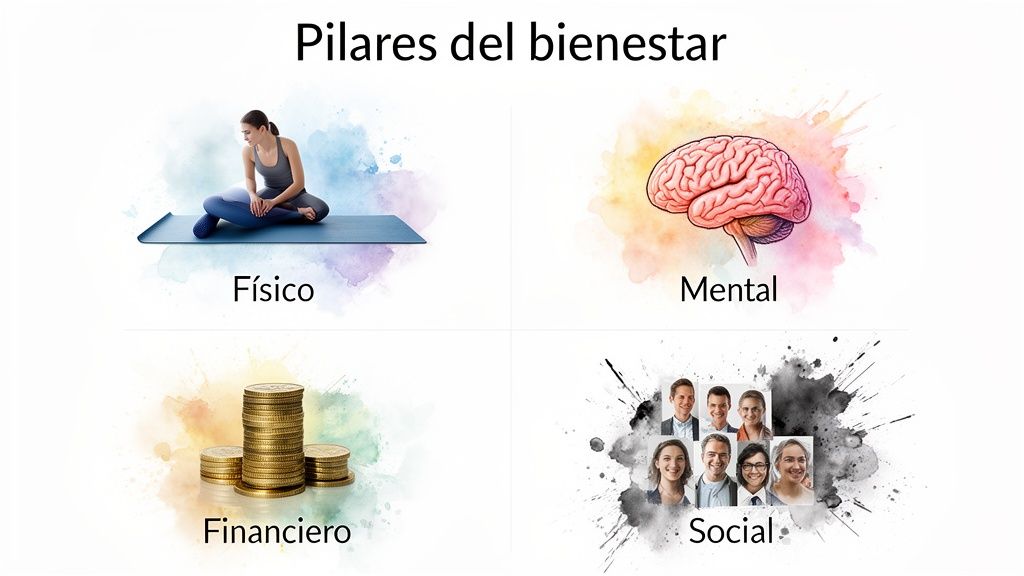
The four pillars of corporate wellness
To give structure to your program logically and not miss anything, we like to think of four pillars. It’s not about having a thousand activities in each one, but offering a range of options that cover the various dimensions of a person’s well-being.
Physical Wellness: This is the most obvious and often the easiest to kick off. It focuses on health, energy, and preventing those typical discomforts of office work.
Mental and Emotional Wellness: Now more than ever, this is essential. Here we tackle stress, anxiety, burnout, and provide tools to manage day-to-day emotions.
Financial Wellness: For many, this is the main source of stress. Providing your team with tools and knowledge in this area generates a loyalty you cannot imagine.
Social Wellness: This focuses on human connection, sense of belonging, and the quality of relationships at work.
The magic lies in how you mix actions from each pillar to create an annual calendar that maintains interest and feels relevant to everyone, not just a few.
Practical ideas for each pillar
Let’s bring these concepts to reality, with concrete examples that work in Mexican companies, with options for all budgets and cultures.
For physical wellness
This pillar is much more than a gym discount. It’s about incorporating movement and body care into the workday.
With a low budget: Organize active breaks led by "internal ambassadors", arrange group walks during lunch breaks, or launch weekly step challenges. This works and costs nothing.
Of visible impact: Office massage days are undoubtedly one of the most valued initiatives. In our experience at Zen to Go, we see that Spa Massages have an immediate effect in reducing tension and stress. The best part for HR is that the logistics are minimal: you don’t need a special room or for people to change clothes, which facilitates high participation.
In Mexico, where work-related stress affects 75% of workers, offering tangible solutions like corporate massages directly tackles symptoms like back pain and anxiety. Companies that measure the ROI of these programs report clear improvements in productivity and retention.
For mental and emotional wellness
Here the game is to provide practical tools for day-to-day life while removing the stigma from mental health.
With a low budget: Organize internal workshops on time management or mindfulness for beginners. Create a channel on Slack or Teams to share resources like podcasts or articles on emotional health.
As a strategic investment: Offer access to online therapy platforms. Hire webinars with psychologists who are experts in key topics such as managing burnout or building resilience. These actions send a powerful message: we really care about how you feel.
For financial wellness
Stress about money eats away at concentration and productivity. Helping your people have healthier finances is a direct investment in their focus.
With a low budget: Invite an expert from a financial institution (many times they do it for free) to give a talk on saving, investing, or how to use credit wisely.
With a structured program: Provide access to personalized financial advisory services as part of your benefits. Develop a financial education program with modules that cover everything from how to create a budget to retirement planning.
For social wellness
We are social beings, and a good work environment is key. This is even more critical in hybrid teams, where connection can easily be lost.
With a low budget: Encourage the creation of interest clubs (reading, running, board games). Organize team breakfasts or celebrate birthdays in a more personal way.
To strengthen the culture: Design team building activities that go beyond just a barbecue. Foster corporate volunteering programs; not only do they unite the team, but they also reinforce the company's purpose.
When designing your program, remember that the diversity of your team is your greatest advantage. Not everything will appeal to everyone, and that’s okay. Think about the different generations and lifestyles you have in your organization. If you need more ideas, I recommend reading our article on wellness activities for multigenerational teams.
The goal is not to have a perfect program from day one. It is to create a varied offering, listen to feedback, and adjust on the fly. This is how a wellness program that truly transforms culture is built.
The practical implementation of your wellness program
With your program already designed and the objectives on the table, we come to the moment of truth: execution. This is where ideas become actions that everyone can see and feel. As HR professionals, we know that a brilliant strategy can die if the implementation is not flawless.
The key is not just to launch activities but to build a movement. It’s about generating anticipation, getting people to want to participate, and ensuring that each initiative lands without operational headaches for you and your team.
A communication plan that generates enthusiasm
Long before the first activity, the success of your program is already at stake. It starts with how you communicate it. A good communication plan is not just about informing; it generates desire and connects the program with the company’s DNA.
Here are some ideas to ensure your message really resonates:
Anticipate and create excitement: Don’t launch everything at once. A couple of weeks before, start releasing teasers on your internal channels. A simple "Ready to recharge?" can be enough to spark curiosity.
Segment your messages: The message is not the same for everyone. Present management with the impact on KPIs. To employees, talk about the direct benefits in their day-to-day lives. For example: "Less stress, more focus, and a well-deserved break in your workday."
Use all available channels: Not everyone reads emails. Leverage WhatsApp groups, office screens, team meetings, and even physical posters to ensure no one misses out.
Communication is not just another point on your checklist; it’s the engine that will drive participation. An amazing program that nobody knows about is a wasted effort. Get people talking about it before it happens.
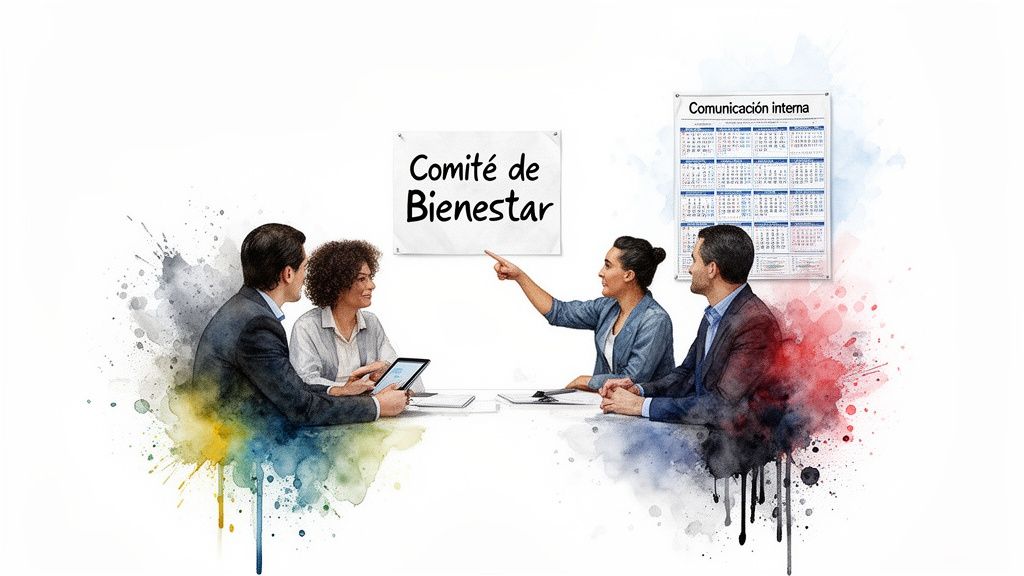
Create a wellness committee with internal ambassadors
Let’s be honest: you can’t do it all by yourself. One of the most powerful strategies we’ve seen work is involving employees from different areas as "wellness ambassadors". They become your eyes, your ears, and above all, your most authentic promoters of the program.
A wellness committee can help you:
Validate ideas: They will provide real and unfiltered feedback on which activities genuinely interest the people in their teams.
Boost participation: They will be the first to sign up and encourage their colleagues. Their enthusiasm is contagious.
Handle logistics: They can assist you with practical details in their areas, relieving you of a significant operational load.
Select individuals who are already naturally influential and genuinely interested in the topic. It doesn’t have to be a formal position but a group of allies who believe in the initiative as much as you do.
The choice of the right provider
Choosing your allies is a critical point. A good provider does not just execute an activity; they become an extension of your HR team. They make your life easier and ensure a high-quality experience for your people.
Although labor poverty has decreased, 82% of Mexicans value good mental health more than a high salary. A comprehensive wellness program must go beyond salary. For HR leaders, organizing events with providers like Zen to Go, who offer digital registration and therapists with first-class hotel experience, directly addresses 38% of cases of concentration difficulties due to stress and generates a positive ROI in 95% of cases. You can read more about the current landscape in this analysis on social rights.
When evaluating providers for your workplace wellness program, use this checklist:
Proven corporate experience: Have they worked with companies like yours? Ask for case studies and references.
Quality and certification of their professionals: How do they select their staff? For example, at Zen to Go, all our therapists hold certifications and go through a rigorous selection process.
Operational ease for HR: Do they provide a registration platform? Do they handle all logistics? Your time is gold; the provider should save you work, not create more.
Flexibility and coverage: Can they serve your different locations? Do they adapt to the schedules and needs of your teams?
Implementation is where your strategy comes to life. By communicating effectively, leveraging ambassadors, and choosing providers that make your life easier, you ensure that your program not only launches but shines.
How to measure real impact and ensure continuous improvement
Launching a wellness program is a big step, but as HR professionals, we know the real work is just beginning. For your initiative not to remain an isolated event but to become part of the culture, you need to measure, learn, and above all, adjust. This is where your strategic role shines, demonstrating with data that wellness is an investment, not an expense.
Constant evaluation is what differentiates a program that endures over time from one that loses momentum after the first quarter. It’s not about seeking perfection, but rather progress.
Feedback is your compass
The most direct and honest way to know if you are on the right track is to ask your people. Satisfaction surveys after each activity are priceless. They don’t have to be long; a few key questions will give you all the information you need.
Overall satisfaction: On a scale from 1 to 10, how satisfied are you with this activity?
Relevance: Do you feel that this initiative responded to a real need of yours?
Perceived impact: How do you feel after participating? (e.g., more relaxed, more focused, more connected with the team).
Open suggestions: What could we improve or what other activities would you like to see?
At Zen to Go, for example, we measure this systematically. Data such as 95% of participants would recommend the program gives us a clear signal that we are providing real value and allows us to adjust details for upcoming sessions.
Connecting the dots with business KPIs
Qualitative feedback is powerful, but to convince management and secure the budget for next year, you need to connect it with the hard KPIs you defined at the beginning. This is where your analysis becomes key.
Cross-reference participation information with your business metrics. Did the area with the highest attendance at chair massage days also show a reduction in days absent due to stress that quarter? If the answer is yes, you already have a data-driven story to tell.
A successful wellness report is not just a list of activities. It is a narrative that shows how investing in people positively impacted the key business indicators.
This correlation is your strongest argument. Show how an initiative focused on physical and mental wellness echoes directly in productivity and retention.
Presenting results that tell a story
When it comes time to create your executive report, avoid dumping data into a presentation. Your goal is to tell a success story that is easy to understand and highlights the achievements.
A structure that works very well is:
Executive summary: A paragraph that synthesizes objectives, key actions, and the most potent results.
Review of objectives: Remind what the initial goals were (e.g., "reduce turnover by 10%").
Key results (the "what"): Present your KPIs visually. "We achieved a participation rate of 85% and an average satisfaction of 9.2/10."
Impact analysis (the "and so what"): Here is where you connect the dots. "This high participation correlated with a 15% decrease in reports of stress, exceeding our initial goal."
Testimonials and qualitative feedback: Include 2 or 3 powerful anonymous comments from employees. They give a face to the data.
Lessons learned and next steps: Show that you are thinking ahead. "What did we learn? How will we evolve the program next semester?".
Continuous improvement is real success
A workplace wellness program is never "finished". Your team’s needs change, the company evolves, and the work context transforms. Use insights from your measurements to adjust your strategy. If an activity had low participation, investigate why. If a workshop was a resounding success, think about how you can offer a second part.
The IMSS-Wellness model achieved a 98.9% satisfaction rate in citizen surveys, demonstrating the impact of accessible health programs. In the corporate sphere, where 75% of employees in Mexico suffer from stress, replicating this approach is key. Programs that use verified therapists and offer versatile modalities (at the desk, Shiatsu chair) manage to transform workplace culture. With only 35% of workers aware of NOM-037, it is up to HR to lead these initiatives and measure their impact to justify the investment. Discover more about the impact of these programs in the IMSS progress report.
In the end, creating a wellness program is about listening, acting, measuring, and repeating. This virtuous cycle is what will consolidate wellness not as an HR initiative, but as an inseparable part of your company’s identity and success. If you suspect that stress is a key factor in your organization, we invite you to explore our stress test to identify levels in your team.
Frequently asked questions about workplace wellness programs
Starting a wellness program from scratch is an incredible challenge, but it’s normal for doubts to arise along the way. As strategic allies in HR, we have supported hundreds of companies in Mexico and already know the questions that arise the most. Here are direct and practical answers, based on that battlefield experience.
What is the minimum budget I can start a wellness program with?
You don’t need a lot of money to take the first steps. The secret is to start with smart, high-impact actions, even if the cost is low. You can begin with internal initiatives, such as active breaks led by volunteer employees, the creation of interest clubs (like reading or sports), or workshops taught by in-house talent.
Now, if you’re looking for immediate and highly valued impact to generate traction, a chair massage day is a master play. It is perceived as a premium benefit, is logistically very easy to organize, and directly addresses physical stress. In our experience, many companies start with a quarterly event like this. Upon seeing positive results in team climate and energy, they scale to a monthly or bi-monthly frequency.
The important thing is to start, measure the impact, and use that data to justify a larger investment in the future.
How do I convince management to invest in wellness?
The key is to speak their language: data, efficiency, and return on investment. Stop presenting wellness as a spending "good for morale" and frame it as a strategic solution to business problems that keep them up at night.
Use the data from your initial diagnosis to build a solid business case. Don’t say, "We need an anti-stress program". Instead, say, "Our turnover rate in the technology area cost us $X pesos last year. A program focused on reducing burnout can decrease that figure by 15%, representing a direct saving of $Y".
To get a “yes” from management, your proposal must be a solution to a business pain point. Connect wellness with metrics like turnover, absenteeism, or productivity. That is the conversation a C-level executive wants and needs to hear.
Lean on Mexican market statistics about stress and its impact on productivity. Propose a pilot program in a specific area with clear success KPIs. Measuring the before and after in absenteeism and engagement will give you the irrefutable evidence to demonstrate impact.
How do I measure the ROI of initiatives like office massages?
Measuring the Return on Investment (ROI) of an initiative like this requires combining direct (quantitative) metrics with indirect (qualitative) ones. Not everything is a hard number, but everything can be measured.
Direct metrics (Hard ROI): Analyze the reduction in absenteeism or days of incapacity in the periods following wellness days. If you have productivity data by team, look for correlations between participation in the program and improvement in results. It’s a simple but powerful data cross-reference.
Indirect metrics (Soft ROI): Launch pulse surveys to measure improvements in mood, perceived company support, and stress reduction. A key indicator is retention; ask in exit interviews if the program positively influenced their experience. Our clients use our participation and satisfaction reports (where 99% of employees feel that the company values their well-being) as fundamental qualitative evidence for their ROI reports.
What activities work best in a hybrid work environment?
Success in a hybrid model is based on flexibility. It’s about offering a menu of options that adapt to everyone, wherever they are. The strategy should be a smart blend of in-person and virtual initiatives.
Activities in the office, like corporate massages or team breakfasts, become powerful magnets. They are a great incentive for people to attend on in-office days, strengthening the culture and human connection that can sometimes dilute in distance.
For remote workdays, provide accessible online options:
Classes on meditation or yoga via videoconference.
Webinars on financial health or stress management.
Access to online therapy platforms.
The key is that each employee, regardless of their physical location, feels supported by the company and has access to quality resources that improve their day-to-day experience.
Creating and sustaining a workplace wellness program is a path of constant learning. At Zen to Go, we understand the daily challenges of HR because we work hand in hand with teams like yours. We are here to be more than a provider; we want to be your strategic ally in transforming your company culture, one wellness experience at a time.
Discover how our flexible corporate massage solutions can simplify your logistics and generate measurable impact on your team. Visit Zen to Go and let’s start building together.