Negative attitudes and how to manage them from HR.

As a Human Resources professional in Mexico, you know that the true engine of a company is its people. However, certain negative attitudes can act as a brake, affecting the work environment, productivity, and increasing turnover. Often, these behaviors are not malicious, but rather a reflection of an organizational culture that does not prioritize well-being or effective communication.
In our experience working with HR areas of various sizes in Mexico, we have seen how identifying and managing these attitudes is key to building a strong and resilient culture. The first step to solving a problem is to recognize it and understand its real impact on day-to-day operations and team morale.
This article will not only give you 8 negative attitudes with concrete examples that you will surely recognize in your day-to-day, but it will also offer you a practical framework to transform them into opportunities for improvement. We will analyze each behavior, its impact on the team, and provide actionable recommendations for managing them, strengthening engagement and demonstrating the strategic value of your role. Get ready to turn these challenges into catalysts for positive change.
1. Resistance to Change and Rejection of Corporate Well-Being
One of the most common negative attitudes in the work environment is resistance to change, especially when it comes to new initiatives like wellness programs. This attitude manifests when leaders or collaborators perceive wellness proposals as unnecessary expenses, distractions from "really important" tasks, or simply a passing trend with no real impact. This initial skepticism can hinder the adoption of programs designed to improve the work environment, reduce stress, and ultimately increase productivity.
To overcome this barrier, it is crucial to understand that well-being is a key piece of modern organizational culture. It is not just about isolated benefits, but about a comprehensive strategy that responds to current employee needs. In this context, transformation is not only technological; it is cultural. To delve into how to prepare an organization for evolution, you can consult this comprehensive guide on digital transformation, which provides a comprehensive view of change.
Analysis and Implementation Strategy
To overcome this resistance, HR professionals must act as strategists, presenting well-being not as a cost, but as an investment with measurable returns.
Start with a Controlled Pilot: Instead of launching a large-scale program, implement a pilot test. For example, a seated Shiatsu massage day from Zen to Go in a single department. This minimizes disruption and allows for the collection of concrete data on its impact to justify the budget.
Demonstrate ROI (Return on Investment): Use satisfaction surveys before and after the pilot. Ask about stress levels, energy, and perception of company support. Data such as a 79% reduction in perceived stress can be powerful arguments for management.
Focus on Quality: A common mistake is opting for low-quality solutions that reinforce the idea that wellness is "superficial." Highlight that the therapists from Zen to Go have over 3 years of certified experience, ensuring a professional service that collaborators will value. By demonstrating quality, trust in the initiative is built.
Understanding in detail what workplace wellness is and what it entails is the first step to effectively communicate it and overcome these negative attitudes.
2. Lack of Priority on Employee Mental and Physical Health
Another of the negative attitudes examples that most impacts the work environment is when leaders downplay the importance of their teams' overall health, focusing almost exclusively on short-term financial goals. This outdated view generates a high-pressure environment, increases absenteeism due to burnout, and drastically reduces work quality. Ignoring well-being is a clear sign of a weak organizational culture which, in the long run, affects talent retention.
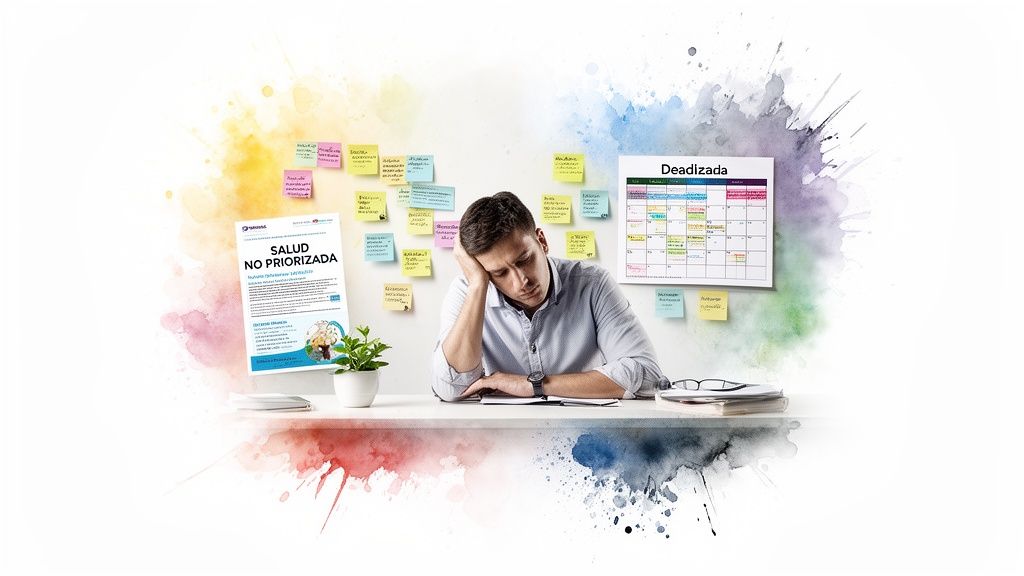
Negligence in this area is not only a human error but also strategic. In our experience, companies in CDMX and Monterrey that implement consistent wellness programs, such as massages from Zen to Go, report measurable improvements in retention and engagement. Understanding the psychosocial risk factors at work, as required by NOM-035, is essential for the HR department to design effective interventions and justify the investment in people.
Analysis and Implementation Strategy
To transform this mentality, HR must position well-being as a productivity driver, not as an expense. The key is to present data and tangible results.
Educate on Well-Being-Productivity Correlation: Present management with case studies and statistics that demonstrate how mental and physical health directly influences business outcomes. A rested and valued team is more innovative and efficient.
Offer Free Demonstration Sessions: One of the most effective tactics is to allow leaders to experience the benefits firsthand. Coordinating a desktop massage session for the management team can radically change their perception by feeling the benefit directly.
Implement Monthly and Measurable Programs: Instead of isolated initiatives, propose a consistent monthly program. For example, a massage day on the last Friday of each month. This creates a positive habit and demonstrates a genuine commitment from the company, reinforcing emotional salary.
Present Employee Testimonials: Gather testimonials after each session. Phrases like "I felt that the company really cares about me" or "I was able to concentrate much better after the massage" are powerful tools to justify the continuity and expansion of the program.
3. Cynicism and Distrust in Service Providers
Another of the negative attitudes examples that HR departments frequently face is cynicism towards external service providers, such as those for corporate well-being. This distrust is based on past bad experiences, the perception that they are "snake oil" solutions, or the fear that the promised quality will not materialize, affecting the credibility of the talent area in front of collaborators and management. This barrier prevents companies from accessing specialized solutions that could positively transform their culture.

As HR professionals, we fully understand this skepticism, especially when the budget is limited and the pressure to demonstrate results is high. However, the right strategic ally not only delivers a service but becomes an extension of your team, ensuring impeccable execution and measurable impact. The key is to know how to differentiate between a transactional provider and a business partner committed to the real well-being of employees.
Analysis and Implementation Strategy
To overcome cynicism and build a trusting relationship, it is essential for providers to demonstrate transparency and professionalism from the first contact. As HR leaders, we must establish clear criteria to validate their reliability.
Verify the Selection Process: A quality provider must have a rigorous recruitment and training process. For example, at Zen to Go, each therapist goes through multiple filters, including interviews, technical tests, and validation of their more than 3 years of certified experience.
Request References and Profiles: Do not hesitate to ask for references from companies of similar size that already trust the service. A serious provider will provide verified profiles of the assigned therapists so that you know exactly who will attend to your team.
Establish Service Guarantees: Trust is built with facts. Agree on a satisfaction guarantee that includes, for example, the replacement of the therapist if they do not meet expectations. This demonstrates the provider's commitment to quality and minimizes the risk for your company.
4. Impatience and Unrealistic Expectations about Results
Another of the negative attitudes examples that often sabotages well-intentioned wellness initiatives is impatience. Leaders or even the HR team themselves expect immediate transformational results, such as a drastic reduction in absenteeism or a sudden increase in engagement, after a single activity. When these deep changes do not materialize instantly, the initiative is labeled as "ineffective" and discontinued, wasting the investment and reinforcing skepticism.
This attitude reflects a lack of understanding of how well-being truly works: its most significant benefits are cumulative and built consistently. A wellness program is not an isolated event, but a sustained strategy that nurtures organizational culture over time. Expecting a miracle cure from a single action is akin to expecting to be fit after a single visit to the gym; it simply is not realistic.
Analysis and Implementation Strategy
To combat this impatience and manage expectations, HR professionals must frame well-being as a medium- to long-term strategy, educating management on the importance of consistency.
Design Sustained Programs: Instead of one-off events, propose a monthly or quarterly programming model. For example, recurring Shiatsu chair massage sessions every two weeks. This encourages regularity and allows benefits to accumulate.
Establish Clear and Progressive Metrics: Define what will be measured and when. Start with immediate impact metrics (post-session satisfaction, perceived stress reduction) and then move towards long-term indicators (retention rates, absenteeism data). Data showing that 99% of employees feel that the company values their well-being after a session is an excellent starting point.
Assign Consistent Follow-Up: To ensure success and continuity, it is vital to have a follow-up plan. At Zen to Go, we assign a dedicated account manager who collaborates with HR to monitor the program, collect feedback, and adjust the strategy, ensuring that goals are met progressively and visibly.
5. Exclusivity and Perception of Elitism in Wellness Benefits
One of the most dangerous negative attitudes for organizational culture is the perception that wellness programs are an exclusive privilege for top management. This attitude arises when benefits, such as massages or access to coaches, are concentrated at the executive levels. This practice not only generates resentment and distrust but also fractures team cohesion and communicates a message of inequality that undermines any effort to build a positive work environment.
For HR professionals, combating this perception is crucial. A wellness program is only effective if it is perceived as inclusive and accessible to all, regardless of rank. It is a tool for integration, not segregation. By democratizing access to well-being, companies reinforce a powerful message: every employee is valuable, and their health matters.
Analysis and Implementation Strategy
To eradicate the perception of elitism, HR must design and implement programs with equity as a central pillar.
Implement Visible Benefits for Everyone: Start with high-impact and easily accessible solutions, such as Shiatsu chair massage days in common areas. By bringing well-being directly to everyone's workplace, the physical and symbolic barrier of the "exclusive club" is eliminated.
Create a Rotation Calendar: For more personalized benefits, such as table massages, organize a rotation calendar by departments. Clearly communicate the dates and ensure that all teams have their turn, demonstrating an organized commitment to equality.
Leverage Corporate Events: Use events such as company anniversaries, quarter-end closures, or year-end parties to offer wellness services to the entire workforce. It is the perfect opportunity for everyone to experience the benefits together, strengthening collective morale.
Transparent Communication: From the launch, emphasize that the wellness initiative is designed for 100% of the organization. Use internal channels to highlight that the goal is to care for all talent, reinforcing the idea of a culture of mutual support.
6. Unnecessary Austerity and Cutting Wellness Budgets
One of the clearest negative attitudes in executive management is poorly understood austerity, which sees corporate well-being as a superfluous expense and the first candidate to be cut in times of financial pressure. This short-sighted view, often driven from financial areas, ignores that investing in employee well-being is a key defensive strategy that protects against much larger long-term costs such as absenteeism, high turnover, and decreased productivity.
This "false economy" mentality arises from not understanding the tangible return on investment (ROI) of wellness programs. By eliminating these initiatives, the company not only saves a smaller budget item but also demotivates teams, increases the risk of burnout, and deteriorates the work environment. Treating well-being as a luxury rather than an operational necessity is a strategic mistake that directly impacts business profitability and sustainability.
Analysis and Implementation Strategy
For HR professionals, justifying the wellness budget in the face of an austerity mentality requires a data-driven approach. It is not about asking for an expense but defending an investment.
Present a Clear Investment Model: Instead of talking about "expenses," frame the proposal as an investment. Calculate the annual cost of absenteeism (days lost x average daily wage) and compare it to the cost of a wellness program like Zen to Go. Show how a controlled cost per employee generates accumulated benefits in productivity and retention.
Offer a Scalable Structure: Propose a controlled start. A pilot program of seated massages in a specific area is a low-cost option that allows for immediate results measurement. This demonstrates value without committing a large initial budget, facilitating approval.
Optimize the Budget with a Strategic Ally: Rely on an account manager, such as those provided by Zen to Go, to design a plan that maximizes every peso. They can help you structure a monthly program that takes advantage of volume discounts, reducing the unit cost and ensuring that the investment aligns with the needs and capabilities of the company.
7. Inflexibility in Meeting Individual Needs and Diversity
Another of the negative attitudes examples that we frequently see is inflexibility. It manifests when wellness programs are implemented with a "one size fits all" approach, ignoring the diversity of needs and preferences of the staff. A rigid program that does not consider the variety of ages, health conditions, or job roles generates distrust and low participation, as collaborators feel that the initiative was not designed with them in mind.
This lack of personalization is a significant barrier. When an employee with a back injury is forced to participate in an intense physical activity, or when a single type of massage is offered that most do not enjoy, the program is perceived as an obligation rather than a genuine benefit. This rigidity can be more detrimental than not offering anything at all, as it creates a negative impression of the company's real commitment to caring for its people.
Analysis and Implementation Strategy
To prevent inflexibility from sabotaging your efforts, the role of HR is to act as a facilitator who listens and adapts the wellness offering. The key is to offer options and flexibility, demonstrating a genuine interest in individual needs.
Conduct Pre-Surveys: Before launching any initiative, distribute a simple survey to understand team preferences. Ask what types of activities they are interested in, what timings work best, and if they have any physical limitations or special needs.
Offer Multiple Options: Instead of imposing a single modality, present a menu of options. For example, when organizing a massage day with Zen to Go, you can offer both seated Shiatsu massage and relaxing desktop massage, allowing each person to choose according to their comfort and preference.
Adjust on the Fly: Actively communicate that the program is flexible. Encourage participants to provide feedback and make adjustments based on their comments. Allowing a collaborator to change therapists or adjust massage intensity demonstrates that the company values their individual experience.
8. Negligence in Communication and Lack of Employee Involvement
One of the negative attitudes examples that most sabotages wellness initiatives is negligence in communication. It occurs when a wellness program is implemented without a clear plan to inform or involve employees. When collaborators do not understand the benefits or feel that the program was designed for them, the result is low participation and a negative perception of the effort, seeing it as an imposition rather than a real benefit.
The underlying problem is treating communication as a final step rather than a central part of the strategy. A wellness program, no matter how excellent, will fail if employees do not know why it is being done, how it works, or what is expected of them. This lack of transparency erodes trust and nullifies the potential of the investment, transforming a gesture of care into a source of confusion or apathy.
Analysis and Implementation Strategy
For a wellness initiative to succeed, HR professionals must act as facilitators of communication, ensuring that the message is delivered clearly and timely.
Anticipated and Specific Communication: Before launching the program, communicate the concrete benefits. Instead of a generic email, send segmented messages explaining how massages, for example, can help reduce stress associated with specific roles.
Involve Employees in Planning: Participation generates commitment. Conduct brief surveys to help teams choose the best times or preferred types of massage. This creates a sense of ownership and ensures that the program fits their real needs.
Leverage Technology to Simplify: Use tools like the Zen to Go platform to send automatic reminders and facilitate appointment management. This reduces the administrative burden for HR and ensures that employees do not forget their sessions, improving participation rates.
Share Results and Encourage Feedback: After the first sessions, share testimonials and positive data, such as the percentage of stress reduction. Publicly celebrate participation and create channels to receive feedback, demonstrating that the opinion of collaborators is valued.
Effective communication is essential to know how to improve the work environment and ensure that investments in well-being generate the desired impact.
Comparison of 8 Negative Attitudes in Workplace Well-Being
Attitude | 🔄 Implementation (complexity) | ⚡ Required resources | 📊 Expected results | Ideal for (use cases) | ⭐ Key advantage / 💡 Recommendation |
|---|---|---|---|---|---|
Resistance to Change and Rejection of Corporate Well-Being | High: requires cultural change and change management | Data, case studies, and pilots; support from HR | Low adoption if not addressed; increase in productivity after pilots | Traditional companies and skeptical middle management | ⭐ Allows designing change strategies; 💡 Start with small pilots and show ROI |
Lack of Priority on Employee Mental and Physical Health | Medium-high: requires education for leaders | Training programs, demo sessions, and testimonials | Improved retention and satisfaction if adopted | Organizations focused solely on financial results | ⭐ Opens potential market; 💡 Offer free demonstrations and monthly programs |
Cynicism and Distrust in Service Providers | Medium: requires transparency and verification | Rigorous selection process, references, and certificates | Increased trust and reliable external hiring | HR with negative past experiences | ⭐ Highlights credentials and processes; 💡 Share verified profiles and guarantees |
Impatience and Unrealistic Expectations about Results | Medium-low: requires education about cumulative benefits | Programming models, volume discounts, metrics | Increasing benefits after 4-6 regular sessions | Leaders expecting immediate results | ⭐ Clarifies long-term benefits; 💡 Propose monthly models and clear metrics |
Exclusivity and Perception of Elitism in Wellness Benefits | Medium: requires inclusive policies and coordination | Scalable solutions (chairs, tables), rotations and volume discounts | Improved morale and cohesion if inclusive | Companies with benefits restricted to executives | ⭐ Fosters organizational equity; 💡 Implement rotations and communicate inclusion |
Unnecessary Austerity and Cutting Wellness Budgets | Medium-high: requires clear economic demonstration | Cost-benefit analysis, low-cost pilots, and reports | Long-term savings from lower absenteeism and turnover | Organizations under budget pressure | ⭐ Solid economic arguments; 💡 Compare absenteeism cost vs. investment in wellness |
Inflexibility in Meeting Individual Needs and Diversity | Medium: requires continuous personalization | Multiple options, pre-surveys, therapist training | Greater engagement and lower risk of rejection or injuries | Diverse workforce and inclusive environments | ⭐ Adaptable solutions increase participation; 💡 Conduct surveys and offer options |
Negligence in Communication and Lack of Employee Involvement | Medium: requires communication and participation systems | Registration platform, automatic reminders, and account manager | Higher attendance and lower waste if communicated well | Launches without prior participation or weak communication | ⭐ Improves implementation with robust processes; 💡 Use platform, involve employees, and send reminders |
From Negative Attitude to Positive Culture: The Strategic Role of HR
We have walked a detailed path through the negative attitudes examples most commonly faced by HR professionals when implementing wellness programs. From resistance to change and cynicism to poorly understood austerity, each of these barriers represents a real challenge but also an invaluable strategic opportunity. Recognizing these patterns is not to point fingers but to accurately diagnose friction points within your organizational culture.
The analysis of these behaviors reveals a fundamental truth: negative attitudes rarely arise out of nowhere. They are often symptoms of deeper issues like a lack of trust in leadership, failed past experiences, or poor communication regarding the "why" of the initiatives. As an HR leader, your role transcends mere benefits management; you become a cultural architect, translator of the management vision, and defender of employee experience.
The Next Step: Transforming Resistance into Resilience
The key to overcoming these objections is not to impose but to integrate. It is crucial to adopt a proactive, data-driven approach to transform skepticism into participation.
Anticipate and Prepare: Do not wait for negativity to arise. Use these negative attitudes examples as a checklist to anticipate possible objections in your next initiative. Prepare solid arguments, testimonials, and data that address each one before they are voiced.
Segment and Personalize: Resistance often stems from the feeling that an initiative "is not for me." Design wellness programs that offer flexibility and options, recognizing the diverse needs within your workforce. A one-size-fits-all approach is a recipe for failure.
Measure to Demonstrate: The best way to combat the perception that well-being is a superfluous expense is with results. Measure the before and after in key indicators such as absenteeism, voluntary turnover, or results from workplace climate surveys. Present this data as a clear and compelling business case.
Ultimately, the goal is to build an ecosystem where well-being is not an isolated event but an integral part of the company's DNA. Every negative attitude overcome is another pillar in constructing a stronger, more resilient, and human organizational culture. Your role as an HR professional is the catalyst that can transform a collection of well-intentioned policies into a sustainable competitive advantage, demonstrating that caring for people is, without a doubt, the smartest strategy for business success.
Transforming an organizational culture requires allies who understand your challenges and offer practical, measurable solutions. At Zen to Go, we have helped hundreds of HR teams in Mexico overcome initial skepticism and demonstrate the tangible value of well-being, turning even the negative attitudes examples most deeply rooted into success stories. Discover how our corporate massage programs, designed for easy implementation, can be the first step towards building a more positive and engaged culture at Zen to Go.