
Massages for pregnant women: a complete wellness guide

Pregnancy is a time of profound changes, but let's be honest, it’s not always a bed of roses. Back pain, swollen legs, and that emotional rollercoaster can leave you feeling completely exhausted. But we want you to know something: you are not alone. These challenges are part of the process and, fortunately, there are wonderful tools to cope with them.
An indispensable ally in your pregnancy
The changes your body goes through during nine months are amazing, but they also represent a significant physical and mental burden. The extra weight, the shift of your center of gravity, and the hormones in overdrive create tensions that build up day after day.
This is where massages for pregnant women stop being a luxury and become a key therapy for your well-being. Think of it as a reset for your body and mind; a necessary pause to reconnect with yourself in the midst of the incredible task of creating life.

From our experience at Zen to Go, accompanying future moms in Mexico since 2019, we have seen firsthand how an adequate prenatal massage makes a huge difference. It’s not just about relieving a specific pain, but about improving your quality of life throughout this stage.
Essentially, a prenatal massage is a deep act of self-care that helps you navigate the challenges of pregnancy with more serenity, energy, and comfort. It’s giving your body the support it needs so you can fully enjoy this journey.
What will you discover in this guide?
In this article, we will guide you to understand why this practice can be your best ally. We will tell you everything you need to know in a clear and friendly manner, based on what we have learned by helping hundreds of clients like you.
We will explain:
What exactly a prenatal massage is and why it is so different from a conventional massage.
The tangible benefits you will feel both in your body and your mood.
When the ideal time is to start and in what situations you should exercise caution.
How to choose a professional and trustworthy service, like our at-home prenatal massage, so you feel safe and cared for.
It is essential to remember this: it is always recommended to receive prenatal massages after the first trimester and, most importantly, consult with your doctor first to ensure that it is the right option for you. Our goal is for you to feel informed, secure, and ready to gift yourself the well-being you deserve.
Understanding what a prenatal massage is and why it is unique
Imagine that your body during pregnancy is an incredible structure under construction, one that needs a very specific and careful type of maintenance. A prenatal massage is not simply a conventional massage with minor adjustments; it is a therapy designed specifically for the unique needs of a future mom.
The fundamental difference lies in the technique and, above all, in safety. Forget about lying face down, a position that is impossible and dangerous during pregnancy. Instead, safe postures are used such as lying on your side, supported with pillows and cushions placed strategically to protect both your belly and your back. The goal is to guarantee total comfort and zero pressure on the baby.
A therapy tailored to your body
Certified therapists in this specialty, like the professionals who collaborate with Zen to Go, not only know how to give a massage; they have an in-depth understanding of the anatomy and physiology of pregnancy. They fully understand the changes your body is experiencing in each trimester.
They know exactly which areas need more attention and which should be treated with extreme delicacy or even completely avoided. For example, they focus on:
The lumbar area and hips: To relieve tension caused by the shift in your center of gravity.
The neck and shoulders: Areas that often accumulate stress and the additional weight of this stage.
The legs and feet: To improve circulation and reduce that annoying swelling.
At the same time, a qualified therapist knows that there are certain pressure points, especially in the ankles and wrists, that should be avoided as they could theoretically stimulate uterine contractions.
Think of an expert gardener caring for a delicate and valuable plant. They do not cut or water randomly; they know exactly where to prune to strengthen it, what nutrients it needs, and how to protect it so it can bloom without any risk. This is how a prenatal therapist works with your body.
Beyond relaxation: safety as a pillar
The main goal of massages for pregnant women is to provide relief and well-being in a completely safe manner. The pressure used is generally softer and more rhythmic than in a deep tissue massage. The techniques are designed to calm the nervous system, not to work intensely on muscle knots that could be counterproductive.
This specialized therapy aims to alleviate pressure on important nerves, such as the sciatic nerve, whose inflammation is a very common complaint. Additionally, it stimulates the lymphatic system, helping your body manage excess fluids and thus reduces swelling. Every movement is designed to nurture you and protect your baby. If you want to explore other wellness options, you can check out our complete guide to massage services to discover more therapies.
In short, a prenatal massage is a combination of science, intuition, and expert care. It is an experience that allows you to connect with your changing body, alleviate the typical discomforts of this stage, and above all, feel cared for and safe as you prepare for your baby’s arrival.
Benefits you will feel in your body and mind
A prenatal massage is much more than a moment of relaxation. Its effects are felt long after the session ends, helping you navigate day-to-day life with more energy and less discomfort. The benefits are very concrete and fall into two main areas that reinforce each other: physical well-being and emotional balance.
Based on what our clients tell us since 2019, integrating regular prenatal massage sessions can completely change how you live and enjoy this stage. Think of it as a direct investment in your health and tranquility.
Physical relief for the challenges of pregnancy
Your body is doing monumental work, and it’s natural that you feel it. A prenatal massage acts as direct support to calm those common discomforts, returning you comfort and lightness.
On a physical level, you will notice how that persistent lower back pain calms down, how tension in the neck starts to recede, and how swelling in your feet and legs decreases. The latter occurs because the massage stimulates the lymphatic system, enhancing circulation and helping your body deal with excess fluids. If you want to better understand how it works, you can learn more about the benefits of lymphatic massage in our dedicated article.
It’s as if you were giving your circulatory system a little push to function better, relieving that feeling of heaviness that often accompanies the third trimester.
And the numbers confirm it. In Mexico, lower back pain is one of the most frequent complaints during pregnancy. Recent studies show that about 71% of pregnant women report this type of pain. Additionally, 46% suffer from discomfort related to the sciatic nerve, and 65% feel discomfort in the pelvic area. These ailments, resulting from weight gain and circulatory changes, find great relief in prenatal massage, which reduces muscle tension and inflammation.
Emotional well-being and deep rest
Pregnancy is also an emotional rollercoaster. Between hormones, anxiety over preparations, and sleepless nights, it’s easy for your mood to be affected. This is where prenatal massage becomes your best ally for mental calm.
The massage acts as a natural stress regulator. It helps lower cortisol levels (the famous stress hormone) and, at the same time, boosts the production of serotonin and dopamine, which we know as the "happiness hormones".
This chemical reaction translates into very real benefits for your day-to-day life:
Improves your mood: You will feel more serene, positive, and equipped to handle emotional ups and downs.
Reduces anxiety: The massage session provides you with a safe space to disconnect from worries and focus solely on yourself and your baby.
You sleep better and more deeply: By calming the nervous system and alleviating physical discomfort, the massage helps you fall asleep more easily and have a higher quality of rest.
This emotional balance not only benefits you, but also creates a calmer environment for your baby’s development. Taking care of your mind is just as important as taking care of your body, and massages for pregnant women are one of the most effective and enjoyable ways to achieve that. Feeling good on the inside reflects directly in how you experience this incredible adventure.
When to receive a prenatal massage and when to exercise caution
One of the most common questions we get from our clients is: "When is the best time to start with massages?" The golden rule, shared by the vast majority of health professionals, is very simple: wait until the first trimester is over.
This initial period, which encompasses up to week 12, is the most delicate stage in your baby’s development. As a precaution, both therapists and doctors prefer to avoid any stimulus that is not strictly necessary. Once you cross the threshold into the second trimester (starting at week 13), and if everything is normal, a wonderful window opens to start enjoying this therapy.
The ideal time to start
From the second trimester onward, your body is much better adapted, and the risk of complications decreases significantly. This is the perfect time to integrate prenatal massages into your self-care routine and start combating those intensifying discomforts, such as lower back pain or swelling in the legs.
The ideal frequency depends entirely on you, how you feel, and, of course, what your doctor recommends. Some future moms find immense relief with a session once a month, while others prefer a massage every two weeks to keep tensions at bay.
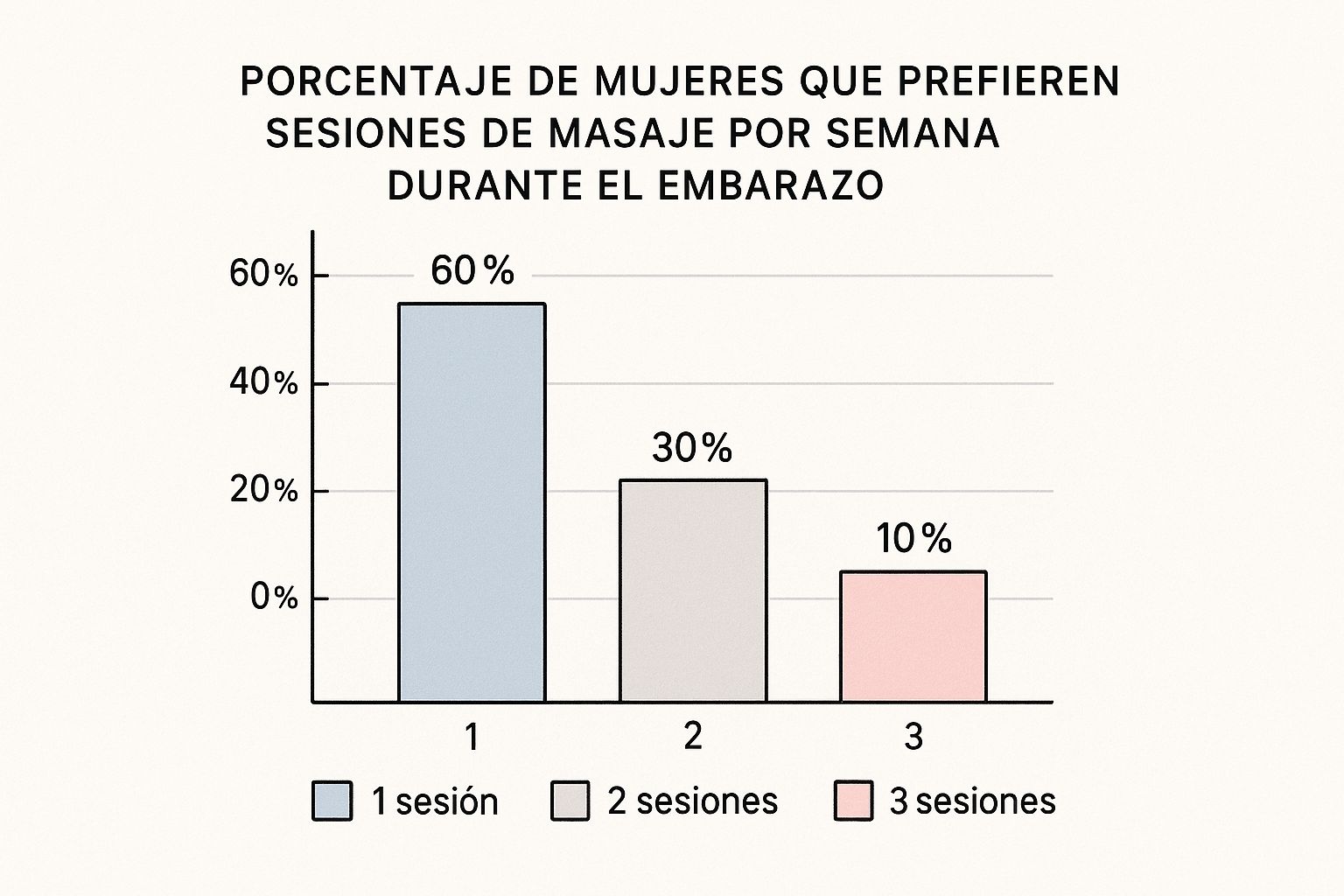
As shown in the chart, based on our clients’ experience, most opt for a weekly frequency for constant relief. This demonstrates the value of integrating massage as an essential part of their well-being during this stage.
Situations that require absolute caution
Although prenatal massage is incredibly safe in most cases, there are clear situations in which it is not recommended. Your well-being is the top priority. Therefore, it’s best to avoid massage if you have any of these conditions:
High-risk pregnancy: If your doctor has classified it as such, any complementary therapy, including massage, must have their approval.
Preeclampsia or hypertension: These conditions require strict medical monitoring, and massage could interfere.
Vaginal bleeding or threat of miscarriage: At the slightest sign of bleeding, any bodily manipulation should be avoided.
Uncontrolled gestational diabetes: Your health must be stable before considering any additional therapy.
Severe nausea or vomiting: If you feel very unwell, it’s best to postpone the session. Your comfort comes first.
To help you navigate these decisions, here’s a quick reference guide.
Quick safety guide for prenatal massages
This table will serve as a practical reference for knowing when it is safe to receive a prenatal massage and when it is essential to first discuss it with your doctor.
Condition | Is massage safe? | Key recommendation |
|---|---|---|
Normal pregnancy after the 1st trimester | Yes | Enjoy it as part of your wellness routine. |
Back pain and sciatica | Yes | It’s one of its most effective applications. |
Leg and foot swelling (edema) | Yes | Helps improve circulation and reduce fluid retention. |
High-risk pregnancy | No, without medical approval | Always consult your obstetrician before scheduling. |
Preeclampsia or hypertension | No | Massage is contraindicated until the condition is controlled. |
Vaginal bleeding | No | It’s an absolute contraindication. Seek medical attention. |
Gestational diabetes | Conditional | If it’s well-controlled and your doctor approves, it may be safe. |
Remember, this guide does not replace the advice of a health professional. Open communication with your medical team is your best ally.
Communication is your best tool. Always talk to your gynecologist or obstetrician before scheduling your first appointment. A "yes" from them is the green light you need to relax with complete peace of mind.
At the end of the day, each pregnancy is a world of its own. Listening to your body and having the support of your doctors will allow you to enjoy this wonderful tool for well-being without any worries. In fact, the principles of relief and body connection are similar to those sought in other therapies, as you can read in our article about the benefits of a relaxing massage.
How to choose a trusted at-home prenatal massage service
Receiving a massage in the comfort of your home during pregnancy is undoubtedly a relief. But it's natural to wonder: how do I know who I’m trusting? The peace of mind of being in expert hands is as important as the massage itself. And the good news is that choosing well isn’t that complicated if you know what to look for.
The key is in the credentials and experience of the person who will attend to you. It’s not enough for them to be a good massage therapist; they must have specific certification in prenatal massage. This specialization ensures that they are well-versed in the anatomy of pregnancy, safe postures, and techniques that are suitable for this stage.
A quality at-home service is there to simplify your life, not to add stress. Therefore, the most important safety filter is the selection process that the company itself applies to its therapists.
Key points for choosing safely
To ensure your experience is truly perfect, we recommend paying attention to these details. These are the same standards we apply at Zen to Go because we know from experience that they make a difference between a regular service and an extraordinary one.
Specific certification: This is the first thing you should ask. Does the therapist have certification in prenatal massage? It’s a non-negotiable requirement.
Proven experience: Find out how many years they have specifically worked with pregnant women. Constant practice sharpens sensitivity and knowledge.
Safe products: Confirm that the oils or lotions they use are neutral, without strong scents or ingredients that may be harmful to you or your baby.
Open communication: A good therapist listens to you. They will ask about your discomforts, adjust the pressure to what you need, and ensure your comfort at all times.
In Mexico, professional at-home services have grown significantly, and rightly so. Moving in the later stages of pregnancy can be very challenging. That’s why companies specializing in massages for pregnant women have gained ground by offering just what is needed, such as lymphatic drainage or relaxing massages for fluid retention and back pain.
Transparency is everything
Beyond the therapist’s experience, clarity in what the service offers is essential. What is included in the price? Do they bring all the necessary equipment? Logistics should not be your problem. A trustworthy service takes care of everything: the massage bed, towels, music… so you can focus solely on enjoying.
At Zen to Go, we know that trust is built with transparency and quality. That’s why each of our therapists is not only certified but has gone through a very rigorous selection process. We provide you with that peace of mind so that your only task is to relax.
Another point is the pricing structure. Sometimes, a very low cost can be a warning sign about the quality or experience of the person attending to you. If you want to better understand what factors influence the cost of a professional and safe service, we invite you to read our article on the price of an at-home massage.
Clarifying the most common doubts about prenatal massage
To help you feel completely confident before scheduling your session, we will address those questions you are probably asking. Here are the most frequently asked questions we hear, answered from our daily experience and with total transparency.
How often can I get a prenatal massage?
The perfect frequency is dictated by your body and, of course, your doctor’s recommendations. What we have seen works wonderfully is a session every two weeks or, at minimum, once a month during the second and third trimesters. This helps keep typical tensions of this stage at bay.
Now, if you’re dealing with something more specific like sciatic pain that won’t leave you alone or significant swelling in your feet, your doctor may suggest slightly more frequent sessions. The golden rule is simple: listen to your body and adjust the frequency according to how you feel.
Is it true that a prenatal massage can induce labor?
This is one of the biggest concerns and is completely understandable. The short answer is no: a prenatal massage, when performed by a certified and experienced therapist, is completely safe and does not induce premature labor.
Professionals specializing in this area know perfectly well which pressure points should be avoided (like certain areas on the ankles or wrists) that could theoretically stimulate contractions. That’s why we stress the importance of choosing someone with the right training. Your peace of mind is at stake.
Safety is not an option; it is the basis of every good prenatal massage. A qualified therapist will never put your well-being or that of your baby at risk; their only goal is to relieve your discomfort safely.
How do I prepare for an at-home massage?
Here comes the best part of at-home services: preparation is minimal. We suggest finding a quiet corner at home where you know there won’t be any interruptions. Wear comfortable clothes and have a glass of water handy before and especially after the session. This helps your body eliminate toxins.
Most importantly, when starting, tell your therapist how you’re feeling that day, if there are any new discomforts or anything that worries you. With Zen to Go, we take care of the rest: we bring the massage bed, neutral oils, and everything necessary to turn that space of yours into a sanctuary of calm.
Does the massage for pregnant women have to hurt?
Not at all. In fact, it’s quite the opposite. The goal of massages for pregnant women is to relieve discomfort, not cause it. The techniques are gentle and the pressure is always adjusted to what feels comfortable and pleasant for you.
If at any time you feel that the pressure is excessive or there is something you simply don’t like, it’s essential to let the therapist know immediately. They will modify the technique without hesitation. Remember that your session should be a pure experience of pleasure and relaxation. If you want to review more thoroughly, you can consult the information about contraindications that our therapists cannot address to be completely sure that the service is for you.
At Zen to Go, our certified therapists are ready to accompany you through this special stage with the safety and care you deserve. Treat yourself to a moment of relief and connection with our at-home prenatal massage.