Corporate wellness in the fintech sector: a guide to reducing burnout and calculating ROI

The corporate wellness in the fintech sector is not a luxury; it is a strategic investment. In an ecosystem that is growing at full speed, it is the key to attracting and, above all, retaining the high-performance talent that drives innovation. This goes far beyond the usual benefits; it is about taking care of the mental and physical health of employees to shield them against burnout and sustain productivity in an environment that never stops.
Why corporate wellness is crucial in the fintech pace
The fintech sector in Mexico is not just growing; it is exploding. For those leading Human Resources, this frantic pace translates into constant pressure: brutal competition for very specific talent, work hours that stretch into infinity, and an urgent need to keep teams energized. We understand your role; it's not just about managing people. It’s about juggling budgets, complying with regulations, and building a culture that keeps your best people from leaving.
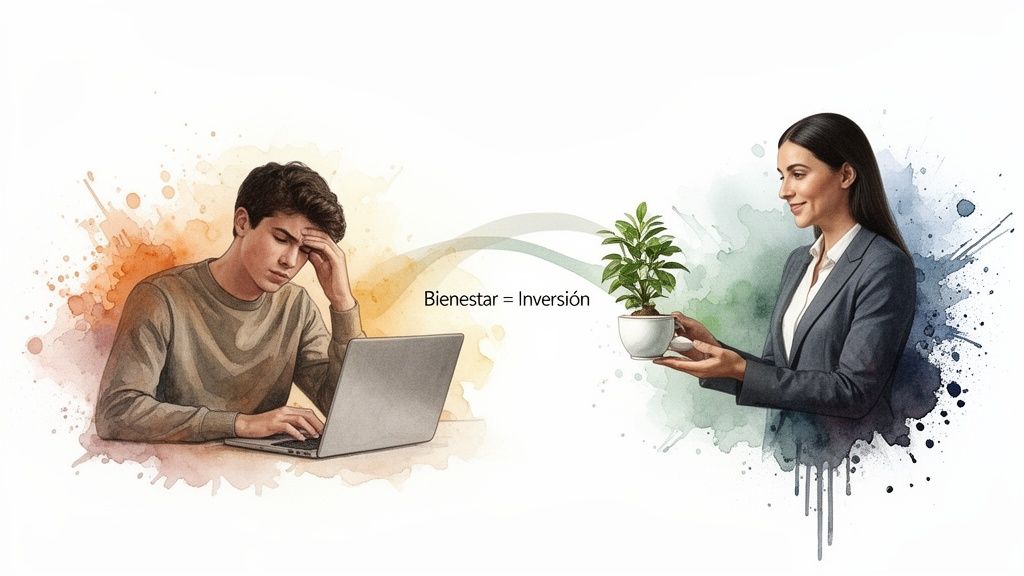
In this scenario, the traditional benefits package is already falling short. Today's talent, especially in such a disruptive sector, is looking for something else: a workplace that genuinely cares for them in a holistic way.
The new value equation in fintech
The challenge is no longer just recruiting the best. It’s creating an environment where they want to stay, grow, and give their all. Constant innovation and aggressive deadlines are the fastest path to burnout, a factor that directly impacts staff turnover and clouds the work environment.
Here is where corporate wellness stops being a "nice expense" and becomes your most powerful strategic tool. It’s not about offering isolated benefits; it’s about building a support system that addresses your teams' pain points at their roots. If you want to dive deeper into the concept, take a look at our guide on what workplace wellness is and why it is essential.
In our experience working with HR teams from various fintechs in Mexico, we have seen that the most successful initiatives are those that naturally integrate into the workday. Those that offer recovery breaks that combat the everyday stress, just when they are needed the most.
A sector that soars with a very human challenge
The dynamics of the Mexican fintech is a giant opportunity, but also a risk for team health. The ecosystem is growing at a rate of 20% per year and already serves more than 70 million users. This speed comes at a cost: a Mercer study indicates that 71% of employees in Mexico are at risk of burnout, a figure that is probably even higher in high-pressure sectors like fintech.
To make it clearer how to connect these challenges with real solutions, we have prepared this table:
Connecting HR challenges in fintech with wellness solutions
Here we show you a practical way to link the problems you face every day with specific wellness programs and their direct impact on the business.
Specific Challenge in the Fintech Sector | Direct Impact on the Company | Applicable Wellness Solution |
|---|---|---|
High turnover of key talent (developers, data scientists). | High recruitment and onboarding costs; loss of knowledge. | Recurring chair massages: improve the atmosphere and are a tangible differentiator. |
Burnout from long hours and constant pressure. | Decreased productivity, increased errors, and absenteeism due to illness. | Guided active breaks (yoga, meditation): reduce cortisol and improve focus. |
Mental stress from aggressive deadlines. | Internal conflicts, low morale, and difficulty collaborating. | Stress management and mindfulness workshops: provide practical tools for everyday life. |
Difficulty attracting talent against competitors. | Longer and more expensive selection processes; inflated salary offers. | Comprehensive wellness programs as part of the value offering. |
Physical tension from long hours in front of the screen. | Absences due to back pain, neck pain, and migraines; low energy. | Chair massages focusing on the cervical and dorsal areas. |
As you can see, each wellness solution is not just an "extra," but a direct and measurable response to a business problem. It’s about moving from reacting to preventing.
Implementing a well-thought-out wellness strategy is not just about boosting morale. It is a key business decision to reduce turnover, protect your culture, and, at the end of the day, ensure that your company not only survives but thrives in an ecosystem that never sleeps.
The measurable benefits of investing in wellness for your fintech
As an HR leader, you know full well that to justify a budget, you must speak the language of business: metrics, KPIs, and return on investment. The good news is that corporate wellness in the fintech sector is not an abstract idea. It is a growth lever with clearly measurable benefits that you can present with complete confidence at the next meeting.
Investing in your team's wellness is not an expense; it is a strategy to safeguard your results. Let’s break down how a well-designed program directly impacts the numbers that matter most to management.
Reduction of turnover and savings in talent costs
In the battlefield that is the fintech world, every resignation from a key talent hurts, a lot. Not only is technical knowledge lost; replacing that person is extremely costly. We’re talking about between 50% and 200% of their annual salary when considering recruitment, selection, onboarding, and the inevitable learning curve.
A solid wellness program addresses the problem at its root: burnout and disconnection from the company. By offering real care spaces, such as chair massages or stress management workshops, you drastically improve the atmosphere and the emotional salary.
"Wellness has stopped being a 'nice extra' and has become a retention tool. In our experience with fintechs, we see that benefits that are felt and lived, such as a relaxing break on a heavy workday, directly influence a collaborator’s decision to stay or start looking for other options."
Decrease in absenteeism linked to stress
Endless hours and constant pressure take their toll. Absenteeism due to stress, anxiety, or back pain and migraines is a silent but enormous cost. It is not just the day that an employee is absent; it is the burden they create on the rest of the team and the possible delays in critical projects.
Programs focused on physical and mental health reduce these absences tangibly. A healthier team, with better tools to manage pressure, is less absent. And when they are present, they are more focused and engaged.
Increase in productivity and focus
Think about your development or data analysis teams. Their work demands maximum concentration. An exhausted team makes more mistakes, is less creative, and takes longer to solve problems. Wellness is not the opposite of productivity; it is its fuel.
High-impact active breaks: Initiatives like Zen to Go's chair massages offer a mental and physical "reset" in just 15 minutes.
Improved mood: A relaxed and valued collaborator has a better disposition. This translates into greater collaboration and a more positive attitude towards challenges.
Renewed energy: Combating accumulated physical tension allows mental energy to go to innovation, not to enduring discomfort.
Strengthening employer branding and regulatory compliance
In the war for talent, your reputation as an employer is everything. A fintech known for caring for its people has a huge competitive advantage in attracting the best profiles and negotiating under better conditions. More broadly, investing in wellness can be a key piece within business growth strategies.
Additionally, a wellness program helps you comply proactively with NOM-035, demonstrating that you are taking concrete actions to prevent psychosocial risk factors. It’s an investment that protects your people and shields your company.
How to design a wellness plan that really works in the fintech pace
A fintech is not a traditional company, and its wellness program cannot be either. As an HR leader, you know that generic solutions fall short in a high-pressure environment, with aggressive deadlines and young talent that values authenticity above all.
Designing a corporate wellness plan for the fintech sector that truly resonates requires a different approach, one that comes from the reality of your teams.
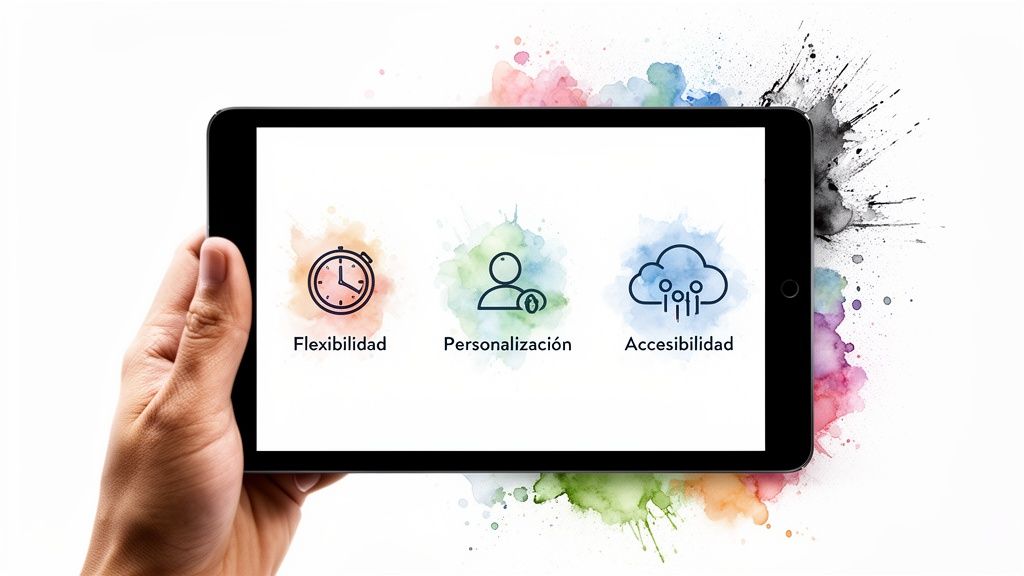
The key, as we have learned at Zen to Go working hand in hand with People & Culture leaders, is to build the program on three pillars that resonate with the fintech's agile mentality.
Pillar 1: Flexibility for a non-stop environment
The pace of a fintech is unpredictable. Product launches, investment rounds, and development sprints set the agenda. A rigid wellness program with fixed schedules is destined to fail before it starts.
Your plan must be as agile as your development teams. The key is to offer options that integrate into the workday without disrupting the most important workflows.
High-impact active breaks: Solutions like 15-minute chair or desk massages allow a physical and mental reset just at the moment of maximum tension, without the need to block a full hour in the schedule.
On-demand content: Provide access to digital platforms with guided meditations, short yoga classes, or mental health resources that employees can use when needed, either in the office or from home.
Adaptable events: Instead of a single "wellness day" each quarter, organize "wellness weeks" with multiple activities at different times. This ensures that everyone can participate, regardless of the project they are deep into.
Pillar 2: Personalization for non-homogeneous talent
Fintech talent is a mosaic of profiles: from very young developers to financial experts with long careers. A "one size fits all" plan isn't going to work for anyone. Personalization is what makes a program valued and, above all, used.
In fact, the rise of wellness in this sector is driven by this need. In a market where, according to recent data, fintechs could exceed 10% of loans granted in Mexico by 2025, the employee experience must be as innovative as the product. You can explore the growth and influence of fintech in Mexico to understand the context better.
To achieve this, the solution is simple but powerful: listen to your people.
Conduct short, anonymous surveys to ask what they need. More support for mental health? Personal finance workshops? Activities to combat sedentary lifestyles? The answers will give you the map to invest the budget wisely.
A great starting point is to define the foundations of your strategy. If you need a complete guide, we recommend our article on how to build a step-by-step workplace wellness program.
Pillar 3: Accessibility for hybrid and remote models
The hybrid and remote work reality is no longer a trend; it is the established reality of the fintech sector. Your wellness program must break down geographical barriers and be equally valuable for those in the office in Mexico City as for those working from Mérida.
This is where technology becomes your best ally.
Unified platforms: Use tools that centralize all wellness benefits and resources, facilitating access from any device.
Providers with national coverage: If you offer in-person benefits like massages, make sure your provider, such as Zen to Go, has a presence in key cities where you have employees.
Quality virtual events: Organize webinars on stress management, finances, or nutrition that are interactive and provide real value, regardless of where the team connects from.
Designing a wellness plan for a fintech is not about having the longest catalog of benefits; it’s about having the smartest one. Focus on flexibility, listen to personalize, and ensure equitable access. In this way, you'll move from offering "one more benefit" to building a competitive advantage that shields your culture and retains your most valuable talent.
Types of wellness programs that really work in a fintech
Let’s go from theory to practice. In the fast-paced world of fintech, not every wellness initiative is going to connect. You need solutions that are as agile, efficient, and high-impact as your own teams.
The goal is not to interrupt workflows but to enhance them. It’s about offering smart breaks that recharge energy just at the critical moment.
As strategic allies of HR, we have seen time and time again that the most successful programs are those that naturally integrate into the workday. They understand that a developer in a sprint cannot be absent for an hour but can greatly benefit from a 15-minute reset that restores clarity.
High-impact active breaks that don’t stop productivity
The most common mistake is thinking of wellness as an event that removes people from their responsibilities. The key to corporate wellness in the fintech sector is precisely the opposite: offering "micro-doses" of recovery that perfectly fit into the work rhythm.
Here is where solutions that address the accumulated physical and mental tension after hours in front of the screen shine.
Sitting Shiatsu Massage: It’s the favorite option, and there’s a good reason for it. In just 15 or 20 minutes, a certified therapist can work on the most tense areas (neck, shoulders, upper back) without the employee needing to change clothes or move to an isolated space. It’s an injection of energy and relief that transforms the office environment in minutes.
Desk Massage: For maximum efficiency, this modality is unbeatable. The therapist approaches directly to the employee's workspace and performs manipulations focused on the upper body. It’s the perfect mental "reset", ideal for breaking creative blocks or relieving tension before an important meeting.
In our experience working with fintechs in Mexico, the day Zen to Go arrives becomes the most anticipated day of the month. The impact on workplace climate is immediate and visible. In fact, our data shows that 99% of employees feel that the company actively values their wellness when receiving such benefits.
Programs that address holistic wellness flexibly
In addition to physical breaks, a robust plan must provide tools for mental, financial, and social health. The key, again, is flexibility and relevance to your collaborators' profiles.
You don’t have to implement everything at once. You can start with a single initiative, measure its impact, and build your program incrementally.
Realistic and easy-to-implement options for HR
We know your time is limited and you manage multiple fronts. That’s why any program you implement must be operationally simple for you. The logistics cannot become another headache.
A good wellness provider takes care of everything for you:
Complete coordination: From scheduling therapists to necessary equipment.
Booking platforms: Allow employees to book their own space, freeing you from manual management.
Internal communication: Provide materials to announce the program and generate excitement within the team.
The goal is for you to be able to launch a high-value initiative with minimal administrative effort. Solutions like chair or desk massages are "plug-and-play": they implement quickly, the impact is immediate, and management for HR is virtually nil. In the end, it’s about choosing the right tools that allow you to focus on strategy while an ally takes care of flawless execution.
Your checklist for implementing a wellness program that really works
Launching an initiative for corporate wellness in the fintech sector may sound like a mountain of work. But the truth is that with a clear roadmap, it becomes a manageable and, above all, successful process.
Think of this checklist as your step-by-step guide, designed to take you from the initial idea to presenting tangible results to management. It’s a proven process that will help you build a solid program, one that truly connects with your team's needs and demonstrates its value to the business.
1. Do a real diagnosis
Before proposing any solution, you need data. It’s key to understand where your people really hurt. Don’t assume you know what they need; instead, ask them.
Anonymous surveys: Launch short and to-the-point questionnaires. Ask about stress levels, workload, work-life balance, and what types of benefits they would value the most.
Focus groups: Organize talks with small groups representing different areas. This will give you a qualitative context that no survey can provide.
Analyze what you already have: Review your turnover, absenteeism, and past climate survey indicators to find patterns.
2. Define clear (and measurable) objectives
A program without objectives is just an expense. To justify the investment and be able to claim victory later, you need clear KPIs from day one. Your objectives must be SMART (Specific, Measurable, Achievable, Relevant, and Time-bound).
For instance, instead of a vague "improve workplace climate", a SMART objective would be: "Reduce voluntary turnover in the development team by 15% within the next six months". Or "Decrease absenteeism due to stress by 10% by the end of the fiscal year".
3. Build a bulletproof business case
With data in hand and clear objectives, it’s time to build your case to get management's approval. Your presentation should be concise, direct, and focused on how this impacts the business.
In our experience, HR leaders who secure approval are those who translate wellness into a financial language. They demonstrate how the program is not a cost but a direct investment to reduce recruitment expenses, increase productivity, and protect the company's most valuable asset: its talent.
4. Choose the right provider
Your wellness provider is a strategic partner, not just a vendor. You need someone who understands the pace of a fintech and simplifies operations for you, not complicates them. Look for an ally that offers flexibility, coverage where you have teams, and a management platform that frees up your time.
Choosing well is half the battle’s success. That’s why here’s a table to help you compare your options intelligently.
How to evaluate corporate wellness providers
A guide to help you choose the right strategic partner for your wellness program by comparing key criteria for the fintech environment.
Evaluation Criterion | Why it matters for a fintech | What to look for in an ally like Zen to Go |
|---|---|---|
Operational flexibility | The pace is fast, and schedules change. You need a provider that adapts to shifts, work peaks, and hybrid models. | Capacity to schedule sessions at different times, coverage in multiple cities, and ease of rescheduling without excessive penalties. |
Understanding of the sector | High pressure, tight deadlines, and burnout are not myths in fintech. Your provider must understand this reality. | Proven experience with technology or finance companies. They offer short, high-impact solutions, like 15-minute chair massages. |
Simple management platform | Your time is limited. You can't spend hours coordinating schedules or chasing invoices. | A digital platform where employees schedule their own sessions, and you receive reports on usage and satisfaction automatically. |
Quality and professionalism | You are putting your people's wellness in their hands. The quality of therapists and service is non-negotiable. | Certified therapists, strict hygiene protocols, and a high Net Promoter Score (NPS) from other corporate clients. |
Ability to measure ROI | You need to demonstrate the value of your investment. A good provider helps you collect the data you need. | Usage reports, post-service satisfaction surveys, and data you can cross-reference with your KPIs (absenteeism, turnover, eNPS). |
A good partner doesn’t just execute; they help you build the business case and demonstrate results.
5. Launch a pilot and communicate strongly
An incredible program can fail due to poor communication. Design an internal campaign that generates anticipation and clearly explains the benefits. Tell them the "why" behind the initiative.
Start with a pilot: Before launching it company-wide, test the program with a specific team or area. This allows you to collect feedback, adjust logistics, and show quick results on a controlled scale. It’s your proof of concept.
Measure, adjust, and scale: Use post-service surveys and analyze the KPIs you defined initially. With that data in hand, you can iterate the program and scale it with the confidence that every peso invested is generating a measurable return.
The following infographic perfectly summarizes how a simple intervention transforms everyday stress.
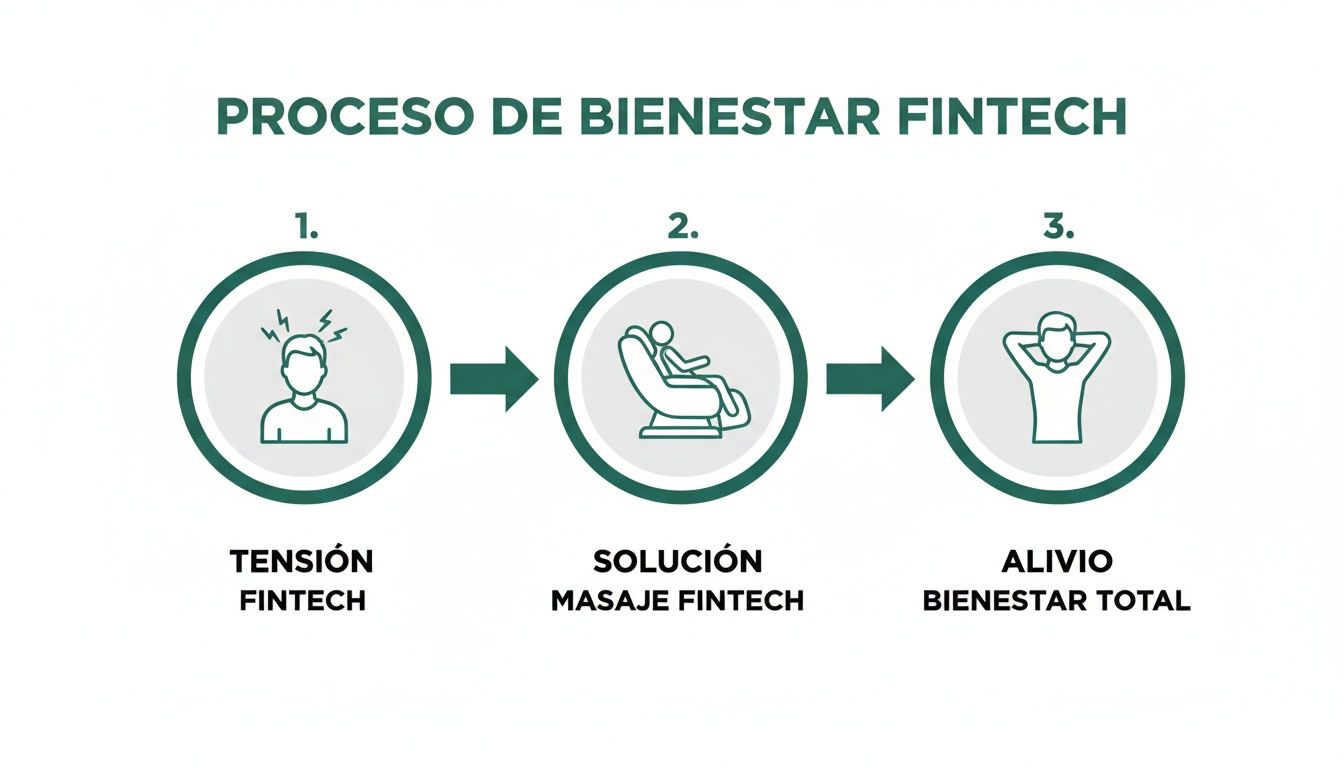
This flow visualizes how a brief but high-impact pause, like a chair massage, converts accumulated tension into tangible relief, improving focus and mood almost immediately. It’s proof that wellness doesn’t have to be complicated to be effective.
How to measure the ROI of wellness to justify your budget
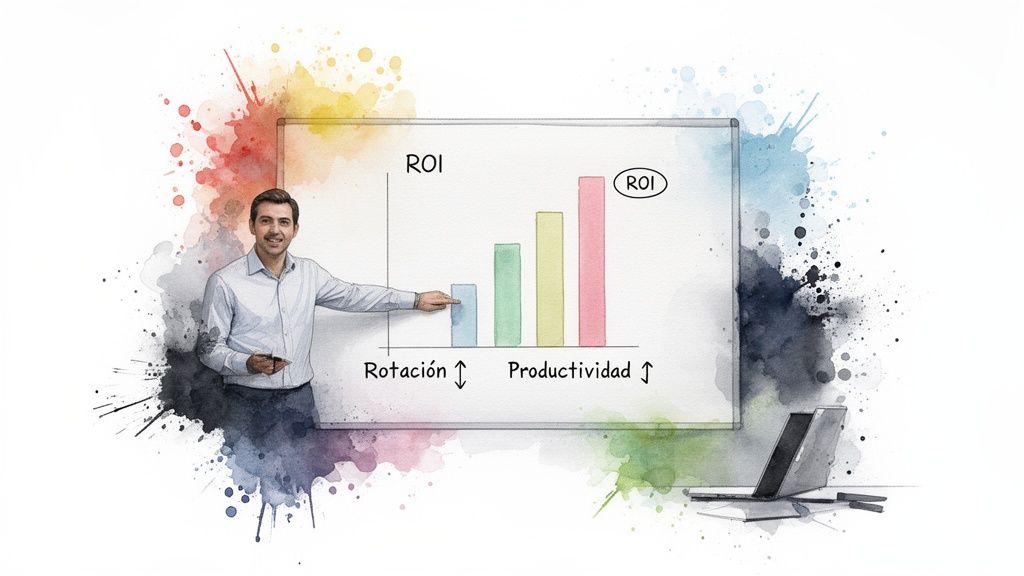
We know that one of the most challenging parts of your role is standing before management and justifying a new budget. It’s not enough to say that wellness "improves the environment"; you need to speak the language of business: Return on Investment (ROI).
The good news is that corporate wellness in the fintech sector generates tangible results—those you can measure, calculate, and present with complete confidence. You’re not asking for an expense; you’re leading one of the smartest investments the company can make.
Quantitative metrics that speak for themselves
This is where hard numbers back your vision. Here are the key indicators you should start tracking to build a bulletproof business case.
Reduction in voluntary turnover: Calculate how much it costs the company to replace a key employee (recruitment, onboarding, learning curve) and compare it with what you invest in wellness. If your turnover decreases by 10% after launching the program, the savings are direct and more than evident.
Decrease in absenteeism: Stress and physical exhaustion are two of the main reasons for absences. Monitor absenteeism rates before and after. Every day of absence you prevent is recovered productivity and less burden on the rest of the team. If you want to delve into its impact, you can read our article on what labor absenteeism is and how to combat it.
Savings in health costs: Although this is a benefit that is more visible in the medium term, a healthier and less stressed team uses medical expense insurance less. This can translate into better conditions when renewing the policy.
Qualitative indicators that translate into value
Not everything is measured in pesos, but everything impacts the business directly. These qualitative metrics show you how perceptions and commitment from your people are changing.
The true power of wellness is seen when data supports what you feel in the environment. At Zen to Go, for example, our data shows a 79% reduction in stress among employees participating in our programs. This data is not just a statistic; it’s a powerful argument for any director.
Improvement in workplace climate surveys: Measure satisfaction and engagement before and after the program. An increase in scores is clear evidence that the investment is resonating with the team.
Increase in eNPS (Employee Net Promoter Score): The question "Would you recommend working here to a friend?" is a powerful thermometer of loyalty. A higher eNPS means you have more ambassadors for your employer brand, attracting talent organically.
Direct feedback from employees: Collect real testimonials. Phrases like "Massage day is what helps me recharge for the month-end close" are pure gold for your reports and presentations.
By combining hard metrics like turnover reduction with human impact data like stress decrease, you build an irrefutable argument. You demonstrate that investing in your people is not only right but also the most profitable.
Frequently asked questions about wellness in fintechs
Here are the most common questions HR leaders in the fintech sector ask us. Let’s get straight to the point with practical answers that will help you make the best decisions for your team and your company.
What is the minimum budget needed to start?
You don’t need a fortune to start seeing results. The key is to begin with initiatives that feel valuable to the team but have a relatively low cost. Something like recurring chair massages is a perfect entry point: it demonstrates a real and visible commitment to wellness and is a format that fits almost any budget.
How do I know if my team will actually use the program?
The secret is simple: don’t impose; ask. Instead of guessing what benefits they want, launch short, anonymous surveys to understand what they need. When solutions arise from the real needs of people, adoption is practically guaranteed. Another good idea is to do a pilot with a small group; it will give you valuable data before launching it company-wide.
What type of wellness works best in a fintech?
The one that integrates into the work rhythm without getting in the way. In a high-pressure environment like theirs, high-impact active breaks are king. Think of 15-minute chair massages: they allow a mental and physical "reset" that directly tackles stress and accumulated tension, improving focus almost immediately.
How do I convince management to invest in this?
Speak the only language they understand: data and ROI. Instead of using phrases like "improving workplace climate", present savings projections from turnover reduction and decreased absenteeism. Use the metrics to demonstrate that corporate wellness in the fintech sector is not an expense but a strategic investment to safeguard talent and productivity.
To continue exploring topics of wellness, efficiency, and other key angles of the work world, I recommend checking out resources from Explore the Simpling blog for resources on wellness and efficiency.
At Zen to Go, we breathe the unique challenges of the fintech sector. Since 2019, we have been helping HR leaders implement wellness programs that really work, that truly reduce stress and strengthen culture from within.
Ready to design a plan that speaks your team's language? Learn about our corporate solutions and request a quote here.