Positive and negative actions: Keys to building an exceptional work environment
As a Human Resources professional, you know that the workplace climate is not something abstract. It is built (or destroyed) with every email, every meeting, and every hallway conversation.
The positive and negative actions are exactly that: the set of behaviors, policies, and habits that, day by day, shape the culture of your company in Mexico. We are not talking about theory, but about the sum of experiences that directly impact engagement, productivity, and, of course, talent retention.
Culture is built with small actions, not with grand speeches
Understanding and managing these actions is key to facing the challenges you have on the table, from a turnover rate that doesn’t decrease to compliance with regulations such as NOM-035.
Think of these actions as the bricks of your corporate building. Positive actions build solid and reliable walls. Negative actions, on the other hand, create cracks that, over time, can compromise the entire structure.
The challenge for HR is not just to identify these behaviors but to actively influence them. It is about assuming your role as the architect of a culture where the interactions that add up far exceed those that detract. This ranges from publicly recognizing an achievement to correcting an inappropriate comment, including implementing policies that genuinely promote balance and respect.
This conceptual map makes it very clear: culture is the nucleus from which both positive and negative actions arise.
As you can see, each type of action generates a chain of opposite results. This reinforces a fundamental idea for any talent leader: cultural management must be intentional and constant, not a one-time effort.
The domino effect in your daily life as HR
Every action, no matter how small it seems, has a domino effect. Leadership that offers constructive feedback (a positive action) can ignite the trust and autonomy of an entire team. Conversely, micromanagement or lack of clarity (negative actions) generate stress and demotivation, directly fueling psychosocial risk factors at work.
In our experience working with HR teams of various sizes in Mexico, we have seen that true cultural change occurs when leaders and employees become aware of the impact of their daily behaviors. The key is to make the invisible visible.
In this guide, we will provide you with a practical framework to identify these behaviors, foster those that build, and mitigate those that destroy, thus consolidating your strategic role in the organization.
How actions impact your HR indicators
The effect of these actions is not just anecdotal; it is directly reflected in the metrics you manage daily. To make it clearer for you to present to management, here is a comparative table that summarizes the opposing effects on your KPIs.
Key HR Indicator | Impact of Positive Actions | Impact of Negative Actions |
|---|---|---|
Staff Turnover | Decreases. Engaged and valued talent does not seek to leave. | Increases. A bad environment is the main driver of talent loss. |
Productivity | Increases. Teams with high trust and clarity are more efficient. | Decreases. Stress and demotivation reduce focus and quality. |
Absenteeism | Reduces. A healthy environment decreases absences due to stress or illness. | Increases. Burnout and anxiety generate more justified and unjustified absences. |
eNPS (Employee Net Promoter Score) | Increases. Employees become promoters of the company. | Plummets. Detractors multiply, affecting the employer brand. |
Work Climate (Surveys) | Consistently improves. A supportive and growth-oriented environment is perceived. | Worsens. Surveys reflect distrust, fear, and lack of communication. |
Compliance (e.g., NOM-035) | Facilitates compliance by creating a favorable psychosocial environment. | Complicates compliance and raises the risk of sanctions and conflicts. |
As you can see, fostering a culture of positive actions is not a "soft" initiative but a business strategy with a measurable and direct impact on the health of the organization.
The real cost of negative actions in your organization
As a leader in HR, you know full well that negative and positive actions are not just simple hallway gossip. They have a real, tangible, and often silent cost that gradually undermines the company’s profitability long before it shows in a financial statement.
Presenting this cost clearly is your strongest argument for justifying new initiatives to management.
Think of negative actions as an invisible tax levied on productivity and commitment. A disparaging comment from a leader, an unclear vacation policy, or the simple lack of recognition not only affects one person; its impact ripples through the entire team.
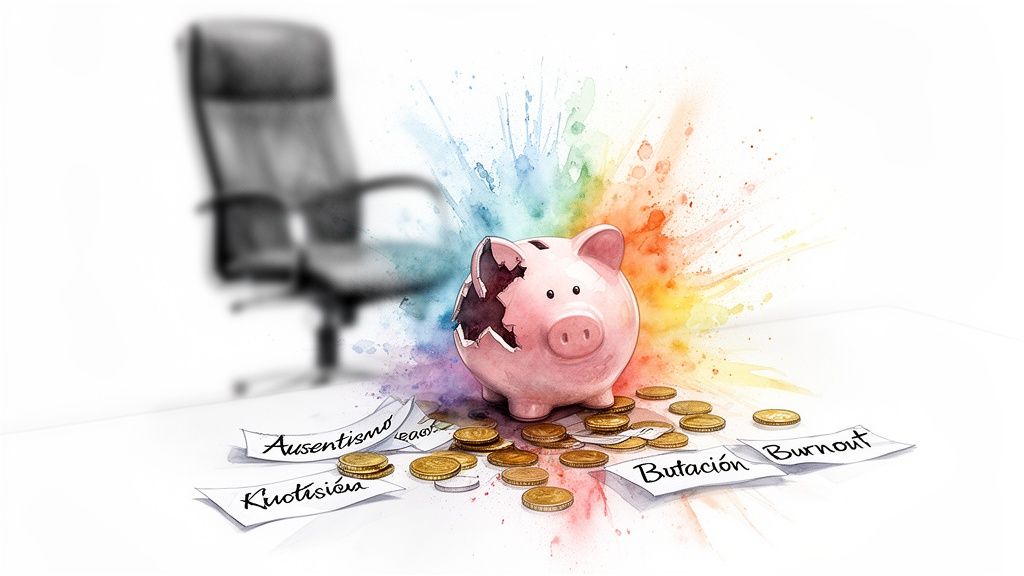
This domino effect manifests very quickly in the indicators that concern you the most, those that have a direct and measurable cost.
The measurable impact on your key metrics
The first visible symptom is often an increase in absenteeism. A stressed or demotivated employee is more likely to fall ill or simply not have the energy to go to work. But there is something even more costly: presenteeism. That employee who is physically in the office but mentally absent, unable to concentrate, innovate, or collaborate.
As discomfort grows, the next blow comes to voluntary turnover. Losing a good employee involves not only the cost of recruiting and training a replacement (which can be as high as 200% of the annual salary of the position) but also the loss of institutional knowledge and the demoralization of the remaining team.
Negative actions are the primary fuel for burnout. A toxic environment not only burns out your best talents but also forces you to spend valuable resources putting out fires instead of building the future.
From discomfort to operational paralysis
Chronic stress and burnout, direct consequences of a negative work environment, do not stop at individual productivity. These phenomena stifle creativity and collaboration, two essential ingredients for the business to innovate and adapt.
To diagnose the problem before it becomes critical, you can rely on very practical tools:
Frequent pulse surveys: Instead of waiting for the annual survey, implement short and periodic polls to gauge the workplace climate almost in real time.
Exit interview analysis: Look for patterns. If several people mention the same leader or policy as reasons for leaving, you have a very clear red flag.
Team productivity metrics: Cross-reference performance data with climate survey results. This will help you identify direct correlations between a bad environment and a decline in productivity.
Quantifying the cost of inaction is essential. When you demonstrate with data how negative actions are affecting the bottom line, the conversation about well-being shifts from "wouldn't it be nice to have" to a strategic necessity.
Practical examples of positive actions that work
Let’s leave theory behind and move on to what truly matters: practice. As an HR leader, you know perfectly well that good intentions amount to nothing if they are not translated into concrete, visible, and, above all, consistent actions.
The most effective positive actions are rarely the most expensive. They are those that are woven into the everyday life of the office and gradually reinforce the culture you want to build. Here are some realistic ideas that are applicable regardless of whether your company is a startup or a corporate giant.
Human and approachable leadership
Leaders are the voice of your organizational culture. What they do (and don’t do) every day is the most powerful positive or negative action that teams receive.
Check-ins that go beyond work: Implement very short weekly meetings, lasting only 15 minutes, where the first question is not about the status of a project, but a simple "How are you?" This small gesture completely changes the dynamics. It shows that you care about the person, not just the employee.
Positive feedback in public: Encourage your managers to recognize good results in team meetings or in internal communication channels. Timely recognition is one of the main drivers of engagement. And doing it publicly multiplies its effect.
Transparency that builds trust: Whenever possible, explain the "why" behind important decisions. This is key to reducing uncertainty, quelling hallway rumors, and building a solid foundation of trust. It makes your people feel like part of the ship, not just rowers.
Recognition that builds community
Recognition does not always have to be top-down. In fact, fostering a culture of appreciation among peers is one of the most powerful and cost-effective tools to strengthen the workplace climate.
A peer-to-peer recognition program is an incredible way to achieve this. You can use a simple platform or, even easier, a dedicated channel on Slack or Teams where people can publicly thank a colleague for their help or a job well done.
In our experience working with HR teams in Mexico, we have seen how these small daily interactions of gratitude strengthen bonds and create a much stronger sense of team than any annual event.
Visible and tangible well-being
Actions that demonstrate a real care for the physical and mental well-being of people are the foundation of emotional salary. It is not just about complying with NOM-035, but sending a clear and strong message: "we truly care about you".
One of the most valued initiatives are wellness programs that are experienced in the office. At Zen to Go, for example, we see every day how chair massages become the most anticipated moment of the week.
They send a powerful message: The company actively invests in reducing stress for its people. It’s not just talk, it’s action.
They are practical and do not interrupt: They take place in the same office, in short sessions that fit into the workday.
They generate immediate impact: A 15-minute break can completely change a person’s energy for the rest of the day.
These actions are the foundations of a positive culture. They do not require gigantic budgets, but they do demand two things: consistency and the genuine commitment of the entire organization, starting, as always, with its leaders.
HR strategies to build a positive culture
Now that you can distinguish between positive and negative actions and understand the domino effect they generate, it’s time to move to practical territory. As an HR leader, your role goes beyond management; you are the architect of deliberate and sustained cultural change.
This is not about launching isolated initiatives. It’s about building a system that, by design, promotes the good and disables the toxic.
Here’s a roadmap, a plan of action to ensure that well-being and respect are no longer the exception but become the daily norm.
1. Diagnose to understand reality, not just symptoms
The first step is always to listen. Before implementing any program, you need an honest and unfiltered snapshot of where you stand. A good diagnosis helps you focus energy where it is truly needed.
Climate and pulse surveys: Combine the large annual survey (the panoramic view) with shorter and more frequent pulse surveys (the close-ups). This will give you a real-time view of the team’s mood.
Focus groups: Organize confidential sessions in a safe space. They are a goldmine for understanding the "whys" behind survey numbers and graphs.
One-on-one interviews: Talk to key leaders and collaborators. This is where you uncover the stories, personal challenges, and deeper perceptions that data does not capture.
Doing this not only gives you valuable information. It sends a very powerful message: "we care about what you experience here, and we are listening to you".
2. Design policies with soul, not just legal jargon
Once you have the lay of the land, the next step is to chart the routes. You need to translate all that learning into clear and human policies that serve as the organization’s manual for coexistence.
A code of conduct is not just a document to comply with the law; it is a declaration of principles. It should be a living guide that reflects the company’s values and tells everyone, plainly, how we expect to treat each other.
Some key policies that must be present include:
Healthy communication protocols: Establish clear guidelines on how to give and receive feedback, how to handle disagreements constructively, and what the unspoken rules of communication are in a hybrid environment.
Flexibility and digital disconnection policies: Promoting a real balance between personal life and work is one of the most powerful and valued positive actions today.
Clear and safe reporting processes: Ensure that there are confidential channels to report negative behaviors, with a guarantee of zero retaliation. People will only speak up if they feel safe.
These policies are the backbone of your culture. They provide certainty, coherence, and safety in daily interactions. A good starting point is to review how you can motivate your teams through these same support structures.
3. Train leaders to be agents of change
You may have the most inspiring policies in the world, but if your leaders do not live and model them, they will remain on paper. Managers and directors are the filter through which collaborators experience the company culture. Their role is critical.
The training must go beyond the technical and focus on deeply human skills:
Empathetic leadership: Train them to truly listen, to try to put themselves in their people’s shoes, and to manage from compassion, not just from demand.
Conflict management: Provide them with practical tools to mediate disagreements and transform them into productive conversations, rather than letting them escalate.
Effective recognition: Teach them to recognize good work in a way that genuinely motivates, that is timely, specific, and sincere.
External pressures also play a role. For instance, although Mexicans' financial health improved slightly in 2023, with a score of 52.8 points, stress due to money remains a key factor in well-being. You can see more details in the INEGI report. By training your leaders, you prepare them to support their teams in a comprehensive manner, understanding that people do not leave their problems at the office door.
Corporate well-being as a strategic positive action
Investing in your people’s well-being is not an expense. It is, in fact, one of the most powerful and strategic positive actions you can implement in your organization.
Think of it this way: while negative actions feed stress and burnout, a well-thought-out wellness program tackles those consequences at their roots. It sends a clear and tangible message that resonates much louder than any speech: "we care about you as a person, not just as part of the workforce."
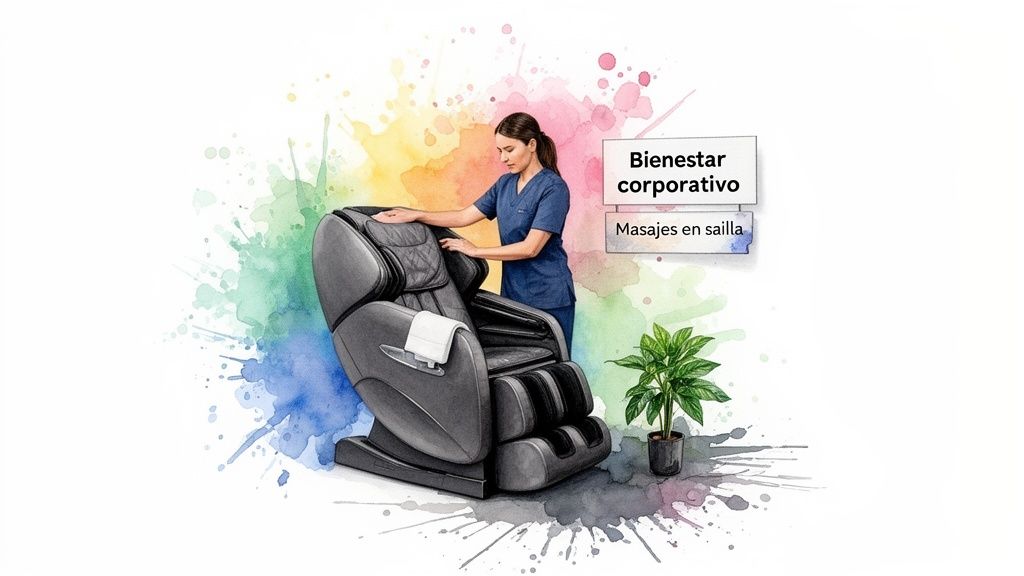
A culture of genuine care is built on actions, not just good intentions. And to achieve this, you need an ally who understands the day-to-day challenges of Human Resources. It’s about choosing initiatives that truly impact collaborators but that are also easy to manage for your team.
Operational ease is key to success
As an HR professional, your time is gold, and you manage a thousand fronts at once. Therefore, any wellness initiative must be easy to implement, almost "plug-and-play". At Zen to Go, we have designed our corporate massage programs with precisely this in mind.
We use an intuitive scheduling platform and assign you a dedicated account manager who handles all the logistics. Zero complications for you.
Our flexibility is another pillar. With modalities like Desk Massages or Shiatsu Chair Massages, we adapt to the space and rhythm of your office. This versatility, combined with our coverage in key cities like Mexico City, Monterrey, and Guadalajara, allows us to offer a tailored solution for companies with different locations and needs. If you want to dive deeper, you can explore what occupational wellness is and how to implement it in our complete guide.
Results that build a positive culture
The data doesn’t lie. The impact of these actions is measurable. In our corporate programs, 99% of participants feel that the company values their well-being. This perception is the seed of a positive culture and the direct antidote against demotivation and apathy that negative environments sow.
The external context also plays in our favor. The overall improvement in peace in Mexico, with a 0.9% reduction in the economic impact of violence according to the Mexico Peace Index 2023, creates a more conducive environment for these initiatives. This stability allows wellness programs in cities like Mexico City or Monterrey to capitalize on a safer environment to boost productivity.
And if we think long-term, well-being can connect with other areas. Consider how investments in sustainability, such as the implementation of energy self-consumption, not only improve corporate image and efficiency but also reinforce a message of comprehensive care: for the people and for the environment.
How to create a cycle of continuous improvement in your company
Managing the workplace climate is not a project with a start and end date. It is rather a living process, a constant cycle of listening, measuring, acting, and adjusting again. The goal is simple: to create a positive spiral where each lesson translates into tangible improvement, reinforcing a culture where positive actions are the norm, not the exception.
As an HR leader, your role here is vital. You are the one who transforms cold survey data into a real conversation, and that conversation into a new well-being policy. Do not underestimate the power of each small action because it is these that, when added together, build trust and long-term commitment.
Inspiring change is acknowledging the complexity of your work and remembering that you are not alone. Your role as a cultural architect is essential to building more human, healthy, and productive workplaces.
In this process, trust is the pillar that sustains everything. One relevant data point outside the work environment: consumer defense actions in Mexico totaled 26.4 million between 2014 and 2023. This reminds us of the enormous importance of transparency and compliance. You can see more of these statistics in the CONDUSEF yearbook.
That’s why, by choosing partners like Zen to Go, who thoroughly vet every therapist, you’re not just offering a service. You’re reinforcing a culture of quality and safety, proving with actions, not just words, your real commitment to the team’s well-being.
So here’s a reflection: what positive action, no matter how small, can you implement this very week? Change always starts with a single step.
With that said, let’s address some common questions
To conclude, let’s tackle those questions you’re likely asking yourself as an HR professional when it comes to putting all this into practice. These are the doubts that always arise when transitioning from theory to action.
How do I know if this is really working?
The key is not to get attached to a single metric. Combine quantitative with qualitative. On one hand, you have your hard data: the turnover rate, levels of absenteeism, results from your climate surveys. These are your headline indicators.
But the complete story is told by the people. Complement those numbers with what you hear in exit interviews, what comes up in focus groups, or even in hallway conversations. The combination of data and human perceptions will give you the real picture of the impact that positive and negative actions are having on your team.
Okay, what do I do if the problem comes from a leader?
This is the most delicate and, unfortunately, one of the most common situations. It requires action, but with strategy and without delay. First, document: note specific behaviors and their objective impact on the team. This is not about opinions, it's about facts.
Then, schedule a private conversation with that leader. Present the facts, not judgments, and establish clear expectations about what needs to change. Offering coaching or leadership training is essential; sometimes, the behavior is not malicious, but the result of a lack of tools.
Now, if the behavior persists after this, it’s time to escalate. Protecting the team and the company culture must always be the priority.
Sounds good, but my budget is limited. What can I do?
This is where creativity beats money. There are many positive actions with high impact and low cost that you can start implementing tomorrow. For example, launch a peer recognition program (a simple Slack channel can work).
Promote more flexible working hours or establish blocks of time without meetings so that people can truly concentrate. Even something as simple as encouraging leaders to provide positive feedback consistently and publicly has enormous power. The key is not the investment, but the consistency and genuine commitment.
Building a culture where the positive outweighs the negative is a marathon, not a sprint. At Zen to Go, we fully understand your challenges and are here to be that strategic ally to help you build tangible and lasting workplace well-being.
Discover how our wellness programs can strengthen your organizational culture.